
K2 Capital Acquisition Corp Raises $138M in IPO Targeting Physical AI and Advanced Energy
KTWO completed a $138 million IPO in January 2026 with plans to pursue acquisitions in Physical AI and small modular nuclear reactors (SMRs).
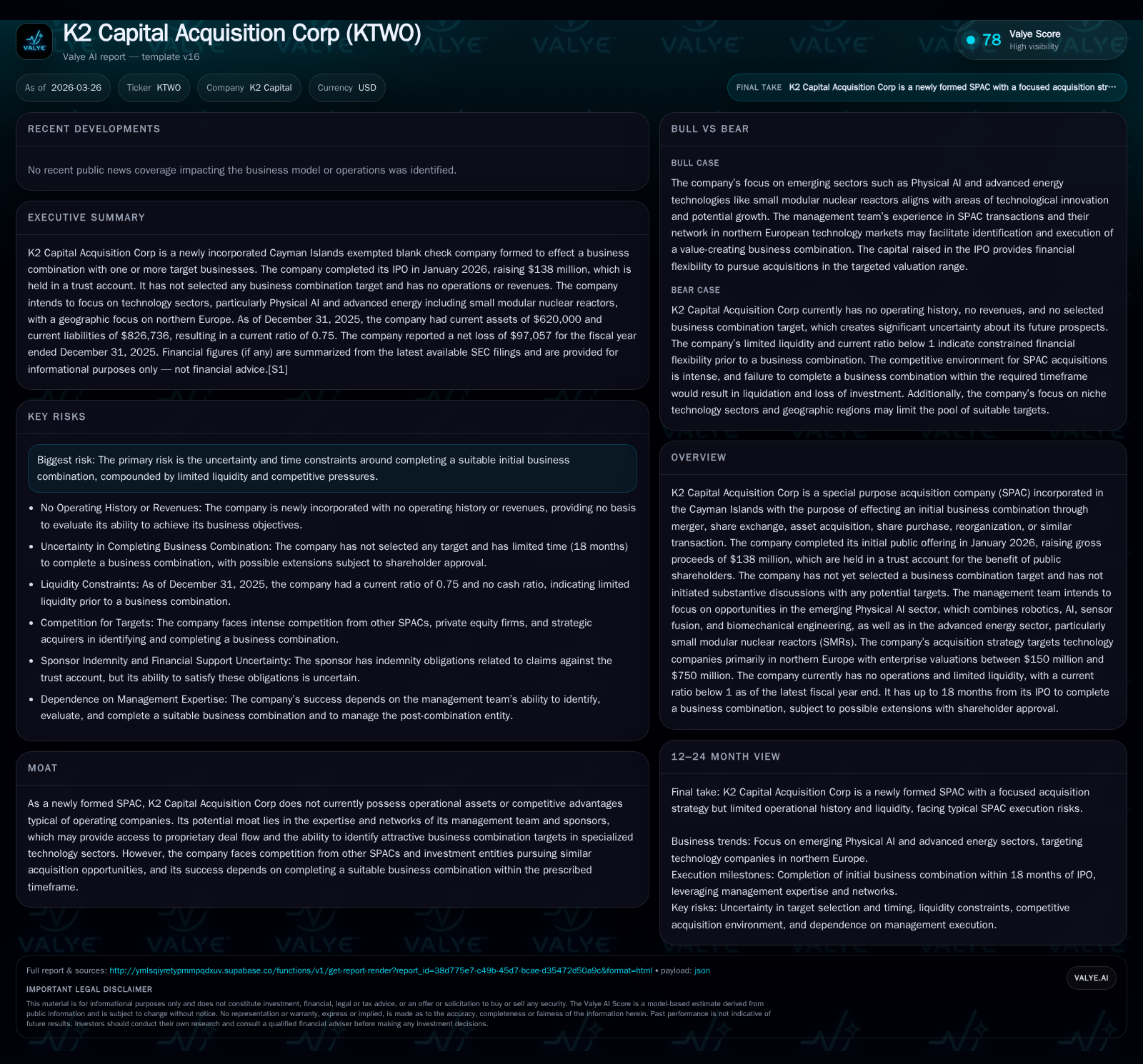
K2 Capital Acquisition Corp (KTWO), a Cayman Islands-incorporated SPAC, raised $138 million through its initial public offering in January 2026. The company, which has no operating history or revenues, aims to identify and complete an initial business combination within 18 months focusing on the emerging Physical AI sector—integrating robotics, AI, and sensor fusion—and the advanced energy sector, specifically small modular nuclear reactors. The capital raised is held in a trust account to protect public shareholders pending a qualifying deal. KTWO leverages its management team's expertise and northern European networks to source proprietary acquisition opportunities.
Company Background and Historical Performance
K2 Capital Acquisition Corp (KTWO) is a Cayman Islands exempted company formed as a special purpose acquisition company (SPAC) with the sole purpose of effecting an initial business combination such as a merger or asset acquisition. KTWO completed its initial public offering on January 30, 2026, raising gross proceeds of $138 million that are held in a trust account for the benefit of public shareholders until consummation of a business combination [S1][S17].
As of December 31, 2025, KTWO had no revenues or operations and reported an operating loss of approximately $97,057. Current assets were $620,000 against current liabilities of $826,736 resulting in a current ratio of approximately 0.75. This reflects typical SPAC pre-combination financials where expenses relate mainly to administrative costs [F1].
Historical performance (annual)
| FY |
|---|
| 2025 |
Source: SEC companyfacts cache [F1].
Note: Revenue data is not applicable due to absence of operational activity.
Business Model and Industry Focus
KTWO’s mandate is to identify one or more target companies primarily in high-growth technology sectors where its management team has expertise. The company currently targets two main industries:
Physical AI: This sector combines robotics with artificial intelligence, sensor fusion, machine learning, and biomechanical engineering. Potential applications include manufacturing automation, logistics, eldercare via humanoid robotics, hazardous environment operations, and domestic services. Advances in computing power, battery technology, and mechanical design underpin the anticipated commercial readiness of these intelligent physical systems [S1][S15].
Advanced Energy - Small Modular Reactors (SMRs): KTWO targets SMR technologies viewed as important for global energy transition efforts due to their enhanced safety features, lower upfront capital costs compared to traditional nuclear plants, modular scalability, and reduced environmental impact. Innovations include modular construction methods and passive safety systems that may facilitate regulatory approval and commercial deployment [S1][S15].
The focus on these specialized sectors reflects KTWO’s strategy to pursue transformative technologies with significant growth potential but also inherent technological risk.
Growth Prospects and Deal Sourcing Strategy
Although KTWO has not yet initiated substantive discussions with potential targets [S1], it leverages its management team’s networks within northern Europe’s technology ecosystem to source proprietary deal flow [S5]. The search prioritizes companies with enterprise valuations predominantly between $150 million and $750 million that have developed differentiated products or services addressing unmet market needs.
Despite macroeconomic challenges such as inflationary pressures and geopolitical uncertainties noted in filings [S24], KTWO positions itself as offering private companies an alternative route to public markets through SPAC mergers rather than traditional IPOs.
Milestones and Expectations
KTWO must complete its initial business combination within 18 months following the IPO closing date in January 2026 or face liquidation [S17]. Investors should monitor:
- Public disclosures regarding target identification or letters of intent.
- Shareholder votes on proposed business combinations.
- Tender offer documentation detailing redemption rights if shareholder approval is not sought.
- Amendments to corporate governance documents affecting redemptions or shareholder rights [S26][S27][S29].
Financial details on prospective targets will mainly be disclosed at the time of proxy statements or tender offer announcements.
Capital Structure, Liquidity, and Capital Allocation
At IPO close, approximately $138 million was deposited into a trust account securing public shareholders’ capital pending completion of an initial business combination [S7][S16]. Interest earned on trust funds may be used for limited operational expenses.
The sponsor contributed approximately $2.6 million through private placement units priced at $8 each subject to lock-up agreements until the business combination closes [S17]. Management may engage in share purchases post-IPO but must comply with securities laws restricting such transactions [S13][S26].
Public shareholders hold redemption rights exercisable upon completion of the initial business combination at about $10 per share plus accrued interest less taxes/expenses. Redemption requires physical or electronic delivery of shares prior to meetings—a process designed to prevent option-like behavior after deal announcements that differs from many other SPACs [S21][S25][S29].
KTWO currently does not pay dividends nor conduct share buybacks given lack of operational cash flow; capital allocation focuses on completing the initial business combination efficiently [F1][S6][S9]. The approximate return on equity figure is elevated (~134%) but reflects net losses against minimal equity during formation rather than operational profitability [F1].
Risk Factors Highlighted by Management
Key risks include:
- No historical operating performance; past management success does not guarantee future results [S12].
- Execution risk amid intense competition among SPACs targeting similar technology sectors [S11].
- Redemption risk reducing available capital if many shareholders redeem at deal close [S20].
- Absence of mandatory independent fairness opinions leaves transaction pricing assessments largely to investors [S1].
- Conflicts of interest arising because sponsors lose entire investment if no deal closes while public shareholders can redeem shares [S1][S12].
- Regulatory risks associated with nuclear technologies potentially delaying SMR-related acquisitions.
- Market volatility impacting valuations especially relevant for disruptive tech sectors vulnerable to macroeconomic shocks.
Summary Outlook
K2 Capital Acquisition Corp exemplifies a modern SPAC focused on niche high-tech verticals such as Physical AI robotics and next-generation clean energy solutions like SMRs. While starting without operational revenues and incurring formation-stage losses, KTWO leverages domain expertise and regional networks to access proprietary mid-market acquisition opportunities primarily within northern Europe.
Success depends critically on completing an attractive business combination within the prescribed 18-month window. Investors should closely follow developments around target selection progress, transaction terms disclosures, shareholder approvals, and redemption dynamics.
This structure highlights how contemporary SPACs seek competitive advantages by focusing on specialized sectors backed by experienced teams yet remain exposed to classic execution risks inherent across blank check companies awaiting definitive deals.
This report is based solely on publicly available SEC filings through March 26, 2026.
Disclaimer: This is research-only, informational analysis and not investment advice. It may include AI-generated interpretation and general industry context. Always verify important details using primary sources.

Comments