
Lionheart Holdings Faces Critical Deadline to Deploy $230M SPAC Capital Amid Market Competition
The blank check company's near-term prospects hinge on successful business combination execution before mid-2026.
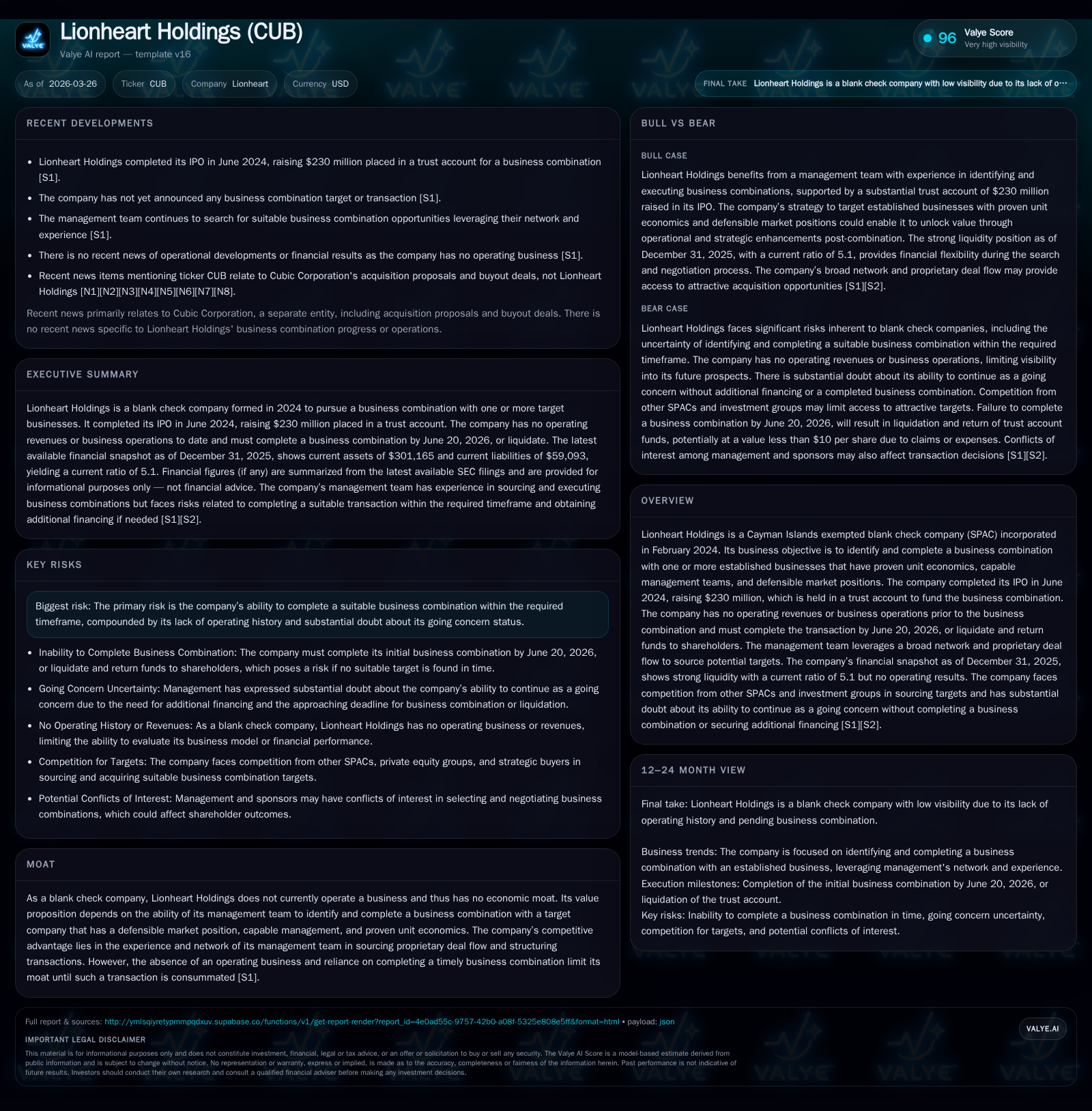
Lionheart Holdings (CUB) is a Cayman Islands exempted SPAC formed in early 2024 and raised $230 million via its June 2024 IPO. It has no operating revenue as of December 2025, maintaining a strong liquidity position with a current ratio of 5.1 but bears substantial doubt about its going concern due to lack of operational cash flow. The company must consummate an initial business combination by June 20, 2026, or liquidate and return capital to shareholders. Leadership’s extensive network drives deal sourcing, targeting established companies with strong unit economics and market positions. However, heightened SPAC competition and the complexity of mergers impose risks on timing and quality of acquisition targets.
Company Overview and Historical Performance
Lionheart Holdings was incorporated as a Cayman Islands exempted company in February 2024 expressly to operate as a Special Purpose Acquisition Company (SPAC), or blank check company. It completed its Initial Public Offering on June 20, 2024, issuing 23 million units priced at $10 each while fully exercising its over-allotment option. This raised gross proceeds of approximately $230 million, including $6 million from a private placement warrant sale to insiders [S1],[S18]. These proceeds were placed into a trust account that currently represents the bulk of the company's assets.
As of December 31, 2025, Lionheart had not generated any operating revenue and only incurred operating losses from non-recurring organizational expenses related to the IPO and ongoing administrative activities. Operating income declined further from -$495K in FY2024 to -$875K in FY2025, marking a year-over-year deterioration of roughly 76% [F1]. Net income conversely rose due to items outside core operations, reaching about $8.95 million in FY2025 versus $5.84 million the prior year, reflective of accounting entries rather than recurring profitability [F1]. Cash flows from operations remain negative albeit improving modestly year over year (-$641K to -$585K) [F1], indicative of continuing pre-acquisition setup expenses rather than cash generation.
Historical performance (annual)
| FY | Net ($mm) | CFO ($) | OpInc ($) | Net YoY |
|---|---|---|---|---|
| 2025 | 9 | -585477 | -874604 | +53.3% |
| 2024 | 6 | -641108 | -495449 |
Source: SEC companyfacts cache [F1].
Capital returns and efficiency (annual)
| FY | ROE% |
|---|---|
| 2025 | -91.3 |
| 2024 | -65.4 |
Source: SEC companyfacts cache [F1].
Operating income reflects ongoing costs before acquisition; current ratio signals healthy liquidity.
Business Model and Growth Prospects
Lionheart Holdings has no commercial operations prior to completing a business combination. Its strategy concentrates on identifying an established target with proven unit economics — defined as consistent revenue growth and sustainable free cash flow potential — paired with strong management expertise and a defensible market niche [S27],[S10]. Unlike some SPACs targeting early-stage or speculative ventures, Lionheart explicitly excludes startups or highly leveraged entities from its acquisition scope.
Management leverages broad industry networks and proprietary deal sourcing channels aiming for transactions offering strategic enhancements or operational improvements post-merger [S6],[S18]. Successful combinations would enable Lionheart to transition from a shell entity into an operational public company with direct revenue streams.
However, this goal faces inherent risks:
- Growing SPAC proliferation heightens competition for quality targets; attractive companies may resist engaging due to reputational concerns around SPAC transactions or prefer traditional IPO routes [S1],[S25].
- Complex deals requiring significant restructuring may delay transaction closure beyond the mandated deadline.
- The absence of pre-defined maximum redemption thresholds could complicate shareholder approval dynamics.
Management has yet to announce any chosen targets as of the latest filings [S1],[S18], heightening event risk related to execution timelines.
Forecasts and Critical Milestones
Lionheart is contractually obligated to complete its initial Business Combination by June 20, 2026 (the "Combination Period") or initiate liquidation procedures returning funds proximate to the original issue price plus accrued interest [S1],[S7]. Failure will result in dissolution; Public shareholders receive redemption payments equal to trust holdings value (approximately $10.70 per share as of end-2025) less minor administrative costs.
While no public guidance exists regarding target selection timing or sector focus beyond general criteria [N1],[S27], key developments to monitor include:
- Announcement of Letter of Intent or definitive agreement signaling target selection.
- Proxy filings detailing target financials ahead of shareholder vote or tender offer.
- Decisions regarding shareholder approval processes that could impact redemption activity.
- Potential capital raises through equity or debt instruments concurrent with deal execution if purchase price exceeds trust assets [S13],[S15].
Capital Structure and Returns Profile
All funds for the initial business combination are currently held within the Trust Account totaling approximately $230 million ([S3],[F1]). Lionheart does not pay dividends nor conduct share repurchases pre-business combination due to its blank check nature [S3]. The Sponsor owns Founder Shares along with Private Placement Warrants purchased at nominal prices; these securities entail no liquidation rights against Trust Account assets if the company dissolves except for newly acquired Public Shares post-IPO [S7].
Lionheart’s equity position was negative approximately -$9.81 million as of fiscal year-end reflecting accumulated losses despite non-cash net income gains [F1]. Return on equity calculation yields approximately -91%, underscoring lack of earnings relative to book value given absence of operating profit generation [F1]. Operating cash flows are negative reflecting ongoing administrative costs without offsetting inflows.
Management has flexibility around transaction financing methods: cash drawn from Trust Account proceeds supplemented potentially by issuance of equity-linked securities or debt—there remains no commitment securing external financing at this stage [S13],[S15]. Such financing would be needed if transaction enterprise value surpasses available cash net of redemptions.
Competitive Positioning Amid Heightened SPAC Activity
SPAC markets remain crowded with many sponsors chasing quality targets across diversified sectors. Lionheart’s competitive edge lies largely in its management team's experience sourced deal pipeline and selective acquisition criteria emphasizing stable businesses with identifiable growth levers [S6],[S10]. However:
- As public scrutiny intensifies around SPAC reputation—target companies increasingly cautious about associating with blank check vehicles.
- Many peers share similar financial capacity (circa low hundreds millions) limiting ability to outbid strategic buyers or large private equity players.
- The clock ticking towards statutory deadlines compresses diligence timeframes that could exacerbate integration risks.
This high-stakes environment heightens pressure on Lionheart’s management team not only to identify suitable candidates but also craft compelling business combinations that clear regulatory hurdles and gain shareholder acceptance despite potential redemption risk [S25],[S9].
Risk Summary
Key risks include:
- Failure to consummate an initial Business Combination by June 20, 2026 leading to mandatory liquidation.
- Challenges finding appropriately scaled target businesses meeting Lionheart’s economic criteria amid intense competition.
- Potential complexities delaying or derailing transactions requiring significant restructuring activities.
- Financial uncertainties including lack of third party financing commitments for transactions exceeding trust asset size.
- Shareholder dynamics influenced by redemption rights without maximum thresholds impacting deal approval environment.
- Risks stemming from reliance on Sponsor indemnifications related to claims against Trust Account funds.
Conclusion and Outlook Considerations
Lionheart Holdings remains a fiduciary vehicle pending activation through business combination—the substantive transformation essential for generating operating revenues and shifting away from its current net loss status. The coming quarters will be critical as it approaches the June 2026 deadline imposing existential limits absent completed mergers. Observers should watch for announcements regarding definitive agreements or exclusivity arrangements that would de-risk outcome uncertainty.
The competitive landscape among SPACs coupled with increasing regulatory scrutiny places added importance on management's ability to secure accretive opportunities balancing scale, growth potential, and shareholder interests within an accelerated timeframe. Given current liquidity strength but persistent operational losses and going concern caveats reflected in filings, success ultimately hinges less on historical performance than execution capability amidst evolving market dynamics.
This analysis relies purely on disclosed company filings through March 25, 2026 ([F1], [S#]) and publicly available information without speculative extrapolation. It is not intended as investment advice.
Disclaimer: This is research-only, informational analysis and not investment advice. It may include AI-generated interpretation and general industry context. Always verify important details using primary sources.

Comments