
Global Self Storage Maintains Modest Growth With Emphasis on REIT Compliance and Sustainability Initiatives
The company’s steady revenue expansion contrasts with margin pressures amid rising regulatory costs and competitive market dynamics.
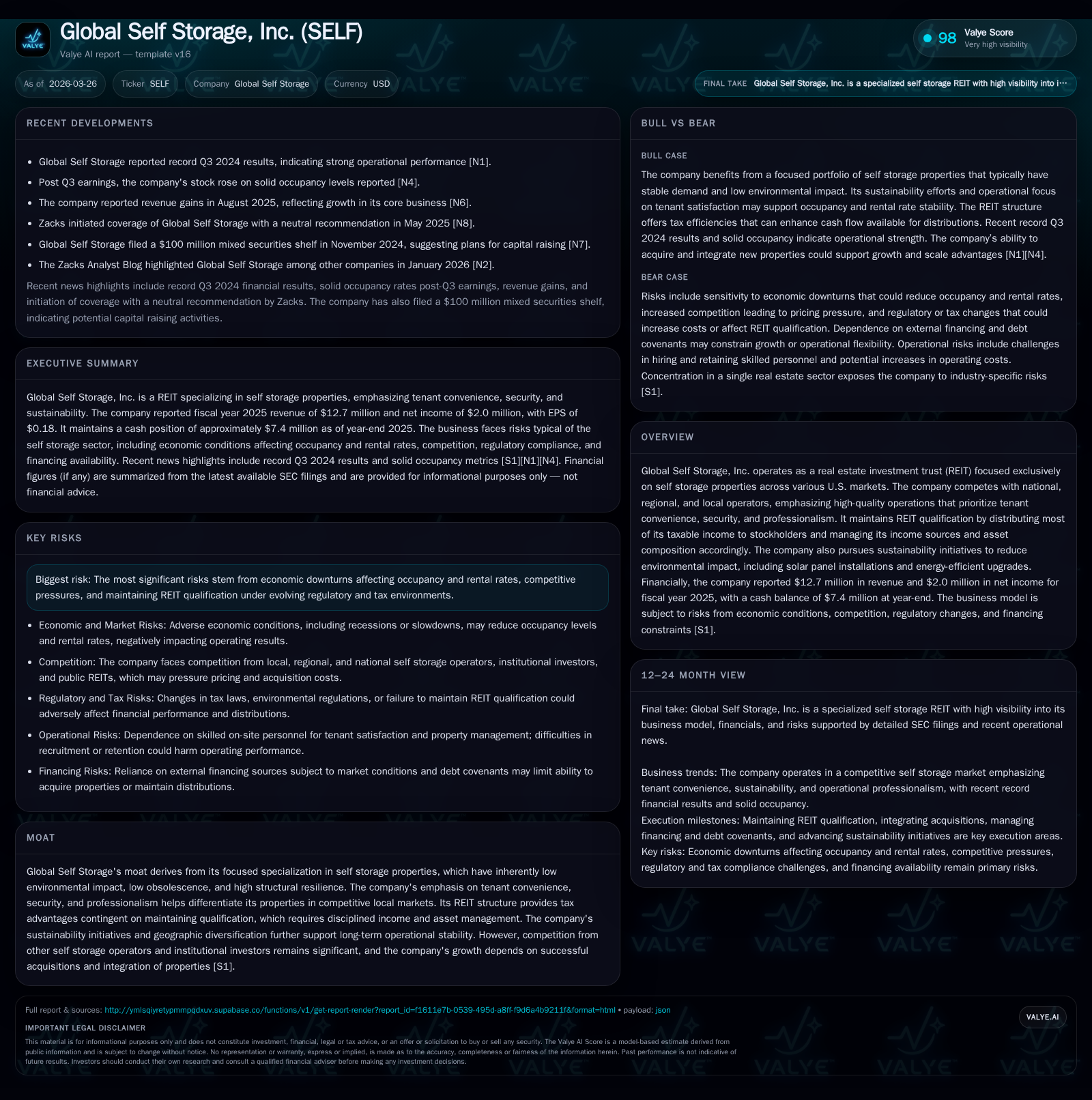
Global Self Storage, Inc. reported modest revenue growth of 1.4% in fiscal 2025, reaching $12.7 million, alongside a slight decrease in net income by 4%. The company continues to focus on tenant-centric operations and sustainability efforts, including solar installations and energy efficiency upgrades, supporting its positioning in the self storage sector. Balancing REIT qualification requirements with competitive acquisition strategies remains a key operational challenge. Future growth hinges on successful property integrations and ongoing capital allocation towards dividends and strategic investments.
Historical Performance
Global Self Storage has demonstrated a pattern of moderate top-line growth over the past four fiscal years. Revenue expanded from approximately $11.9 million in FY2022 to about $12.7 million in FY2025 ([F1]). This steady increase of roughly 1.4% between FY2024 and FY2025 reflects resilient demand within its portfolio of self storage properties across diverse U.S markets. Operating income experienced a slight decline compared to earlier years but showed stabilization around $3 million in FY2025 after dipping from $3.5 million reported in FY2022 ([F1]). Net income likewise contracted by about 4% year-over-year to close near $2 million as of the end of FY2025.
Margins appear pressured by rising environmental compliance expenditures and investments into energy-efficient upgrades highlighted in the company's sustainability agenda ([S4],[S14]). Despite these margin pressures, operating cash flow exhibited positive momentum with a nearly 3.3% uplift over the same period, underscoring the firm's ability to generate cash internally to fund ongoing operations and distributions ([F1]).
Historical performance (annual)
| FY | Rev ($mm) | Net ($mm) | CFO ($mm) | OpInc ($mm) | Rev YoY | Net YoY |
|---|---|---|---|---|---|---|
| 2025 | 13 | 2 | 4 | 3 | +1.4% | -4.0% |
| 2024 | 13 | 2 | 4 | 3 | +2.8% | -27.7% |
| 2023 | 12 | 3 | 5 | 3 | +2.1% | +42.8% |
| 2022 | 12 | 2 | 5 | 4 |
Source: SEC companyfacts cache [F1].
Capital returns and efficiency (annual)
| FY | Div ($mm) | ROE% |
|---|---|---|
| 2025 | 3 | 4.4 |
| 2024 | 3 | 4.5 |
| 2023 | 3 | 6.1 |
| 2022 | 3 | 4.3 |
Source: SEC companyfacts cache [F1].
Revenue growth has been largely organic within existing operations complemented by select acquisitions consistent with stated strategy.
Business Model & Competitive Positioning
Operating exclusively as a real estate investment trust (REIT), Global Self Storage focuses solely on self storage assets. Its moat is rooted in specialized expertise managing low-obsolescence properties characterized by low environmental impact and structural resilience ([S1],). The company's competitive edge stems from operational excellence: prioritization of tenant convenience via technology-enabled rentals platforms; stringent security protocols; and professional property management teams incentivized through comprehensive employee benefit programs ([S10],[S15]).
Competition is robust at a hyperlocal level with numerous regional operators vying within tight geographic proximities—typically within three to five miles—driving pricing discipline and necessitating high standards ([S10]). On the acquisition front there is pronounced competition from institutional investors and private equity funds with potentially greater capital resources which can drive up purchase prices ([S1]).
Moreover, Global Self Storage continually endeavors to augment its portfolio with accretive acquisitions while ensuring integration milestones are achieved without compromising rental rates or occupancy metrics—both crucial for maintaining stable ROE (~4.4% approx.) as derived from net income relative to equity base ([F1]).
Sustainability Initiatives & Regulatory Landscape
The firm has instituted a cross-functional Sustainability Committee tasked with setting environmental priorities aligned with long-term value creation ([S15]). Recognizing the inherently lower carbon footprint of self storage facilities compared to other real estate types mitigates some regulatory risks but does not eliminate substantial obligations.
Key initiatives include the deployment of solar panel arrays at selected properties projected to reduce reliance on grid electricity and associated costs; upgrade projects replacing conventional lighting with high-efficiency LEDs; installation of smart HVAC systems for energy management; and digital transformation efforts that reduce paper use through online rental processes (,[S15]).
Environmental regulations such as CERCLA impose potential liabilities related to contamination even after property acquisition underpinning careful due diligence processes before purchase ([S14]). Climate-related transition risks include emerging federal and state ESG requirements which could amplify disclosure demands or operational costs. Conversely physical climate exposures manifest as more frequent weather extremes that could disrupt assets or raise maintenance expenses ([S14]).
Policy uncertainty persists given "anti-ESG" legislative actions intersecting investor sentiment whose increasing focus on sustainable practices can affect capital attractiveness or reputation risks should ESG goals be perceived insufficient ([S4],).
Capital Structure & Liquidity
As of December 31, 2025 Global Self Storage held cash reserves approximating $7.4 million providing moderate liquidity buffers amid funding needs for working capital or project spend ([F1],). The company depends considerably on external financing markets for acquisitions while remaining subject to covenants embedded within loan agreements mandating minimum net worth and liquidity ratios tied directly to outstanding debt balances ([S5],[S9],[S24],[S25]). These covenants constrain leverage flexibility while protecting lender interests but may limit opportunistic transactions under stressed conditions.
Equity capital has remained largely stable with modest reductions in total equity from $48 billion range down slightly over previous years reflecting minor net losses offset partially by distributions ([F1]). Dividend payments have tracked consistently around $3.28 million annually reflecting board policy calibrated against operating cash flows and tax-driven REIT compliance mandates ([F1],[S16]). Buybacks are not prominently disclosed suggesting preference for stable payouts over repurchases.
Growth Prospects & Risks
Looking ahead the company identifies acquisition-led growth within core markets as the primary lever alongside selective redevelopment aimed at capturing higher rents post-renovation while adhering prudently to underwriting standards that avoid excessive cost escalations or prolonged vacancies (,[S18],[S29]). Expansion into markets exhibiting favorable demographic trends supports continued demand stability.
Challenges are multifold:
- Economic slowdowns or recessions could depress occupancy rates or force rent concessions hindering revenue growth prospects given sensitivity noted during government shutdown scenarios or macro uncertainty ([S20],).
- Maintaining REIT qualification invokes technical rigor comprehending asset composition tests and income source thresholds; missteps here risk corporate-level taxation upending distributable cash models ([S1],[S13],[S25]-[S27]).
- Competitive intensity not only pressures tenant retention/rate optimization but inflates acquisition cost basis when multiple bidders emerge possibly eroding future returns (,[S10],[S22]).
- Environmental liabilities from legacy contamination or evolving climate regulations may require unanticipated expenditures impairing profitability ([S14],).
- Reliance on key senior personnel specialized in self storage industry nuances introduces succession risk should turnover occur without adequate replacements leading to execution disruptions ([S26]).
- Technological adoption lag including AI-powered operational systems could diminish efficiency gains or tenant engagement compared to more digitally advanced competitors ([S6]).
What To Watch
Although explicit formal guidance is absent [N#], notable indicators influencing next phases include:
- Acquisition announcements reflecting pipeline health.
- Rental rate trends relative to local market benchmarks.
- Operational margin compression linked closely with regulatory cost trajectories.
- Liquidity position vis-à-vis debt maturities amid credit market conditions.
- Progress reports from Sustainability Committee updates tracking carbon reduction achievements.
- REIT compliance filings signaling any material tax qualification risks.
Investors may also monitor quarterly earnings press releases such as the record Q3 results announced earlier this year which could offer interim signals on momentum beyond FY figures [N1].
Conclusion
Global Self Storage's steady financial trajectory reflects an established business model finely tuned for resilience within a highly fragmented marketplace dominated by local operators yet increasingly contested by institutional entrants. Its strategic commitment toward sustainability practices coupled with cautious capital deployment supports operational integrity going forward while navigating pressing challenges posed by regulatory environments and economic cyclicality.
Disclaimer: This analysis is based on available SEC filings through March 26th, 2026 ([F1], [S#]), public disclosures including earnings releases with no speculative projections offered beyond reported data or explicit company statements. It does not constitute investment advice or recommendations.
Disclaimer: This is research-only, informational analysis and not investment advice. It may include AI-generated interpretation and general industry context. Always verify important details using primary sources.

Comments