
Provectus Biopharmaceuticals Faces Clinical-Stage Challenges with Patent-Backed Immunotherapy Pipeline
Provectus leverages a proprietary rose bengal sodium platform with extensive patent protections while grappling with persistent financial deficits and critical capital needs.
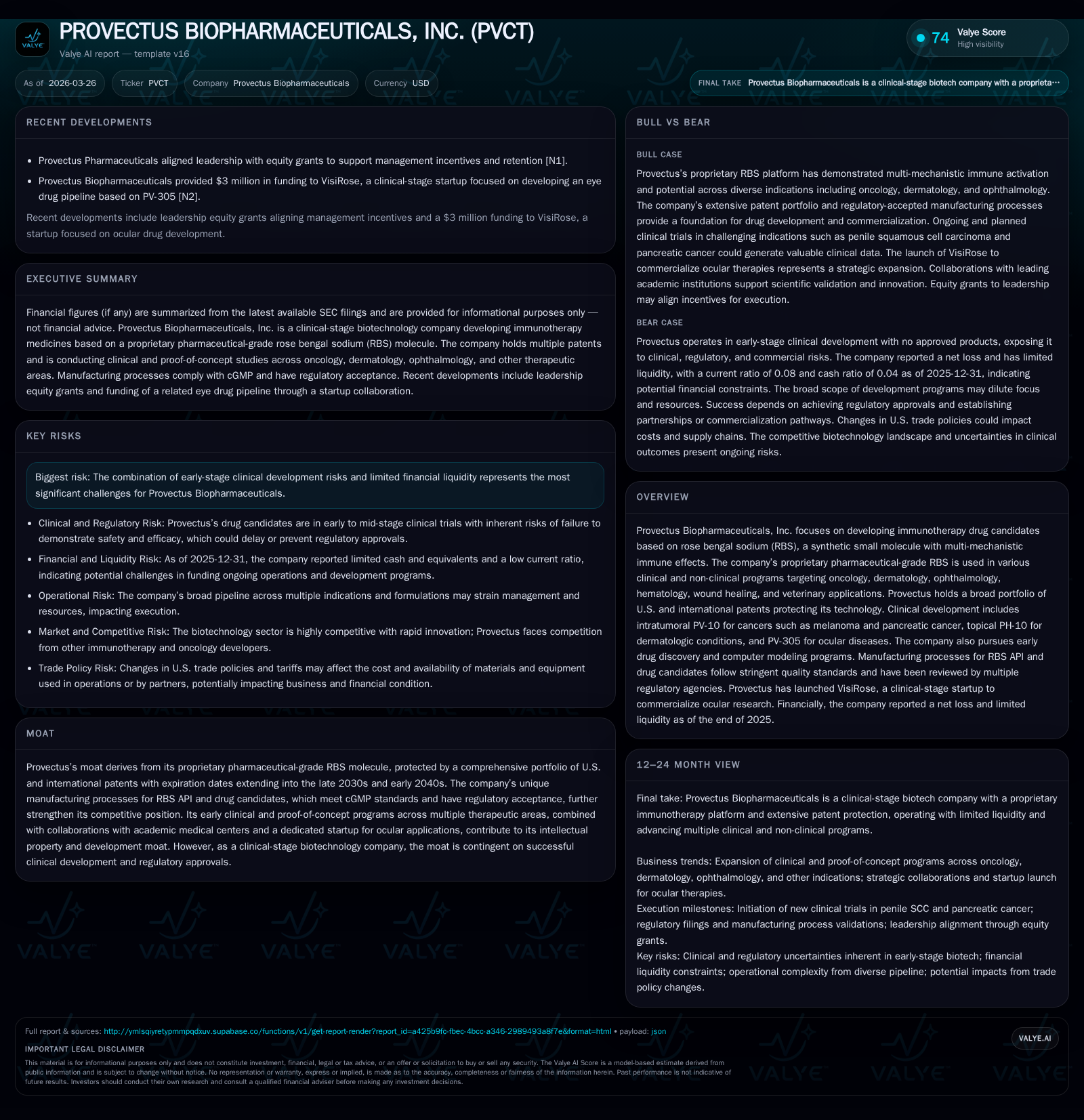
Provectus Biopharmaceuticals, Inc. is a clinical-stage biotech company developing immunotherapy drug candidates centered on its pharmaceutical-grade rose bengal sodium (RBS) molecule. Despite a broad patent portfolio securing its intellectual property into the late 2030s and beyond, the company continues to operate with zero commercial revenues and sustained operating losses, reflecting the high-risk profile of early-stage biotech firms. Provectus’s pipeline spans multiple indications, primarily in oncology, dermatology, and ophthalmology, but remains at early-to-mid clinical evaluation phases. The company faces substantial liquidity constraints and going concern warnings that hinge on future capital raises to continue advancing development and regulatory efforts.
Foundations of Growth: Rose Bengal Sodium’s Unique Position in Immunotherapy
At the heart of Provectus Biopharmaceuticals’ drug development platform lies rose bengal sodium (RBS), a bioactive synthetic small molecule classified among halogenated xanthenes. This pharmaceutical-grade RBS serves as the active pharmaceutical ingredient (API) across all current clinical and non-clinical programs. The company's innovation has yielded an essentially pure form of RBS—nearly 100% purity—which it uniquely manufactures under stringent chemistry, manufacturing, and control (CMC) protocols meeting current Good Manufacturing Practices (cGMP) standards. Regulatory bodies in multiple countries including the U.S. FDA, Germany’s BfArM, Australia’s TGA, France’s ANSM, Italy’s AIFA, Mexico's COFEPRIS, and Argentina's ANMAT have reviewed and accepted these manufacturing processes for use in clinical trials [S1][S19].
Crucially, RBS exhibits multi-mechanistic immunomodulatory effects—it can act both as an electron acceptor and donor and may induce stimulatory or inhibitory immune responses depending on delivery parameters. Its mechanistic versatility allows targeting diverse diseases via different administration routes: intratumoral (direct tumor injection) primarily for oncology indications; topical application for dermatology; oral delivery explored in preclinical oncology models; plus ongoing studies in ophthalmology and other areas such as wound healing and veterinary oncology [S1]. This modularity enhances Provectus’s tactical flexibility across multiple therapeutic fronts.
Historical Performance: Persistent Operating Deficits Reflect Early-Stage Status
Provectus remains a pure clinical-stage entity without product approvals or commercial revenues since its founding in 2002. Financial statements verify no recorded revenues through the latest reporting year ending December 31, 2025 [F1]. The company’s operating income reflects sizeable but stable losses that increased modestly year-over-year by around 16.8%, reaching approximately -$5.3 million in 2025 [F1]. Net losses tracked similarly at nearly -$5.4 million with a 14.8% deterioration compared to the prior year.
Operating cash flows remain consistently negative—approximating -$3.3 million in 2025 (-1.3% YoY decline)—indicative of continuous operational burn typical among early stage biotechs investing heavily in R&D without corresponding commercial offsets. Capital expenditures over recent years have been minimal (~$6k annually), emphasizing the light capex profile relative to operating costs focused on drug development activities [F1].
Historical performance (annual)
| FY | Net ($mm) | CFO ($mm) | OpInc ($mm) | Net YoY |
|---|---|---|---|---|
| 2025 | -5 | -3 | -5 | -14.8% |
| 2024 | -5 | -3 | -5 | -52.6% |
| 2023 | -3 | -3 | -3 | +12.7% |
| 2022 | -4 | -3 | -3 |
Source: SEC companyfacts cache [F1].
Capital returns and efficiency (annual)
| FY | ROE% |
|---|---|
| 2025 | 86.2 |
| 2024 | 79.4 |
| 2023 | 40.8 |
| 2022 | 57.1 |
Source: SEC companyfacts cache [F1].
Lack of revenues underscores continuing pre-commercial status; steadily rising losses align with increased investment in clinical programs.
Clinical Pipeline Overview: Multi-Mechanistic RBS Programs Across Oncology and Beyond
Provectus's pipeline centers mainly on two lead clinical candidates: PV-10—a formulation containing RBS administered by intratumoral injection—and PH-10—a topical formulation targeting dermatologic conditions—plus PV-305 for ocular disorders applying topical delivery.
PV-10 is being investigated for various solid tumors including melanoma (historically locally advanced cutaneous melanoma), pancreatic ductal adenocarcinoma (mPDAC), penile squamous cell carcinoma (SCC), head and neck squamous cell carcinoma (HNSCC), bladder cancer (preclinical oral investigations), and canine cancers through veterinary programs [S1][N1][S16][S28]. Additional topics addressed include oral formulations targeting hematologic malignancies under non-clinical pathways.
PH-10 explores immune-modulating actions topically applied to inflammatory dermatological conditions.
PV-305 is under study for ocular disease treatment modalities leveraging similar mechanisms but tailored delivery.
Together these candidates demonstrate Provectus’s strategy of deploying its unique small molecule platform across multiple disease types leveraging different administration routes to maximize therapeutic potential while awaiting key efficacy readouts in early phase trials [N1][S1]. It is important to note these programs remain largely exploratory or at early proof-of-concept stages with inherent uncertainties surrounding eventual regulatory success or commercial viability.
Intellectual Property as Competitive Moat in a Crowded Biotech Landscape
A significant strategic advantage resides in Provectus’s comprehensive patent estate protecting its proprietary pharmaceutical-grade RBS API along with methods for synthesis and therapeutic applications including notable combination cancer therapies [S1]. Key U.S. patents such as Nos. 8,530,675; 9,107,887; and others provide coverage extending roughly from early issuance dates circa 2013–2016 out towards expirations spanning from approximately 2030 to the early 2040s.
International patents complement this protection with awards from Canada (expiring 2039), Australia (2039–2041), Korea (~2039), among others secured recently demonstrating active defense of IP horizon [S25].
Beyond patents themselves are proprietary manufacturing processes that embody quality-by-design principles compliant with cGMP regulations worldwide. These innovations reduce impurities found in non-pharmaceutical grade rose bengal materials historically associated with lot-to-lot variability—enhancing reproducibility critical for regulatory acceptance of drug products [S19][S20].
These protective factors offer meaningful barriers against generic competition or academic replication within typical patent expiry horizons that define biotech moats if accompanying clinical progress materializes successfully.
Capital Structure and Liquidity Challenges: Implications for Operational Continuity
While Provectus possesses robust IP assets and an innovative clinical pipeline foundation, its financial position reveals acute short-term vulnerabilities:
- Cash balance stood at $251K at December 31, 2025.
- Current liabilities exceeded current assets dramatically resulting in a working capital deficit of roughly $6.33 million.
- Shareholders’ equity remained substantially negative near -$6.3 million indicating persistent accumulated deficits over decades [F1][S10][S18].
Management discloses “substantial doubt” regarding the company's ability to continue as a going concern for at least one year post-filing citing ongoing operating losses projected to persist amid costly developmental efforts requiring significant additional capital raises [S1][S18].
Capital raises might come from equity offerings—potentially dilutive—or debt financing where feasible but no guarantees exist regarding availability on acceptable terms if at all given market conditions.
No recent history of share buybacks or dividend distributions aligns logically with the scarcity of internal funds and prioritization of survival by advancing pipeline rather than shareholder returns presently [F1].
This tight liquidity creates imminent financial risk underscoring dependency on external funding to sustain operations beyond near term.
Future Growth Prospects: Balancing Clinical Advancements Against Funding Needs
Despite financial strains limiting operational runway without infusion of new capital, Provectus is actively pursuing clinical development milestones intended as pivotal catalysts:
- Planned initiation of new intratumoral PV-10 monotherapy/combination trials targeting pre-operative penile SCC and mPDAC aims to leverage historical data sets alongside new prospective evidence generation [S1][N1].
- Additional regulatory strategic initiatives focus on maximizing data applicability across global health agencies consistent with ICH standards enhancing pathway prospects overseas [S7].
- Early discovery drug candidates alongside computer modeling projects signal diversification efforts albeit at very preliminary stages potentially unlocking future value-infused avenues contingent on ongoing research progress [S28].
Operational capacity remains hampered by cash constraints potentially limiting trial site expansions or enrolment speed thus affecting timelines amid intrinsically lengthy FDA approval processes fraught with unpredictable delays or requirements for supplementary studies—a common theme among small biotechs attempting regulatory breakthroughs [S4][S6][S21].
Partnerships or licensing agreements might emerge as alternative funding or commercialization routes but may require relinquishment of valuable rights diminishing upside capture if executed under duress conditions stemming from liquidity pressures.
Triggers to Watch: Regulatory Milestones, Partnerships, and Capital Raises
Key upcoming inflection points that stakeholders should monitor include:
- Completion reports from Phase trials addressing efficacy/safety endpoints in penile SCC or mPDAC clinical settings potentially providing critical validation data influencing regulatory pathways or partnering interest profiles [N1][S4].
- FDA decisions regarding Investigational New Drug applications or trial design acceptances could materially alter development trajectories.
- Announcements detailing strategic collaborations or licensing arrangements offering non-dilutive financing combined with commercialization support would assuage cash concerns while potentially accelerating market entry timelines [N1][S3].
- Equity financing rounds remain pending variables which will heavily impact shareholder dilution levels; success or failure here fundamentally alters continuity assessments given negligible cash balances reported end FY25.
Due diligence observers should track peer companies’ progression timelines alongside market receptivity toward novel immunotherapies incorporating bioactive small molecules akin to RBS helping contextualize competitive positioning even as Provectus seeks niche differentiation through proprietary manufacturing excellence plus extended patent coverage.
Shareholder Value and Return Metrics: From Negative Earnings to Hope for Value Creation
Given Provectus's unprofitable status characterized by continuous operating deficits amounting cumulatively close to $263 million since inception without generating revenue streams suggests conventional return metrics like ROE are not directly meaningful but rather inverted due to substantial negative equity position recorded around minus $6.3 million at fiscal year-end 2025 creating statistically anomalous ratios approximating positive ROE percent solely due to equation mechanics without underlying profitability improvement [F1].
Dividend payments remain absent per standard industry praxis given retained loss absorption needs coupled with insufficient cash flow generation capacity compelling reinvestment prioritization toward research activities over shareholder distributions.
Investor appraisal hinges largely on probabilistic valuation tied to successful clinical trial readouts spurring licensing deals or eventual product approvals capable of producing revenue growth reversing loss trends—a speculative premise typical among clinical-stage biotechnology firms reliant on disruptive scientific innovation underpinned by protected intellectual property but vulnerable to execution risks.
This analysis reflects publicly disclosed financial results from SEC filings through FY2025 ([F1],[S#]), supplemented by recent corporate disclosures ([N#]). It refrains from forward-looking statements unsupported by cited evidence. All information is presented without investment advice or recommendations.
Disclaimer: This is research-only, informational analysis and not investment advice. It may include AI-generated interpretation and general industry context. Always verify important details using primary sources.

Comments