
Celcuity Inc.’s Strategic Push for Approval and Commercialization of Gedatolisib
Celcuity advances its lead kinase inhibitor through critical regulatory milestones while grappling with escalating financial losses and debt.
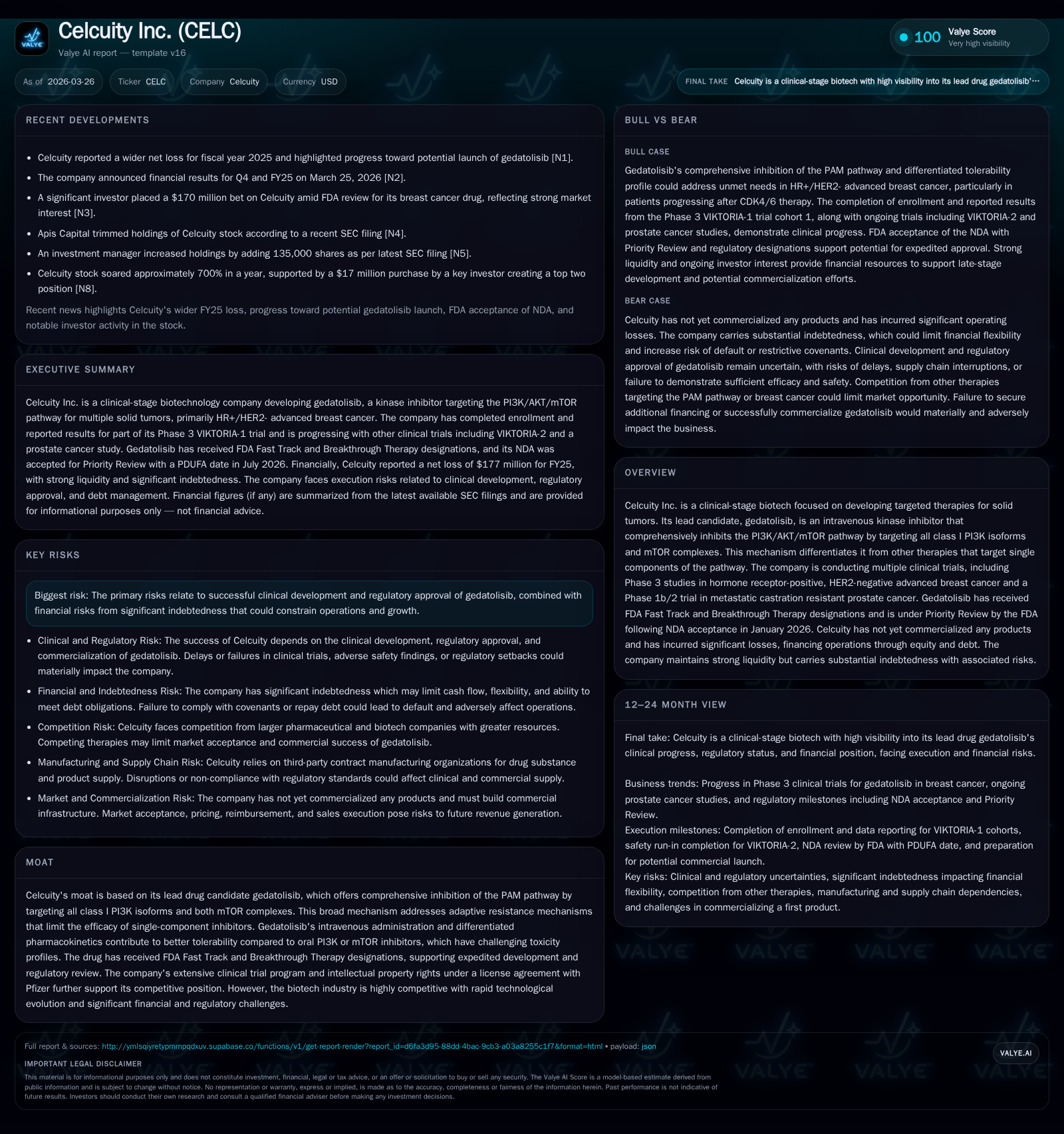
Celcuity Inc. focuses on developing gedatolisib, a kinase inhibitor with a comprehensive approach targeting all class I PI3K isoforms and mTOR complexes, distinguishing it within the PAM pathway inhibitors space. The company has completed enrollment in pivotal Phase 3 trials and secured FDA Fast Track and Breakthrough Therapy designations, with a Priority Review underway post-NDA submission in January 2026. Despite these clinical advances, Celcuity has incurred widening losses driven by intensified R&D investment, alongside significant indebtedness that presents operational constraints ahead of potential commercialization. Market participants should closely monitor regulatory decisions, trial data readouts, and the firm’s capital management as key inflection points.
Strong Momentum in Clinical Development: Gedatolisib’s Differentiated PAM Pathway Inhibition
Celcuity Inc. centers its therapeutic strategy on gedatolisib—a kinase inhibitor uniquely positioned to comprehensively inhibit the PAM (PI3K/AKT/mTOR) signaling axis by simultaneously targeting all class I PI3K isoforms alongside both mTORC1 and mTORC2 complexes [S1]. This broad mechanism addresses key limitations observed in therapies that focus solely on single nodes such as PI3Kα or mTORC1 inhibition. The pharmacokinetic profile of intravenous gedatolisib distinguishes it from oral counterparts, potentially improving tolerability by mitigating gastrointestinal toxicities commonly associated with oral PI3K or mTOR inhibitors.
The clinical program underscores this differentiation: the Phase 3 VIKTORIA-1 study includes two cohorts evaluating gedatolisib plus fulvestrant (± palbociclib) in hormone receptor-positive (HR+), HER2-negative advanced breast cancer (ABC) patients stratified by PIK3CA mutation status—the wild-type cohort has completed enrollment with detailed data reporting while the mutant cohort enrollment is also complete [S1][N2]. The ongoing VIKTORIA-2 trial examines first-line use of gedatolisib combined with CDK4/6 inhibitors and fulvestrant for endocrine-resistant HR+/HER2- ABC cases.
Complementing breast cancer efforts is a Phase 1b/2 trial assessing gedatolisib with darolutamide in metastatic castration resistant prostate cancer (mCRPC), highlighting an intent to expand indications beyond breast malignancies [S1]. Regulatory endorsements reinforce this momentum: FDA granted Fast Track designation in January 2022 and Breakthrough Therapy status in July 2022 for HR+/HER2- ABC post-CDK4/6 progression [S1]. NDA acceptance occurred January 2026 followed by Priority Review assignment—accelerating prospects toward market authorization amid a highly competitive oncology drug development environment [N2].
Historical Financial Performance Reflects Intensifying Investment Into Pipeline Advancement
Celcuity's financial trajectory over recent years evidences escalated investments into clinical development and related infrastructure necessary for near-term commercialization readiness. Operating losses have expanded markedly each fiscal year: from approximately -$39.4 million in FY22 to -$66.2 million in FY23, then accelerating to -$113.3 million in FY24 and further widening to -$172.2 million in FY25—representing an approximate 52% deterioration year-over-year from FY24 to FY25 [F1]. Similarly, net losses followed this steepening trend, rising from -$40.4 million (FY22) to -$177.0 million (FY25), a near tripling over three years reflecting growing R&D spend coupled with increasing general & administrative expenses required for building commercial capabilities.
Operating cash flows corroborate the intensifying cash burn; negative CFO escalated drastically from around -$36.0 million in FY22 to almost -$153.3 million in FY25—an increase exceeding fourfold within three years indicating significant outlays to support clinical trials and strategic initiatives pending revenue generation [F1]. Capital expenditures remain minimal relative to operational spend (~$0.25 million annually), consistent with a biotech focused squarely on drug development rather than heavy fixed assets.
Equity diminished moderately from $139.8 million at FY23’s end to $100.6 million at FY25 close—a reflection of cumulative net losses contributing to reduced book equity base and underscoring a challenging return scenario highlighted by an approximate negative ROE of -176% for FY25 when comparing net loss against shareholders’ equity [F1].
Historical performance (annual)
| FY | Net ($mm) | CFO ($mm) | OpInc ($mm) | Capex ($) | Net YoY |
|---|---|---|---|---|---|
| 2025 | -177 | -153 | -172 | 249000 | -58.4% |
| 2024 | -112 | -83 | -113 | 249878 | -75.3% |
| 2023 | -64 | -54 | -66 | 97644 | -58.0% |
| 2022 | -40 | -36 | -39 | 158768 |
Source: SEC companyfacts cache [F1].
Capital returns and efficiency (annual)
| FY | FCF ($mm) | ROE% |
|---|---|---|
| 2025 | -154 | -176.1 |
| 2024 | -84 | -96.7 |
| 2023 | -54 | -45.6 |
| 2022 | -36 | -30.2 |
Source: SEC companyfacts cache [F1].
Table: Historical Financial Overview for Celcuity Inc., USD millions where applicable [F1]
The pattern aligns with typical clinical-stage biotech profiles transitioning toward commercialization but raises sustainability considerations given the magnitude of losses relative to limited revenue streams.
Operational Setbacks and Risk Factors: The Role of Debt and Regulatory Hurdles
Celcuity carries significant indebtedness amounting to roughly $339 million as of December 31, 2025, including $201.3 million from Senior Notes due 2031 bearing a coupon rate of 2.75%, supplemented by $130 million secured term loans [S5][S8]. Such leverage introduces multiple layers of risk: restrictive covenants embedded within loan agreements constrain operational flexibility by limiting additional debt incurrence or equity issuance without violating terms, potentially complicating timely capital raises if needed.
Moreover, financial obligations include mandatory repurchase provisions on notes following fundamental corporate changes—a liability risk accentuated if liquidity tightens around repayment or refinancing periods [S5]. Cash flow prioritization toward debt service reduces funds available for R&D or commercial buildout activities.
Regulatory uncertainty remains material despite FDA’s expedited review designation; although Priority Review accelerates evaluation timelines, approval is not assured [S9][S10]. Post-approval conditions may impose costly requirements such as REMS programs or Phase 4 studies further burdening resources.
Additionally, Celcuity must navigate extensive healthcare compliance landscapes encompassing anti-kickback statutes, false claims laws, HIPAA data privacy rules, and state-level pharmaceutical regulations that collectively elevate operational complexity upon commercial launch [S4][S6][S16][S24]. Intellectual property litigation risks also loom given industry prevalence of patent disputes that could affect exclusivity windows or necessitate licensing commitments [S13][S15]. These factors conjoin into formidable barriers that newly commercializing biotech firms must address strategically.
Anticipating Milestones: FDA Priority Review and Upcoming Trial Results
A critical near-term catalyst centers on the FDA's decision regarding gedatolisib's NDA submitted in January 2026; the assigned Priority Review status targets a shortened six-month standard timeline compared to traditional reviews—potentially setting an approval verdict date roughly mid-to-late 2026 [N2][S1][N3]. This milestone will crucially influence investor sentiment and operational planning.
Parallel clinical programs underpin future growth prospects:
- Completion data releases from VIKTORIA-2 trial testing first-line combination therapy for endocrine-resistant HR+/HER2- ABC,
- Ongoing recruitment progress updates from CELC-G-201 Phase 1b/2 study addressing metastatic castration resistant prostate cancer,
- Additional exploratory endpoints including patient-reported outcomes derived from previous cohorts delineating efficacy-tolerability balance.
These data readouts will be pivotal for label expansion discussions within regulatory agencies worldwide beyond U.S. approval processes [S19][N2]. Achieving robust clinical validation especially across genetically distinct tumor subsets such as PIK3CA mutation wild-type versus mutant may bolster competitive positioning.
Capital Structure and Cash Position: Navigating Funding Needs Before Commercial Launch
Despite rapid cash consumption related to trial execution and organizational buildup, Celcuity maintains a strong current ratio exceeding 10x supported by $165.7 million cash reserves as of fiscal year-end December 2025 against relatively moderate current liabilities totaling about $44.15 million [F1]. This liquidity position bodes well for covering near-term operational expenses absent major unforeseen outlays or disruptions.
Nonetheless, free cash flow remains heavily negative at approximately -$153.5 million combining operating cash flow deficit minus nominal capital expenditures [F1], mapping directly onto reported net income losses indicative of ongoing funding reliance.
Capital raises have historically been equity-driven alongside convertible debt instruments; however substantial dilution risk persists especially if additional rounds become necessary before significant product revenue commences post-approval launch preparations [S5][N1]. Moreover, existing debt agreements restrict ability to freely issue additional securities without lender consent creating funding timing risk.
Investors should carefully monitor upcoming financing developments including any equity offerings or partnership collaborations Celcuity might pursue to shore up longer-term runway spanning post-marketing scale-up phases.
What to Watch: Commercial Readiness, Reimbursement Environment, and Competitive Differentiators
Successfully translating gedatolisib’s clinical potential into commercial performance hinges on multiple execution factors beyond regulatory green light:
- Establishment of internal salesforce infrastructure or external marketing alliances,
- Navigating payer landscapes particularly amid tightening reimbursement scrutiny over kinase inhibitors given mounting cost containment pressures globally,
- Capitalizing on intravenous administration utility which may enhance adherence and mitigate toxicity relative to oral PAM pathway inhibitors yet introduces logistical complexities in outpatient infusion setups,
- Leveraging intellectual property protections licensed via Pfizer enabling competitive barriers despite fast-evolving oncology therapeutic domains [N2][S1][S21].
Pharmacoeconomic evidence supporting cost-effectiveness will be critical to secure favorable formulary access – a formidable challenge given legislated drug price reforms such as those contained within the Inflation Reduction Act impacting Medicare pricing negotiation beginning in mid-decade years [S23].
Future competitive dynamics also include emergent next-generation PAM inhibitors emerging from rival biotechnology pipelines emphasizing combination regimens or novel delivery platforms demanding continual innovation attention from Celcuity management teams.
Disclaimer: This analysis is intended solely for informational purposes based on publicly available SEC filings and news reports as cited herein. It does not constitute investment advice or recommendations.
Disclaimer: This is research-only, informational analysis and not investment advice. It may include AI-generated interpretation and general industry context. Always verify important details using primary sources.

Comments