
Churchill Capital Corp XI’s IPO Raises $414M to Fund Business Combination by 2027 Deadline
As a newly formed SPAC, Churchill Capital Corp XI focuses on leveraging an experienced management team and proprietary sourcing capabilities to identify an attractive acquisition target before year-end 2027.
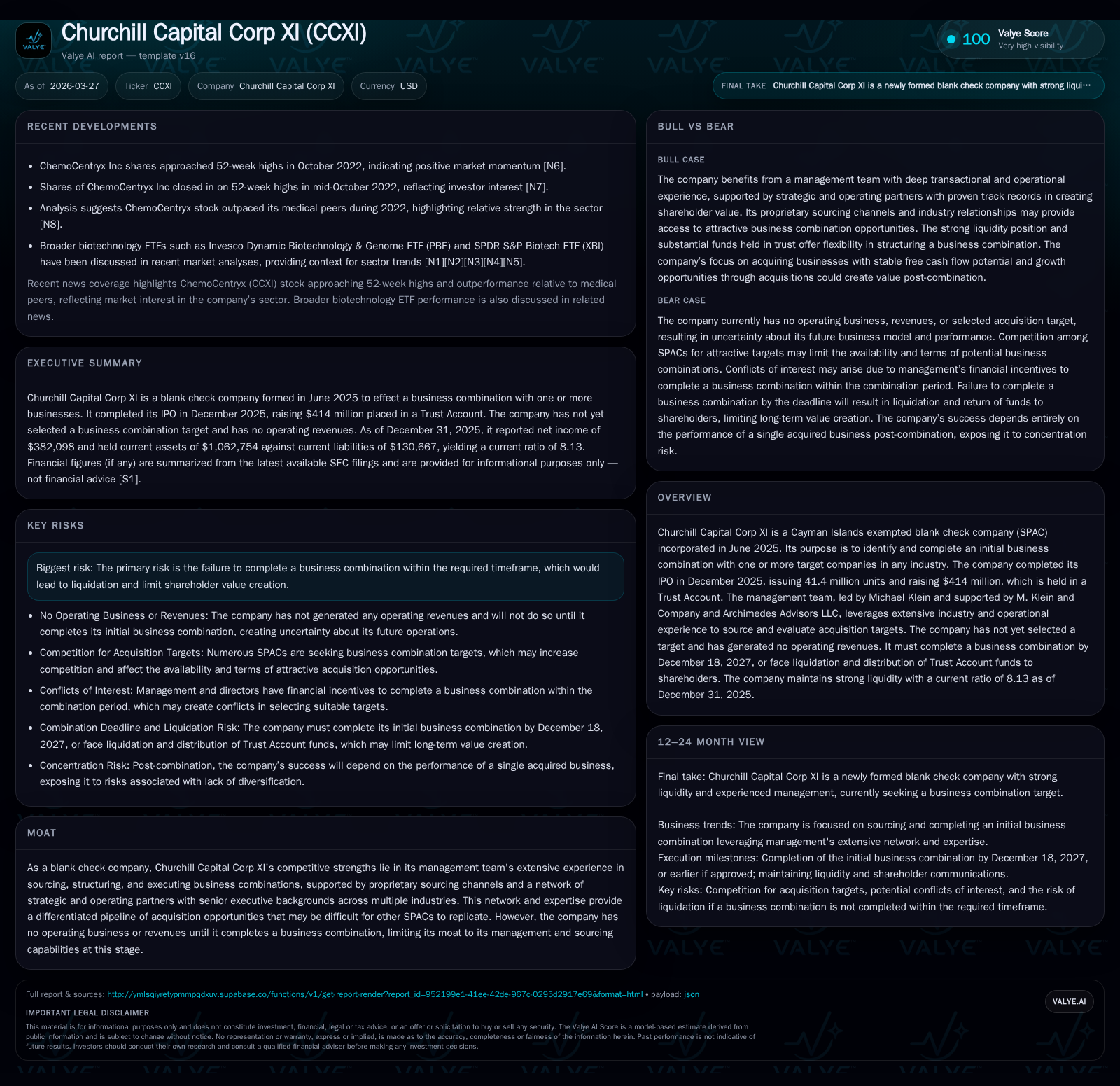
Churchill Capital Corp XI, a Cayman Islands exempted blank check company established in mid-2025, raised $414 million through its December 2025 IPO. The company has yet to select an acquisition target, aiming to complete a business combination by December 18, 2027. Its competitive edge stems from a management team led by Michael Klein and strategic operating partners who provide industry expertise and deal execution prowess. While it carries no operating revenues or diversified business segments currently, Churchill benefits from strong liquidity and robust governance mechanisms prepared for shareholder redemptions should the combination deadline lapse.
Overview and Historical Performance
Churchill Capital Corp XI (CCXI) was incorporated as a Cayman Islands exempted blank check company on June 4, 2025. Its foundational purpose is to seek out one or more suitable businesses across industries for an initial business combination (IBC). It launched its initial public offering (IPO) in December 2025, successfully raising approximately $414 million by selling 41.4 million units at $10 each [S1][F1]. This capital is principally held in a trust account earmarked exclusively for funding an eventual business combination.
Because it is a newly formed Special Purpose Acquisition Company (SPAC), Churchill has yet to generate any operating revenues or establish ongoing business operations. Historically, the company’s activities have been confined to organizational tasks, completing the IPO, and initiating its search process for qualified acquisition targets [S1][S20]. Consequently, there is limited historical financial performance beyond the proceeds raised and associated costs.
Historical performance (annual)
| FY |
|---|
| 2025 |
Source: SEC companyfacts cache [F1].
Net income reflects largely non-operating elements typical for a SPAC at this early stage [F1]. The current ratio stands at a robust 8.13 as of December 31, 2025 (current assets of approximately $1.06 million versus current liabilities around $0.13 million), confirming strong liquidity suitable for operational runway until the IBC is executed [F1].
Business Model and Competitive Positioning
As a blank check entity without commercial operations or product offerings, Churchill’s "moat" primarily resides in its leadership and sourcing capabilities. CEO Michael Klein leads the management team leveraging decades of investment banking and deal-making expertise through M. Klein and Company along with Archimedes Advisors LLC. Their network comprises senior former executives of multiple S&P 500 companies across sectors like consumer goods, industrials, technology, finance, energy, and more [S8][S23][S25]. These "Operating Partners" assist not only in sourcing attractive targets but also in providing operational guidance post-combination.
The SPAC explicitly avoids broadly marketed processes; instead it draws from proprietary sourcing channels backed by relationships with private equity sponsors, venture capitalists, credit funds, lenders, and corporate management teams [S23][S25]. Their approach focuses on companies that demonstrate strong recurring revenue streams, steady free cash flows with potential for margin expansion or operational improvement, and where valuation upside can be unlocked through strategic execution [S8][S28].
This sector-agnostic stance combined with broad functional expertise gives Churchill potential competitive differentiation relative to other SPACs relying on less seasoned management teams or generic deal pipelines [S27]. However, this advantage remains unproven until it executes a successful transaction.
Future Growth Prospects
Growth for Churchill hinges entirely on consummating a business combination within the next ~20 months. The company must close an IBC by December 18, 2027—or by March 18, 2028 if certain contractual preliminary agreements are reached beforehand—or face mandatory liquidation [S1][S4]. Successful identification of a target offering meaningful operational scale and forward earnings trajectory would mark the commencement of genuine revenue generation.
The management team’s focus is on targets exhibiting:
- Strong long-term growth potential driven by compelling industry fundamentals.
- Opportunity for consolidation benefits or enhancement via acquisitions.
- Stable free cash flows with prospects of generating sustainable incremental cash flow improvements.
- Operational vulnerabilities addressable through managerial expertise and financial restructuring [S8][S28].
Nonetheless, the opportunity set is constrained by intense competition among numerous SPACs chasing attractive assets. Economic fluctuations or prolonged market volatility can further impair the ability to negotiate favorable transaction terms or complete deals promptly [S27].
On balance, while well-positioned through experience and relationships to source quality deals with structural upside characteristics, Churchill remains subject to significant timing and execution risks inherent in SPAC strategies [S23][S25].
Governance and Redemption Rights
The company’s governing documents enforce shareholder protections customary for SPACs. Public shareholders are entitled to redeem their shares at approximately $10.01 per share if no IBC materializes by the deadline [F1][S19]. Redemptions extinguish shareholder rights fully upon completion of redemption distributions.
Sponsor equity interests (Founder Shares) totaling about $5 million contributed via private placement do not confer redemption rights but represent alignment incentives contingent on deal success [S1][S7]. They may purchase additional public shares subject to regulatory compliance to help achieve quorum approvals needed during business combination voting arrangements [S16][S17].
The amendment mechanism requires special resolution thresholds (~two-thirds majority vote) ensuring shareholders have control over extension proposals beyond the original term [S11]. The Board maintains discretion to approve earlier liquidation if deemed appropriate.[S1]
Capital Allocation and Financial Returns
Given its pre-acquisition status:
- Churchill holds nearly all funds raised in a Trust Account earning interest net of permitted withdrawals.
- Operating expenses are funded outside the Trust Account from nominal cash reserves.
- No dividends or share repurchase programs exist as per regulatory guardrails applied to SPAC structures.[F1][S7]
Return metrics such as ROE currently lack relevance due to absence of operating earnings; calculated ROE stands negative at around -2.7% reflecting preliminary administrative outlays against contributed capital [F1]. Cash flow generation will dramatically shift post-business combination subject to target company performance.
Monitoring upcoming announcements related to target identification progress, shareholder meeting schedules for approval votes or tender offers will be critical milestones ahead.
Risks Summary
Principal risks center on failure to complete an initial business combination within the prescribed timeframe resulting in mandatory liquidation protocols whereby public shareholder funds are returned minus expenses [S4][S19]. Limited operating history imposes uncertainties tied strictly to managerial execution capabilities and competitive sourcing environment. Market volatility may also hamper transaction viability or pricing attractiveness.
Additional considerations include:
- Potential concentration risk post-combination due to reliance on a single acquired entity’s performance.[S29]
- Regulatory challenges affecting redemption processes or acquisition structuring.[S12]
- Sponsor conflicts arising from parallel obligations linked to other affiliated blank check vehicles although current disclosures indicate no binding exclusivity arrangements.[S27]
Conclusion
Churchill Capital Corp XI exemplifies a modern SPAC leveraging high-caliber dealmakers and operational experts poised to deploy roughly $414 million toward acquiring a promising enterprise within two years of IPO closing. Its competitive moat relates fundamentally to management depth combined with proprietary sourcing networks spanning various industries critical for realizing valuation uplift opportunities post-merger.
Investors should watch closely developments around target identification decisions alongside evolving market conditions which strongly influence both timing pressures and merger terms. Liquidity remains strong with substantial Trust Account reserves coupled with legal safeguards ensuring fair treatment of public shareholders should no transaction occur timely.
Unless an initial business combination is consummated effectively ahead of its stipulated deadline in late 2027 or shortly thereafter with proper approvals obtained from shareholders under Nasdaq requirements governing SPAC transactions, Churchill faces wind-up proceedings distributing residual trust funds less administrative costs back proportionally to investors.
Disclaimer: This report provides an informational analysis derived exclusively from available SEC filings as of March 27, 2026 ([F1], [S#]) without offering investment advice or recommendations.
Disclaimer: This is research-only, informational analysis and not investment advice. It may include AI-generated interpretation and general industry context. Always verify important details using primary sources.

Comments