
Kornit Digital’s Transition to Recurring Revenue: Evaluating Growth amid Operating Losses
Kornit Digital drives top-line resilience through its All-Inclusive Click model despite sustained operational deficits.
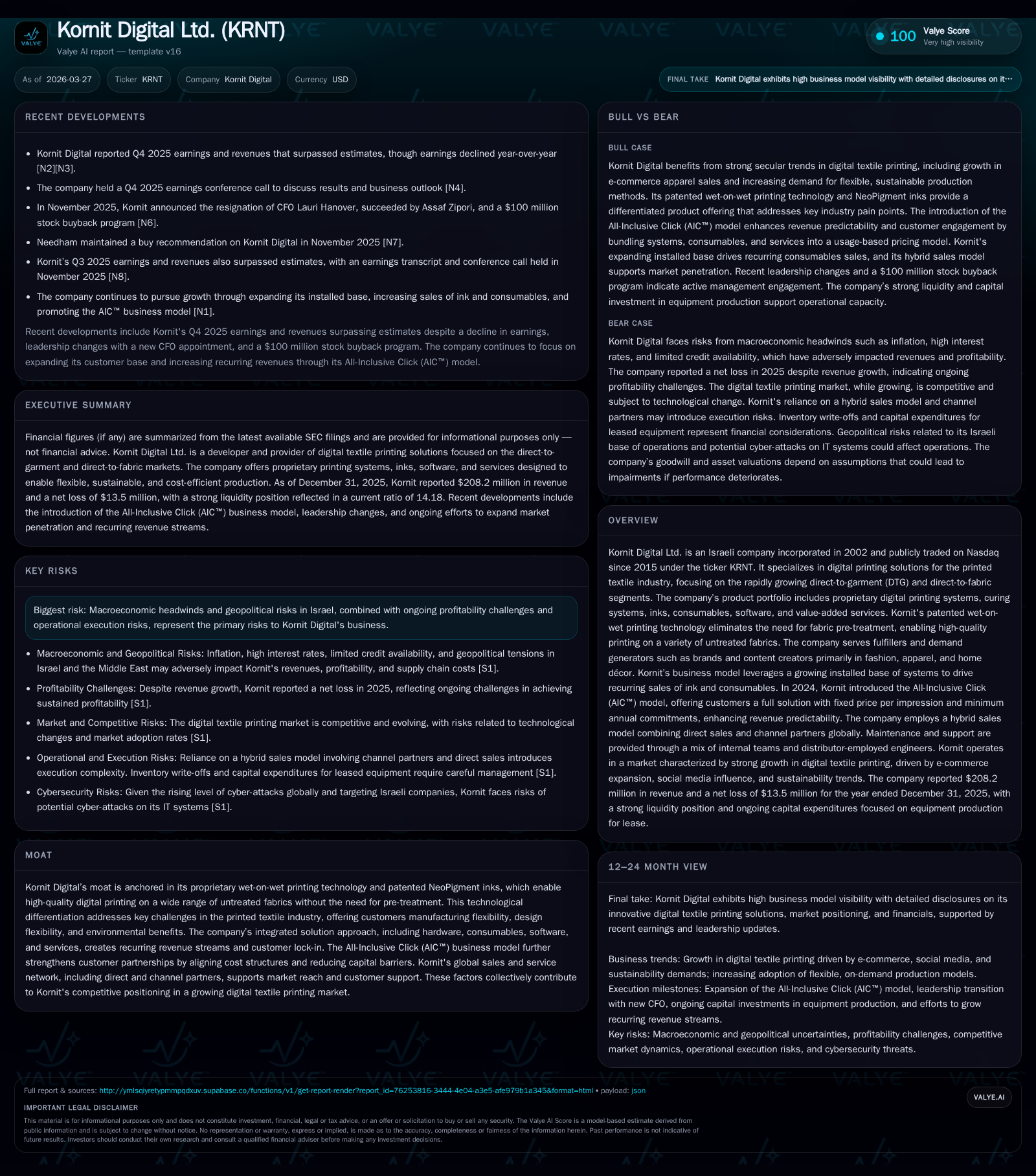
Kornit Digital has anchored its market position in digital textile printing on patented wet-on-wet technology, yet recent years reveal modest revenue growth alongside ongoing operating losses. The 2024 rollout of the All-Inclusive Click (AIC™) business model represents a strategic pivot toward recurring revenue streams, reducing upfront capital barriers for customers and enhancing revenue predictability. While this model supports expansion into direct-to-garment and direct-to-fabric segments, Kornit continues to manage elevated R&D and capex expenditures that pressure profitability. Key risks include geopolitical tensions impacting supply chains and macroeconomic factors affecting customer demand.
Historical Performance and Revenue Drivers: From Technology Innovation to Moderate Growth
Kornit Digital has steadily strengthened its foothold in the printed textile market since its founding in 2002 by leveraging proprietary wet-on-wet printing technology coupled with NeoPigment inks that enable high-quality digital printing directly onto untreated fabrics. This reduces complexity and environmental impact compared to analog methods.[S8]
From a financial perspective, the company achieved revenues of $208.2 million in FY2025, a modest increase of 2.1% over the previous year’s $203.8 million.[F1] This moderate growth reflects Kornit's ability to sustain sales momentum despite headwinds including fluctuating global demand and macroeconomic pressures.[S1] However, revenue trails behind the higher figure posted in FY2022 ($271.5 million), underscoring lingering market challenges.[F1]
Operating losses have gradually contracted from a peak deficit of $87.5 million in FY2023 to $34.6 million by the end of FY2025.[F1] This narrowing loss profile signals increased operational efficiency and some leverage gained from scale but indicates ongoing profitability strain during investments into growth initiatives.
This pattern suggests that while Kornit’s technological moat aids sustained customer interest and system deployments across multiple digital textile printing segments, mature market adoption rates combined with macro uncertainty cap near-term revenue acceleration.
Historical performance (annual)
| FY | Rev ($mm) | Net ($mm) | CFO ($mm) | OpInc ($mm) | Rev YoY | Net YoY |
|---|---|---|---|---|---|---|
| 2025 | 208 | -14 | 25 | -35 | +2.1% | +19.5% |
| 2024 | 204 | -17 | 49 | -37 | -7.3% | +73.9% |
| 2023 | 220 | -64 | -35 | -88 | -19.1% | +18.6% |
| 2022 | 272 | -79 | -99 | -70 |
Source: SEC companyfacts cache [F1].
Capital returns and efficiency (annual)
| FY | Buybacks ($mm) | FCF ($mm) | ROE% |
|---|---|---|---|
| 2025 | 26 | 3 | -1.9 |
| 2024 | 84 | 34 | -2.3 |
| 2023 | 56 | -42 | -8.1 |
| 2022 | -102 | -9.1 |
Source: SEC companyfacts cache [F1].
Table: Kornit Digital Historical Financial Performance (FY2022-FY2025). All figures USD millions; YoY computed where applicable.[F1]
The All-Inclusive Click (AIC™) Model: Redefining Customer Partnerships and Revenue Streams
In early 2024, Kornit introduced the All-Inclusive Click (AIC™) business model—a comprehensive solution offering customers full access to printing systems along with ink, consumables, software licenses, training, and service for a fixed fee per impression based on minimum annual commitments typically spanning five years.[S3][S4]
The AIC™ model fundamentally alters Kornit's revenue recognition pattern: systems remain owned by Kornit and the company recognizes lease revenue progressively over time while ink and consumable revenues correlate directly with actual impressions made by customers.[S4][S19] This contrasts with traditional one-time system sales recognized at delivery.
Strategically, AIC™ shifts capital expenditure barriers from customers onto Kornit’s balance sheet—inviting broader adoption by minimizing upfront investment obstacles for businesses scaling digital textile printing capabilities.[S4]
Moreover, AIC™ bolsters recurring revenue streams linked closely to customer throughput performance rather than product shipments alone—aligning incentives between vendor and user while smoothing revenue volatility inherent in equipment sales cycles.
The current applicability of AIC™ encompasses key platforms including Apollo and Atlas MAX series models targeting mass production DTG markets as well as direct-to-fabric segments.[S4]
Market Expansion and Product Portfolio Advances: Direct-to-Garment and Direct-to-Fabric Segments
Kornit's core technological advantage—wet-on-wet printing—is pivotal across both high-throughput direct-to-garment (DTG) operations printing on finished textiles (e.g., shirts, fleeces) as well as newer direct-to-fabric solutions used upstream for home décor or technical apparel production.[S6][S23]
Product innovation highlights include:
- Apollo platform launched in January 2024 designed for industrial scale outputs up to approximately hundreds of garments per hour tailored for mass customization.[S23]
- Atlas MAX Poly, introduced July 2022, which incorporates Kornit MAX technology enabling premium print quality on polyester and blends suited for sportswear or athleisure markets with proprietary ProGuard consumables reducing dye migration concerns.[S23][S24]
- Roll-to-roll solutions like Avalanche Poly Pro aimed at diverse fabric types equipped with multi-color NeoPigment® Robusto ink sets facilitating complex design reproduction stringent durability requirements.[S24]
Kornit's integrated software stack complements hardware capability improvements: QuickP Production software manages print job preparation; K-RIP embedded RIP processes color management; cloud-based Kornit Konnect analytics platform optimizes fleet utilization through real-time monitoring.[S24]
Simultaneously expanding direct sales efforts alongside channel partnerships enhances geographic penetration while targeting emerging use cases such as web-to-print businesses boosting footprint among both demand generators like brands/content creators and fulfillment providers.[S3][S6]
Profitability Challenges and Operating Expenses: Understanding Kornit's Income Dynamics
Despite narrowing operating losses—from nearly $88 million in FY2023 to approximately $35 million in FY2025—Kornit continues recording substantial negative margins attributable predominantly to rigorous R&D spending needed for product innovation plus expanded costs supporting the AIC™ leasing infrastructure.[F1][S1]
Research and Development expenses remain a significant line item reflecting continuous investments into new ink formulations, system enhancements, automation features that support throughput gains required by industrial textile printers.[S5] Warehousing consumables inventory also impacts working capital profiles given replenishment cycles tied to installed base growth.
Operational costs face inflationary headwinds exacerbated by geopolitical tensions impacting logistics from Israel headquarters—a nexus exposed to freight cost volatility linked to fuel prices affected by regional conflicts involving Iran.[S1][S12]
Supply chain disruptions raise component costs unpredictably while cybersecurity expenditures increase as Kornit responds proactively through obtaining SOC2 certification validating controls over data security amid rising AI-powered cyber threats.[S16][N1]
While margins improve slightly due to scaling benefits and efficiency gains, the pace of profitability turnaround remains moderate given ongoing strategic reinvestments.
Capital Investment, Cash Flows, and Returns: Navigating Growth vs Financial Discipline
Capital expenditures surged sharply over recent years—from $2.9 million in FY2022 climbing nearly sevenfold to $21.3 million in FY2025—to support production of equipment specifically for lease as part of AIC™ arrangements rather than outright sales.[F1][S5]
This elevated capex underpins long-term growth strategies but temporarily depresses free cash flow generation despite positive operating cash flows of $24.6 million recognized late last year.[F1] Free cash flow calculated as operating cash flow minus capex remains positive but modest at roughly $3.35 million during FY2025,[F1] indicating tight cash conversion driven by large upfront investments.
Notably, Kornit allocated $26 million towards share repurchases during FY2025 illustrating confidence in intrinsic value yet highlighting constrained return on equity—approximately negative -1.9% given net losses against equity base above $712 million—reflecting ongoing net income deficits limiting distributable earnings capacity.[F1][S27]
Liquidity indicators remain sound with current ratios exceeding fourteen times as current assets substantially outweigh liabilities,[F1] providing ample operational runway through ongoing transition periods.
Risk Landscape: Macro Headwinds, Geopolitical Exposure, and Cybersecurity Posture
Kornit operates amidst complex risk dynamics shaped chiefly by geopolitical volatility surrounding Israel headquarters—including potential protracted conflicts involving neighboring Iran—that threaten supply chain continuity via elevated shipping costs driven by fuel price shocks or transportation disruptions.[S12][N1]
Additional macroeconomic constraints manifest via persistent inflationary pressures coupled with higher interest rates restricting credit availability among customers exploring capital-intensive technology adoption pathways affecting equipment purchase cycles.[S1]
Cybersecurity risk is prominent given increasing sophistication of threats amplified via AI utilization potentially undermining IT system integrity critical for digital platform operations supporting cloud order intake workflows through acquired Custom Gateway solutions.[S16]
Kornit demonstrates proactive governance addressing these concerns through SOC2 Type I certification attained for its Kornit X platform during FY2025 alongside ISO/IEC27001 maintenance confirming mature information security management frameworks.[S16] A robust Information Security Committee chaired jointly by CEO and CISO exists alongside regular employee cybersecurity training initiatives reinforcing risk mitigation culture from board level downward.
Outlook and Key Milestones: What to Watch for in Kornit's Scaling Trajectory
Key indicators for assessing future progress center on accelerated adoption metrics surrounding the All-Inclusive Click model expanding beyond initial DTG core into new bulk apparel verticals including footwear segments where licensing agreements have been cultivated.[N1][N2][S13]
Completion of Business Continuity Plan anticipated within calendar year 2026 will serve as resilience benchmark complementing ongoing post-pandemic supply chain adaptation efforts ensuring operational reliability under stress scenarios.[S16]
Upcoming product rollouts integrating standalone software combining embedded RIP capabilities with fleet management aim to sharpen user experience for mixed portfolio clients encompassing Apollo plus legacy Atlas units enhancing value propositions driving impressions per installed printer base upwards.[N1][N2][S24]
Industry-wide digital textile printing market projected compound annual growth rate around double digit percentages offer tailwinds yet depend heavily on realization of unit economics improvements alongside customer's ability to convert from analog legacy processes economically—a dynamic where Kornit's differentiated technology combined with risk-managed investment posture could unlock scalable profitability inflections.
This analysis is grounded exclusively on publicly available company disclosures up to March 27, 2026, SEC filings including Form 20-Fs and relevant news reports without any speculative forward-looking statements beyond cited company guidance or official milestones.
Disclaimer: This is research-only, informational analysis and not investment advice. It may include AI-generated interpretation and general industry context. Always verify important details using primary sources.

Comments