
Marblegate Capital's Financial Strains and Industry Dependencies in Taxi Fleet Operations
Marblegate Capital Corp focuses on NYC taxi fleet management and medallion loan financing, facing mounting operational challenges and regulatory risks.
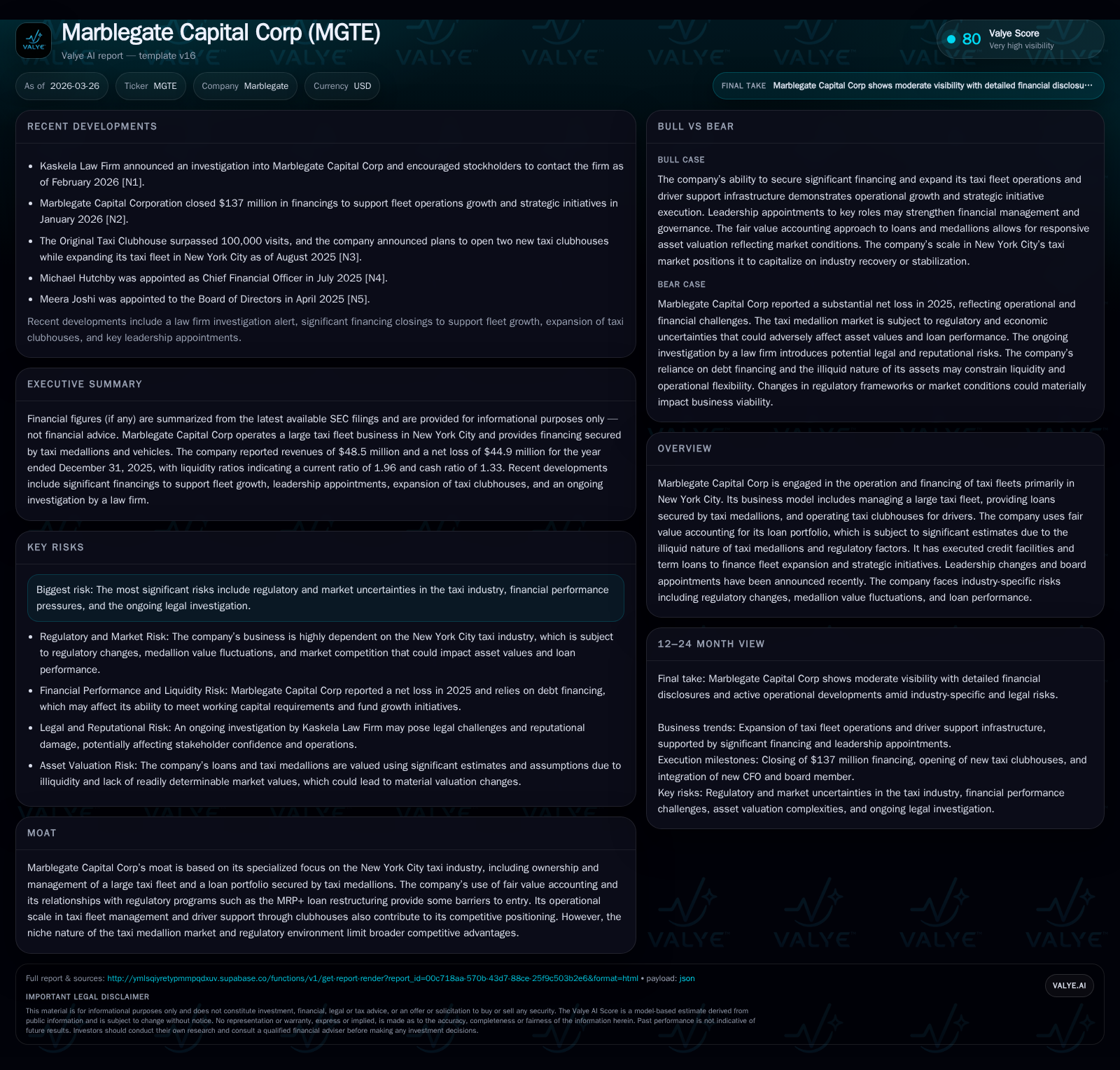
Marblegate Capital Corp operates a specialized business concentrated in New York City's taxi industry, managing fleets, providing loans secured by taxi medallions, and operating driver support services. Despite a resilient revenue stream reaching $48.5 million in 2025 [F1], the company reported a significant net loss of $44.9 million that year, largely due to non-cash adjustments and acquisition impacts [F1][S1]. Its leverage through secured revolving and term loan facilities underpins fleet expansion efforts but also exposes the firm to tight financial covenants and liquidity constraints [S4][S5]. The company’s future growth hinges on stabilizing medallion loan performance and scaling fleet profitability, though these are capped by regulatory changes and market competition from ride-sharing services. Litigation risks and an ongoing legal investigation add further uncertainty to Marblegate’s outlook [N1][S13][S20].
Company Overview
Marblegate Capital Corp is deeply embedded in New York City's taxi ecosystem through an integrated model comprising taxi fleet operations, financing loans secured by taxi medallions, and supportive services such as clubhouse management for drivers. The company's focus on this niche transport sector offers some competitive barriers—stemming from local regulatory complexity and the relatively illiquid nature of medallion collateral—but these also constrain broader scalability given the sector's inherent limitations.
Historical Financial Performance
The firm's revenue reached approximately $48.5 million in fiscal year 2025 according to the latest annual results [F1]. This steady top line is largely drawn from its fleet leasing operations and loan interest revenue anchored against medallion collateral. Operating income was modest at $0.8 million while net loss totaled $44.9 million, reflecting substantial non-cash derecognition events linked with acquisitions (notably Signal Taxi), expense escalations related to fleet expansion investments, and declines in interest income on loans [F1][S1][S17].
Historical performance (annual)
| FY |
|---|
| 2025 |
Source: SEC companyfacts cache [F1].
The decrease in net cash provided by operating activities by approximately $9.1 million (~89%) was chiefly tied to consolidation effects from the Signal Taxi acquisition including an $8 million non-cash derecognition of deposit liabilities plus weaker interest income streams reducing operating cash inflows substantially [S15][S17]. Investing outflows increased sharply due primarily to nearly $37.8 million spent on purchasing vehicles plus a $15.9 million asset acquisition associated with TML IV LLC further expanding its taxi vehicle base [S15]. Financing activities showed increased inflows (+$48.1M), driven mainly by proceeds from long-term debt issuances offsetting some expenditures though highlighting reliance on external financing sources for growth capital [S15].
Capital Structure and Financial Covenants
As of December 31, 2025 Marblegate had two primary debt arrangements: a secured revolving credit facility capped at $120 million with DZ Bank (of which it had drawn $25 million initially) used partly for purchasing newly acquired TML IV LLC assets; and a separate term loan facility totaling around $17.2 million aimed mainly at financing new taxicab vehicle acquisitions [S4][S10]. These facilities are collateralized by restructured MRP+ loans housed within a bankruptcy-remote special purpose vehicle (SPV), which provides borrowing capacity capped at about 80% of eligible receivables balance ($39.8 million as borrowing base at year-end) [S4][S7][S11].
The debt agreements carry strict covenants around minimum consolidated net worth ($100 million), adjusted net income thresholds ($1 per fiscal year starting FY2026), debt-to-equity ratio ceilings (<=1.75x per the Vehicle Facility), interest rate hedging mandates ensuring hedge coverage between 80-110% of outstanding balances post-January 31, 2026, among others that restrict asset sales or granting liens without lender consent [S5][S6][S12]. Violating these terms could trigger defaults accelerating repayment obligations or enforcement remedies including repossession of pledged collateral.
Future Growth Prospects
Growth opportunities center on scaling profitably within the taxi fleet management segment via incremental vehicle purchases supported by debt financing leveraging their recent acquisition of TML IV LLC integrated into their existing medallion loan portfolio [N1]. Restructuring under municipal MRP+ programs supports some stability via subsidized loan modifications aimed at improving delinquency rates.
However, multiple factors cap this upside:
- Ongoing regulatory uncertainty concerning taxi medallion values
- Continued erosion of traditional taxi demand vis-à-vis ride-hailing competitors putting pressure on fleet utilization rates
- Loan portfolio risks given speculative borrower profiles mostly comprising small owner-operators with less transparency or audited financial information [S1][S13]
- Stringent financial covenants reducing maneuverability around capital allocation or expansions
- Potential adverse effect of rising interest rates despite hedging strategies that may not fully offset cost increases [S22]
Risks also include ongoing legal investigations flagged publicly by law firms focusing on corporate governance or compliance matters—though no material litigation currently threatens immediate financial impact according to filings [N1][S13][S20].
Returns & Capital Allocation
Marblegate’s returns reflect challenges: approximate negative return on equity near -9% stemming primarily from net losses weighed down by impairment charges, acquisition-related costs, and operational headwinds in loan collections/income generation [F1]. Cash flows remain mildly positive with free cash flow estimated near $0.9 million due to disciplined capital expenditure aligned with vehicle purchases aimed toward expanding revenue-generating assets gradually [F1][S15].
No dividend payments or share repurchases were disclosed; retained earnings appear directed toward operational needs or deleveraging per covenant demands.
Industry Context Analysis
The taxi industry underpinning Marblegate's business continues confronting profound transformations since peak medallion pricing pre-dating widespread ride-hailing app adoption years ago. Regulatory frameworks have yet to evolve uniformly governing driver rights, fare structures or lending conditions exacerbating credit risk profiles across medallion-secured loans.
Fleet operations increasingly require cost efficiencies through technology integration or better third-party logistics partnerships—as Marblegate relies heavily on third-party service providers for garage operations and vehicle repairs—introducing operational risk should suppliers fail under evolving urban transit norms [S1]. Cybersecurity concerns add layers of complexity given sensitive borrower data maintained digitally.
Conclusion & Outlook Considerations
Marblegate Capital Corp shows strategic focus on NYC’s tightly knit taxi market amplified by deliberate leveraging of credit facilities aimed at growing irrevocable asset bases like fleets and loan portfolios backed by historically valuable but currently volatile medallions. However, constrained profitability paired with extensive leverage governed by restrictive covenants highlights elevated operational risk amid external pressures.
Key developments warranting close monitoring include:
- Delinquency trends within MRP+ loan portfolios affecting borrowing base calculations impacting liquidity availability.
- Progress or setbacks tied to litigation inquiries or regulatory actions potentially altering risk weighting or cost structure.
- Compliance performance regarding financial covenants such as minimum equity levels which govern continuity under current financing models.
- Market movements in ride-sharing competition compressing demand for legacy taxi services.
While Marblegate holds specific expertise providing niche moats rooted primarily in localized market knowledge and long-standing relationships with drivers and city regulators, its prospects remain bounded by inherent industry secular shifts necessitating ongoing adaptation.
This analysis is based solely on publicly available disclosures as of March 26, 2026 ([F1], [N1], SEC filings). It reflects historical data without forecasting investment outcomes or advising stock transactions.
Disclaimer: This is research-only, informational analysis and not investment advice. It may include AI-generated interpretation and general industry context. Always verify important details using primary sources.

Comments