
Oil States International Navigates 2025 Challenges with Backlog Support and Strong Cash Flow
Oil States International faced a difficult 2025 with significant operating losses due to asset impairments but strengthened liquidity through credit facility enhancements and robust cash flow, supported by a substantial backlog providing revenue visibility into 2026.
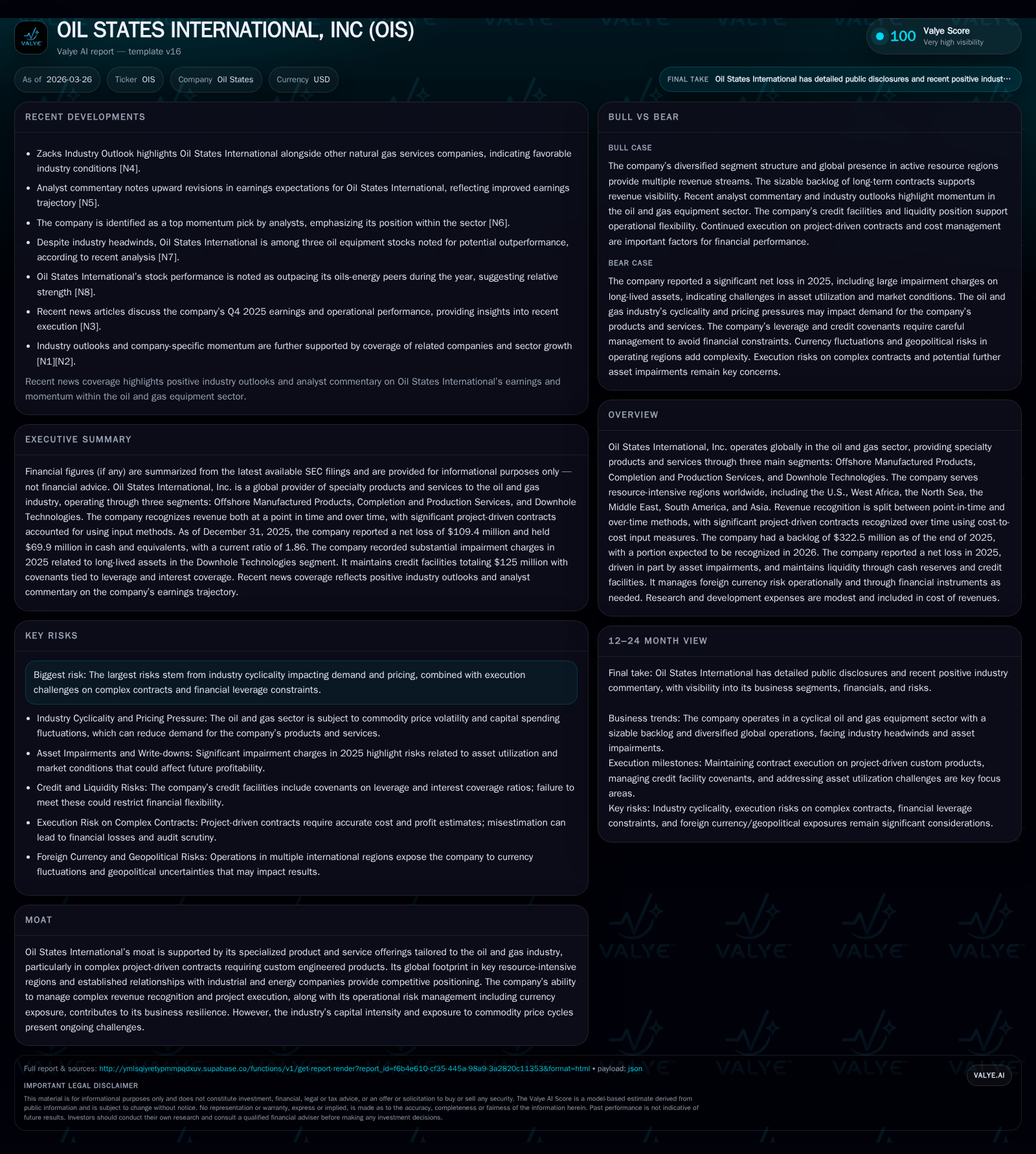
In 2025, Oil States International recorded a steep operating loss primarily driven by asset impairment charges amid volatile oilfield market conditions. The company’s revenue recognition reflects complex contracts combining point-in-time and over-time methods, with a $322.5 million backlog underpinning near-term revenue. An amended credit agreement increased borrowing capacity and imposed disciplined covenants, while strong operating cash flow enabled positive free cash flow and share repurchases despite net losses. Leadership transition announced in early 2026 marks a strategic inflection point as the company manages industry cyclicality and execution risks.
Challenging Financial Results Amid Market Volatility
Oil States International experienced significant financial headwinds in fiscal year 2025, recording an operating loss of nearly $98 million compared to a minimal operating loss in the prior year [F1][S1]. This deterioration was driven largely by substantial non-cash asset impairment charges reflecting diminished valuations of long-lived assets amid challenging market conditions.
Revenue recognition complexities arise from the company's contract structures: approximately 39% of revenues were recognized at a point in time—primarily from short-term standard product sales—while about 61% were recognized over time under cost-to-cost input methods tied to custom engineered offshore product contracts [S9][S26]. This approach introduces sensitivity to project execution timing and cost estimates.
Business Segments and Geographic Reach
Operations are organized into three key segments: Offshore Manufactured Products (OMP), Completion & Production Services (CPS), and Downhole Technologies (DHT). These segments cater to upstream exploration and production needs with specialized products and services critical across multiple resource-intensive regions including the United States (both onshore/offshore), North Sea, Middle East, West Africa, South America, and Asia [S20].
This geographic diversification helps mitigate regional risks but exposes the company to foreign currency fluctuations managed through operational hedging strategies [S15].
Backlog Provides Near-Term Revenue Visibility
At December 31, 2025, Oil States held a backlog of approximately $322.5 million related to multi-year contracts [S16]. Management anticipates that around 35% of this backlog will be recognized as revenue during calendar year 2026, offering some predictability amidst market uncertainty.
Strengthened Liquidity via Credit Facility Amendments
In January 2026, Oil States entered into an amended Cash Flow Credit Agreement consolidating existing asset-based lines into combined facilities totaling $125 million—a $75 million revolving credit facility (including a $40 million letter of credit sublimit) plus a $50 million term loan facility maturing in January 2030 [S4][S5][S10].
The credit agreement features interest rates based on Term SOFR plus margins ranging from 2.50% to 3.50%, along with commitment fees on unused amounts. Covenants require maintaining interest coverage ratios above 3.00x EBITDA and total net leverage ratios capped between 2.50x and potentially up to 3.25x EBITDA under certain conditions; senior secured leverage is limited to no more than 2.00x EBITDA [S4][S14].
These terms enhance financial flexibility while imposing prudent controls on indebtedness and capital distributions.
Robust Cash Flow Supports Capital Allocation Discipline
Operating cash flow surged roughly 129% year-over-year to approximately $105 million in fiscal year 2025 compared with about $46 million the previous year [F1][S6]. Capital expenditures remained moderate at roughly $16 million yielding positive free cash flow exceeding $84 million.
This cash generation enabled share repurchases totaling approximately $16.6 million despite net losses for the year totaling about $109.4 million [F1], underscoring management’s focus on disciplined capital deployment.
Research and development expenses were integrated within cost of revenues totaling roughly $5.1 million for the year consistent with ongoing innovation efforts [S6].
Return on equity was negative at approximately -19%, reflecting profitability challenges despite strong cash flow generation against a substantial equity base [F1].
Industry Risks and Leadership Transition
The company continues to face risks from cyclical oil prices affecting demand for its specialized products and services as well as execution risks inherent in complex multi-year contracts [S7][S8]. Financial leverage adds sensitivity given debt servicing requirements amid variable earnings.
On March 19, 2026, CEO Cindy B. Taylor announced her planned retirement effective May 1, marking an inflection point that could influence strategic direction amid an unsettled industry backdrop [S3][N1].
External commentary has noted improving earnings estimates positioning Oil States favorably relative to some peers; however, prudent monitoring remains essential as stability is sought beyond recent disruptions.
Historical performance (annual)
| FY | Net ($mm) | CFO ($mm) | OpInc ($mm) | Net YoY |
|---|---|---|---|---|
| 2025 | -109 | 105 | -98 | -871.5% |
| 2024 | -11 | 46 | -2 | -187.3% |
| 2023 | 13 | 57 | 23 | +235.1% |
| 2022 | -10 | 33 | 3 |
Source: SEC companyfacts cache [F1].
Capital returns and efficiency (annual)
| FY | Buybacks ($mm) | ROE% |
|---|---|---|
| 2025 | 17 | -19.1 |
| 2024 | 14 | -1.7 |
| 2023 | 7 | 1.8 |
| 2022 | -1.4 |
Source: SEC companyfacts cache [F1].
This overview highlights how Oil States International’s specialized engineering capabilities paired with backlog management have helped navigate a turbulent period marked by asset impairments and margin pressures typical of cyclical sectors reliant on upstream spending patterns. The company's strengthened liquidity profile combined with robust cash flow generation positions it cautiously for recovery phases under evolving leadership.
Disclaimer: This report is informational only and does not constitute investment advice or recommendations.
Disclaimer: This is research-only, informational analysis and not investment advice. It may include AI-generated interpretation and general industry context. Always verify important details using primary sources.

Comments