
Rein Therapeutics Advances LTI-03 Development Amid Financial Constraints
Rein Therapeutics prioritizes clinical progress of LTI-03 for idiopathic pulmonary fibrosis while managing significant operating losses and liquidity challenges.
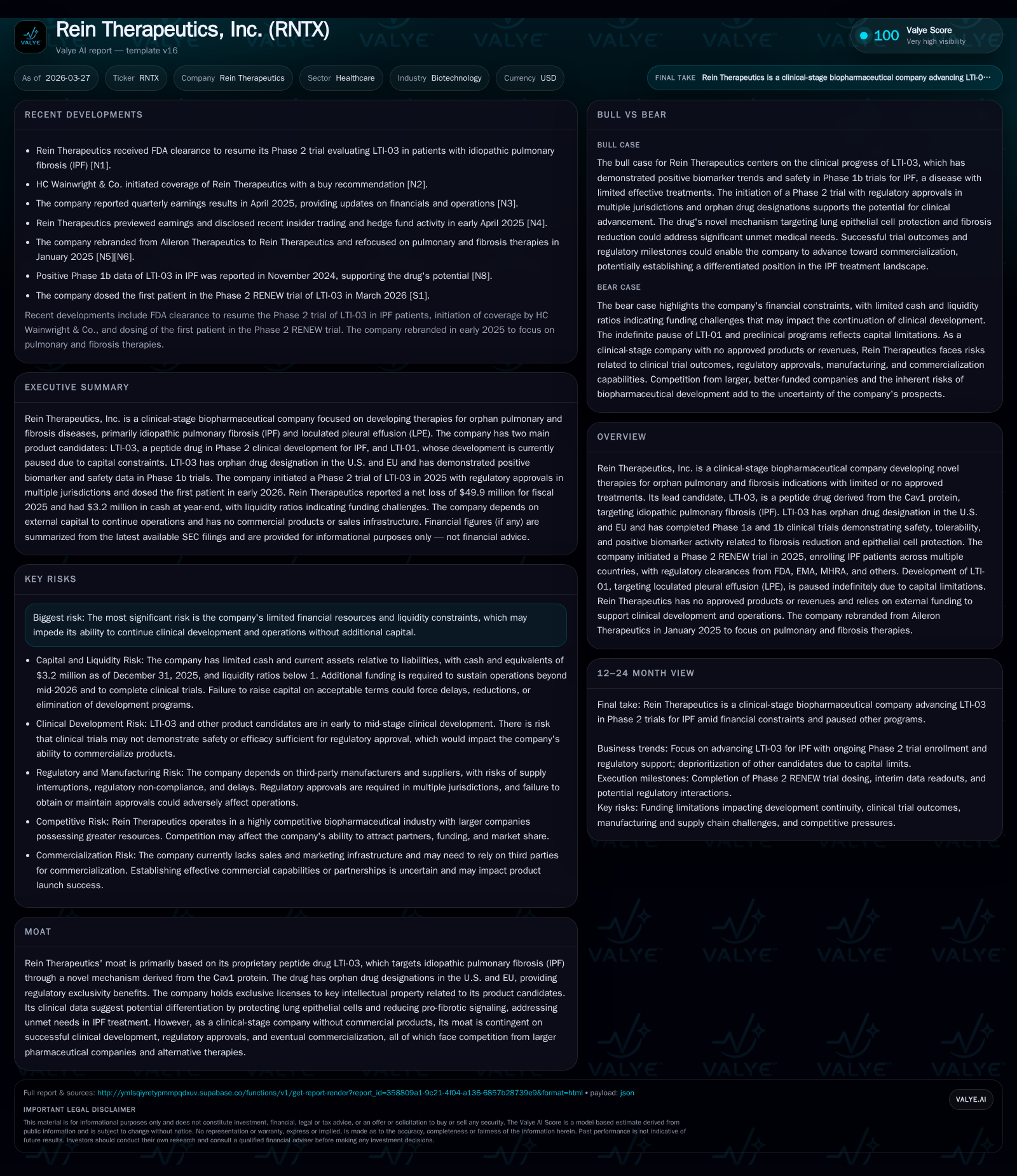
Rein Therapeutics is a clinical-stage biopharmaceutical company focused on developing LTI-03, a novel peptide drug targeting idiopathic pulmonary fibrosis (IPF) via a Cav1-derived mechanism. Following Phase 1 trials demonstrating safety and biomarker activity, the company initiated a multinational Phase 2 trial in 2025. Development of its second candidate, LTI-01 for loculated pleural effusion, is paused indefinitely due to funding constraints. Rein reports substantial operating losses and limited cash reserves, with no product revenues. The company’s differentiation lies in orphan drug designations and a unique approach protecting lung epithelial cells, though financial pressures pose risks to sustained clinical advancement.
Clinical Development Focused on LTI-03
Rein Therapeutics’ lead candidate, LTI-03, is a proprietary peptide derived from the Cav1 protein aimed at treating idiopathic pulmonary fibrosis (IPF), a progressive lung disease with high mortality and limited treatment options [S1]. The drug targets protection of alveolar epithelial type 2 cells and inhibition of pro-fibrotic pathways, addressing aspects beyond fibroblast proliferation targeted by existing therapies.
Phase 1a and Phase 1b studies confirmed safety and tolerability while showing pharmacodynamic biomarker activity indicative of reduced epithelial injury and fibrotic signaling [S1]. These results supported initiation of the pivotal multinational RENEW Phase 2 trial in 2025 under regulatory clearances from FDA, EMA, MHRA, among others [S1]. This study is designed to evaluate efficacy and optimize dosing across diverse populations.
Strategic Pipeline Prioritization
Previously, Rein developed LTI-01 targeting loculated pleural effusion (LPE), an orphan indication with no approved therapies [S1]. Despite completing early-phase trials, development was paused starting mid-2024 due to funding constraints and remains on indefinite hold as of late 2025 alongside certain preclinical programs [S1]. The company thus concentrates resources on advancing LTI-03.
Financial Performance and Liquidity
Rein’s financials reflect ongoing R&D investment without product revenues [F1]. Operating losses improved from -$65.1 million in FY2024 to -$50.6 million in FY2025 (22% reduction), while net loss narrowed from -$62.9 million to -$49.9 million (21% reduction) [F1]. Operating cash flow burn decreased modestly to -$19.4 million in FY2025 from -$22.3 million in FY2024 [F1]. Capital expenditures are minimal relative to operating costs.
Cash and equivalents totaled approximately $3.2 million at fiscal year-end 2025 against current liabilities near $6.2 million, resulting in a current ratio around 0.7 which signals liquidity pressure [F1]. Shareholders’ equity declined substantially year-over-year to $16.9 million at FY2025-end from $54.4 million in FY2024 consistent with operational deficits [F1].
Historical performance (annual)
| FY | Net ($mm) | CFO ($mm) | OpInc ($mm) | Net YoY |
|---|---|---|---|---|
| 2025 | -50 | -19 | -51 | +20.7% |
| 2024 | -63 | -22 | -65 | -299.7% |
| 2023 | -16 | -20 | -16 | +42.4% |
| 2022 | -27 | -25 | -28 |
Source: SEC companyfacts cache [F1].
Capital returns and efficiency (annual)
| FY | ROE% |
|---|---|
| 2025 | -294.8 |
| 2024 | -115.6 |
| 2023 | -228.4 |
| 2022 | -146.7 |
Source: SEC companyfacts cache [F1].
Note: Capital expenditure data is only available through FY2022 [F1].
Return on equity based on FY2025 figures is approximately -295%, reflecting the developmental stage without profitability or revenue generation [F1].
Competitive Positioning and Differentiation
The fibrosis treatment landscape features competition from large pharmaceutical companies including Roche (Esbriet), Boehringer Ingelheim (Ofev and Jascayd), AbbVie Inc., Bristol Myers Squibb Company among others actively developing or marketing products for IPF [S16].
Rein’s distinct approach centers on its Cav1 peptide mechanism that uniquely aims to protect lung epithelial cells while mitigating fibrotic signaling pathways—contrasting with existing therapies that mainly target fibroblast proliferation without epithelial restoration [S1][S16]. This mechanism may provide competitive advantages if clinical efficacy is confirmed.
Regulatory Status and Market Access Considerations
LTI-03 has received orphan drug designation in both the United States and European Union providing benefits such as marketing exclusivity post approval and potential development incentives [S1][S25]. This status supports Rein’s ongoing global Phase 2 program across FDA-, EMA-, and MHRA-regulated regions.
However, pricing and reimbursement remain uncertain given evolving healthcare policies particularly for accelerated approval drugs that may face coverage barriers despite orphan status [S4][S17].
Capital Allocation and Investor Return Outlook
Without commercial products or revenues to date ([F1]), Rein’s capital allocation focuses predominantly on clinical development activities for LTI-03 while deprioritizing other pipeline programs.
No dividends or share repurchases have been declared or are expected given the company’s pre-commercial stage ([F1]). Recent fundraisings include private placements of promissory notes totaling $2.3 million entered into early 2026 indicating efforts to sustain operations amid liquidity constraints [S3].
Effective management of cash burn will be critical until clinical milestones enable partnership opportunities or larger financing rounds.
Risks Beyond Clinical Development
Key risks facing Rein include:
- Funding adequacy concerns driven by ongoing high cash burn relative to limited cash reserves [F1],
- Intellectual property risks including potential third-party patent claims or enforcement challenges [S6][S11][S20],
- Competition for scientific talent that could impact innovation pace and execution [S16],
- Regulatory uncertainties especially regarding accelerated approval pathways which may require confirmatory trials increasing timelines or costs [S8][S14],
- Healthcare reform pressures potentially limiting pricing or reimbursement even with orphan exclusivity status [S4][S15][S17].
Currently there are no material legal proceedings involving Rein but ongoing vigilance is necessary given industry patent litigation prevalence [S7][S19].
Milestones to Monitor
Investors should watch closely for:
- Progress on patient enrollment across multinational Phase 2 trial sites,
- Interim safety and biomarker readouts that could validate therapeutic hypotheses,
- Updates on capital raising efforts given liquidity pressures,
- Regulatory feedback impacting trial design or approval strategies.
These factors will be pivotal in shaping Rein’s development trajectory.
Disclaimer: This summary is based solely on publicly available information as of March 27th, 2026 and does not constitute investment advice.
Disclaimer: This is research-only, informational analysis and not investment advice. It may include AI-generated interpretation and general industry context. Always verify important details using primary sources.

Comments