
Journey Medical's Revenue Recovery and Operating Improvements Amid Competitive Dermatology Sector
Journey Medical Corp posted moderate revenue growth in 2025 coupled with narrowing net losses, supported by new product launches and patent-driven portfolio strength.
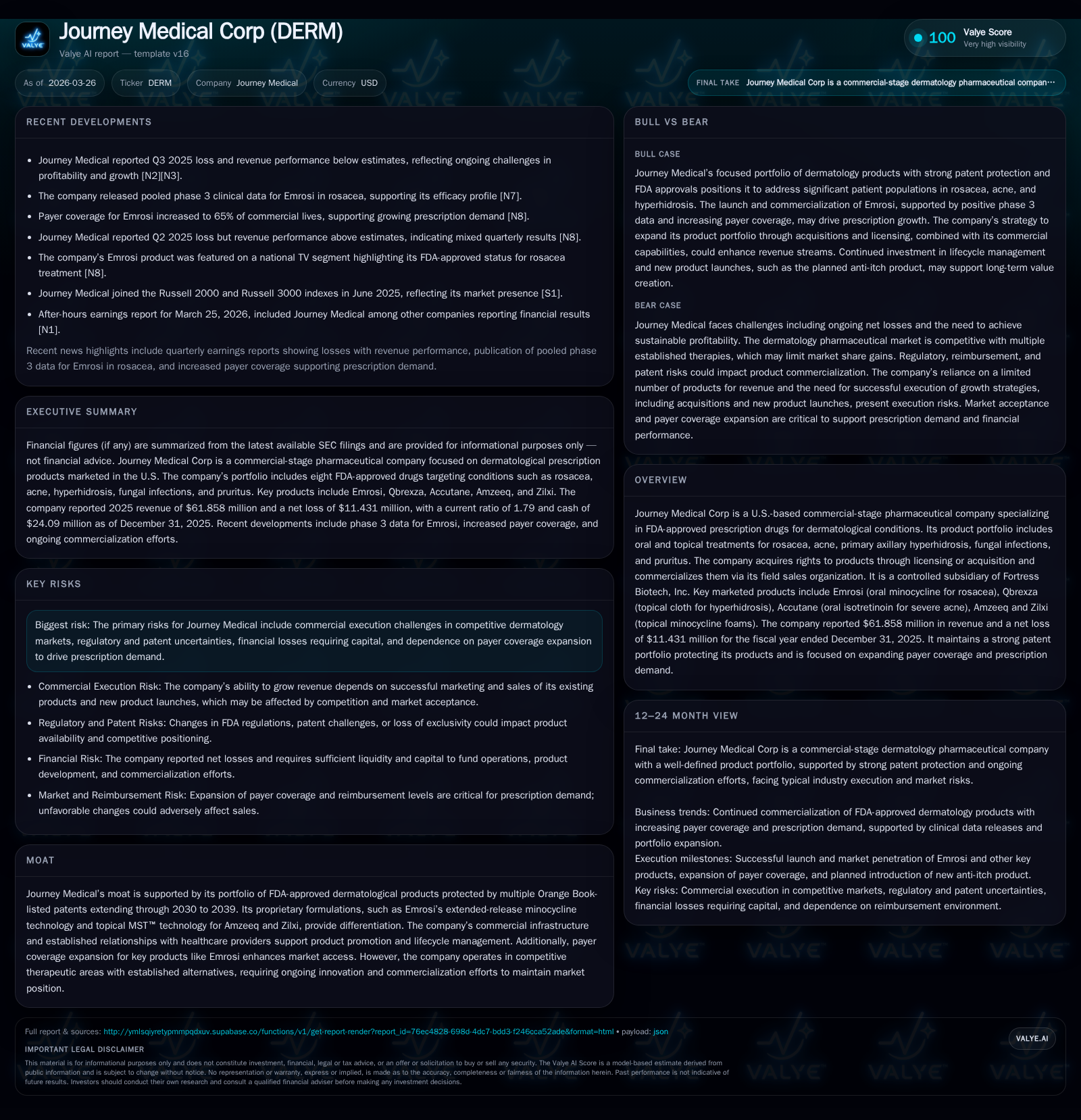
In FY2025, Journey Medical achieved $61.9 million in revenue, marking a 10.2% increase over the prior year, largely driven by the commercial launch of Emrosi. Despite this top-line improvement, the company operated at a net loss of $11.4 million, although this represented a modest improvement compared to prior years. Key drivers include proprietary drug formulations protected by Orange Book-listed patents and an effective licensing-based commercial strategy leveraging an established sales team. Challenges remain in securing payer coverage amid competitive dermatology markets and sustaining positive cash flows. Going forward, monitoring uptake of recently launched products and managing regulatory compliance are essential milestones.
FY2025 Financial Snapshot: Modest Growth during Lingering Losses
Journey Medical Corp reported revenues of approximately $61.86 million for the fiscal year ended December 31, 2025, representing a rebound of 10.2% compared to $56.13 million in 2024 [F1][S1]. This recovery contrasts with the sharp decline experienced in FY2024 (-29.2%), demonstrating partial restoration of commercial momentum notably following the introduction of Emrosi during this period [N1][S1]. Operating losses narrowed significantly to -$8.17 million from -$13.68 million in the prior year, while net losses improved to -$11.43 million compared to -$14.67 million (both figures from [F1]).
Nevertheless, operating cash flow remained negative at -$12.44 million for FY25—a deterioration relative to -$9.13 million in FY24—driven largely by elevated capital expenditures which held steady at $15 million ([F1]). This dichotomy between revenue growth and persistent cash burn underscores the company's continued investment phase aimed at expanding its dermatology franchise despite ongoing profitability challenges.
Historical performance (annual)
| FY | Rev ($mm) | Net ($mm) | CFO ($mm) | OpInc ($mm) | Rev YoY | Net YoY |
|---|---|---|---|---|---|---|
| 2025 | 62 | -11 | -12 | -8 | +10.2% | +22.1% |
| 2024 | 56 | -15 | -9 | -14 | -29.1% | -280.8% |
| 2023 | 79 | -4 | 5 | -2 | +7.5% | +87.0% |
| 2022 | 74 | -30 | -14 | -28 |
Source: SEC companyfacts cache [F1].
Capital returns and efficiency (annual)
| FY | FCF ($mm) | ROE% |
|---|---|---|
| 2025 | -27 | -35.9 |
| 2024 | -24 | -73.1 |
| 2023 | 0 | -18.9 |
| 2022 | -34 | -174.5 |
Source: SEC companyfacts cache [F1].
*Note: Volatile year-over-year trends reflect timing of product launches and expense recognition shifts.
The Emrosi Impact: New Product Launch and Sales Momentum
A pivotal element underpinning the FY25 revenue recovery was Emrosi (Minocycline Hydrochloride Extended-Release Capsules), which secured FDA approval on November 1, 2024 [S1]. The company initiated commercialization efforts in April 2025 leveraging an existing commercial team developed for its dermatology portfolio.
Emrosi targets inflammatory lesions of rosacea—a sizable market segment—and is distinguished by its extended-release technology that differentiates it from conventional minocycline therapies [S1][N1]. The product was developed in collaboration with Dr. Reddy's Laboratories Ltd., combining proprietary formulation expertise with global pharmaceutical resources.
Initial commercial traction contributed materially to FY25 revenue expansion despite the limited full-year sales window [S1]. Emrosi’s launch underscores Journey's capacity to successfully convert late-stage pipeline assets into active sources of top-line growth by harnessing differentiated drug delivery technologies backed by regulatory clearance.
Patent Protections and Proprietary Technology as Moat Pillars
Journey Medical’s intellectual property portfolio forms a defensive barrier critical to its competitive positioning within dermatological pharmaceuticals [S16][S21]. The company holds multiple Orange Book-listed patents covering key products such as Emrosi through patent expirations spanning from 2030 up to potentially 2039 [S1]. These patents protect extended-release minocycline capsule technology as well as MST™ topical foam delivery methods used respectively in Emrosi and foam products Amzeeq and Zilxi.
Such patent protections help mitigate generic substitution risk—a significant threat within dermatology where many branded therapies face erosion from cost-sensitive generic versions post-exclusivity loss [S21]. Moreover, Journey supplements patent exclusivity with trade secret know-how and licensing agreements designed to foster incremental innovation while defending its formulation advances [S23][S28].
The value of proprietary technology extends beyond legal protections; it supports formulary inclusion debates where cost-effectiveness is weighed alongside differentiated clinical profiles sourcing distinct prescriber preferences amidst competing therapeutic classes.
Commercial Strategy: Licensing Acquisitions and Sales Force Deployment
Journey Medical adopts a business model centered around acquiring or licensing rights to externally developed dermatology assets rather than heavy internal R&D investment [S1][S11]. It markets eight FDA-approved prescription drugs primarily addressing conditions such as rosacea, severe acne, hyperhidrosis, fungal infections, and pruritus.
Critical marketed products include Qbrexza® for axillary hyperhidrosis (launched May 2021), Accutane® (oral isotretinoin for nodular acne), Amzeeq® and Zilxi® foams based on minocycline formulations alongside Emrosi [S1][N1]. These diverse assets provide some revenue diversification but also necessitate concentrated commercial execution through Journey’s field sales organization comprising approximately two-thirds of its ~58 total employees as of March 2026 focused on sales and marketing functions [S6].
This lean infrastructure aligns closely with customer relationships across roughly over 600 specialty pharmacies and independent distributors—typical channels for prescription dermatology products where payor reimbursements are often complex [S11]. While this approach enables scalability via external innovation sourcing, it introduces reliance risks related to execution quality amid competitors possessing broader portfolios or integrated pipelines.
Market Access Realities: Payer Coverage and Competitive Pressures
Securing adequate reimbursement remains paramount for Journey Medical’s commercial success particularly given specialized pricing dynamics within prescription dermatology [S16][S17][S18]. Payer coverage expansions—especially Medicare Part D formulary inclusions—facilitate patient access while helping mitigate out-of-pocket cost barriers that can restrict adoption.
However, Journey faces entrenched competition from larger pharmaceutical entities such as Galderma Laboratories and Almirall whose broader therapeutic offerings exert significant marketing clout within rosacea, acne, and hyperhidrosis categories [S16][S21]. Increasingly stringent cost containment policies—including mandatory generic substitution programs—apply downward pressure on both pricing power and prescribing volume.
Additionally, the specialty pharmacy channel often negotiates rebates or discounts contesting formulary placement favorability—a nuanced battleground requiring tailored payer engagement strategies common among mid-sized dermatology-focused pharma firms seeking scale advantage.
Capital Structure, Cash Flows, and Returns on Equity
As of December 31, 2025, Journey Medical maintained a cash balance near $24 million alongside current assets totaling roughly $66.87 million versus current liabilities of approximately $37.44 million which calculates to a current ratio of about 1.79 indicating solid short-term liquidity management [F1].
Nevertheless, operating cash flow remained negative at approximately $12.44 million against ongoing capital expenditures steady at $15 million annually since FY2024 indicating continued investment commitments placing pressure on free cash flow generation—which is roughly estimated negative near $27.44 million in FY25 ([F1]).
The company carries term loan indebtedness under credit arrangements amended in mid-2024 linked directly with Emrosi's approval milestone under SWK Funding LLC facility featuring interest rates tied to SOFR plus spread subject to repayment starting early 2026 [S18].
Negative net income totaling approximately -$11.43 million coupled with equity base near $31.85 million implies an approximate ROE of negative -36%, capturing the consequences of sustained losses during scale-up phases common to specialty pharmaceutical commercialization efforts with patent-protected niche drugs [F1]. No dividends or buyback programs are currently reported given focus on reinvestment and liability servicing.
Forward Look: Milestones to Monitor and Strategic Constraints
Near-term catalysts revolve around deepening penetration for recently launched Emrosi wherein incremental quarterly sales figures will validate acceptance dynamics post-April 2025 commercial debut [N1][S6]. Additionally, international licensing partnerships such as the supply agreement for Amzeeq entering China via Cutia Therapeutics may broaden geographic reach contributing ancillary royalty streams over time [S6][N1].
On the operational front compliance adherence continues under evolving regulations including Drug Supply Chain Security Act (DSCSA) obligations mandating product traceability enforcement across wholesale distribution channels—a growing concern given recent U.S federal focus on counterfeit mitigation [S7].
Risks persist from competitive intensity introducing pressure on pricing/reimbursement along with possible patent challenges or litigation that could impact exclusivity frameworks undermining market share protection ideals [S22][S23].Financial sustainability relies heavily on successful portfolio expansion coupled with efficient capital allocation strategies amid currently recurrent operating deficits limiting near-term profitability improvements.
Disclaimer:
This report presents an analytical overview based on publicly available SEC filings and market disclosures without providing investment advice or recommendations regarding securities transactions.
Disclaimer: This is research-only, informational analysis and not investment advice. It may include AI-generated interpretation and general industry context. Always verify important details using primary sources.

Comments