
Cognition Therapeutics Advances Synapse-Protective Alzheimer's Candidate Amid Clinical and Funding Challenges
Clinical progress with zervimesine highlights potential in neurodegenerative disorders amid a need for capital and regulatory milestones.
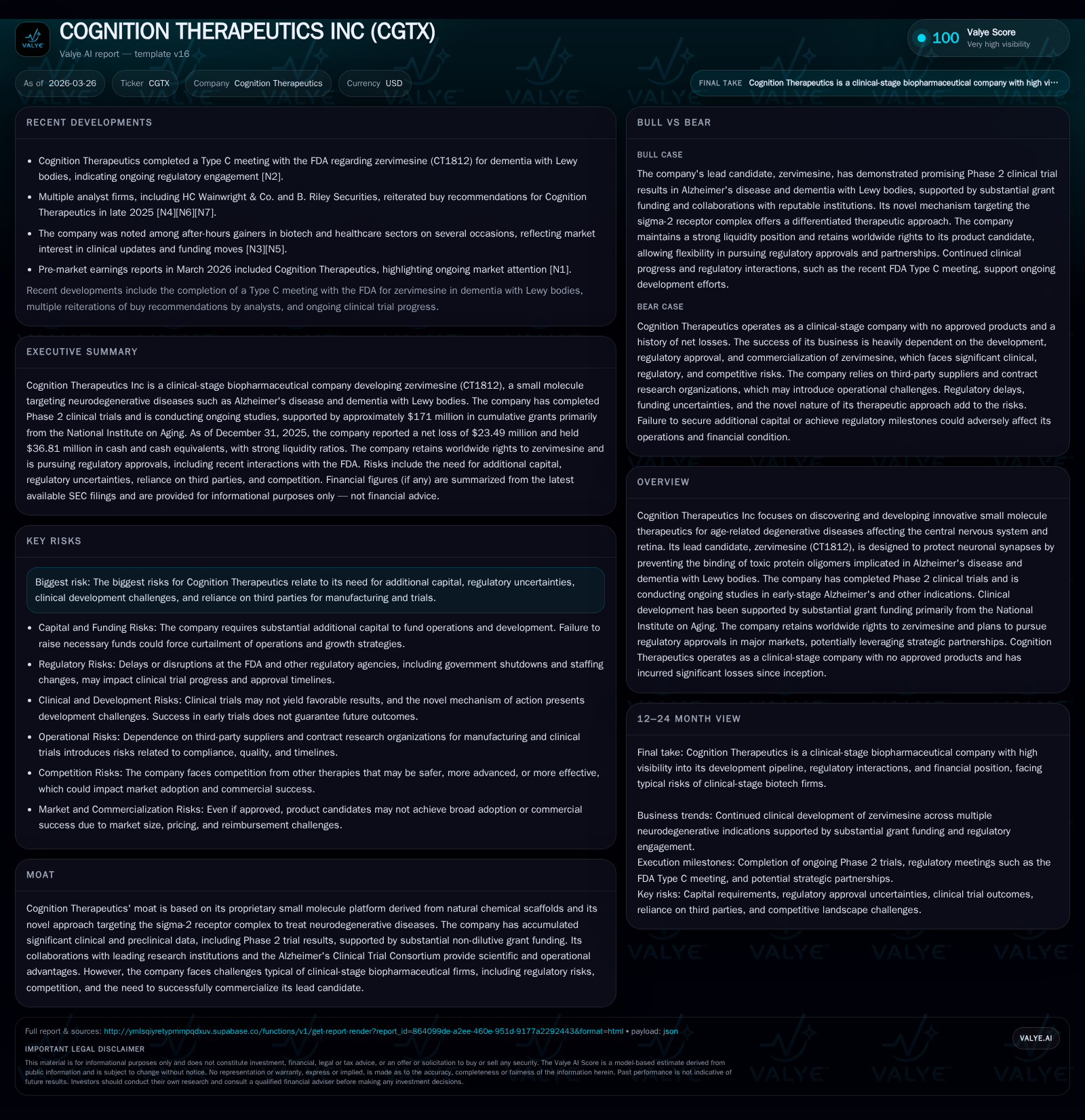
Cognition Therapeutics Inc is a clinical-stage biopharmaceutical developing zervimesine (CT1812), a small molecule targeting protein oligomers implicated in Alzheimer's disease and dementia with Lewy bodies. The company has completed Phase 2 trials and is advancing studies in early-stage AD and DLB psychosis, supported by extensive NIH grant funding totaling over $171 million. Despite promising safety and efficacy signals, Cognition faces typical clinical-stage risks including regulatory uncertainties, need for additional capital, reliance on third parties, and lack of commercial history. Recent strategic decisions focus resources on dementia programs while shelving their dry AMD study, reflecting prioritization within constrained budgets.
Company Overview
Cognition Therapeutics Inc operates as a clinical-stage biopharmaceutical focused on age-related degenerative diseases affecting the central nervous system and retina. Its proprietary approach centers on small molecule therapeutics derived from conditioned extraction of natural chemical scaffolds, specifically targeting the sigma-2 receptor complex involved in neurodegeneration. The lead asset, zervimesine (CT1812), aims to protect neuronal synapses by displacing toxic oligomers of β-amyloid (Aβ) and α-synuclein that contribute to Alzheimer's disease (AD) and dementia with Lewy bodies (DLB) progression [S1][S10][S14].
Historical Performance
While Cognition remains pre-revenue with no approved products, it has steadily advanced zervimesine through multiple Phase 2 clinical trials: COG0201 (SHINE) in mild-to-moderate AD, COG0203 (START) in early-stage AD/MCI, COG1201 (SHIMMER) in DLB, and COG2201 (MAGNIFY) in geographic atrophy secondary to dry AMD [S10][S20]. To date, these efforts have been heavily supported by grant funding primarily from the National Institute on Aging (NIA), amounting to ~$171 million cumulatively through December 2025 [S18][S25]. This grants reliance provides an important non-dilutive capital source allowing focussed clinical development.
Financially, Cognition has incurred operating losses each year typical of clinical-stage biotech firms invested heavily in R&D without product sales. Operating income improved marginally from an operating loss of -$53.97M in FY2024 to -$47.80M in FY2025 (11.4% improvement). Net losses narrowed more significantly from -$33.97M to -$23.49M (30.9% improvement). Operating cash flow remained negative at -$24.59M in FY2025 but improved versus prior year by approximately 13.6%. Capital expenditures remain minimal (~$4K annually), consistent with an asset-light clinical model [F1].
The balance sheet showed strong liquidity with cash and equivalents of $36.8M at end-2025 against current liabilities of $13.9M resulting in a current ratio around 3.45 – providing runway but pointing toward ongoing financing needs as trials continue [F1]. Equity totaled approximately $34.27M reflecting cumulative capital raising.
Historical performance (annual)
| FY | Net ($mm) | CFO ($mm) | OpInc ($mm) | Capex ($) | Net YoY |
|---|---|---|---|---|---|
| 2025 | -23 | -25 | -48 | 4000 | +30.9% |
| 2024 | -34 | -28 | -54 | 4000 | -31.7% |
| 2023 | -26 | -16 | -51 | 147000 | -20.5% |
| 2022 | -21 | -19 | -44 | 171000 |
Source: SEC companyfacts cache [F1].
Capital returns and efficiency (annual)
| FY | FCF ($mm) | ROE% |
|---|---|---|
| 2025 | -25 | -68.5 |
| 2024 | -28 | -181.2 |
| 2023 | -16 | -105.4 |
| 2022 | -19 | -53.2 |
Source: SEC companyfacts cache [F1].
Lead Product Development Progress
Zervimesine's clinical profile is characterized by its unique mechanism: modulating sigma-2 receptor complex to block pathologic oligomer binding which is hypothesized to preserve synaptic function – a novel approach distinct from amyloid-clearing antibodies [S14][S10].
Alzheimer's Disease: The Phase 2 SHINE study (COG0201), completed enrollment with data reported in late 2024 showed safety and signs of efficacy sufficient to support advancement [S10]. The ongoing Phase 2 START trial enrolled 545 patients with mild cognitive impairment or early AD; topline results are expected after participants complete an estimated treatment period of roughly 18 months following December 2025 [S20]. End-of-Phase 2 interaction with the FDA endorsed plans for a Phase 3 trial enriched for patients exhibiting specific biomarkers like low plasma p-tau217 to enhance signal detection [S20]. EMA feedback suggests a longer trial duration may be needed.
Dementia with Lewy Bodies: The SHIMMER trial involving 130 mild-moderate DLB patients met its primary endpoint for safety while demonstrating encouraging efficacy signals across neuropsychiatric domains including hallucinations and delusions—the core symptoms of DLB psychosis [S27]. A subsequent open-label Expanded Access Program initiated mid-2025 enrolled eligible patients completing SHIMMER to gather longer-term safety data while Cognition pursues FDA alignment for a dedicated DLB psychosis registration program [S20][S24].
Dry AMD: The MAGNIFY study investigating geographic atrophy associated with dry age-related macular degeneration demonstrated a slowing of lesion growth rate versus placebo by approximately 29% per top-line analysis before being voluntarily discontinued early in January 2025 to prioritize dementia indications without safety concerns triggering the decision [S21].
Future Growth Prospects
Growth hinges on advancing zervimesine through pivotal regulatory milestones toward approval primarily for AD and secondarily for DLB psychosis—a large unmet need area lacking effective treatments [S10][S20]. Positive Phase 3 outcomes could provide a breakthrough disease-modifying therapeutic addressing cognitive decline via synapse preservation rather than solely amyloid clearance.
Additional growth drivers include expansion into related neurodegenerative disorders based on the sigma-2 receptor platform technology leveraging conditioned extraction-derived libraries for novel small molecules capable of crossing blood-brain barriers effectively [S14]. Meanwhile, maximizing value from current assets includes possible strategic partnerships or licensing arrangements given the company retains worldwide rights for all indications [S23].
However, prospects are capped by typical clinical-stage risks such as potential regulatory setbacks noted due to FDA staffing challenges amid governmental disruptions which could delay review timelines [S15][S16]. The uncertainty around commercialization pathways—especially adoption barriers for first-in-class CNS drugs—is non-trivial alongside the risk of competitive entrants advancing alternative therapies.
Continued reliance on grants underlines vulnerability should non-dilutive funding levels drop or government priorities shift [S6][S18][S23]. Also critical will be successful scaling of manufacturing processes as current candidates have not been produced commercially or at large scale yet [S5].
Forecasts and Milestones to Watch
While no explicit revenue guidance exists due to pre-commercial status, key milestones include:
- Readout of primary endpoints from the COG0203 START trial likely post-mid-2026 following completion of treatment periods.
- FDA meetings planned around DLB psychosis clinical program design and discussions following Type C meeting held January 2026 signaling progression towards pivotal trial planning [N1][S20].
- Phase 3 study initiation timing depends on START results interpretation alongside further regulatory consultation.
- Potential new grant or partnership announcements impacting funding runway.
These events will significantly influence operational cash burn profiles, capital raise requirements, and project prioritization moving forward.
Capital Allocation and Returns
Cognition's capital allocation has predominantly prioritized R&D investment into clinical trials for zervimesine across multiple indications utilizing robust NIH grants (~$171 million awarded cumulatively as per latest filings). Remaining grant funds totaled about $35.7 million available as of year-end [S18], supporting near-term operations without immediate dilution.
Despite persistent operating losses (-$47.8 million in FY2025), net losses declined by nearly one-third versus prior year owing partly to expense management or grant offsets ([F1]). Operating cash flow was negative at nearly -$24.6 million suggesting continued cash consumption aligned with ongoing trial activities absent revenue inflows.
The company maintains no dividend policy or share buybacks consistent with its clinical stage profile focused entirely on advancement towards products eligible for commercialization [F1]. An approximate ROE is negative around -68%, typical given accumulated losses relative to equity base.
Raising additional capital remains a material necessity given cash runway considerations despite healthy liquidity ratios (current ratio ~3.45), likely via equity or strategic collaborations based on standard biotech sector practice [F1][S8][S12].
Industry Context Analysis
Neurodegenerative therapeutics face compound challenges: the CNS drug space has high attrition rates driven by complex disease biology, blood-brain barrier penetration difficulty, and clinical endpoint uncertainties tied to heterogeneous patient populations—all seen here with Cognition’s multifaceted development across AD stages and DLB phenotypes.
Grant funding dominance underscores public sector dependency common for early-stage CNS research programs where private venture investment sometimes lags until pivotal proof-of-concept data emerge.
The sigma-2 receptor mechanism offers novelty compared to dominant amyloid-clearing antibody approaches but also introduces unknowns requiring confirmatory efficacy signals beyond initial phases—typical tension between innovation risk and potential differentiation.
Commercializing CNS disease-modifying agents calls for extensive education efforts addressing prescribers' cautious adoption given historical disappointments; reimbursement dynamics are evolving subject to health system willingness to pay premiums for cognitive preservation which could affect market size realization.
Summary Remarks
Cognition Therapeutics presents a concentrated story centered on zervimesine’s synaptoprotective approach addressing major neurodegenerative diseases—AD and DLB—with diversified but resource-intensive pipeline supported extensively by government grants easing financial pressures somewhat during this prolonged developmental phase.
Recent positive safety profiles and signs of efficacy alongside active regulatory engagements mark meaningful progress while underscoring the capital intensity inherent in late-stage CNS drug development without immediate commercial returns.
The company must navigate regulatory reviews impacted by governmental operational uncertainties alongside competitive emerging therapies aiming at conceptually different biological targets.
Near-term focus rests on generating clear data from ongoing Phase 2 programs culminating into Phase 3 design agreement essential for regulatory submission trajectories ultimately determining valuation inflection points beyond persistent operating deficits.
Investors should monitor milestone readouts, additional funding events, clinical trial enrollment progressions, partner engagement announcements, and any shifts within regulatory frameworks potentially accelerating or delaying timeline execution.
This report synthesizes publicly available filings without providing investment recommendations.
Disclaimer: This is research-only, informational analysis and not investment advice. It may include AI-generated interpretation and general industry context. Always verify important details using primary sources.

Comments