
Serina Therapeutics Advances POZ Technology Amid Intensifying Losses and Upcoming Parkinson’s Trial Milestone
Clinical-stage Serina Therapeutics pushes proprietary polymer platform in neurological drug delivery while managing escalating losses and capital needs.
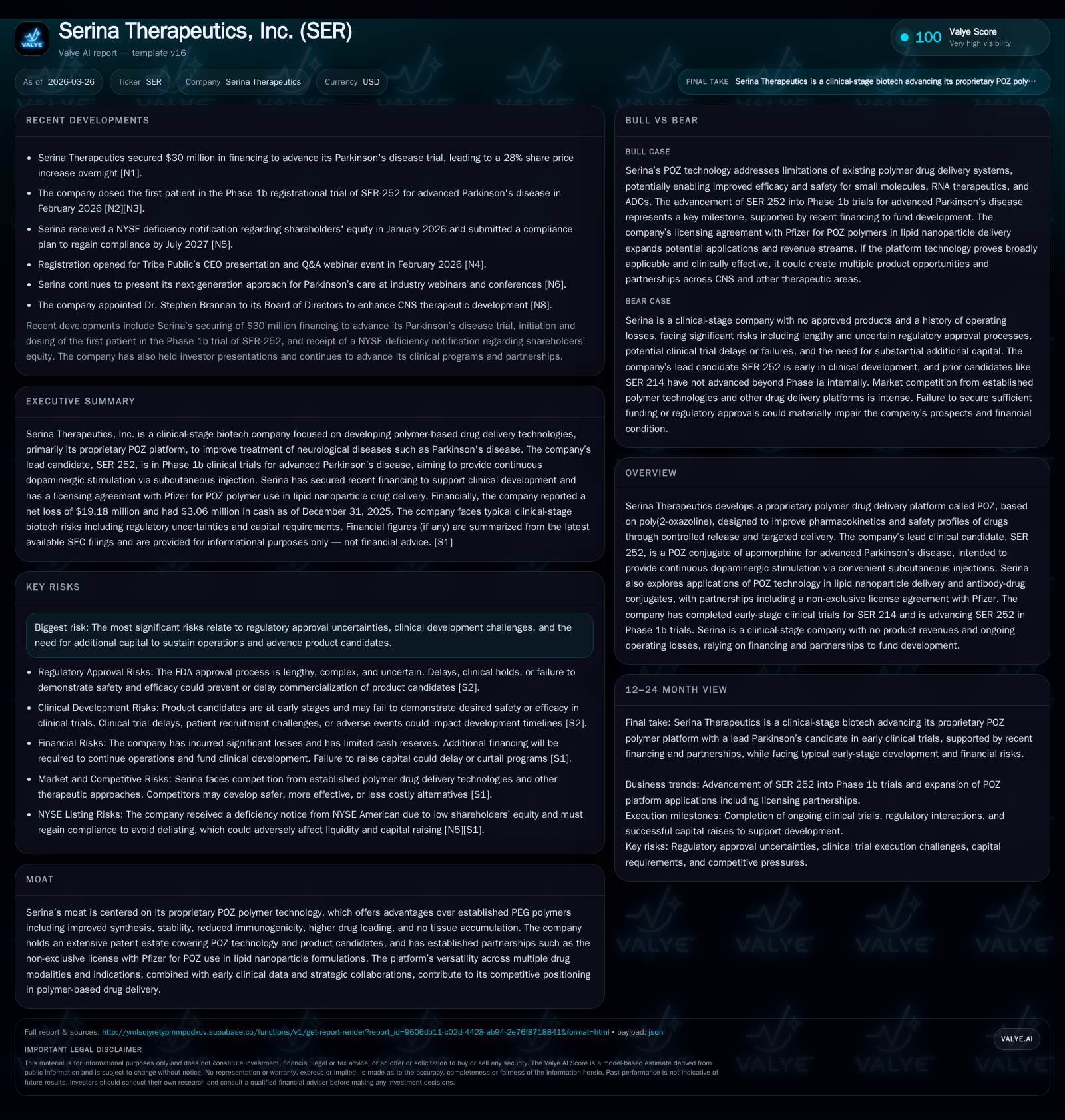
Serina Therapeutics, a clinical-stage biotech specializing in polymer drug delivery via its proprietary POZ platform, continues progressing its lead candidate SER-252 through Phase 1b trials targeting advanced Parkinson’s disease. Despite promising technology advantages over PEG polymers and strategic collaborations including a Pfizer license, the company reported widening operating losses in 2025 and limited cash reserves, reflecting ongoing investment in R&D without revenue generation. Key near-term catalysts include clinical readouts for SER-252 and potential deal developments, while substantial regulatory, financial, and developmental risks persist along the path to commercialization.
Company Overview
Serina Therapeutics operates as a clinical-stage biotechnology company pioneering advancements in drug delivery through its proprietary polymer platform known as POZ, based on poly(2-oxazoline) polymers. Utilizing synthetic water-soluble polymers engineered to optimize pharmacokinetics and safety profiles, the company focuses mainly on neurological diseases with an emphasis on repurposing existing drugs whose efficacy is often hampered by suboptimal pharmacokinetics such as short half-life or toxicity limitations [S1].
The POZ technology distinguishes itself from established polyethylene glycol (PEG) conjugation methods by offering improved synthesis safety—leveraging stable monomeric intermediates rather than flammable ethylene oxide—and enhanced storage stability without air oxidation concerns. Further advantages include reduced immunogenicity observed in preclinical models and higher drug loading capabilities enabling more precise controlled release profiles [S1].
Serina’s lead clinical candidate, SER-252, exemplifies this innovation: it is a POZ conjugate of apomorphine aimed at providing continuous dopaminergic stimulation through convenient subcutaneous injections for patients with advanced Parkinson's disease [S1]. This approach targets overcoming the limitations of current therapies that suffer from fluctuating plasma levels leading to motor complications.
Historical Financial Performance
Serina’s financial trajectory reflects its early-stage development profile with no product revenues but steadily increasing investment in R&D and clinical activities. Operating losses have expanded significantly over the past four fiscal years, illustrating intensifying expenditures associated with clinical program advancement:
Historical performance (annual)
| FY | Net ($mm) | CFO ($mm) | OpInc ($mm) | Net YoY |
|---|---|---|---|---|
| 2025 | -19 | -18 | -24 | -72.2% |
| 2024 | -11 | -17 | -17 | +24.7% |
| 2023 | -15 | -8 | -10 | -41.5% |
| 2022 | -10 | -6 | -7 |
Source: SEC companyfacts cache [F1].
Capital returns and efficiency (annual)
| FY | ROE% |
|---|---|
| 2025 | 51843.2 |
| 2024 | -1738.1 |
| 2023 | -270.7 |
| 2022 | 60.8 |
Source: SEC companyfacts cache [F1].
Notes: Operating income (OpInc), net income (NetInc), operating cash flow (CFO), capital expenditures (Capex), and shareholders' equity shown for years ended December 31; amounts are USD [F1].
The company’s net losses deepened markedly from $11.1 million in FY2024 to $19.2 million in FY2025 (~72% increase year-over-year). Operating cash outflows remained strong and relatively stable between FY2024 and FY2025 near $18 million annually. Equity swung from a positive $641k at the end of FY2024 into slightly negative territory at year-end FY2025 suggesting increased liabilities or accumulated deficits [F1].
This trend reflects intensifying clinical trial costs as Serina progresses its pipeline especially SER-252 studies. Despite modest capital expenditures primarily related to corporate facilities or equipment ($59k in FY2025), research and development expenses dominate cash burn.
Growth Drivers and Value Proposition
The central growth thesis rests on leverage of the POZ technology which could redefine polymer-based drug delivery by overcoming long-recognized limitations with PEG conjugates such as immunogenicity risks (e.g., anti-PEG antibodies) and constrained manufacturing safety logistics [S1]. The broad adaptability of the POZ platform encompassing small molecules like apomorphine (SER-252), RNA modalities via lipid nanoparticle delivery platforms under license collaborations (e.g., Pfizer), and antibody-drug conjugates presents multi-modality expansion avenues.
SER-252's Phase 1b registrational trial initiation earlier in Q1 2026 marked a material developmental milestone aiming at patients with advanced Parkinson's disease who have high unmet medical needs due to fluctuating therapeutic effects using existing dopaminergic medications [N2][N3]. Its design incorporates continuous release profiles intended to reduce motor fluctuations—a known limitation of current apomorphine formulations.
Besides direct development programs (including SER-214 completed early-stage trials), Serina has bolstered its moat through intellectual property protections covering core POZ chemistry processes plus formulations built on multiple patent families globally [S1]. Notably the non-exclusive license arrangement with Pfizer dated prior to these events affirms external validation of the platform's viability beyond small molecule indications [S1].
Progress and Upcoming Milestones
The most immediate catalyst centers on SER-252 Phase 1b study enrollment progression plus interim or final data readouts expected through late 2026/early 2027 that could support eventual NDA filings pending regulatory feedback [N2][N3]. While timelines for NDA submissions remain undisclosed explicitly by Serina to date [S1], successful registrational data would set the foundation for future commercialization discussions.
Further medium-term milestones include applying POZ technology across lipid nanoparticles for RNA therapies leveraging the Pfizer collaboration that could represent an additional value pillar if successful. Early-stage exploratory antibody-drug conjugates employing POZ polymer conjugates may offer broader portfolio diversity but remain speculative given their nascent status [S1].
Risks and Operational Challenges
Serina faces quintessential high risk factors characteristic of early-stage biotech developers:
- Regulatory uncertainty due to absence of prior NDA submissions; reliance on complex approvals both U.S. FDA and international agencies where reimbursability may constrain uptake [S4–S8].
- Heavy capital intensity requiring consistent funding inflows; limited cash reserves ($3.06 million at end-FY25) mandated recent $30 million capital raise completed March 2026 aimed at funding SER-252 progress [N1][F1].
- Intellectual property litigation exposure common within polymer tech sectors given overlapping patents held by competitors or third parties [S9–S12].
- Clinical development risks inherent with innovator medicine trials including patient enrollment hurdles or adverse safety signals which could delay or derail approvals [S25].
- Evolving healthcare pricing reforms under U.S. federal laws plus international cost containment pressures potentially restricting future pricing/reimbursement levels for pioneering therapies [S19][S24].
Capital Allocation and Returns Context
Operating losses continue unabated reflecting R&D spend focused strategy without commercial revenues. Serina generated operating income losses widening annually from -$7 million in FY22 up to nearly -$24 million by FY25 with corresponding net losses reaching nearly $19 million last fiscal year [F1]. The company does not pay dividends nor has reported share repurchases suitable for a firm at this stage.
Free cash flow remains negative given large operating outflows far exceeding minimal CapEx incurred. The balance sheet shows very limited liquidity ($3.06 million cash & equivalents at FY25-end) alongside liabilities exceeding available assets leading to slightly negative equity position (-$37k) further highlighting reliance on external financing cycles for continuity [F1].
Current ratio approximates a reasonable short-term liquidity cushion (~1.7x) owing mainly to conservative management of current liabilities relative to cash plus other current assets which totaled $6.08 million against liabilities of $3.56 million [F1]. Nonetheless ongoing capital needs necessitated successful recent equity raise announced March 19th 2026 totaling $30 million earmarked specifically for SER-252 trial continuation [N1], evidencing clear dependency.
Return metrics such as ROE are distorted due to large net losses against minimal or negative shareholder equity typical for early clinical biopharma ventures [F1].
Industry Context Analysis
Within the specialty polymer-excipient drug delivery domain where PEG conjugation has traditionally dominated clinical usage since the late ’90s due to FDA approvals across many biologic drugs — challenges such as anti-PEG antibodies increasingly limit long-term efficacy for chronically dosed therapeutics. Innovations like POZ polymers offer promise if they can demonstrate safety benefits coupled with manufacturability improvements lowering costs and complexity — all critical factors shaping downstream adoption among pharmaceutical innovators seeking next-generation formulation platforms.
Moreover, CNS disorders including Parkinson’s disease remain one of the largest neurodegenerative markets globally where therapeutic options require continual innovation addressing unmet patient quality-of-life gaps created by oscillating symptom control from oral/transdermal formulations.
Successful implementation of extended-release continuous dopaminergic agents administered via subcutaneous injection would represent meaningful differentiation if phase trials confirm pharmacodynamic stability alongside favorable safety/tolerability profiles.
However commercialization pathways depend heavily on regulatory endorsement compounded by acceptance within managed care schemes increasingly scrutinizing novel treatment cost-effectiveness against standard therapy baselines.
What To Watch Going Forward (Analysis)
Key items warranting attention include:
- SER-252 Phase 1b trial enrollment milestones followed by data disclosures potentially influencing timelines toward pivotal registration trials.
- Updates regarding ongoing partnership extensions or licensing deals expanding breadth/applications of POZ beyond internal pipelines.
- Funding rounds announcements given modest cash runway that impacts operational continuity.
- Regulatory feedback on initial submissions or discussions shaping NDA strategy adaptations.
- Developments pertaining to patent landscape challenges reflective of biotech industry legal risk exposure.
Management commentary during upcoming quarterly earnings releases or investor presentations will also provide insights into strategic priorities balancing clinical progression vs capital optimization efforts.
Summary
Serina Therapeutics embodies a classic clinical-stage biotech profile anchored on proprietary polymer chemistry aimed at transforming drug delivery paradigms particularly within challenging neurological indications such as advanced Parkinson’s disease. Its POZ platform unveils promising attributes vis-à-vis legacy PEG systems offering scalable industrial synthesis advantages alongside improved pharmacological attributes.
Nonetheless substantial hurdles remain including heavy pre-commercial losses escalating over recent years combining clinical risk uncertainties plus acute dependence on capital raises validated partially by recent successful financings dedicated to advancing lead candidate SER-252’s critical Phase 1b studies.
The firm's ability to ultimately convert innovative chemistry advantages into marketable therapies hinges on demonstrating clear clinical benefits alongside gaining regulatory approvals amid an environment increasingly sensitive to pricing pressures worldwide.
Investors should monitor upcoming trial results carefully along with liquidity management strategies while remaining cognizant of the layered challenges intrinsic to novel polymer-based therapeutics development across CNS indications.
Disclaimer: This report presents factual company analysis without investment advice or recommendations. It synthesizes publicly available SEC filings and news sources without extrapolations beyond cited data points.
Disclaimer: This is research-only, informational analysis and not investment advice. It may include AI-generated interpretation and general industry context. Always verify important details using primary sources.

Comments