
Brookfield Wealth Solutions Faces Growth Deceleration and Competitive Pressures After AEL Acquisition
BNT’s rapid top-line expansion slows in 2025 with strategic balance sheet management amid evolving insurance market dynamics.
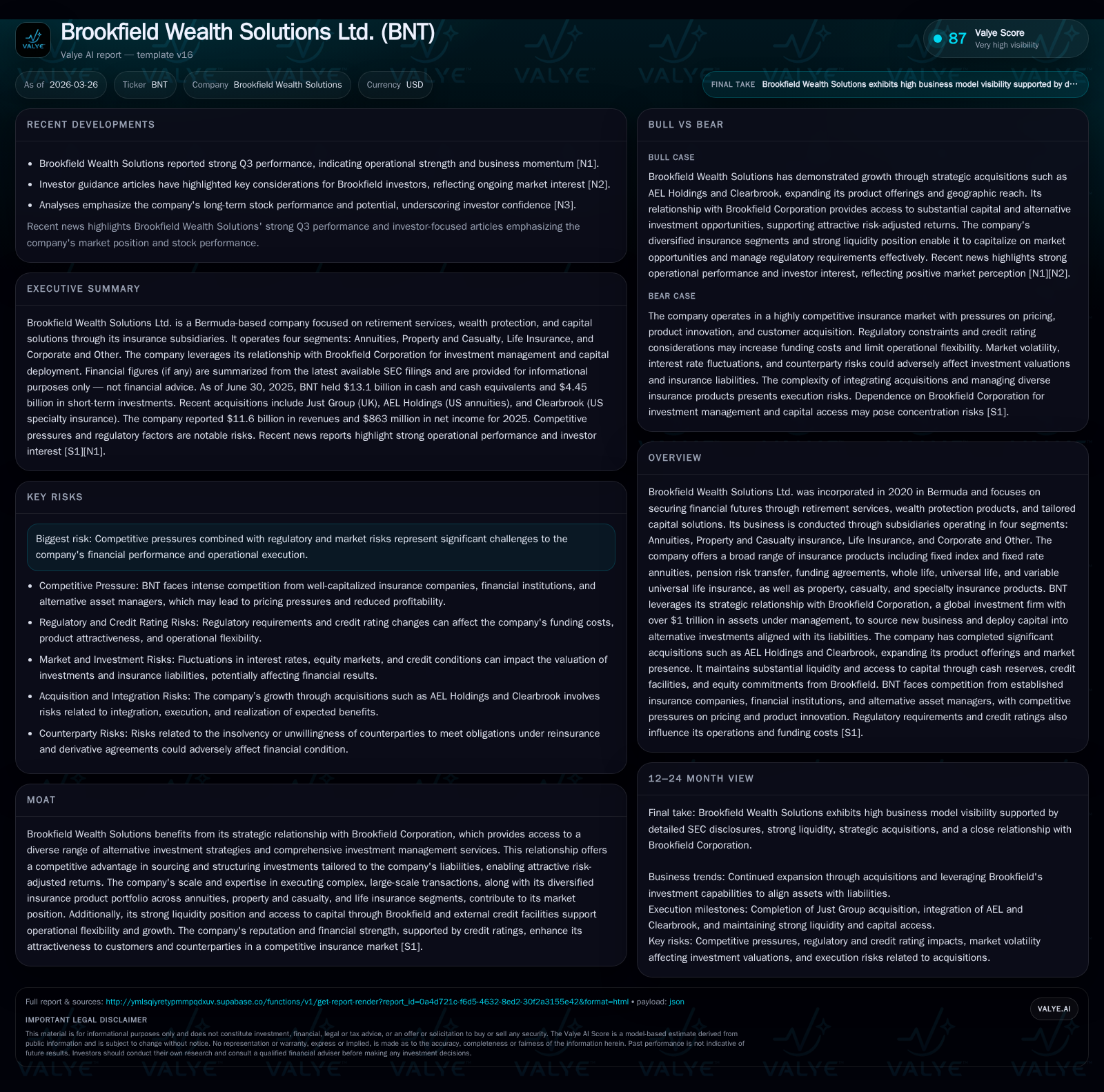
Brookfield Wealth Solutions Ltd. (BNT), since its 2020 inception, leveraged acquisitions and its relationship with Brookfield Corporation to accelerate growth. Revenue surged from $4.3 billion in 2022 to $14.1 billion in 2024, driven largely by the acquisition of American Equity Investment Life Holding Company (AEL) and expansion across annuities, property and casualty, and life insurance segments. However, in 2025, revenue fell 17.5% year-over-year to $11.6 billion while operating cash flow declined 42.8%, signaling margin and integration pressures amid a competitive and highly regulated environment. BNT maintains significant liquidity supported by Brookfield’s capital commitments but faces risks from regulatory constraints, market competition, and execution complexities for future acquisitions.
Historical Growth Trajectory
Since incorporation in Bermuda in late 2020, Brookfield Wealth Solutions Ltd. has rapidly expanded through a combination of strategic acquisitions and organic growth across its four core segments: Annuities, Property & Casualty insurance (P&C), Life Insurance, and Corporate Services.[S1] The pivotal acquisition of American Equity Investment Life Holding Company (AEL) in May 2024 significantly bolstered BNT's footprint within the U.S., resulting in near doubling of net premiums from approximately $4.1 billion in 2023 to over $8.2 billion in 2024.[S1]
This accelerated scale is mirrored at the consolidated level where total revenue escalated from roughly $4.3 billion in FY2022 to $7.0 billion in FY2023 and then skyrocketed to over $14 billion in FY2024 per company filings.[F1] The combination of annuity product offerings—particularly fixed index annuities—and increased presence in pension risk transfer (PRT) underpin this expansion.[S1] Table below summarizes key financial metrics from FY22 to FY25:
Historical performance (annual)
| FY | Rev ($bn) | CFO ($bn) | Capex ($mm) | Rev YoY |
|---|---|---|---|---|
| 2025 | 11.6 | 2.6 | 69 | -17.5% |
| 2024 | 14.1 | 4.6 | 40 | +100.9% |
| 2023 | 7.0 | 1.5 | 135 | +62.9% |
| 2022 | 4.3 | 0.6 |
Source: SEC companyfacts cache [F1].
Capital returns and efficiency (annual)
| FY | FCF ($bn) |
|---|---|
| 2025 | 2.5 |
| 2024 | 4.5 |
| 2023 | 1.4 |
| 2022 |
Source: SEC companyfacts cache [F1].
[F1] Note: Operating cash flow refers to net cash from operations before capex.
Financial Performance Insights
Despite the aggressive growth in early years, BNT's revenue contracted by approximately one-sixth between FY24 and FY25,[F1] indicating emerging headwinds such as pricing pressures and possible integration-related volume normalization after the AEL acquisition.[S1][N1]
Net income attributable to shareholders similarly softened, reflecting operational efficiencies under strain amidst volatile investment income markets.[S1] The effective tax rate shifted significantly with a normalized charge consistent with global multi-jurisdictional operations spanning Bermuda, U.S., Canada, and the UK.[S7]
Operating cash flow dropped sharply by over forty percent even as capital expenditures rose modestly, highlighting margin compression likely linked to claims experience increases and reinvestment into technology or business development.[F1]
Return on equity remains subdued at approximately two percent given the enlarged capital base post-acquisition.[F1] BNT’s sizeable equity injection facilitated by Brookfield’s $2 billion undrawn equity commitment provides room for deploying future growth investments but will require operational scaling for better returns.[S5]
Capital Structure and Liquidity
The company maintains a diversified liability mix with total corporate borrowings around $628 million complemented by almost $4.9 billion non-recourse borrowings that mature staggered over the next five years,[S4] furnishing financial flexibility amid an asset-intensive insurance business.
Corporate liquidity sits comfortably at above $1 billion with an additional $62 billion held within insurance portfolios,[S5] reflecting prudent asset-liability management practices essential for underwriting longevity risk exposures inherent in annuities.
Brookfield’s support through revolving credit lines totaling nearly $400 million plus external bilateral credit facilities further mitigates refinancing risk.[S5]
Future Growth Prospects
Management has explicitly pointed to pension risk transfer arrangements as a core driver for future growth,[S1] leveraging their strong balance sheet to structure large-scale liability reinsurance transactions attractive to institutions seeking longevity risk mitigation.
Geographic diversification efforts are evidenced by their inaugural Japanese reinsurance agreement completed via subsidiary American National Insurance Company in September 2025,[S1] tapping into the growing Asian insurance markets.
Brookfield’s unique access to alternative investments caters for better liability matching improving risk-adjusted returns; however, this niche also exposes them to non-traditional asset volatility requiring sophisticated portfolio oversight.[S11]
Potential acquisition opportunities remain part of BNT’s strategy but carry integration risks alongside regulatory hurdles that could delay deal closures or dilute near-term earnings.[S6][S19]
Regulatory Environment & Risks
Operating predominantly across Bermuda, U.S., Canada, Japan, and the UK subjects BNT to multifaceted regulatory regimes covering solvency capital requirements such as NAIC RBC ratios for U.S subsidiaries,[S10] Bermuda Monetary Authority enhanced capital requirements,[S10] as well as Ontario’s Life Insurance Capital Adequacy Test (LICAT).[S10]
Rate regulation challenges particularly impact P&C lines where rate increases are subject to state commissioner approvals potentially limiting profitability ramp-ups.[S17][S18]
Compliance demand extends into consumer protection regulations including SEC Regulation Best Interest impacting variable annuity sales,[S15] alongside GDPR-like data privacy laws affecting customer data handling across jurisdictions.
The company acknowledges operational risks from potential fraud or systemic failures requiring robust internal controls augmented by frequent regulator audits.[S14]
Increased scrutiny on climate-related disclosures further adds complexity given investors’ growing expectations on environmental reporting embedded within insurance portfolios considering long-term liabilities exposed to climate risk trends.[S8]
Competition Dynamics & Differentiation
Brookfield faces an intensely competitive landscape characterized by scale economies favoring large incumbent insurers with national reputations supported by broad distribution networks.[S23]
New digital entrants leveraging online platforms shorten product life cycles necessitating ongoing innovation especially within annuity products where traditional fixed rate offerings face substitution pressures.[S23]
Their strategic alliance with Brookfield Corporation provides exclusive access to alternative asset strategies not broadly available to competitors aiding differentiated liability-asset matching capability — a key moat factor.[valye_report_excerpt.moat]
However, competition also extends into inorganic pathways where both financial institutions and asset managers vie aggressively for insurer partnerships or platform acquisitions forcing BNT into complex negotiations with potential price premiums diminishing margins.[S23]
Returns & Capital Allocation Strategy
Given limited direct data on dividends or share repurchase activity,[F1][S1], BNT currently appears focused on reinvesting free cash flow—which stood at approximately $2.55 billion in FY25 after capex—towards growth initiatives including acquisitions and expanding reinsurance arrangements.
The equity commitment provided by Brookfield ensures access to patient capital which should reduce pressure on near-term external funding cost though leverage levels require monitoring given some maturity concentration beyond five years for non-recourse borrowings offering refinancing timing risks.[S4][S9]
ROE at circa two percent indicates room for improved capital efficiency preferably via margin enhancement or accelerating profitable premium growth rather than simple balance sheet expansion alone.[F1]
What To Watch Going Forward (Analysis)
- Progress on closing additional pension risk transfer deals critical for sustained premium inflows.
- Integration effectiveness post-AEL acquisition impacting expense ratios and net income stability.
- Regulatory developments especially around suitability rules governing annuity sales potentially influencing product design.
- Evolution of alternative investment returns against liabilities amid shifting macroeconomic conditions including interest rates.
- Competitive response particularly digital innovations affecting price elasticity across core product segments.
- Liquidity profile changes relative to debt maturities and any draws on credit facilities indicating operational strain.
- Potential new market entries such as Asia complementing Japan foothold viability.
This report synthesizes publicly available SEC filings (20-F), recent Nasdaq news articles (N1), press releases within Form 6-K filings ([S2],[S3]), along with Valye News’ financial metrics aggregation [F1]. It aims only to present analysis without recommendation or forecasting beyond public disclosures.
Disclaimer: This is research-only, informational analysis and not investment advice. It may include AI-generated interpretation and general industry context. Always verify important details using primary sources.

Comments