
Quantum Biopharma Pursues MS Therapeutics Amid Clinical and Capital Hurdles
Quantum Biopharma balances the progression of its patented MS drug candidate with capital raises, cryptocurrency volatility, and litigation risks shaping near-term operations.
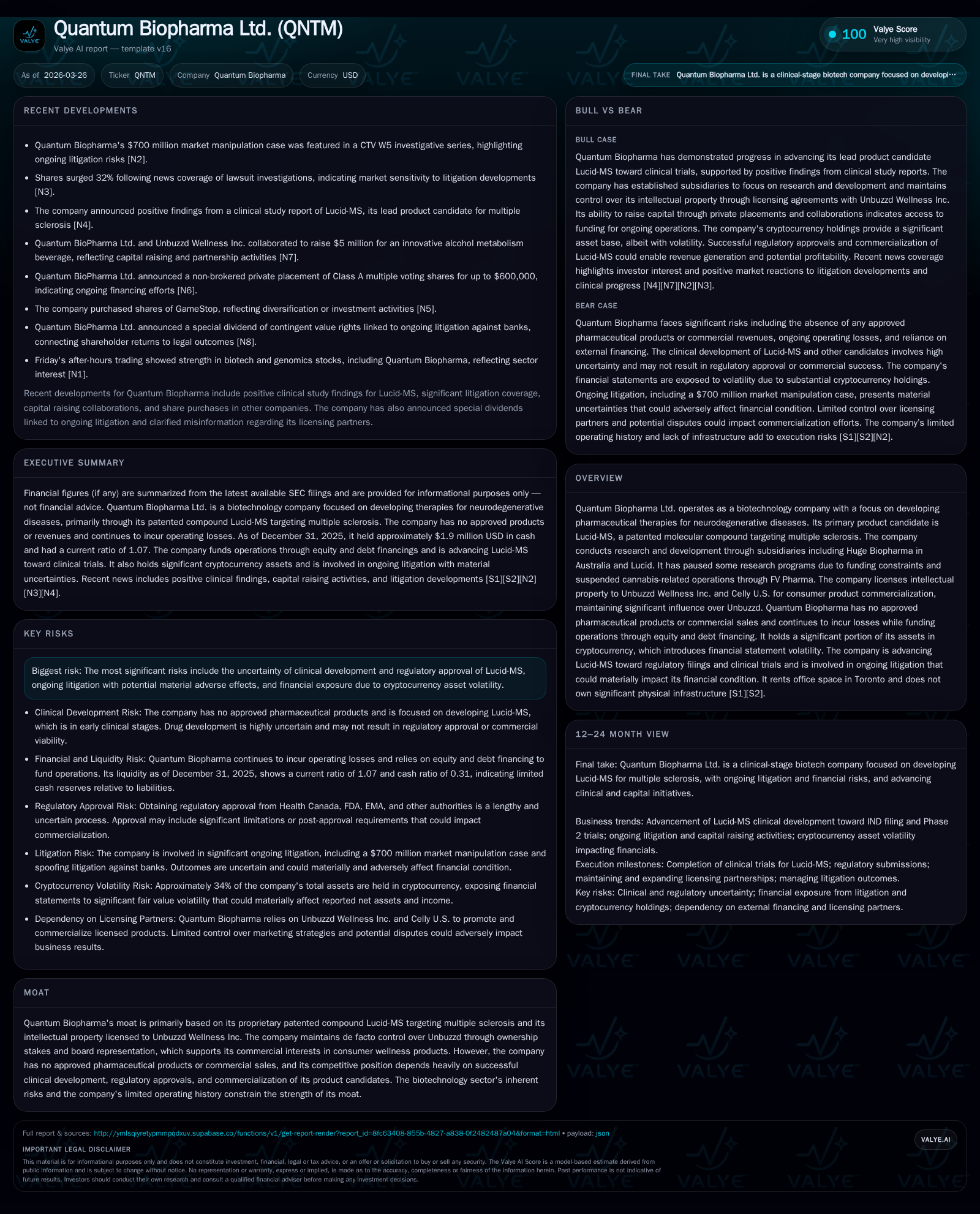
Quantum Biopharma Ltd. remains an early-stage biotech focused on developing Lucid-MS for multiple sclerosis, with clinical advancement plans underway but no approved products or commercial revenues. The company’s financials reveal substantial losses amid funding through convertible debentures, loans, and equity offerings; its balance sheet is uniquely exposed to cryptocurrency asset volatility comprising about a third of total assets. Litigation involving market manipulation and banking disputes adds to operational uncertainties. Future growth hinges on progressing IND filings and phase 2 trials while maintaining liquidity through continuous financing, particularly as some research programs have been paused due to funding constraints.
Financial History: Loss Trends and Equity Evolution
Quantum Biopharma's financial trajectory reflects a clinical-stage biotech entity under development pressures. The company recorded net losses narrowing from approximately -$35.3 million in FY2021 to -$23.6 million in FY2022—a notable improvement of about 33% year-over-year per latest filings [F1]. Despite this reduction in losses, the return on equity remains deeply negative at approximately -462%, underscoring ongoing operating deficits driven by significant R&D investments without product revenues.
Equity has declined significantly from over $30.5 million in FY2022 to around $5.1 million at FY2025-end [F1], reflecting accumulated deficits alongside capital raising activities including convertible debentures issuance totaling about $3.2 million and other debt and equity financings noted in annual disclosures [S1]. The current ratio stands near parity at approximately 1.07, indicating a delicate liquidity position given liabilities balanced against current assets that include liquid cryptocurrency holdings.
Operating cash flow shows sustained cash burn approximating $8.2 million for fiscal year ending December 31, 2025. This was financed primarily through convertible notes ($3.2M), loans ($1.5M), sale of finance receivables ($1.8M), and proceeds from ATM offerings ($0.3M) [S1][S8], confirming reliance on continuous funding during no commercial revenues.
Historical performance (annual)
| FY |
|---|
| 2025 |
| 2024 |
| 2023 |
| 2022 |
Source: SEC companyfacts cache [F1].
Note: Operating cash flow is approximate based on management discussion; cryptocurrency asset percentage derived from total assets data.
Lucid-MS Development Progress and Clinical Pipeline Status
Quantum’s primary focus is Lucid-MS—a patented molecular compound targeting Multiple Sclerosis (MS). Key research activities are conducted through subsidiaries Huge Biopharma (Australia) and Lucid, supporting preclinical studies and clinical development preparations respectively [S1][S12]. Huge Biopharma was established in early 2024 specifically to advance these efforts.
The company plans to advance Lucid-MS toward an Investigational New Drug (IND) application filing followed by initiating Phase 2 clinical trials in MS patients as immediate milestones [S1][S4]. These stages will increase research expenses as regulatory oversight intensifies.
Other pipeline projects such as Lucid-PSYCH for major depressive disorders remain paused due to funding prioritization toward Lucid-MS [S12]. Additionally, after terminating FSD-PEA development in 2023 initially, Quantum resumed related research via its Australian subsidiary FSD Australia in Q3 2024 signaling phased re-engagement with selective non-core programs [S5].
Cryptocurrency Holdings: Asset Volatility and Accounting Considerations
A distinctive element of Quantum’s financial profile is its large cryptocurrency holdings representing about one-third of total assets at FY-end 2025 [S1]. These digital assets are accounted for at fair value through profit or loss under IAS2 and IFRS13 standards using prices from BitGo—its primary custodian—which requires significant management judgment regarding valuation reliability.
This exposure causes pronounced volatility in net assets as gains or losses fluctuate with crypto market movements impacting comprehensive income statements [S4]. Auditors or regulators could require restatements if valuation methods are challenged.
Such an asset mix differs from typical biotech companies that usually emphasize patents or cash equivalents; investor sensitivity to valuation swings necessitates close scrutiny.
Capital Structure and Funding Mechanisms in a Pre-Revenue Phase
Quantum operates without any revenue from pharmaceutical sales due to its early-stage status with no regulatory approvals yet secured [F1][S9]. To fund operations—including costly R&D—it relies extensively on external financing:
- Convertible debentures issuance amounting to several million dollars provides key debt financing but entails future dilution risk [S1][S15].
- Loan proceeds around $1.5 million complement liquidity alongside monetization of finance receivables generating about $1.8 million during FY2025 [S1][S8].
- Equity issuances via At-The-Market (ATM) offerings have raised limited proceeds (~$0.3 million), with the ATM agreement terminated late in 2025 indicating shifts in capital strategy [S14][S15][S24].
Management assesses working capital as sufficient for planned operations over the next twelve months; however continuous access to new funding remains critical given zero product revenue and rising R&D costs approaching mid-stage trials [S1][S8]. Market conditions thus pose material uncertainty around future fundraising terms.
Intellectual Property Licensing and Subsidiary Roles in Commercial Strategy
Beyond direct drug development, Quantum licenses proprietary IP related mainly to the wellness brand unbuzzd™ exclusively to Unbuzzd Wellness Inc. and Celly U.S., aiming for consumer health market penetration beyond prescription medicines [S4][S10].
Quantum holds approximately a 20% equity stake in Unbuzzd but exercises de facto control through affiliated parties owning over half the shares plus board representation including shared CFO roles between both companies evidencing governance influence [S10]. This arrangement diversifies business opportunities beyond pharmaceutical risks.
However reliance on licensees’ operational performance carries uncertainties since Quantum retains limited marketing control while contractual obligations could lead to disputes affecting royalty streams or brand value [S6].
Litigation Risks Affecting Financial Stability
Material legal challenges add uncertainty:
- GBB Market Manipulation litigation alleges securities misconduct potentially impacting asset valuations or causing contingent liabilities [S4][S7].
- Banking spoofing claims involving major banks such as CIBC/RBC further complicate risk profiles with outcomes that could affect financial condition materially [S4][S9].
These litigations are highlighted as significant risk factors that could individually or collectively adversely affect operations or capital adequacy typical of clinical-stage biotechs but elevated here by unique litigated exposures [S7][S9].
Key Upcoming Milestones and Investor Considerations
Investors should focus on:
- IND application filing dates marking regulatory progression critical for subsequent clinical phases though exact timing remains undisclosed publicly [S1][S3].
- Initiation of Phase 2 trials representing substantive scientific validation steps affecting safety/efficacy outlooks.
- Updates on ongoing litigation outcomes including court rulings or settlements that may alter risk profiles.
- Success securing additional financing amidst market conditions shaping operational sustainability.
Given lack of explicit corporate guidance on revenue inflections or approval timelines, updates on these fronts will be pivotal for assessing company prospects.
Sustainability of Operations: Cash Flows, ROE, Capital Allocation Insights
Quantum’s deeply negative return on equity (-462%) reflects intense reinvestment focused solely on pre-commercial R&D absorbing capital without offsetting sales inflows so far [F1]. No dividends or share repurchase programs exist consistent with preserving liquidity for drug development amid uncertain profitability timelines [F1][S14][S18].
Operational costs appear controlled; e.g., head office rental costs approximate C$72k annually indicative of a lean footprint aligned with outsourcing research rather than fixed assets accumulation [S5].
Cash flows confirm steady burn financed through diverse capital sources requiring ongoing investor receptivity given absence of internal cash generation capacity presently.
Conclusion / Disclaimer
Quantum Biopharma Ltd.’s profile typifies an early-stage biotech investing heavily upfront into drug development while managing clinical uncertainties compounded by unusual financial exposures such as cryptocurrency holdings alongside legal risks elevating overall enterprise risk. Stakeholders must closely monitor IND submissions, Phase 2 trial progressions alongside evolving litigation outcomes coupled with continued capital raises needed in a non-revenue environment. Future viability depends critically on navigating regulatory hurdles effectively while maintaining liquidity amidst volatile asset classes and shifting investor sentiment. This report synthesizes publicly available SEC filings without providing investment advice.
Disclaimer: This is research-only, informational analysis and not investment advice. It may include AI-generated interpretation and general industry context. Always verify important details using primary sources.

Comments