
How Central Bancompany Balances Regulatory Challenges with Technology and Growth
Central Bancompany leverages robust capital management and AI-driven technology upgrades to drive growth while navigating regulatory and market pressures.
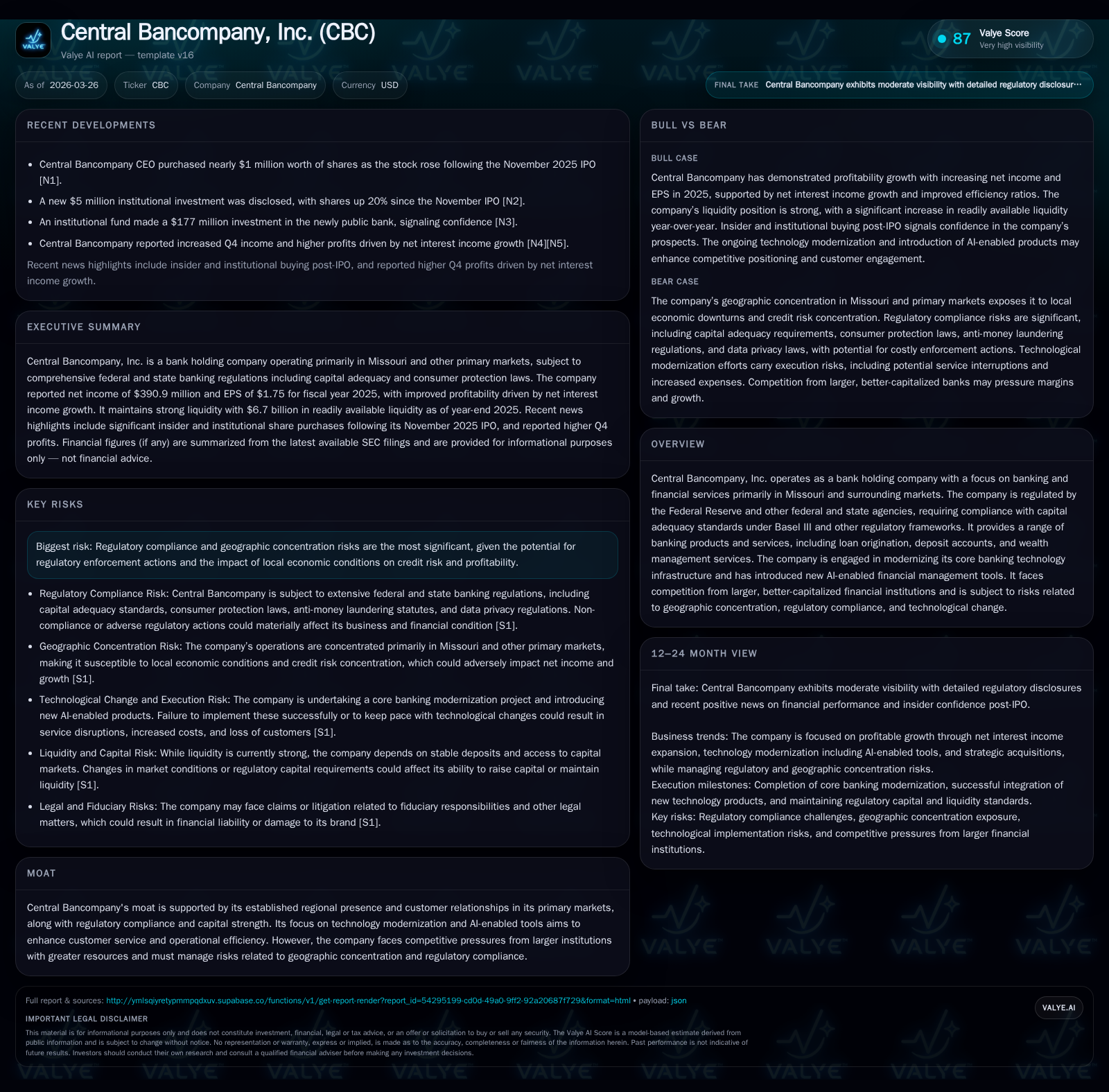
Central Bancompany, Inc. maintains a solid financial foundation supported by a disciplined credit loss environment and strong capital ratios that exceed Basel III standards. Its regional market concentration in Missouri is both a moat and a challenge in facing competition from larger players. The company advances its competitive position through strategic modernization of core banking infrastructure, notably adopting AI-enabled financial tools, enhancing client engagement and operational efficiency. Shareholder returns are managed cautiously given regulatory constraints, with dividends and targeted buybacks aligned with capital flexibility. Insider buying post-IPO signals confidence, while future growth hinges on successful technology deployment balanced against capital adequacy and deposit stability amid interest rate volatility.
Track Record of Growth: Historical Performance and Credit Trends
Central Bancompany demonstrated consistent financial performance in fiscal year 2025 highlighted by net income of approximately $390.9 million and an estimated return on equity (ROE) of 10.3%, establishing a credible base for sustainable profitability [F1]. Asset quality metrics reveal ongoing improvement; net charge-offs declined to $14.1 million in 2025 from $15.2 million the prior year—a decrease of 7.5%. This trend aligns with a modest reduction in allowance for credit losses from about $154 million to $150 million (a -3.1% change), driven by prudent risk assessment frameworks that blend historic loan loss experience with macroeconomic insights such as GDP growth forecasts and unemployment rates [S1]. The allowance methodology accounts for portfolio composition shifts via peer data adjustments, critical when internal historical rates are less reflective of current conditions.
CBC's loan portfolio remains diversified primarily across commercial real estate (inclusive of construction, development), residential loans, consumer credit products, all evaluated both collectively and individually for impairment where warranted—reflecting sound credit risk discipline [S1]. Such diligence contributes to the stable credit profile evident in declining net charge-offs.
Historical performance (annual)
| FY |
|---|
| 2025 |
Source: SEC companyfacts cache [F1].
Table reflects central profit drivers alongside key credit loss metrics and liquidity position ([F1],[S1],[S4]).
Capital Strength and Risk Management Amid Regulatory Demands
CBC exemplifies robust capital stewardship compliant with Basel III mandates fully effective since January 2019, maintaining substantial buffers well above regulatory thresholds. As of December 31, 2025, the Company’s total risk-based capital ratio was approximately 29.29%, exceeding the minimum required threshold of 8%, along with CET1 and Tier 1 ratios comfortably surpassing their respective minima (4.5% CET1; 6% Tier 1) [S14]. This cushion supports operational resilience against unexpected losses or economic shocks.
Liquidity management is equally prioritized; readily available liquidity surged over one-third (+35.3%) year-over-year to $6.7 billion—propelled by an +86% increase in cash reserves at the Federal Reserve and improved secured borrowing capacity through FHLB advances and collateralized securities lending facilities [S4]. These enhancements reduce funding risks intrinsic to regional banks reliant on deposit bases.
The Asset/Liability Committee (ALCO) oversees liquidity risk via regular reporting against guidelines covering loan-to-deposit ratios—which decreased slightly to about 72%—and other metrics designed to preempt funding shortfalls or rapid deposit outflows [S4][S7].
Regulatory compliance extends beyond capital ratios: CBC acts as a "source of strength" for its subsidiary bank, requiring readiness for capital injections if subsidiary solvency weakens—a potentially costly obligation especially if external capital raising becomes necessary under stress scenarios [S1][S10]. This reality anchors CBC’s conservative stance on leverage, dividends, and share repurchases.
Geographic Concentration and Competitive Landscape Dynamics
CBC’s competitive advantage rests on its entrenched presence within Missouri-focused primary markets comprising roughly 87.8% of total loans [S5]. While this facilitates deep customer relationships fostering loyalty across commercial banking, retail deposits, trust, and wealth management services, it concentrates exposure to localized economic cycles including real estate sector volatility or regional employment trends.
The company operates amid an industry marked by consolidation; larger competitors benefit from scale enabling diversified offerings and technological investments less accessible to smaller regional players [S20]. CBC must innovate within resource constraints while managing pricing pressure on loans and deposits.
These dynamics underscore regulatory attention on credit concentration risks arising from geographic asset clustering vulnerable to cyclical downturns or sector-specific shocks such as commercial real estate stress prevalent in Midwestern economies [S20].
Technology Modernization as a Strategic Differentiator
In response to digital transformation imperatives, CBC is modernizing its core banking infrastructure emphasizing AI-enabled financial management tools designed to enhance client analytics capabilities and decision support functions. This initiative aims to improve customer retention while driving operational efficiencies that may positively impact cost-income ratios over time.
Integrating advanced technologies into legacy systems presents challenges due to compliance controls and data security requirements but offers incremental differentiation vis-à-vis peers slower to adopt digital solutions or tailor offerings for digitally fluent clients.
Innovation also aligns with industry trends emphasizing personalized customer experiences alongside backend automation such as AI-driven underwriting models or intelligent fraud detection frameworks critical for emerging regulatory compliance around cybersecurity and privacy laws [S11][S16].
Shareholder Returns: Dividends, Buybacks, and Capital Allocation
CBC pursues a measured approach toward shareholder returns balancing investor expectations against regulatory mandates tied to Basel III capital conservation buffers [S9]. Dividend policies remain stable yet conservative with distributions calibrated not to impair core capital; stock repurchases occur opportunistically within limits imposed by capital adequacy constraints ensuring excess capital is judiciously redeployed without jeopardizing regulatory standing [F1][S9].
Returns on equity near double digits (~10%) attest to respectable profitability framing this allocation philosophy as balancing reinvestment into technology upgrades/loan growth against rewarding shareholders.
Investor Sentiment Evidenced by Executive Insider Activity
Post-IPO insider transactions signal strong executive confidence: the CEO purchased nearly $1 million worth of shares shortly after market debut—a move aligning management interests closely with long-term shareholder value creation amidst market volatility [N1]. Additional disclosed purchases totaling around $5 million since the November IPO further reinforce optimism regarding the company’s growth trajectory among institutional insiders underpinning share price gains exceeding +20% during this period [N2]. Insider activity serves as a meaningful barometer distinguishing intrinsic corporate conviction from general market speculation.
Looking Ahead: Growth Opportunities and Balance Sheet Constraints
Future prospects hinge on successfully scaling AI-enabled service deployments while prudently managing regulatory capital demands that may constrain rapid balance sheet expansion given maintenance of comfortable CET1 buffers remains paramount [S14][N2]. Loan portfolio growth must consider geographic concentration limitations alongside potential rate environment headwinds affecting borrower repayment capacity particularly on adjustable-rate exposures.
Interest rate volatility presents notable risks: modeling indicates short-term repricing mismatches could compress net interest margins if liabilities reprice faster than assets—especially if depositors shift funds toward higher-yielding alternatives reducing reliance on historically stable low-cost deposits funding loan origination activity [S7]. Monitoring deposit flow stability alongside macroeconomic changes will be critical.
Key Metrics To Monitor Going Forward
Stakeholders should track quarterly developments in:
- Net interest margin reflecting yield curve shifts;
- Updates to allowance for credit losses incorporating macroeconomic outlooks;
- Loan portfolio growth rates across commercial real estate segments;
- Progress on AI tool integration impacting operational efficiency;
- Capital adequacy including CET1 levels relative to provisioning events;
- Insider transaction disclosures indicating shifts in management sentiment;
- Deposit mix changes signaling funding cost or balance stability trends.
These indicators combined with narrative guidance from leadership will provide directional clarity absent speculative forecasting.
This analysis is based exclusively on Central Bancompany's publicly filed disclosures as of March 2026 coupled with recent public market news without speculative projections or investment recommendations.
Disclaimer: This is research-only, informational analysis and not investment advice. It may include AI-generated interpretation and general industry context. Always verify important details using primary sources.

Comments