
QT Imaging’s Quest to Transform Breast Cancer Screening with Sound-Based 3D Technology
QT Imaging merges novel acoustic technology with AI-driven software, navigating financial, regulatory, and market hurdles in breast cancer diagnostics.
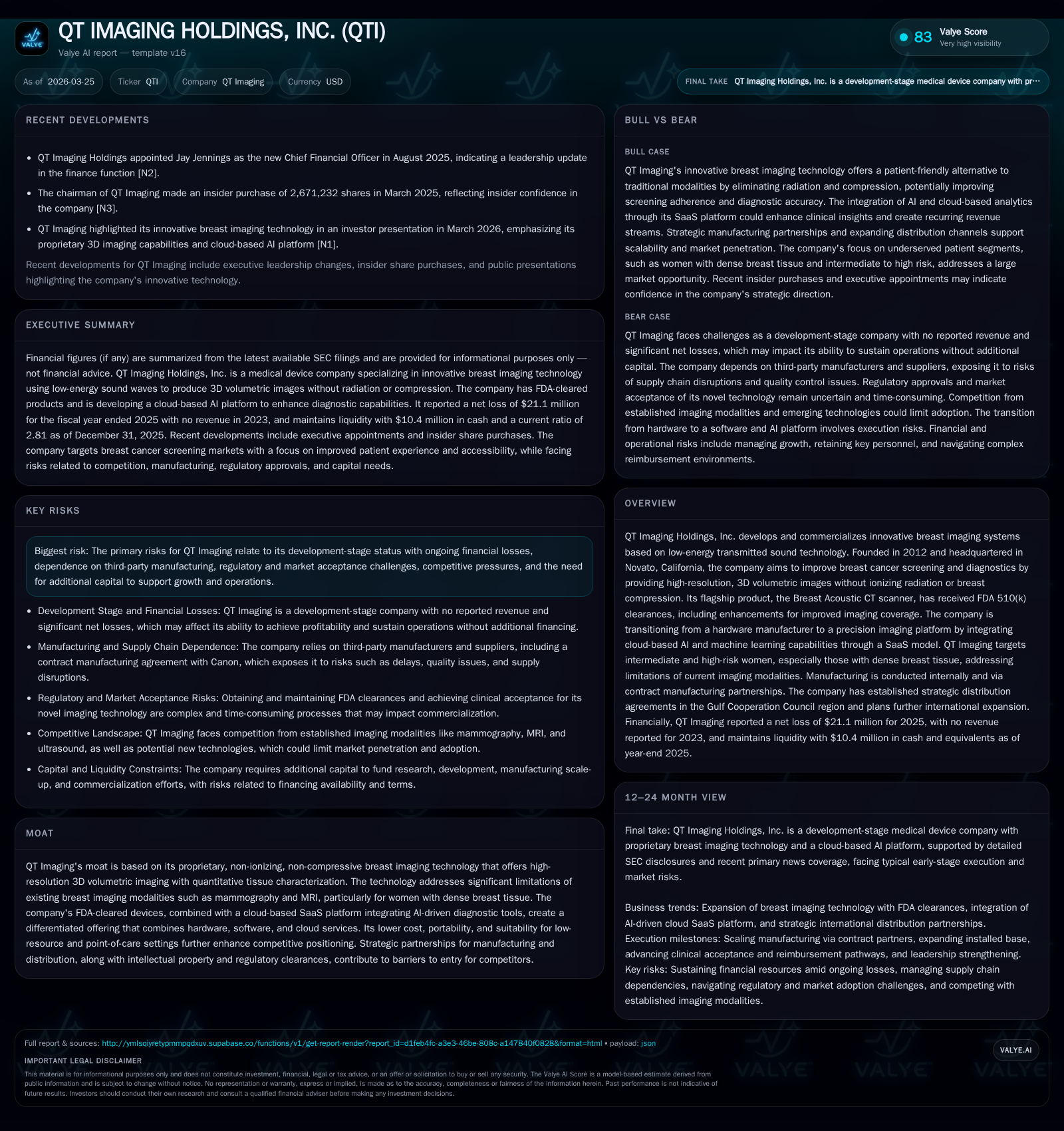
Founded in 2012, QT Imaging Holdings, Inc. has developed a proprietary low-energy transmitted sound technology that produces high-resolution, non-ionizing 3D breast images without compression. Despite significant technical innovation and FDA clearance for its Breast Acoustic CT scanner, the company remains in a development stage with no meaningful revenue and sizable operating losses narrowing only recently. QT Imaging is shifting towards a SaaS precision imaging platform integrating cloud-based AI to enhance diagnostic capabilities. However, it faces challenges in scaling manufacturing, securing regulatory approvals internationally, achieving market acceptance, and managing negative cash flows amid ongoing capital needs.
Innovating Breast Imaging: From Concept to Market
QT Imaging Holdings was founded in 2012 with a mission to improve breast cancer diagnostics through an innovative approach utilizing low-energy transmitted sound waves. Supported by approximately $18 million in NIH funding over time, QT Imaging developed a patented imaging platform based on ultra-low frequency sound transmission and reception combined with inverse scattering reconstruction algorithms. This permits detailed volumetric imaging of breast tissue without the ionizing radiation associated with X-ray mammography or the discomfort linked to breast compression.
The flagship product, the QT Breast Scanner (notably Model 2000A), captures high-resolution three-dimensional images allowing quantitative assessment of tissue properties such as fibroglandular volume. Unlike conventional mammography which heavily depends on operator experience and compressive imaging modalities, QT’s technology promises consistent output by leveraging physics-based inverse scattering and digital signal processing.
The device has achieved multiple FDA 510(k) clearances (K162372, K220933) for ultrasonic imaging reflecting reflection- and transmission-mode scan data [S1][S24], alongside a CE Mark enabling marketing within the European Union. These regulatory approvals mark critical milestones in transitioning from research prototype to clinically deployable system. However, the company remains cautious in framing the QT Breast Scanner as an adjunct rather than replacement to mammography due to ongoing validation efforts.
Targeting women with dense breast tissue — a group where mammography is less sensitive — QT Imaging’s solution aims to close diagnostic gaps especially for intermediate- and high-risk patients. Cloud connectivity forms another cornerstone of their vision: seamless software updates, AI-enabled image analysis, and collaborative platforms enhance interpretation accuracy while maintaining workflow efficiency [S25].
Historical Financial Performance: Operational Losses Amid Product Development
Operating at the forefront of medical device innovation entails significant upfront costs without immediate top-line generation—QT Imaging exemplifies this path. The company reported zero revenue through at least end-2023 according to SEC XBRL data [F1], underscoring its developmental stage nature.
Losses have persisted but show a trend toward narrowing operating deficits: from an operating loss of approximately $-12.2 million in FY2024 down to $-4.4 million in FY2025 — a year-over-year improvement near +63.6% [F1]. Meanwhile, net loss expanded sharply in absolute terms from $-8.98 million in FY2024 to $-21.1 million in FY2025 due primarily to increased R&D expenditures and possibly one-time items or expanded operational burn accompanying scaling efforts.
Cash flow from operations has remained negative throughout: roughly $-8.9 million outflow in FY2025, slightly better than $-10 million outflow in FY2024 [F1], indicating persistent cash burn albeit moderated somewhat by operational tightening. Capital expenditures remained modest ($124K in FY2025), highlighting heavy investment tilted toward R&D over fixed assets.
Liquidity ratios remain satisfactory as of December 31, 2025 — with $22.1 million current assets against $7.9 million current liabilities producing a current ratio around 2.81 — signaling reasonable short-term solvency positioning despite ongoing losses [F1]. No dividends or share buybacks have been declared given developmental cash flow profiles.
Historical performance (annual)
| FY | Net ($mm) | CFO ($mm) | OpInc ($mm) | Capex ($) | Net YoY |
|---|---|---|---|---|---|
| 2025 | -21 | -9 | -4 | 124000 | -134.6% |
| 2024 | -9 | -10 | -12 | 87790 | -123.2% |
| 2023 | -4 | -2 | -5 | -45.1% | |
| 2022 | -3 | -1 | -4 |
Source: SEC companyfacts cache [F1].
Capital returns and efficiency (annual)
| FY | FCF ($mm) | ROE% |
|---|---|---|
| 2025 | -9 | -327.1 |
| 2024 | -10 | 94.2 |
| 2023 | 32.2 | |
| 2022 | 21.2 |
Source: SEC companyfacts cache [F1].
Table Note: Revenue remained nil through reporting periods consistent with development-stage investment phase.
Technology and Competitive Differentiation in Breast Cancer Screening
QT Imaging’s moat revolves around its proprietary use of low-energy transmitted sound for breast tissue visualization—an advancement dramatically diverging from established X-ray mammography or MRI-based modalities. This technology delivers true volumetric resolution enabled by inverse scattering reconstruction algorithms that quantify tissue mechanical properties beyond mere anatomical representation [N1][S25]. The absence of ionizing radiation eliminates cumulative dosage concerns over repeated screening cycles.
Moreover, no breast compression avoids patient discomfort issues inherent to mammography workflows making it more amenable for frequent monitoring particularly among younger or dense-breast cohorts who face diagnostic challenges today.
Integration of artificial intelligence and machine learning into their evolving SaaS platform enhances data fidelity through automated biomarker extraction including spectral physiologic characterization—a level typically unavailable outside costly MRI exams [N1][S25]. The multi-modal approach coupling physical hardware advances with cloud-powered analytics differentiates QT Imaging amid intensifying competition where pure hardware providers lack equivalent software ecosystems.
The capability combination—quantitative tissue characterization; non-invasive volumetric imaging without ionization/compression; embedded AI analytics; SaaS delivery—positions QT Imaging uniquely at the intersection of technological innovation and emerging diagnostic paradigms.
Regulatory Environment and Market Acceptance Risks
Regulatory oversight represents both gatekeeper and bottleneck for QT Imaging’s commercial trajectory. The U.S. FDA mandates rigorous premarket evaluations including extensive design controls and post-market surveillance obligations applying not only to hardware devices but also software iterations impacting clinical performance [S6][S7][S18]. Maintaining compliance with Quality System Regulations (QSR) is critical; failure risks include recalls or injunctions affecting distribution capabilities.
QT Imaging holds FDA Clearances under Section 510(k) pathways (validated safety comparative claims against predicate devices). However the company anticipates iterative reviews for new claims or modifications which may introduce delays or require additional clinical trials potentially elevating expenditure levels [S17][S24]. Post-clearance scrutiny governs promotional labeling truthfulness enforced by FDA alongside FTC truth-in-advertising laws aiming to prevent misleading marketing claims—non-compliance could invite damaging regulatory enforcement or competitor litigation under statutes such as Lanham Act provisions [S4][S6].
International regulations similarly pose hurdles; recent SFDA approval (March 17, 2026) marks progress into Middle Eastern markets yet full CE Mark compliance renewal is ongoing alongside anticipated submissions targeting further global access expansion [S11][S25].
From market receptivity standpoint, entrenched clinical habits around mammography dominate reimbursement landscapes creating adoption inertia compounded by need for accumulating robust clinical efficacy data demonstrating cost-effectiveness versus standard care practices before widespread insurance coverage inclusion is viable [S5]. Training healthcare professionals on new device usage adds complexity while competitive alternatives continue advancing technologically demanding sustained differentiation.
Transitioning to a Software-as-a-Service Model: Growth Prospects and Challenges
Beyond hardware commercialization lies QT Imaging’s strategic pivot toward delivering a precision imaging platform encompassing cloud-based AI tools under a tiered subscription model branded QTI Precision Pathway [N1][S25]. This affords customers structured access to continuous software enhancements including advanced visualization modules/biomarker quantification facilitating longitudinal patient management.
Such SaaS deployment reduces dependency solely on upfront device sales by monetizing analytic features locked behind memberships scalable by institutional size or utilization patterns—essential in driving recurring revenue streams critical for sustainable growth trajectories.
However scaling production capabilities involves operational intricacies given reliance on contract manufacturing through partnerships like Canon Manufacturing Agreement (CMSC), exposing the company to supply chain risks impacting costs and fulfillment speed if coordination challenges emerge at commercial volumes [S7].
Moreover adoption success requires executing effective sales strategies engaging clinical stakeholders promoting value propositions against conservative incumbent diagnostic modalities plus overcoming potential hesitancy rooted in unfamiliarity with acoustic imaging principles.
Assessing Capital Allocation, Liquidity, and Shareholder Returns
At fiscal year-end December 31, 2025, QT Imaging held approximately $10.4 million cash and equivalents within current assets totaling ~$22.1 million versus current liabilities near $7.9 million yielding favorable short-term liquidity buffer expressed as a current ratio around 2.81 per SEC filings [F1]. This balance suggests prudence managing cash runway during extended loss-making phases typical for medtech firms innovating novel platforms.
Capital expenditures remain restrained relative to research-driven operational burn illustrating focus on sustaining core development activities rather than heavy infrastructure investments currently [$124K Capex vs nearly $9M negative CFO] [F1].
No dividends or share repurchases have been implemented corresponding naturally to the company’s early commercial stage accompanied by substantial accumulated deficit surpassing $53 million as of end-2025 evidencing heavy historical investment expenditures [F1][S1]. Return on equity metrics calculated reflect deep negative territory (~-327%) driven by net losses dwarfing shareholders’ equity base confirming development-phase financial profile lacking positive earnings generation capacity thus far [F1].
Future capital raises remain probable given continuing R&D commitments necessary before potential profitability horizons solidify while sustaining agility managing dilution impacts will be vital should funding environment evolve unfavorably or appetite diminish.
Key Catalysts and Milestones: What Investors Should Watch Next
Looking ahead through an analytical lens rather than prescriptive guidance reveals several inflection points shaping QT Imaging’s trajectory:
- Expansion of commercial deployments in existing geographies validating effectiveness at scale beyond initial tens-of-scanners installations referenced historically [S1]; measuring real-world customer uptake addressing physician acceptance barriers.
- Regulatory developments including pursuit of further clearances/approvals such as CE Mark renewals alongside widening international footprints beyond recent SFDA endorsement received March 17, 2026 marking Gulf region entry point success [S11][S25].
- Clinical study results showcasing comparative advantages in sensitivity/specificity relative to mammography/MRI crucially impacting payer reimbursement inclusion discussions ultimately underpinning sustainable revenue models.
- Incremental licensing or partnership announcements bolstering manufacturing scalability or enhancing software ecosystems expanding functionality e.g., advanced biomarker incorporations via QTI Olea Viewer subscriptions linked directly to SaaS revenues [N1][S25].
- Management incentives indicate alignment with growth milestone attainment evidenced by recent CEO base salary increase coupled with cash bonus authorization approved early March 2026 signaling confidence yet recognition of performance-linked expectations occurring shortly thereafter March board meeting disclosures around March 20th [S3].
- Monitoring closely any regulatory feedback loops requiring additional evidence submissions delaying product advancement timelines given historically iterative FDA engagement nature on modifications/extensions may influence go-to-market pacing materially impacting burn duration expectations [S17][S24].
This analysis synthesizes documented financial results alongside regulatory disclosures emphasizing objectively observable facts without conjecture on prospects beyond evidentiary support present as of March 25, 2026 filings/newsage disclosures cited herein ([F1],[N1],[S#]). Readers are cautioned that forward-looking statements inherently bear execution risks including clinical trial outcomes variability regulatory revisions competitive dynamics capital markets conditions beyond company control which could materially alter trajectory outlined herein.
Disclaimer: This is research-only, informational analysis and not investment advice. It may include AI-generated interpretation and general industry context. Always verify important details using primary sources.

Comments