
Paysign’s Rebound: From Revenue Pressure to Operating Income Surge
Paysign, Inc. has transformed a substantial revenue contraction into a robust operating income rebound through strategic platform integration and market diversification.
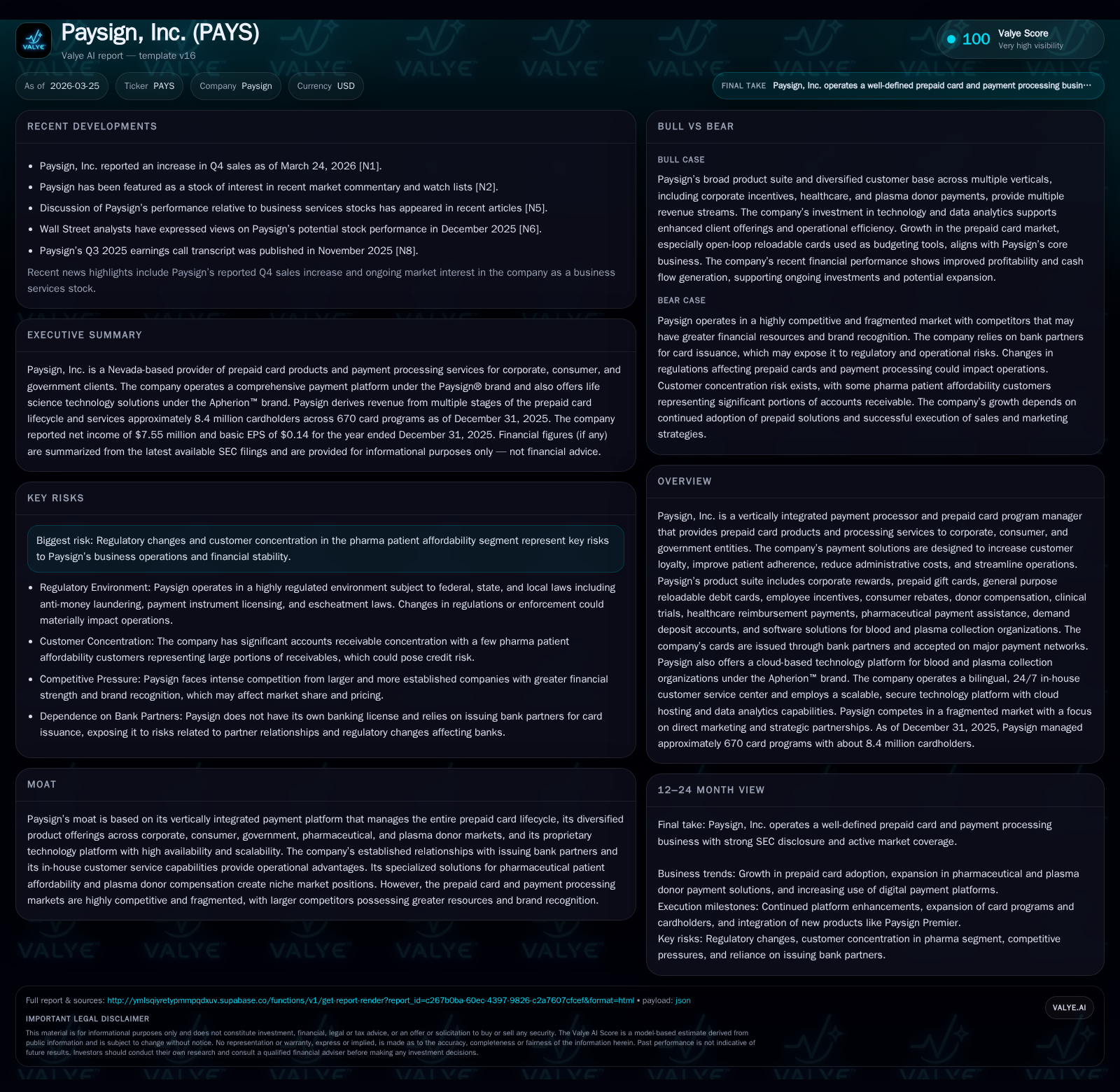
Paysign experienced a notable revenue decline of over 30% between 2019 and 2020, yet has since delivered a remarkable operating income increase exceeding 600% from 2024 to 2025. This turnaround is underpinned by its vertically integrated prepaid card lifecycle platform, diversified product offerings across corporate, government, and niche pharmaceutical markets, and focused investments in scalable technology. While the pharma patient affordability segment drives growth opportunities, it also introduces regulatory and concentration risks that require close monitoring. Free cash flow generation improved substantially in 2025, supporting modest share repurchases and reflecting disciplined capital allocation amid competitive pressure.
Historic Financial Trajectory and Revenue Evolutions
Paysign's financial performance over recent years presents a compelling narrative of operational resilience despite top-line pressures. The company's annual revenues increased from $15.2 million in fiscal year (FY) 2017 to a peak of $34.7 million in FY2019 [F1]. However, starting in FY2020, revenues fell sharply by approximately 30.4%, dropping to about $24.1 million [F1]. This contraction reflects challenging conditions across key markets amid evolving competitive dynamics.
Despite declining revenues post-2019, Paysign reversed earlier operating income losses—such as the negative $0.17 million in FY2023—to achieve a striking operating profit of $7.36 million in FY2025 [F1]. This amounts to a year-over-year surge of over 620% compared to FY2024's operating income of roughly $1.02 million [F1]. The net income similarly nearly doubled to $7.55 million in FY2025 from $3.82 million a year earlier [F1]. Cost discipline combined with improved operating leverage facilitated this profitability inflection.
Historical performance (annual)
| FY | Net ($mm) | CFO ($mm) | OpInc ($mm) | Capex ($) | Net YoY |
|---|---|---|---|---|---|
| 2025 | 8 | 52 | 7 | 1209048 | +97.9% |
| 2024 | 4 | 23 | 1 | 434901 | -40.9% |
| 2023 | 6 | 28 | 0 | 262556 | +528.4% |
| 2022 | 1 | 25 | 0 | 105186 |
Source: SEC companyfacts cache [F1].
Capital returns and efficiency (annual)
| FY | Buybacks ($) | FCF ($mm) | ROE% |
|---|---|---|---|
| 2025 | 375786 | 51 | 15.6 |
| 2024 | 495045 | 23 | 12.5 |
| 2023 | 1127884 | 27 | 26.4 |
| 2022 | 25 | 6.3 |
Source: SEC companyfacts cache [F1].
*YoY % reflects change versus prior provided fiscal year or closest available year where appropriate.
Operating Model and Technology Platform Advantages
Paysign’s core strength lies in its vertically integrated prepaid card lifecycle management platform leveraging proprietary cloud-based technology with a service-oriented architecture [S4]. Operating continuously on interconnected secure data centers complemented by cloud hosting ensures high availability for clients’ payment processing needs.
The technology stack supports comprehensive workflow stages including transaction processing, cardholder enrollment, value loading, and account management, running sophisticated data analytics, and providing customer service through bilingual call centers and digital touchpoints such as mobile apps and two-way SMS communication [S7]. This modular architecture allows Paysign to offer scalable solutions adaptable to various client requirements while reducing costs – an edge when competing against larger fintech incumbents.
Integration flexibility enables seamless onboarding of new card programs across corporate incentives, general purpose reloadable cards, and pharmaceutical payment assistance services [S4]. Critically, the platform also supports strict regulatory compliance layers vital for anti-money laundering (AML) standards and payment network rules enforced via issuing bank partners [S10].
Segment Diversification and Niche Market Positioning
Paysign operates across diverse verticals including corporate rewards, gift cards, general purpose reloadable debit cards (GPR), employee incentives, consumer rebates, donor compensation, offerings tailored for clinical trials, and healthcare reimbursement payments [S5][S6][S7]. Beyond financial products, the company manages life science software solutions under the Apherion™ brand designed specifically for blood and plasma collection organizations—a niche but growing vertical aiding operational efficiency for donation centers [S15].
Managing approximately 670 active card programs servicing an estimated 8.4 million cardholders underscores Paysign’s broad footprint in both consumer-facing and B2B applications [S5]. This diversification reduces dependence on any single customer or sector—a material risk mitigant given historical concentration concerns—while enabling cross-selling opportunities among different client segments.
Notably,the corporate expense control space including per diem and travel prepaid cards attracts large enterprises seeking streamlined employee spend management without manual expense reports [S20]. Government-funded programs for benefits disbursement add another dimension of revenue stability.
Pharma Patient Affordability: Growth Driver or Risk Catalyst?
The pharmaceutical patient affordability segment represents both an opportunity frontier—and an operational risk vector—for Paysign [S8][S14][S17][S26]. This area involves processing claims and administering payments that subsidize patients’ out-of-pocket prescription drug costs on behalf of pharma manufacturers.
Significantly,a single pharma customer accounts for approximately 31% of accounts receivable balances at the end of FY2025—a reduction from prior years but indicative of ongoing client concentration risk [S6][S26]. Alongside large customers representing additional sizable portions of receivables,the segment exposes Paysign to credit risk tied to claim reimbursement cycles.
Moreover,this business is subject to stringent federal healthcare regulations governing fraud prevention and accurate billing under Medicare/Medicaid frameworks [S23]. Frequent regulatory scrutiny can impact claim adjudication processes,and potential policy shifts may affect program economics negatively.
While patient affordability products enhance adherence rates for drug therapies (a value-add selling point),the legal complexities surrounding false claims acts and HIPAA privacy requirements must be continually managed to prevent costly penalties or reputational damage.
Near-Term Outlook Reflected in Q4 2025 Earnings
Recent commentary from Paysign’s Q4 FY2025 earnings call highlights improved sales activity with new account wins across strategic segments coupled with strengthening payment volumes [N1][N2]. Though the company withheld long-term guidance,increased pricing discipline on program fees alongside expanded cross-selling initiatives signals momentum building.
Operational milestones such as deeper automation within payment adjudication workflows coupled with enhanced data analytics are anticipated to drive margin expansion going forward.Near-term metrics focused on client retention rates,payment volume growth,and incremental interchange fee gains will be critical indicators to evaluate progress amid macroeconomic uncertainty.
Capital Allocation Discipline and Shareholder Returns
Paysign generated approximately $52.45 million in net cash from operating activities during FY2025 reflecting strong underlying cash conversion despite top-line pressures [F1][S13][S18]. Capital expenditures totaling around $1.21 million were modest relative to cash flow,in line with ongoing investments in internal software development and technology upgrades rather than heavy fixed asset additions.
Conservative capital management is evidenced by limited stock repurchase activity which amounted to around $375 thousand during FY2025 versus nearly half a million prior year,true shareholder distributions remain minimal or reinvested into growth initiatives [F1][S11].
An approximate return on equity near 15.6% for FY2025 suggests efficient use of equity capital following several years of subdued profitability—a positive signal regarding management’s ability to generate value from invested funds [F1].
This financial flexibility could support opportunistic enhancements to capital returns if sustainable operating momentum persists without compromising liquidity or strategic priorities.
Regulatory Environment and Industry Competition Challenges
Operating within the prepaid card ecosystem exposes Paysign to extensive regulation spanning AML mandates,money transmission licensing,state escheatment laws,data privacy protections,and compliance requirements imposed by major card networks such as Visa or Mastercard—all requiring sustained investment in compliance infrastructure [S4][S8][S10][S14].
Additionally,the healthcare-related payment services segment bears elevated scrutiny related to federal false claims statutes,HIPAA privacy standards,and other anti-fraud regulatory frameworks that amplify legal complexity compared to conventional prepaid cards [S23].
Competition remains intense with numerous players ranging from legacy processors,specialized fintech startups,to large diversified firms boasting considerable scale advantages.Financial services industry fragmentation offers some niches for specialization,yet larger competitors generally command stronger brand recognition,funding capacity,and broader service portfolios necessitating continuous innovation from Paysign to maintain relevance [S4].
Conclusion
Paysign’s journey epitomizes a resilient fintech player leveraging vertical integration,toehold niche product offerings,and cloud-native technology capabilities to offset revenue softness while delivering marked profit growth.Growth prospects hinge critically on successfully navigating pharmaceutical patient affordability dynamics,broadening client diversification,and preserving operational excellence within an exacting regulatory landscape.
Stakeholders should monitor key operational metrics —including payment volumes,new program launches,and regulatory developments—to gauge whether impressive profitability gains translate into sustainable longer-term competitive positioning.
Disclaimer: This analysis is based solely on information provided through official SEC filings,[F1]and publicly available news transcripts as cited,and does not constitute investment advice or recommendations.
Disclaimer: This is research-only, informational analysis and not investment advice. It may include AI-generated interpretation and general industry context. Always verify important details using primary sources.

Comments