
Range Capital Acquisition Corp II: Trust Account Strength and Acquisition Challenges Ahead
Range Capital Acquisition Corp II launched with substantial capital resources but faces typical SPAC execution risks ahead.
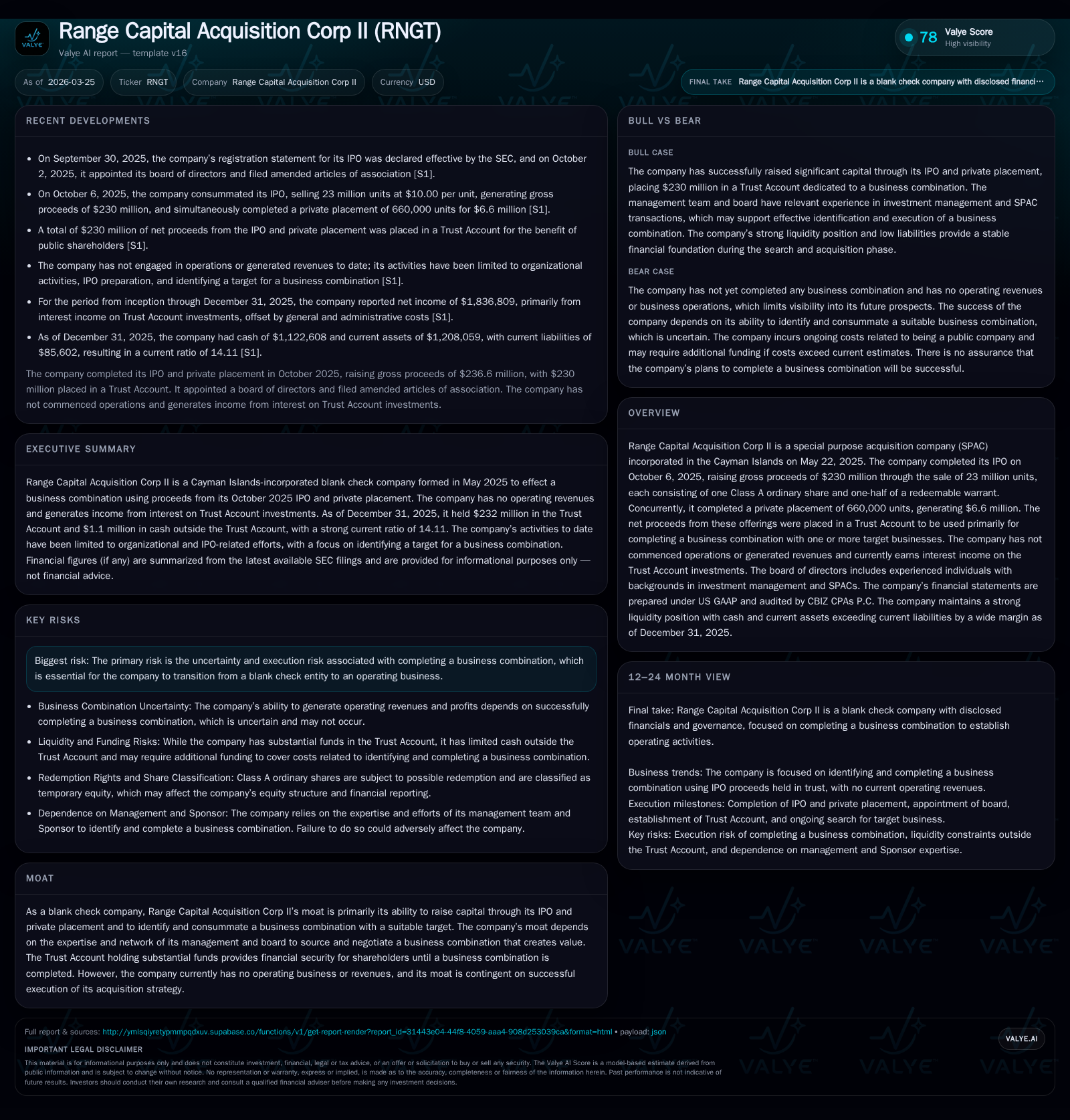
Range Capital Acquisition Corp II completed a sizable IPO and private placement in late 2025, securing $230 million into a Trust Account to fund a forthcoming business combination. The company currently operates without active revenues, generating interest income on trust assets while incurring administrative expenses. Its management team’s expertise and strategic positioning underpin its moat, though the SPAC remains exposed to typical acquisition execution risks. Investors should monitor the company's progress in identifying and consummating a suitable business combination, which will dictate future returns and operational prospects.
IPO Completion and Trust Account Establishment: Capital Foundation
Range Capital Acquisition Corp II initiated operations as a Cayman Islands exempted company in May 2025, culminating its initial public offering (IPO) on October 6, 2025. It raised $230 million gross proceeds through the sale of 23 million units priced at $10 each, inclusive of the exercise of underwriters' full over-allotment option for 3 million units [S1][S6]. In parallel, a private placement generated an additional $6.6 million from 660,000 units sold to the Sponsor and underwriters’ representative. Net proceeds totaling $230 million were placed in a segregated Trust Account invested primarily in U.S. Treasury-backed money market funds held by Continental Stock Transfer & Trust Company [S6][S16]. Transaction costs aggregated approximately $13.2 million including cash underwriting fees and deferred underwriting commissions payable upon completion of a business combination [S6][S23]. This Trust Account provides financial security for public shareholders while underpinning transactional flexibility for deal consummation.
Operational Status and Financial Performance since Inception
Consistent with the typical SPAC lifecycle, Range Capital Acquisition Corp II has no operating revenues or active business operations pre-business combination. The only income recorded during the initial period ending December 31, 2025 was non-operating interest earned on investments held within the Trust Account amounting to approximately $2.1 million [F1][S1][S2]. Offsetting this was general and administrative (G&A) expense of roughly $268 thousand primarily related to legal, accounting, financial reporting compliance, and minimal administrative activities [F1][S1]. The resulting net income was positive at $1.84 million driven exclusively by trust interest [F1]. Operating cash outflows totaled approximately $395 thousand as the company funded IPO preparation costs and early deal sourcing efforts [S9]. Working capital outside the trust stood at just over $1.2 million as of year-end with liabilities limited principally to accrued offering costs and deferred underwriting fees [F1][S21].
Historical performance (annual)
| FY |
|---|
| 2025 |
Source: SEC companyfacts cache [F1].
Table data corresponds to fiscal year ended December 31, 2025 per latest SEC filing [F1]
Management Expertise and Board Composition: Strategic Moat Elements
The board appointed in early October 2025 consists of professionals with prior experience relevant to investment management and SPAC transactions including Tim Rotolo, James Grigor, Alexander Matina, and John Lovett [S1]. Such pedigree is critical for attracting deal flow, structuring favorable merger terms, and navigating shareholder approval processes intrinsic to de-SPAC transactions considered high-risk but potentially lucrative if well executed. Sponsor involvement is notable through its participation in private placement units which also aligns interests amid challenges sourcing attractive targets given current competitive SPAC landscape [S13][S27]. The potential use of PIPE (private investment in public equity) financing as part of future combinations leverages these relationships further enhancing deal flexibility.
Navigating Business Combination Targets and Selection Risks
Range Capital Acquisition Corp II faces customary SPAC-specific uncertainties centered on successfully completing an initial business combination within a prescribed two-year window post-IPO closing [S22]. Failure to consummate such a transaction triggers liquidation rights for shareholders based on Trust Account value subject to deductions. Risks enumerated include shareholder redemptions that can impair deal funding capacity; board approval contingencies; adverse market conditions impacting valuations; possible regulatory hurdles; and general negotiation risks [S20][S28]. These factors underscore significant execution risk that remains the pivotal determinant of the company’s transition from blank check entity to operating company.
Capital Allocation Framework Including Use of Trust Funds and Working Capital
Capital allocation prudently separates funds held in the Trust Account from working capital deployed for transaction-related overhead. The Trust Account balance stood at approximately $232.1 million invested mainly in short-duration government securities as of December 31, 2025 [F1][S21]. Funds outside trust were allocated towards due diligence efforts, legal advisory fees, travel related to prospective targets, and administration totaling just under $1.3 million [S4][S6]. The Sponsor maintains commitment capacity via non-interest bearing working capital loans up to $1.5 million, convertible into post-combination units at $10 per unit if drawn upon—but no loans were outstanding as of year-end [S4][S15]. Deferred underwriting fees totaling around $8.05 million remain payable only upon successful deal closure aligning incentives with fiduciary outcomes [S23].
Cash Flow Dynamics, ROE Insights, and Dividend Policy Prospects
The company's reported net income is principally attributable to interest income earned on trust assets with minimal operational costs resulting in positive bottom-line figures despite no revenue-generating operations [F1]. Return on equity (ROE) is negative at approximately -26.7%, explained by equity components including founder shares issuance costs reflected as accumulated deficit outweighing net earnings during start-up phase absent operational cash flow generation [F1]. No dividends have been declared or are expected prior to completion of a business combination since all resources serve acquisition intent; any future dividend policies are contingent on cash flow profiles post-merger reflecting target business profitability and cash generation [S14][F1].
Monitoring Future Catalysts: Milestones to Watch for Value Creation
Key upcoming milestones for Range Capital Acquisition Corp II revolve around identification and announcement of one or more acquisition targets meeting minimum value thresholds—namely those with implied fair market values exceeding 80% of net Trust Account balances excluding deferred underwriting commissions [S12]. Shareholder vote approvals will follow announcement with redemption rights enabling investors to exit if unsatisfied with proposed deals—a feature intensifying pressure on management’s selection process [S22][S28]. Warrant exercisability commencing no earlier than one year post-IPO additionally presents potential equity dilution considerations influencing capitalization structure upon deal closure [S16]. Ultimately value creation hinges on successful de-SPAC transaction completion within mandated timelines coupled with integration success of acquired entities.
Range Capital Acquisition Corp II enters its operational phase backed by robust capital reserves staged for deployment via its substantial Trust Account—the foundational moat ensuring financial security pre-combination. However, intrinsic SPAC structural risks predicated on timely execution of an accretive business combination remain formidable hurdles ahead. Management’s experience offers critical intangible advantages but ultimate performance hinges squarely on deal success amidst evolving market dynamics. Stakeholders should attentively observe forthcoming announcements relating to target selection progress indicators along with shareholder responses shaping post-merger trajectory.
This analysis is based exclusively on publicly available SEC filings as of March 25, 2026 ([S1]-[S28]) supplemented by structured numerical disclosure from company facts ([F1]). No investment advice or price predictions are offered herein.
Disclaimer: This is research-only, informational analysis and not investment advice. It may include AI-generated interpretation and general industry context. Always verify important details using primary sources.

Comments