
Social Commerce Partners Corp’s Launch: Capital Foundation and Tactical Horizon in SPAC Model
Social Commerce Partners Corporation completed its IPO in December 2025, establishing a $100 million trust account to pursue a social commerce acquisition within a tight 24-month window.
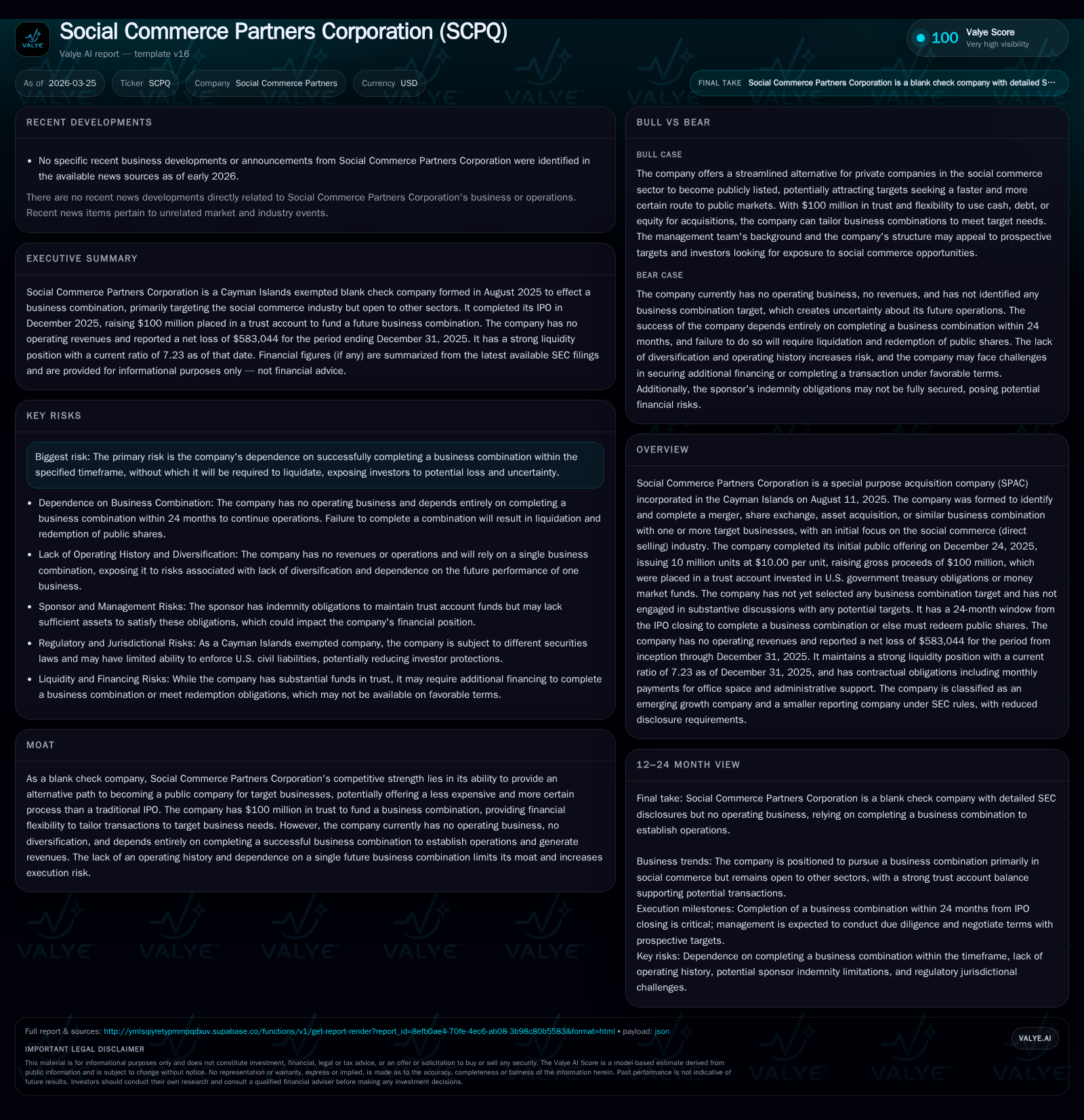
Social Commerce Partners Corp (SCPQ) inaugurated its public life with a December 24, 2025 IPO, raising $100 million and placing the proceeds in a trust invested mainly in short-term U.S. Treasuries and money market funds. As a Cayman Islands-incorporated blank check company, SCPQ’s operational history is limited to pre-IPO organizational activities and expenses totaling approximately $583K net loss in 2025. The company targets an acquisition within the social commerce (direct selling) sector but retains flexibility on industry and geography. Execution risk centers on completing a business combination within two years or facing mandatory liquidation and shareholder redemption. Governance provisions grant shareholders robust redemption rights post-approval vote, while the company maintains substantial liquidity and sponsor backing to defer capital shortfalls. Investors should monitor milestones around deal announcements and voting processes as critical indicators of SCPQ’s path forward.
SPAC Genesis and IPO Capitalization: Foundation Details
Social Commerce Partners Corporation was incorporated as a Cayman Islands exempted company on August 11, 2025 with the express purpose of effecting one or more business combinations, typically via merger or asset acquisition. On December 24, 2025, SCPQ consummated its initial public offering comprising 10 million units at $10 per unit generating gross proceeds of $100 million. Each unit consisted of one Class A ordinary share plus half of one redeemable warrant exercisable at $11.50 per share [S1]. Simultaneously with this IPO, SCPQ completed a private placement sale of an aggregate 350,000 Private Placement Units at the same unit price for additional gross proceeds of $3.5 million; most private units were purchased by its sponsor and underwriter BTIG [S1].
Following the IPO close, the $100 million raised was deposited into a dedicated Trust Account held by Continental Stock Transfer & Trust Company as trustee. The funds in this Trust Account are restricted to investments only in U.S. government treasury obligations with maturities of 185 days or less or qualifying money market funds conforming to Rule 2a-7 under the Investment Company Act. This portfolio composition intends to preserve capital while awaiting identification and consummation of an acquisition target [S1][S16]. These structural elements reflect standard SPAC regulatory and fiduciary safeguards common among Cayman-incorporated blank check companies.
Transaction costs related to underwriting fees totaled about $6 million including both cash and deferred components reducing net cash available for future business combinations [S1].
Historical Footprint: Operating Activity and Financial Position Through Year-End 2025
Since inception through year-end December 31, 2025, Social Commerce Partners did not engage in any operations beyond organizational setup pertinent to preparing for its IPO and subsequent search phase for acquisition target(s). Consequently, there were no revenues generated during this period [S1].
Its financial statements report total operating losses amounting to approximately $642,635 for FY2025 driven primarily by non-cash share-based compensation expense approximating $515K related to founding team members plus general administrative costs aggregating near $127K [F1][S1]. Offsetting these expenses was interest income earned from investments held in the Trust Account totaling around $59,591—an indication that despite net loss SCPQ's cash balances accrued modest earnings consistent with secure short-duration instruments.
At December 31, SCPQ reported current assets totaling about $1.06 million versus current liabilities near $147 thousand yielding a current ratio above 7x – indicative of substantial short-term liquidity outside trust funds presumably utilized for working capital and due diligence expenditures [F1].
Historical performance (annual)
| FY |
|---|
| 2025 |
Source: SEC companyfacts cache [F1].
Strategic Focus on Social Commerce: Market Opportunity and Selection Criteria
Although SCPQ retains broad discretion to pursue acquisition candidates across industries or geographies, its stated intent is to concentrate primarily on businesses engaged in social commerce — also commonly referred to as direct selling — which encompasses companies relying on direct person-to-person sales through digital platforms or networks [S1]. This strategic lens aligns with management’s domain expertise seeking to leverage their understanding to identify promising targets potentially underserved by traditional venture paths.
Nevertheless, the mandate remains flexible permitting opportunistic pivots if superior opportunities arise elsewhere or outside social commerce sectors given specific risk-reward considerations.
Execution Timeframe and Critical Risks of Business Combination Deadline
A defining characteristic binding SCPQ's timeline is its statutory requirement encoded within its charter: having only a twenty-four month window from IPO closing (December 24, 2025) within which it must finalize an initial business combination. Failure to consummate such transaction compels the company to promptly redeem outstanding public shares at pro-rata values derived from Trust Account cash plus accrued interest less minor permitted deductions before proceeding with liquidation under Cayman Islands law [S1][S23]. This creates an immutable "ticking clock" risk that substantially concentrates execution uncertainty.
This deadline heightens pressure upon SCPQ’s management team not only to identify suitable targets but also successfully negotiate terms amid competitive pressures facing social commerce companies seeking public-market access or growth capital which may limit candidate availability or valuation ceilings.
Furthermore, dependence on only one future material corporate event magnifies investor exposure absent diversified lines of revenue generation prior to merger.
Capital Structure & Allocation Plans: Trust Funds, Working Capital, and Sponsor Support
Of the gross proceeds raised via IPO ($100M), nearly all resides securely within the Trust Account invested conservatively as described earlier; this forms SCPQ’s principal war chest dedicated solely toward executing its acquisition ambition or returning value upon liquidation [S1][S21]. Interest earned thereon accrues incrementally adding modest incremental capacity.
Outside this protected fund sits approximately one million dollars earmarked mainly as working capital employed during search-related activity such as target due diligence expenses, legal compliance costs associated with maintaining public reporting obligations as well as preliminary negotiations [S5].
Sponsors additionally retain ability — though no obligation — to extend Working Capital Loans up to $1.5M that can be repaid upon completing a business combination or potentially convertible into Private Placement Units post-merger reflecting equity stakes aligned with founder interests [S6]. This buffer provides supplemental liquidity that mitigates risks stemming from underestimated diligence outlays or operational cash consumption prior to deal closure.
Governance and Redemption Mechanics: Shareholder Safeguards in Business Combination
Governance frameworks grant holders of Class A ordinary shares significant rights including voting privileges governing approval of proposed initial business combinations requiring an ordinary resolution meaning simple majority vote by shares voted together as a single class — provided quorum requirements under Cayman Companies Act section 60(4) are met — typically represented by at least one-third attendance including sponsor-owned shares [S4][S22].
Crucially for investors’ downside protection, public shareholders have enforceable redemption rights exercisable irrespective of how they vote (for/against/abstain) allowing them to redeem their shares at per-share amounts equaling aggregate Trust Account balance divided by outstanding shares calculated shortly before transaction closing less taxes payable (generally near original offering price plus accrued interest), effectively creating an exit valve if dissent emerges post-announcement or valuation concerns arise [S9][S26].
The sponsors have contractually waived redemption rights on founder shares reducing conflict-of-interest risks during shareholder votes.[S17] This structure implicitly balances incentive alignment between founders aiming for successful merger completion with investor protections against unfavorable deals or stagnation.
Key Metrics Snapshot: Financials in Absence of Operating Revenues
The financial profile data available from inception through year-end 2025 underscores standard SPAC characteristics devoid of traditional operational KPIs:
- Operating Loss totaled approximately $643K principally from share-based compensation expense.
- Net Loss was around $583K after crediting interest income earned from trust assets.
- Current assets exceed liabilities sevenfold reflecting fortified liquidity.
- Approximately $100M held safely within Trust Account earmarked exclusively for merger funding.
Investors should cautiously interpret financial metrics within this framework recognizing that income statement losses reflect preliminary launching costs rather than ongoing cash-flow generating operations typical for established entities.
Forward-Looking Signals: What to Watch for in SCPQ’s Merger Moves
Investors tracking Social Commerce Partners must prioritize transparency around key milestones associated with target identification processes including any formal signing letters of intent (LOIs), exclusivity arrangements or advanced negotiations progressing imminently toward definitive agreements. Subsequently observable events will include proposed deal announcement disclosures triggering proxy solicitations accompanied by full transaction documentation outlining structure considerations such as financing mix involving cash/equity/debt components along with anticipated timing for shareholder meetings where redemption rights activate. Additional focus areas encompass any shifts regarding extension requests beyond original deadlines (though legally constrained), enhanced sponsor loan activity signaling potential working capital pressures ahead of deal closure and market reception gauged through trading volumes in units/shares/warrants around major corporate events. Overall visibility into pipeline development will remain limited until significant disclosures owing to competitive confidentiality but remains critical given absence until then of operating results or diversifications.
This analysis synthesizes audited financial results alongside regulatory disclosures without projecting speculative outcomes beyond disclosed facts. Social Commerce Partners Corp presents typical attributes seen across newly formed SPACs emphasizing large-scale trust-account backed acquisition ambitions constrained by finite execution windows posing intrinsic risks alongside embedded mechanisms for investor recourse through redemption rights inherent in Cayman Islands governance frameworks. Readers should consider these factors carefully when evaluating SCPQ’s progression towards consummating its first meaningful business combination enabling transition from blank check vehicle toward an operational enterprise platform focused initially on social commerce verticals.
Disclaimer: This is research-only, informational analysis and not investment advice. It may include AI-generated interpretation and general industry context. Always verify important details using primary sources.

Comments