
Nasus Pharma Advances Intranasal Epinephrine Amid Financial and Regulatory Hurdles
Clinical progress in epinephrine delivery contrasts with ongoing losses and regulatory complexity for Nasus Pharma Ltd.
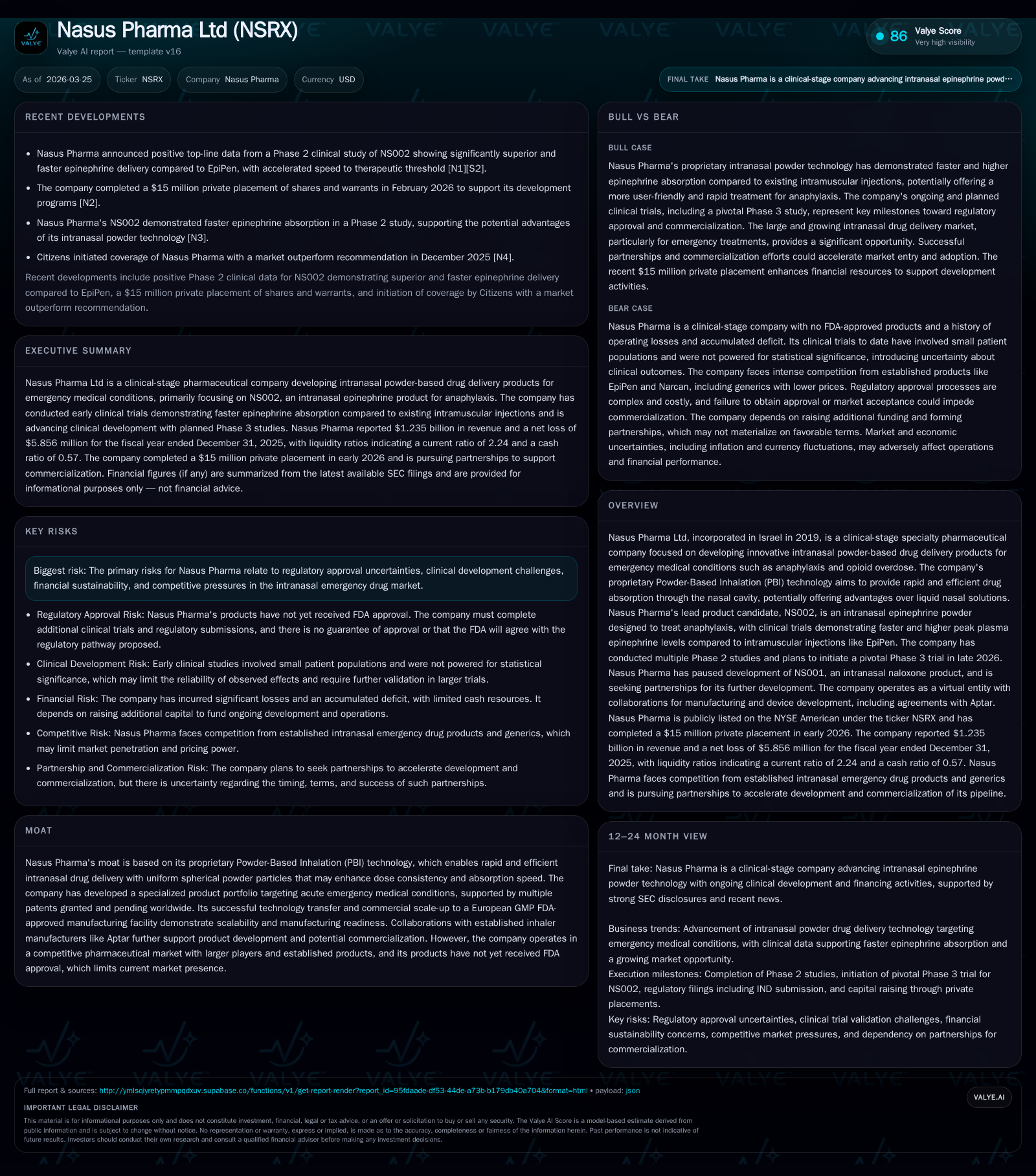
Nasus Pharma Ltd, a clinical-stage specialty pharmaceutical company focused on intranasal drug delivery for emergency conditions, has demonstrated faster epinephrine delivery with its lead candidate NS002 compared to traditional EpiPen injections. Despite significant R&D progress and proprietary Powder-Based Inhalation technology, the company remains unprofitable with a net loss of $5.86 million in 2025 and limited cash reserves. Nasus plans a pivotal Phase 3 trial for NS002 by late 2026 but faces substantial regulatory, reimbursement, and competitive risks in the nascent intranasal emergency drug market.
Company Overview
Nasus Pharma Ltd (NSRX), incorporated in Israel in 2019, is a clinical-stage specialty pharmaceutical company developing innovative intranasal powder-based drugs targeting acute emergency medical conditions such as anaphylaxis and opioid overdose [S1][S24]. The company’s core asset is its proprietary Powder-Based Inhalation (PBI) technology that produces uniform spherical particles designed to enable rapid and efficient absorption through the nasal cavity — a vascularized area conducive to fast therapeutic action [S24].
Nasus operates virtually with headquarters in Tel Aviv and leverages partnerships with established inhaler manufacturers like Aptar for device development. Its R&D focus centers on several product candidates, prominently NS002 (intranasal epinephrine powder) aimed at treating anaphylaxis episodes, alongside other pipeline programs [S1][S24].
Historical Performance and Financial Review
Nasus remains pre-commercial without approved products generating revenue from commercial sales. The reported top-line figure of approximately $1.235 billion in 2025 primarily reflects non-cash accounting treatments related to fair value adjustments of convertible securities rather than operating revenue [F1].
Operating income was negative at approximately -$4.9 million while net income was a loss of about -$5.86 million for fiscal 2025 [F1]. Free cash flow was negative near -$4.93 million reflecting continued investment in R&D against minimal capital expenditures ($14K) which have increased from prior years [F1][S13].
Historical performance (annual)
| FY |
|---|
| 2025 |
Source: SEC companyfacts cache [F1].
The current ratio above 2 indicates sufficient short-term liquidity relative to liabilities; however, the cash balance was only $1.24 million at year-end [F1], underscoring pressing capital needs for progression through costly clinical phases.
Product Development Progress
Nasus’ lead candidate NS002 has shown promising early clinical data: recent Phase 2 results demonstrated significantly superior pharmacokinetics over EpiPen's intramuscular injection with faster achievement of therapeutic plasma epinephrine levels—critical during anaphylactic emergencies [N1][S2]. Based on these data, Nasus intends to initiate a pivotal Phase 3 trial targeting late 2026 [S2]. This study will be determinative for potential regulatory submissions.
Development of NS001 — an intranasal naloxone formulation designed to treat opioid overdose — has been paused as management refocused resources on NS002 and other pipeline assets [S24]. Additional pipeline projects include NS004 targeting metabolic disorders poised to enter first-in-human trials in the second half of 2026 and NS005 for cardiovascular conditions currently in formulation stages [S10].
Market Landscape and Competitive Context
Intranasal administration offers clear advantages in emergency medicine: non-invasive delivery enabling prompt self-administration without trained personnel or injection devices. However, Nasus competes against entrenched injectables like EpiPen as well as emerging liquid-form nasal sprays from multinational pharmaceutical companies.
While Nasus’ PBI technology presents differentiation via dry powder formulation potentially improving dose consistency and faster systemic uptake, regulatory approvals remain uncertain given stringent FDA expectations including demonstration of safety, efficacy, manufacturing compliance (cGMP), and post-market surveillance commitments [S4][S6][S7]. Furthermore, reimbursement landscapes are evolving under U.S. healthcare reforms impacting drug pricing negotiations [S11][S19].
Risks and Regulatory Considerations
Key risks include:
- Regulatory hurdles requiring successful completion of costly large-scale trials plus satisfactory manufacturing audits.
- Financial sustainability concerns given continued losses with limited cash reserves.
- Competitive pressures from larger incumbents developing alternative or biosimilar intranasal solutions.
- Healthcare policy changes potentially limiting pricing power post-commercialization.
- Complex legal compliance obligations across multiple jurisdictions necessitating robust governance frameworks [S16].
Capital Allocation and Financing
Nasus does not pay dividends consistent with clinical-stage biotech norms; shareholder returns depend on capital appreciation tied to successful product development [S15][F1].
Operational cash burn primarily funds growing R&D activities aligned with escalating clinical trials between 2024 and 2025 [F1][S13]. Capital expenditures remain low reflecting the virtual operational model.
To address liquidity constraints documented at fiscal year-end with only $1.24 million cash reserves despite solid current assets coverage ratio (~2.24), the company secured a $15 million private placement issuance of shares and warrants in February 2026 providing runway extension into critical developmental milestones including the launch of Phase 3 for NS002 [N2].
Outlook and Milestones to Monitor
Key inflection points include:
- Initiation and progress updates from the pivotal Phase 3 trial for NS002 expected late 2026.
- Potential partnering or licensing agreements aimed at accelerating commercialization given limited internal commercial infrastructure.
- Clinical advancement of pipeline candidates NS004 (metabolic) and NS005 (cardiovascular).
- Regulatory agency feedback on trial endpoints or manufacturing inspections.
- Developments in healthcare reimbursement policies impacting nascent intranasal emergency therapies.
Absent explicit guidance beyond pipeline timelines published thus far, investors should watch clinical results releases closely as well as capital position developments owing to ongoing operating losses.
Conclusion
Nasus Pharma occupies a promising niche within emergency medicine by innovating intranasal powder formulations leveraging their specialized PBI technology platform. Clinically differentiated Phase 2 data support faster epinephrine delivery crucial for anaphylaxis treatment compared to existing injectables like EpiPen.
Despite recent financing efforts bolstering near-term liquidity, the company faces typical challenges of clinical-stage biopharmaceutical innovators including persistent financial deficits, difficult regulatory pathways laden with compliance risk, competitive threats from larger players with entrenched product portfolios, along with unpredictable healthcare market reforms that could impact pricing strategies post-approval.
Continued progress toward Phase 3 launch later this year represents a critical milestone shaping Nasus' developmental trajectory over coming periods.
This analysis is based solely on publicly available information as of March 25, 2026. It does not constitute investment advice or recommendations.
Disclaimer: This is research-only, informational analysis and not investment advice. It may include AI-generated interpretation and general industry context. Always verify important details using primary sources.

Comments