
Cayson Acquisition Corp's Capital Structure and Deal Execution Challenges Define Its SPAC Trajectory
Cayson's performance hinges on completing its initial business combination within an extended deadline amid financial uncertainties.
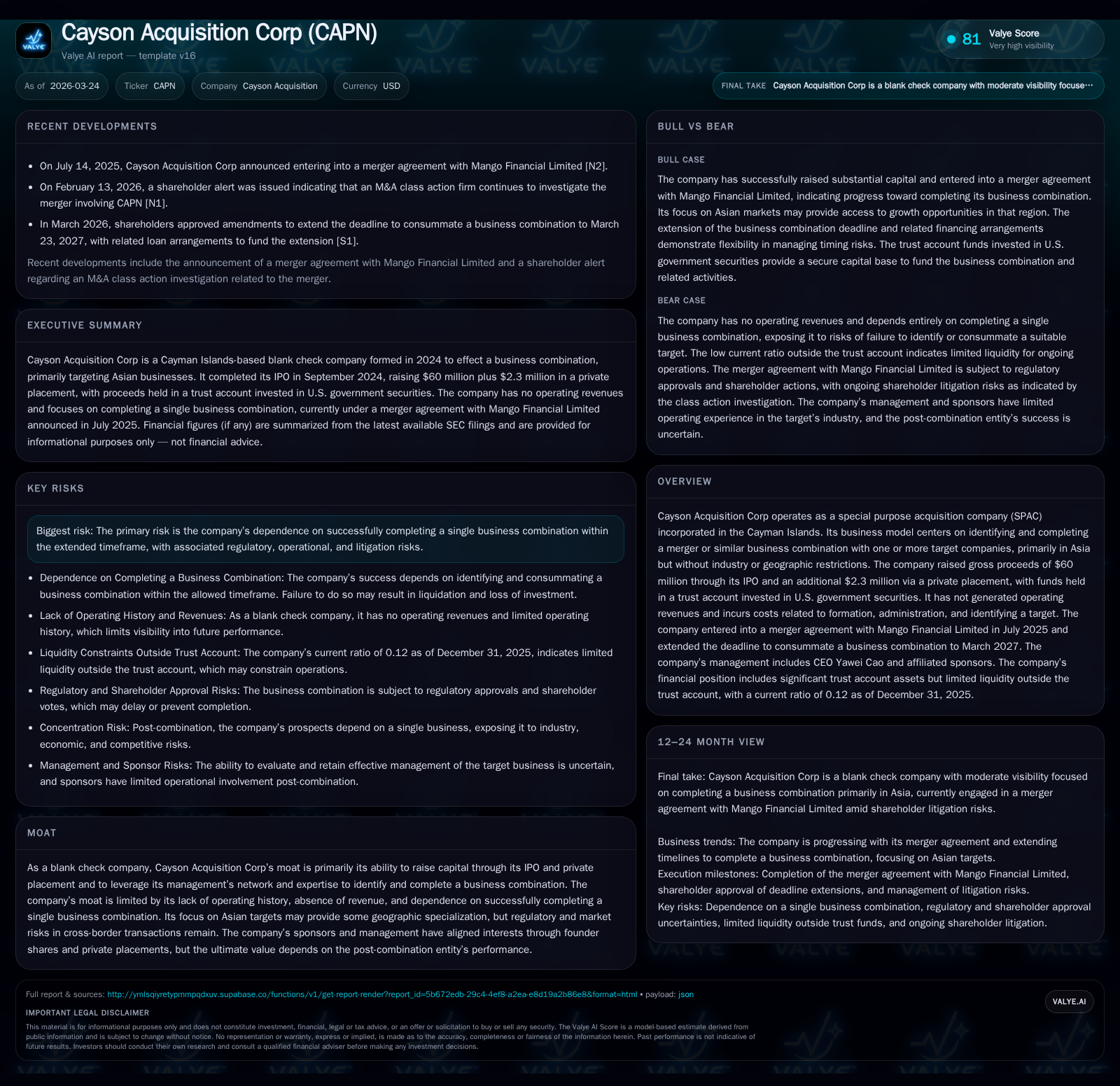
Cayson Acquisition Corp, a Cayman Islands-based special purpose acquisition company (SPAC), raised $62.3 million via IPO and private placement but has yet to complete a business combination. Its financials reflect no operating revenues, with net income driven by interest income from trust-held cash. The company faces impending deadlines to close its merger with Mango Financial Limited or seek alternative targets. Operating losses and working capital deficits raise going concern questions, underscoring the capital-intensive nature of SPAC operations prior to combination closure. The near-term trajectory depends on successfully navigating regulatory approvals and market conditions for cross-border mergers in Asia.
Company Overview
Cayson Acquisition Corp is a blank check company incorporated in the Cayman Islands in mid-2024 for the sole purpose of effecting a business combination, typically via merger or share exchange. Unlike traditional operating companies, Cayson lacks revenue-generating operations; instead, it functions by raising funds from public markets and identifying suitable target companies primarily focused on Asia, though not geographically restricted.
The company completed its IPO on September 23, 2024, issuing six million units priced at $10 each and raised an additional $2.3 million through a private placement with affiliated sponsors including CEO Yawei Cao and TenX Global Capital LP. These gross proceeds have been deposited into a U.S.-based Trust Account invested conservatively in U.S. government securities that generate interest income.
Historical Performance
As a nascent SPAC, Cayson has no operating revenues as of December 31, 2025. Its financial results largely consist of interest income earned on trust-held cash assets offset by operational expenses incurred during the search for an acquisition target and general administrative costs.
A summary of key annual financial metrics from inception through FY2025 is presented below:
Historical performance (annual)
| FY | Net ($) | CFO ($) | OpInc ($) | Net YoY |
|---|---|---|---|---|
| 2025 | 1637488 | -401584 | -908002 | +244.4% |
| 2024 | 475489 | -369218 | -281186 |
Source: SEC companyfacts cache [F1].
Capital returns and efficiency (annual)
| FY | ROE% |
|---|---|
| 2025 | -50.3 |
| 2024 | -30.8 |
Source: SEC companyfacts cache [F1].
This data underscores that while operating expenses continue to create losses at the income statement level (-222.9% YoY operating income decline), net income is positive due to rising interest on trust investments (+244.4% YoY net income increase). Operating cash flow remains negative as administrative and due diligence expenditure outpaces operational inflows.
Growth Prospects and Business Combination Pathway
Cayson's primary growth catalyst lies in consummating its planned initial business combination with Mango Financial Limited—a deal announced in July 2025 with deadline extensions granted through March 2027 [S3]. Successful merger execution would mark Cayson’s transition from a SPAC shell to an operating entity capable of generating revenue.
However, recent reports indicate shareholder litigation inquiries into this and other SPAC mergers signaling heightened scrutiny that could affect timing or terms [N1]. Furthermore, regulatory approvals required in Asian jurisdictions for cross-border transactions introduce procedural risk factors that may delay or complicate completion [S19].
Absent concrete revenue forecasts or milestones disclosed by management beyond confirming merger-related deadlines extension [S3], investors should monitor updates around regulatory filings or further extensions closely.
Returns and Capital Allocation
Given its pre-combination status, Cayson has no dividends or share repurchase programs implemented or planned; all capital is prioritized toward maintaining adequate funding for operational needs including target acquisition efforts.
The company's balance sheet reflects a substantial amount held under trust ($64.5 million as of December 31, 2025), earmarked explicitly for the intended acquisition or redemption if no deal occurs [F1]. Outside this trust account, Cayson faces liquidity constraints evident from a working capital deficit exceeding $1.15 million owed mainly to accrued expenses relating to formation costs and ongoing admin fees [F1]. To alleviate cash flow pressures related to closing timelines, sponsors issued unsecured non-interest-bearing promissory notes totaling $1.2 million to extend deal completion deadlines without diluting shareholders [S5].
Return metrics such as ROE are not meaningful at this stage because reported equity sits negative owing to accumulated deficits exceeding paid-in capital; approximated ROE stands at approximately negative 50% reflecting these factors rather than underlying profitability [F1].
Operational Risks and Litigation Considerations
Beyond execution risks inherent in any SPAC structure—dependence on completing one significant transaction within predefined timeframes—Cayson has exposure typical of firms targeting Asian businesses including foreign investment restrictions particularly concerning Chinese entities using VIE structures disallowed by company policy [S15]. Timing uncertainties regarding approval processes remain material risk drivers.
Additionally, class action investigations targeting several recent SPAC mergers include Cayson’s merger deal as per February 2026 Nasdaq source raising concerns about potential litigation outcomes [N1]. While management confirms no current material litigation against it directly affecting operations or leadership reputations [S19], market vigilance of these developments is warranted.
Sector Analysis (Context)
SPACs have surged over recent years as alternative routes for companies seeking public listings without traditional IPO processes. However, growing regulatory attention coupled with increasing legal scrutiny reflects maturation pains within this sector where investor protection mechanisms are evolving rapidly following high-profile problematic SPAC deals broadly impacting valuations & deal viability across the industry.
Cross-border transactions remain especially complex given multi-jurisdictional compliance demands alongside geopolitical factors influencing investor sentiment toward Asian technology-driven sectors typically sought by funds like Cayson.
Conclusion and Monitoring Points (Analysis)
Cayson Acquisition Corp exemplifies a classic blank check company facing critical transitional challenges where capital deployment timing and regulatory navigation will ultimately dictate value creation potential or liquidation outcomes. While well-capitalized through secured trust funds preserved for acquisition purposes providing some structural moat during pre-merger periods, its negative working capital status combined with uncertain legal environment necessitates keen attention toward merger consummation milestones.
Key developments to watch include any amendments extending merger deadlines further beyond March 2027; announcements concerning regulatory clearances in target jurisdictions; potential impact from ongoing M&A class action investigations; sponsor financing arrangements if liquidity issues intensify; as well as disclosures post-merger attempt regarding integration strategies or operational pivots should Mango Financial combination materialize.
This report is intended solely for informational purposes providing analysis based on public filings as of March 24, 2026. It does not constitute investment advice or recommendations.
Disclaimer: This is research-only, informational analysis and not investment advice. It may include AI-generated interpretation and general industry context. Always verify important details using primary sources.

Comments