
Rentokil Initial's Post-Acquisition Growth and Innovation Trajectory
Rentokil Initial leverages its Terminix acquisition and innovation investments to expand its global pest control and hygiene services footprint.
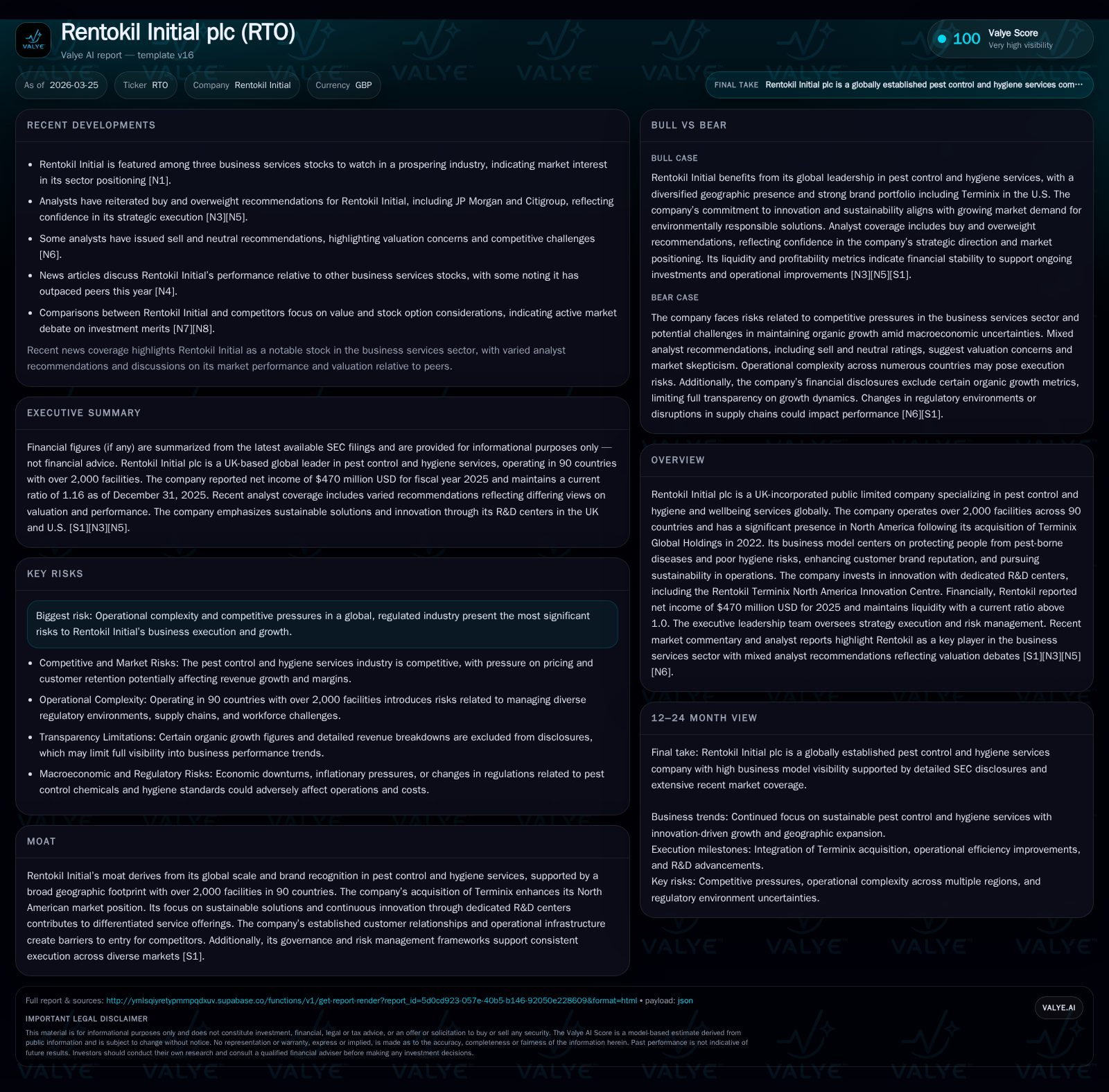
Rentokil Initial plc has significantly expanded its scale and market presence following the acquisition of Terminix Global Holdings in 2022, marking a pivotal shift in its growth trajectory. The company's strategic focus on R&D, exemplified by the Rentokil Terminix North America Innovation Centre, underpins differentiated service offerings and sustainability initiatives, while its well-capitalized financial structure supports ongoing investments. Capital allocation remains disciplined, with a consistent dividend policy and opportunistic share buybacks highlighting management’s confidence. However, operational complexity in regulated global markets and competitive pressures present ongoing risks.
Historical Performance: Scaling through Acquisition and Expansion
Rentokil Initial plc has charted substantial growth in recent years, primarily driven by its strategic acquisition of Terminix Global Holdings in 2022. This acquisition marks a seminal expansion into the lucrative North American pest control market, complementing Rentokil's already extensive international footprint with over 2,000 facilities across 90 countries [S1].
Fiscal data from the company's 2025 Annual Report reveals a net income of $470 million USD for the year ending December 31, 2025 [F1], reflecting continued profitability amidst integration efforts. Rentokil’s current ratio is reported at approximately 1.16 [F1], signaling liquidity adequacy to meet short-term obligations—critical when managing complex operations spanning multiple regulatory regimes.
The investment in scale via acquisitions has bolstered both revenue potential and operational capacity, allowing Rentokil to service a broader client base. This expansion aligns with industry demands where scale offers cost leverage in logistics, field technician deployment, and supply chain efficiencies inherent to pest control service delivery.
Historical performance (annual)
| FY |
|---|
| 2025 |
Source: SEC companyfacts cache [F1].
Drivers of Growth: Innovation, Market Reach, and Sustainability
Beyond scale, Rentokil’s growth engine hinges on innovation centered around pest-borne disease mitigation and hygiene service differentiation. In March 2024, Rentokil inaugurated the Rentokil Terminix North America Innovation Centre—an R&D facility focused on developing biologically informed solutions that address evolving customer needs while enhancing sustainability credentials [S1].
This focus on biological pest management techniques—reducing chemical dependencies—and digital monitoring tools represents a pivotal shift in service sophistication. These innovations contribute not only to enhanced efficacy but also support the company’s environmental stewardship objectives.
Sustainable practices resonate with larger clients increasingly sensitive to brand reputation risks related to health hazards or environmental impact. Rentokil leverages its innovation pipeline to maintain client contract retention rates but also open avenues into adjacent hygiene and wellbeing services delivering comprehensive risk mitigation packages.
Market Positioning Post-Terminix: Strengthening North America Leadership
Terminix's acquisition granted Rentokil access to the dominant US termite and pest management brand recognized widely across the country [S1]. This move entrenched Rentokil as a top-tier competitor in North America—a critical region for growth given robust demand trends for residential and commercial pest control driven by disease prevention imperatives.
Investor confidence followed suit; UBS notably upgraded their stance on Rentokil Initial's Depositary Receipt citing enhanced market positioning after this acquisition [N1]. The integration benefits include cross-selling opportunities between hygiene solutions and established pest control contracts as well as operational synergies from combining field service operations.
Financial Health Overview: Profitability, Liquidity, and Returns
Rentokil exhibits a moderate yet stable return on equity around 8.6% [F1], which while modest reflects the capital-intensive nature of the service operations combined with steady earning power from long-term contracts.
At fiscal year-end 2025, cash and cash equivalents stand at $2.32 billion USD while current assets total $3.86 billion USD against current liabilities of $3.32 billion USD [F1], substantiating a current ratio of about 1.16—comfortably above the threshold indicating reliable liquidity to support day-to-day expenditures during scaling phases or adverse economic environments.
Margin durability is challenged by regulatory compliance costs that vary by jurisdiction but offset partially by pricing power aligned with customer willingness to pay for health risk reductions.
Capital Allocation: Dividends, Share Buybacks, and Debt Management
Management demonstrates prudent financial stewardship through disciplined capital allocation policies documented across multiple filings [S4–S14]. Dividend payments continue consistently as part of shareholder returns strategy.
Simultaneously, Rentokil executed several tranche share repurchases totaling thousands of shares traded primarily on the New York Stock Exchange and London Stock Exchange between March 9–17, 2026 [S4–S14]. These tactical buybacks convey confidence by the board in intrinsic value while managing equity dilution post-acquisitions.
Debt levels remain carefully managed with ample liquidity buffers documented including an analysis of funding sources detailed within filings [S1],[S29]. This measured approach balances growth funding needs against interest cost sensitivity amid prevailing macroeconomic inflationary dynamics.
Outlook and Emerging Risks: Operational Complexities and Sector Dynamics
The company’s expansion into diverse geographies intensifies operational complexity broadly characterized by managing multiple regulatory frameworks particularly on environmental health standards specific to chemical application controls [S1].
Competitive pressures persist as regional local players specialize in niche segments or price-sensitive contracts challenging market share gains.
Moreover, economic stressors influencing credit risk provisions—especially related to trade receivables—require close monitoring given the company's broad customer base comprising commercial property sectors which can be cyclically impacted [S1].
Key Metrics to Watch: Earnings, Cash Flow Conversion, and ROE Trajectories (Analysis)
Stakeholders should observe cash flow conversion trends post-Terminix integration carefully to gauge operational efficiency improvements or persistent working capital strains originating from enlarged trade receivable management needs.
Earnings reports will be key for signs of margin resilience amid continued inflationary pressures impacting labor costs or raw materials used in hygienic solutions.
Additionally, ROE trajectory will inform if capital deployed towards acquisitions and innovation achieves expected returns or if adjustments are needed in asset utilization strategies.
Disclaimer: This analysis is based solely on disclosed documents including SEC filings and publicly available news sources as referenced; it does not constitute investment advice or recommendations.
Disclaimer: This is research-only, informational analysis and not investment advice. It may include AI-generated interpretation and general industry context. Always verify important details using primary sources.

Comments