
Tron Inc.'s Strategic Shift: Uniting Licensed Merchandise with Blockchain Treasury
Tron Inc. integrates its established licensed merchandise operations with a pioneering blockchain-based treasury strategy centered on TRX tokens.
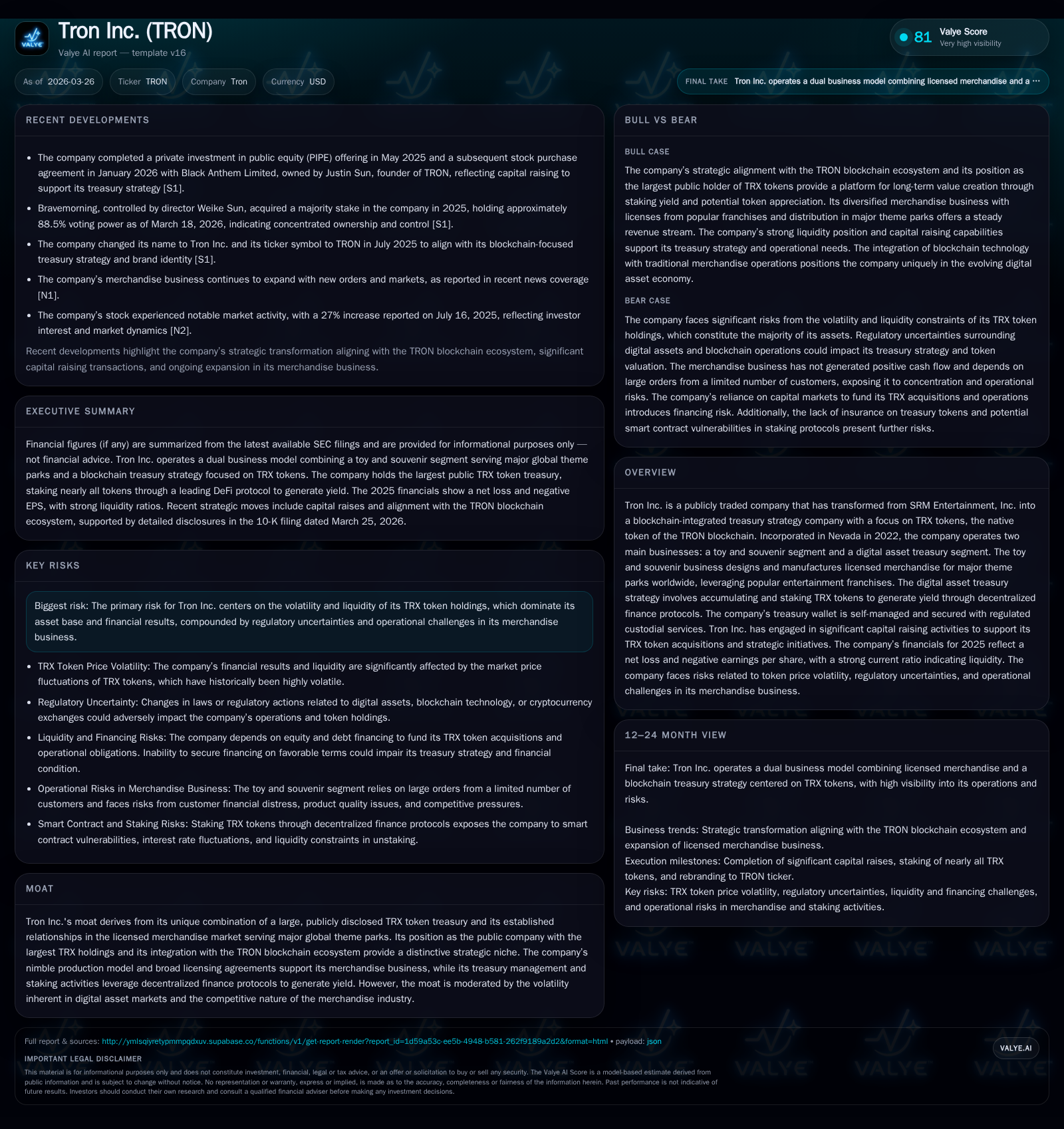
Originally SRM Entertainment, Tron Inc. has transitioned from a traditional toy and souvenir manufacturer to a hybrid operator combining legacy licensed merchandise with a significant digital asset treasury centered on TRX tokens. Despite operating losses and negative cash flows over recent years, the company’s distinctive positioning as the largest publicly disclosed holder of TRX tokens affords unique growth avenues through decentralized finance staking yields. However, financial volatility, regulatory uncertainties in digital assets, and operational complexities in the merchandise business present considerable challenges. Monitoring capital raises, token accumulation, and licensing expansions will be key for assessing future trajectory.
From SRM Entertainment to Tron: Evolution of Business Model and Revenue Drivers
Tron Inc., incorporated in Nevada in 2022 following its rebranding from SRM Entertainment, represents a strategic pivot from traditional entertainment merchandising into digital asset management rooted in blockchain technology [S1]. The company retains its legacy toy and souvenir business through its wholly-owned subsidiary operating globally with major clients like Walt Disney Parks and Universal Parks. These products derive from high-profile entertainment franchises offering steady licensed content creation and manufacturing revenue.
Parallel to this established segment is the company's innovative digital asset treasury strategy targeting the TRON blockchain’s native TRX tokens. This duality reflects a deliberate blend of tangible consumer goods production with virtual asset accumulation and yield generation via decentralized finance (DeFi) protocols — an uncommon hybrid model that shapes both operational dynamics and financial outcomes.
The transition began with acquiring SRM Ltd., a Hong Kong-based manufacturer, in August 2023 which fortified their physical merchandise foundation amidst the broader blockchain integration journey post-2022 incorporation [S1]. Tron Inc.’s rebranding was symbolically reinforced through Nasdaq ticker change to "TRON" aligning corporate identity closely with their TRX-centric treasury focus achieved by mid-2025 [S1,S23].
Financial Performance Analysis: Operating & Net Income Trends over the Past Three Years
Analyzing Tron Inc.'s financials reveals persistent operating deficits that have deepened over three fiscal years recorded up to 2025. Operating losses widened from approximately -$2.0 million in FY2023 to -$4.3 million in FY2024 before narrowing slightly to -$2.5 million by FY2025 [F1]. However, net losses diverged markedly reaching -$16.8 million by FY2025 compared to -$4.3 million in FY2024 and just over -$2 million in FY2023, reflecting significant non-operating charges or impairments possibly linked to digital assets adjustments or restructuring costs [F1].
Operating cash flows mirror this trend of negative performance but show signs of recovery improving from -$766,877 in FY2023 to nearly double at -$1.4 million in FY2025 after peaking -$2.9 million in FY2024 [F1]. Meanwhile, shareholders’ equity ballooned dramatically due primarily to sizeable capital injections as equity stands at $210 million at end-2025 compared with under $6 million two years prior [F1], indicative of aggressive financing activities offsetting operating cash burn.
Historical performance (annual)
| FY | Net ($mm) | CFO ($mm) | OpInc ($mm) | Net YoY |
|---|---|---|---|---|
| 2025 | -17 | -1 | -3 | -287.4% |
| 2024 | -4 | -3 | -4 | -111.3% |
| 2023 | -2 | -1 | -2 |
Source: SEC companyfacts cache [F1].
Capital returns and efficiency (annual)
| FY | ROE% |
|---|---|
| 2025 | -8.0 |
| 2024 | -82.0 |
| 2023 | -49.8 |
Source: SEC companyfacts cache [F1].
Data sourced directly from [F1] for accurate YoY trend illustration.
Digital Asset Treasury Strategy: TRX Token Holdings and Decentralized Finance Yield Generation
A central pillar distinguishing Tron Inc.’s business model is its extensive investment in TRX tokens native to the TRON blockchain ecosystem. As of March 18, 2026 the company reports holding approximately 549.7 million staked TRX (sTRX) tokens alongside about 9.8 million unstaked tokens managed within a self-custodied treasury wallet adopting regulated custodial services for security compliance [S19]. This level of disclosure makes them the leading public corporate holder of these digital assets.
Staking sTRX involves locking tokens via smart contracts within DeFi protocols on the TRON network to generate yield earnings composed both of traditional staking rewards and energy rental income — system resources essential for contract execution on TRON blockchain [S19,S24]. This yield farming approach attempts to harness crypto-native income streams distinct from conventional interest-bearing instruments.
However the company recognizes smart-contract vulnerabilities including coding bugs or malicious exploits that might jeopardize token value or liquidity along with systemic risks such as network outages or protocol parameter changes potentially reducing yield rates or increasing redemption fees [S19]. Regulatory uncertainty looms large given digital assets remain subject to evolving global oversight frameworks; specifically whether tokens like TRX could eventually be classified as securities would impose substantial compliance burdens affecting operational freedom [S7,S21].
Additionally prominent stakeholders associated with the TRON ecosystem — notably founder Justin Sun — hold sway over market perception influencing token price volatility which directly impacts Tron Inc.’s repricing risk exposures as well as valuation metrics for their treasury holdings [S19]. Despite these concerns the entity expresses intent to continue augmenting its TRX token portfolio over time.
Licensed Merchandise Segment: Market Footprint, Product Portfolio, and Operational Challenges
Tron’s traditional business anchors around licensed toys and souvenirs manufactured predominantly through its Hong Kong subsidiary which services marquee global theme parks including Walt Disney Resorts and Six Flags among others [S1]. Their product suite leverages intellectual property rights tied to blockbuster entertainment franchises thereby anchoring customer demand via recognized brands.
The merchandise division contends with standard industry hazards including seasonal demand fluctuations characteristic of theme park attendance cycles which drive periodic revenue volatility quarter-over-quarter and year-over-year [S1,S4]. Supply chain volatility emerges as a material risk given reliance on third-party manufacturers with no long-term binding contracts raising concerns about capacity stability or production disruptions especially during peak selling seasons or geopolitical disturbances impacting transportation routes.
Inventory management also presents complexity balancing sufficient stock levels against risks of excess that could result in margin erosion through markdowns or returns compounded by wholesale distributor channel variability and uncertain purchase volumes lacking firm commitments from major partners [S4,S13]. Pricing pressures exerted by distributors seeking rebates or shifted payment terms further strain profitability margins.
Intellectual property protection is vital given threats from counterfeiters challenging brand exclusivity especially across foreign markets where legal enforcement may be limited; defending IP rights through litigation remains costly while product safety regulations impose compliance overhead potentially affecting product release timelines or incurring penalties if standards falter [S4,S6,S14].
Capital Structure, Equity Ownership Changes, and Capital Raising Activity Insights
The structural ownership transformation marks another defining facet of Tron Inc.’s evolution highlighted by a June/July 2025 PIPE transaction involving Bravemorning acquiring majority stakes through exercising warrants representing $110 million capital infusion via purchase of approximately 220 million common shares resulting in ~86.6% stock ownership initially expanding further via convertible preferred stock ownership pushing total voting control above 90%, later adjusting slightly but still controlling ~88.5% voting power by March 2026 [S1,S3].
This concentration reshaped governance dynamics situating Bravemorning – closely held by director Weike Sun – as central strategic leader steering both blockchain treasury accumulation efforts alongside continuing licensed merchandise operations centered around unlocking synergies inherent in integrated brand strategy alignment.
Such capital movements supported aggressive scaling of token acquisitions fueling treasury growth while also underwriting working capital demands required for international merchandising expansion amid volatile retail environments thus enabling operational continuity during transition phases without meaningful reliance on operating profits which remain negative historically [F1,S29].
PIPE warrants issuance typifies contemporary capitalization mechanisms leveraged by emerging firms striving simultaneously for fintech innovation funding alongside traditional commercial enterprise maintenance — exemplifying cross-sector funding interplay unique among comparable entities evolving toward crypto-integration models.
Risk Environment: Regulatory, Market Volatility and Industry-Specific Challenges
Tron faces layered risk exposures deriving from both its heritage toy/souvenir marketplace participation and its new venture into volatile nascent digital assets treasury management:
- Merchandise segment confronts risks tied to competition-induced margin pressures amplified by supply chain fragility including supplier dependency without long-term contracts risking interruptions; complicated sales channel inventory management necessitates agile forecasting against sudden order deferrals or cancellations adversely affecting revenue pacing; regulatory compliance encompassing Consumer Product Safety Improvement Act (CPSIA) mandates continuous monitoring introducing cost volatility; intellectual property infringements—counterfeits or litigation claims—entail costly defensive actions potentially impairing brand strength impacting customer loyalty sensitive within theme park retail environments; labor disputes within factories heighten operational disruption probabilities [S4,S6,S14,S15].
- Digital asset treasury exposes the company profoundly to regulatory headwinds around classification ambiguities regarding security laws potentially triggering registration requirements which would impose restrictive operational jurisdictions under Investment Company Act frameworks limiting trading freedoms; intensified scrutiny following high-profile exchange collapses like FTX elevate compliance costs particularly concerning anti-money laundering (AML), sanctions adherence under U.S Foreign Corrupt Practices Act (FCPA), money transmitter licenses alongside marketplace integrity challenges emanating from unregulated trading venues transparency deficiencies risking liquidity shocks or fraud events damaging investor confidence; smart contract technical risks include bugs/security vulnerabilities undermining token backing; founder-related market influence introduces additional headline risk propagating unforeseen valuation swings hurting balance sheet stability; systemic macroeconomic conditions influence digitals adoption rates all contributing compound forecasting uncertainties absent historical comparables for such business amalgams .
Cybersecurity breaches represent an increasingly critical vector affecting all aspects—digital wallet custody solutions demand rigorous internal controls backed by regulated custodianship but remain exposed theoretically given zero tolerance failure expectations complicating insurance coverage availability thus growing directors/officers liability concerns increasing operational overhead burdens typical for companies pioneering digital asset custody models absent widely accepted industry best practices currently under development internationally [S7,S21].
Future Outlook: Growth Prospects, Milestones to Watch, and Execution Constraints
Explicit forward guidance is absent per available filings but observable vectors set expectations for key performance drivers must be watched closely:
- Licensed merchandise business benefits from new orders recently reported signaling potential market share re-expansion amid recovering global theme park attendance trends post-COVID-19 disruptions; product pipeline refreshes incorporating new franchise licenses could stimulate demand if successfully executed against channel inventory pressures observed historically limiting upside surprise potential; supply chain stabilization remains pivotal enabling timely fulfillment avoiding seasonal missed revenue opportunities plus margin preservation needs ongoing negotiation leverage balancing raw material cost inflation exposure versus customer pricing elasticity responses noted across retail sectors recently [N1,S1];
- Digital asset treasury strategy embodies growth captured through scaling incremental TRX token purchases supported by secured capital injections facilitating elevated staking sTRX balances expanding yield farming returns assuming stable DeFi protocol parameters; expansion plans could include optimized yield generation techniques via diversified DeFi engagement or collateralized borrowing strategies leveraging token holdings repeating market practices gaining traction within crypto finance although accompanied by amplified compliance necessities requiring cautious evolution;
- Regulatory landscape evolution requires agile responsiveness given evolving U.S., U.K., Chinese regulatory doctrines shaping permissible activities involving digital assets possibly constraining aggressive strategy deployment timelines thus creating execution risk around timing effectiveness;
- Key milestones expected involve quarterly disclosures detailing growth in TRX holdings/staking rewards measurable by publicly verifiable blockchain data coupled with merchant order book growth metrics updating investors on core product acceptance crucial for sustaining dual income models;
- Execution constraints center around managing legacy merchandising cyclicality without eroding ongoing investment appetite fostered by speculative nature of blockchain returns relying heavily on token price appreciation dynamics inherently unpredictable long term thus reinforcing necessity for maintaining diversified operational capabilities maintaining optionality between segments reliant upon separate economic drivers rather than single dependency systemically hazardous environments [[N1],[S1]].
Capital Allocation Profile: Cash Flow Trends, Returns on Equity, Dividends And Buybacks
Tron’s capital allocation presently indicates prioritization toward strategic expansion rather than shareholder distributions:
Operating cash flow remains negative albeit improving consistent with enlarging scale operational complexity combined with investments unfolding across both merchandise production cycles and digital asset acquisition costs resulting expansionary phasing effects outpacing present earnings ability manifested through cumulative net losses amounting near $17 million for FY2025 despite roughly $210 million equity base fostered primarily through equity issuances rather than retained earnings generating an approximate negative return on equity near -8% [-16.8m / $210m] illustrating ongoing value creation challenges relative to invested capital scale currently manifesting overall cash burn position negating free cash flow generation expectations since capital expenditures details are unspecified but likely included partly within CFO considering scale restrictions noted [-$1.69m approx FCF] per available reports emphasizing financing-driven survival rather than organic cash generation capacity yet reflecting measured improvement trajectories suggesting possible break-even horizons over medium term dependent on successful commercialization plus staking yields ramp-up aligned cohesively sustaining balanced liquidity posture reflective of strong current ratio exceeding 19x denoting ample short-term solvency but also signifying significant cash reserves earmarked possibly toward further token acquisition funding commitments restraining dividend or buyback capacity at present stage affirming reinvestment priority clearly documented without indication of declared dividend policies nor shares repurchase programs reflecting typical early-stage transformation profile hence prioritizing capital preservation aligned with developing dual-business sustainability objectives rather than shareholder return payout schemes documented thus far [F1],[S29].
This analysis synthesizes publicly available SEC filings ([S#]) alongside recent news ([N#]), supplemented exclusively by numeric data drawn strictly from companyfacts snapshot ([F1]). The narrative deliberately avoids conjecture beyond grounded interpretations consistent with disclosed information illustrating Tron Inc.’s unique juxtaposition of traditional licensing commerce merged innovatively with next-generation blockchain treasury strategies unlocking unprecedented corporate pathways yet accompanied by evident multi-dimensional risks requiring careful governance oversight amid fluid regulatory climates.
Readers are reminded this report is not investment advice but an informational assessment based solely on supplied official disclosures.

Comments