
MetaVia Inc.'s Patent Strength and Clinical Advances Fuel Future Prospects Despite Ongoing Losses
MetaVia strengthens its competitive position through extensive global patents and encouraging clinical data, even as financial challenges persist.
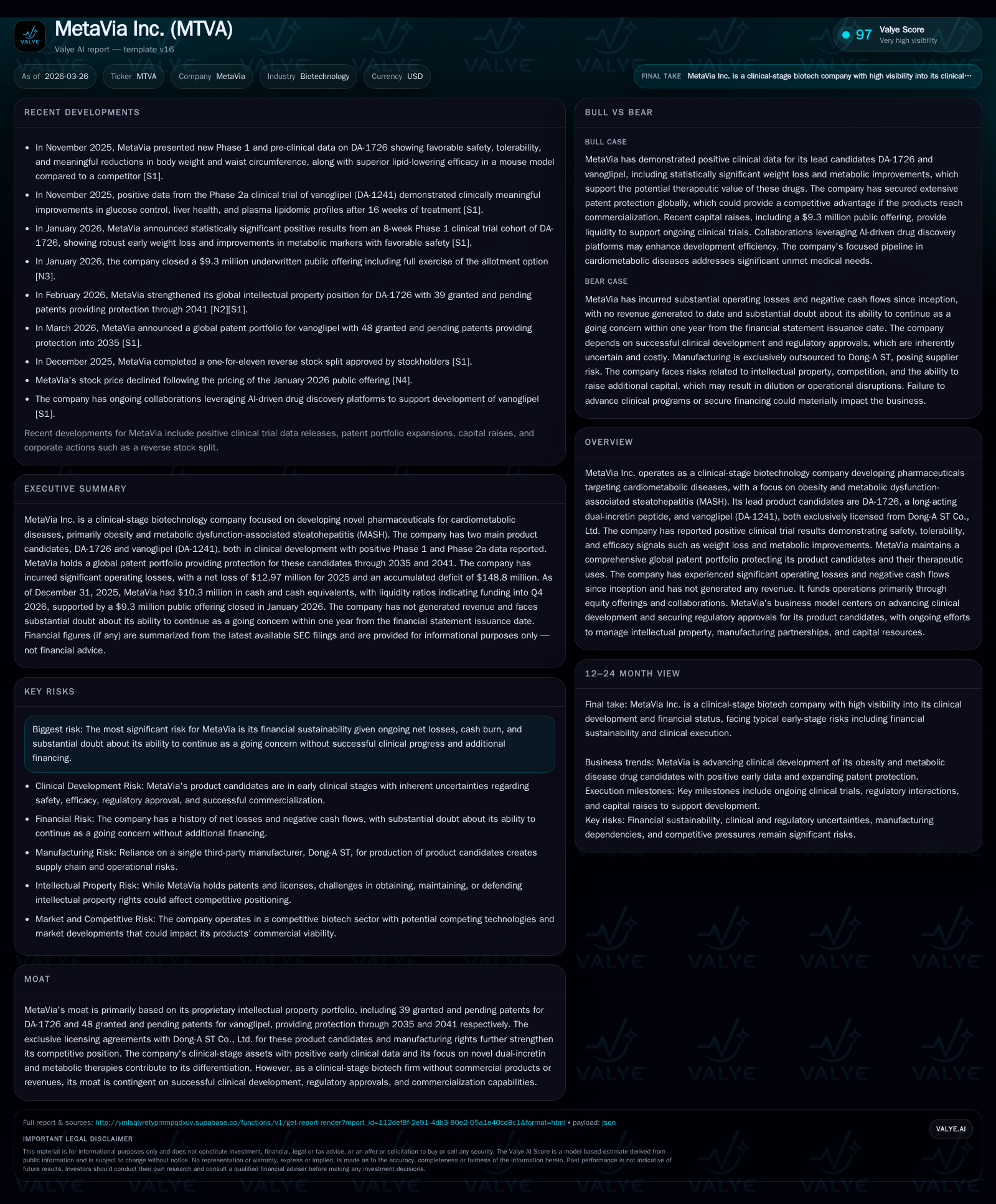
MetaVia Inc., a clinical-stage biotech focused on cardiometabolic diseases including obesity and MASH, leverages a powerful portfolio of patents licensed exclusively from Dong-A ST to safeguard its lead candidates DA-1726 and vanoglipel through 2041 and 2035 respectively. Positive Phase 1 and Phase 2a trial data reveal promising safety, tolerability, and efficacy signals such as weight loss and metabolic improvements that underpin the company’s scientific prospects. However, enduring operating losses with net income at negative $13 million in 2025 highlight ongoing financial constraints, compounded by auditor doubts over going concern status. MetaVia depends on raising additional capital to support upcoming higher-dose titration clinical studies and broader development programs. Its moat remains tied closely to intellectual property strength and successful regulatory pathways.
Evolution of MetaVia’s Clinical Pipeline and Patent Portfolio
MetaVia Inc., a clinical-stage biotechnology firm specializing in cardiometabolic disease therapeutics, notably obesity and metabolic dysfunction-associated steatohepatitis (MASH), anchors its growth strategy on two proprietary drug candidates: DA-1726 and vanoglipel (DA-1241). These compounds are exclusively licensed from Dong-A ST Co., Ltd., enabling the company to secure manufacturing rights alongside intellectual property control.
As of early 2026, MetaVia holds an expansive global patent portfolio comprising 39 granted and pending patents for DA-1726 that extend protection at least through 2041 [N2][S1]. This includes novel peptide structures and long-acting dual-incretin designs targeting obesity and related cardiometabolic conditions. Complementarily, vanoglipel boasts a robust portfolio of 48 issued or pending patents spanning the U.S., Europe, Japan, China, among others, protecting compositions, manufacturing processes, and therapeutic applications into approximately 2035 [S1]. This patent breadth establishes significant barriers to entry by competitors over a substantial timeline.
DA-1726 operates via dual-incretin receptor agonism—a mechanism increasingly recognized for addressing glucose regulation alongside weight management—distinguishing MetaVia’s approach within a crowded metabolic therapy landscape. The manufacturing exclusivity rights granted strengthen the company's prospective commercial positioning by controlling supply chain dynamics.
2025 Financial Performance: Operating Losses Amid Progress
MetaVia experienced sustained operating losses throughout its history without generating product revenues to date. The fiscal year ending December 31, 2025, reflects a meaningful contraction in these losses compared to prior years [F1]. Operating income improved from -$28.8 million in 2024 to -$13.7 million in 2025 (a roughly 52.4% improvement) while net loss narrowed from -$27.6 million to -$13.0 million—a sizeable yet continuing deficit [F1].
Operating cash flow followed suit with usage decreasing by approximately one-third year-over-year but remaining negative at about -$15.7 million [F1]. Capital expenditures were minimal at $2,000 indicating focused spending largely on R&D rather than physical assets [F1].
The company held $10.3 million in cash and equivalents with current assets of $10.9 million versus current liabilities of $5.6 million yielding a current ratio near 1.93 [F1]. Despite this liquidity buffer, auditors express substantial doubt about MetaVia's ability to continue as a going concern absent further successful financing efforts [S1][S11][S12]. This underlines persistent financial headwinds common among clinical-stage biotechs moving toward later-stage trials.
Historical performance (annual)
| FY | Net ($mm) | CFO ($mm) | OpInc ($mm) | Capex ($) | Net YoY |
|---|---|---|---|---|---|
| 2025 | -13 | -16 | -14 | 2000 | +53.0% |
| 2024 | -28 | -25 | -29 | 8000 | -121.3% |
| 2023 | -12 | -11 | -16 | 50000 | +10.7% |
| 2022 | -14 | -12 | -20 | 3000 |
Source: SEC companyfacts cache [F1].
Capital returns and efficiency (annual)
| FY | FCF ($mm) | ROE% |
|---|---|---|
| 2025 | -16 | -243.3 |
| 2024 | -25 | -347.9 |
| 2023 | -11 | -74.7 |
| 2022 | -12 | -64.2 |
Source: SEC companyfacts cache [F1].
Table shows operating metrics for FY2022-FY2025; YoY changes computed where data available [F1]
Clinical Trial Highlights and Novel Therapeutic Modalities
Throughout late 2025 into early 2026 MetaVia has reported encouraging clinical findings for both DA-1726 and vanoglipel which bolster confidence in the underlying science.
For DA-1726—a long-acting dual-incretin peptide—the Phase 1 multiple ascending dose (MAD) cohorts exhibited favorable safety and tolerability with pharmacokinetic profiles supporting once-weekly subcutaneous dosing [N2][S1]. Notably in an extended eight-week MAD cohort at the highest tested dose of 48 mg without titration showed early robust weight loss signals along with statistically significant reductions in waist circumference—a key metabolic risk metric—and meaningful improvements in glucose control parameters as well as liver stiffness measurements indicative of hepatic benefits [N2][S1]. Preclinical obese mouse models found DA-1726’s efficacy comparable to pemvidutide but with superior lipid-lowering effects—a point of differentiation in metabolic control.
Vanoglipel's Phase 2a results also underscored its dual activity across hepatic and systemic metabolic pathways demonstrating clinically meaningful improvements after sixteen weeks including enhanced glucose regulation markers and favorable plasma lipidomic profiles that suggest broad cardio-metabolic target engagement [N2][S1]. These data were strengthened by AI modeling conducted in collaboration with Syntekabio’s DeepMatcher® platform which validated inflammatory and cardiometabolic mechanisms supportive of advancement into MASH indication trials [N2][S1].
Industry-standard terminology such as MAD cohorts for dose escalation safety evaluation coupled with plasma lipidomics profiling showcase MetaVia's employment of advanced biomarker tools emphasizing translational research sophistication.
Growth Drivers: Intellectual Property and Strategic Collaborations
MetaVia’s growth trajectory is heavily influenced by its IP moat formed via exclusive licenses from Dong-A ST complemented by an aggressive patent filing strategy covering both product composition and therapeutic use domains expiring between the mid-2030s to early-2040s for key candidates [N2][S1][S6]. Such extensive patent coverage not only protects against generic competition but also secures manufacturing exclusivity critical for downstream commercialization economics.
The company’s partnership with AI-driven drug discovery firm Syntekabio serves as a strategic catalyst enhancing predictive analytics capabilities for target validation—an increasingly critical advantage within precision medicine pipelines [N2][S6]. Moreover collaboration terms extend beyond licensing into shared services agreements involving investigational drug manufacturing underscoring integrated operational synergies essential for cost-effective clinical progression [S21][S25].
This dual approach marries traditional biopharmaceutical IP defense mechanisms with cutting-edge AI-enabled discovery workflows providing differentiated scientific leverage amidst competitive cardiometabolic therapeutic markets.
Capital Structure, Liquidity, and Future Financing Needs
At December-end 2025 MetaVia maintained $10.3 million cash balances supported primarily through equity offerings including an underwritten public transaction in January yielding gross proceeds near $9.3 million plus warrant exercises totaling modest additional inflows [S1][S10][S11]. Equity accounted for nearly all funding sources given no material debt liabilities; however auditors flagged substantial doubt regarding continued viability absent further capital infusion within twelve months [S1][S22].
Operating cash burn remains elevated at approximately $15.7 million annually driven largely by research & development expenditures despite reductions from peak prior-year investment pace reflecting completed trial phases [F1][S21][S25]. The current ratio at nearly two times indicates short-term liquidity sufficiency but longer-term solvency hinges on successful equity raises or partnerships since no recurring revenue streams exist.
Management openly acknowledges plans for future fundraising activities encompassing equity sales via at-the-market offerings or collaborations though no firm commitments are yet secured leading to inherent uncertainty about financing timelines or costs implying potential dilution risks [S12][S14].
Projected Milestones: Upcoming Clinical Studies and Regulatory Pathways
While explicit financial guidance is absent from filings or press releases concerning revenue or profitability timelines—understandable given clinical stage status—the company highlights upcoming Phase 1 Part 3 titration trials targeting higher-dose escalation schedules for DA-1726 in obese healthy adult volunteers following recent IRB approval from Clinical Pharmacology of Miami [N2][S1]. These studies aim to better define safety margins balancing tolerability against optimized efficacy weighted toward durable metabolic improvements.
Additional forward catalysts expected involve data readouts from ongoing dose-ranging studies plus collaborative findings linked to AI-driven target confirmation efforts supporting regulatory dossiers preparation especially if Phase 2 trials yield confirmatory endpoints across cardio-metabolic disease spectrums including hypertension or type II diabetes contexts (analysis).
Investors should monitor announcements related to milestone achievements or any regulatory submissions potentially initiating accelerated review pathways given unmet medical needs incentives typical within obesity/MASH therapeutic segments (analysis).
Risks Surrounding Continued Financing and Regulatory Approval
MetaVia faces material risks primarily anchored on sustained financial strain owing to operating losses exceeding $12.9 million annually coupled with accumulated deficits near $149 million by end-2025 hampering capital raising flexibility without incurring significant dilution pressure on shareholders’ equity estimated around $5.3 million currently translating into approximate negative ROE levels around -243% reflective of non-revenue earners at this stage [F1][S1].
Regulatory complexities inherent in FDA approval processes particularly for novel dual-incretin modalities introduce execution uncertainties compounded by litigation risks arising from third-party intellectual property claims common within biotechnology sectors where patent validity or infringement disputes could impose costly protracted legal battles detracting resources from core development activities [S4][S6][S15][S16].
Moreover compliance hurdles span environmental health safety obligations associated with hazardous substances used during R&D plus healthcare fraud abuse laws potentially limiting approved commercialization frameworks imposing additional operational burdens under federal/state regimes globally [S7][S24].
Loss of key personnel or failure to protect trade secrets despite confidentiality measures could erode competitive advantages exacerbating execution risks further contributing to valuation volatility intrinsic to clinical-stage biopharma enterprises [S26].
Capital Allocation Dynamics: Burn Rates, R&D Spend, and Shareholder Returns
Capital deployment remains heavily concentrated on research & development functions consuming roughly half of total operating expenses which decreased from $21.6 million in direct R&D costs during FY2024 down to $6.8 million in FY2025 due primarily to winding down specific trial phases including closure credits related to DA-1241 clinical research organizations engagements offsetting nominal increases in employee compensation plus consulting fees as indirect costs [F1][S21][S25].
General & administrative expenses also declined slightly reflecting tighter budget controls with principal outlays around legal fees protecting intellectual property assets critical amid pervasive infringement risks throughout the sector but without any allocation toward dividend payments or share repurchase activities consistent with typical developmental stage companies lacking positive cash flow or earnings streams [F1][S9][S10].
Prepaid expenses related to outsourced contract research organization activities are capitalized under accounting standards until performance benchmarks trigger expense recognition providing transparency into operational cost timing structure supportive of project management.
The net free cash flow position remains negative exceeding $15.7 million annually underscoring continuous dependency on external financing sources locking equity holders into dilution risk until commercialization is achieved (analysis).
This analysis summarizes information derived solely from provided filings dated through March 26th, 2026 ([F1], [N#], [S#]) without incorporating external assumptions or forecasts beyond those explicitly stated. Given MetaVia's current developmental status accompanied by substantive financial losses described herein alongside promising yet early-stage clinical data sets backed by strong intellectual property positions prevailing uncertainties prescribe caution when evaluating their long-term commercial potential.
Disclaimer: This is research-only, informational analysis and not investment advice. It may include AI-generated interpretation and general industry context. Always verify important details using primary sources.

Comments