
Rockwell Medical’s Capital Constraints and Competitive Dynamics Define 2025 Performance
The company’s reliance on a concentrated customer base and tight liquidity amid operational streamlining framed its 2025 financial outcomes.
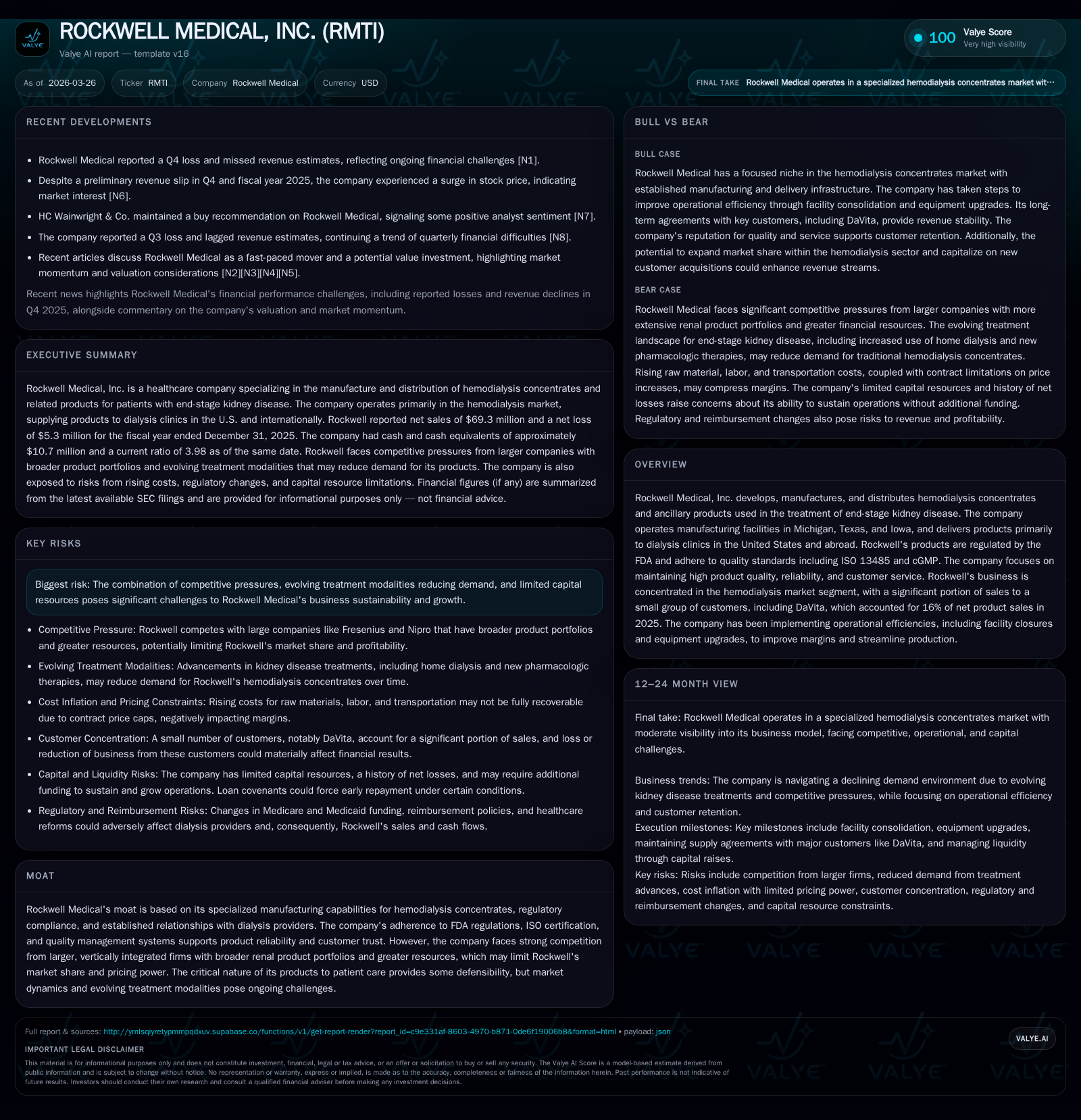
Rockwell Medical, Inc. operates within the specialized hemodialysis concentrates market where patient safety and product reliability are paramount. Despite its critical role, the company endured a marked revenue decline and swung to operating losses in 2025 as its largest customer, DaVita, significantly reduced purchases. Concurrently, competitive pressure from larger, vertically integrated firms limited pricing power while capital constraints imposed by debt covenants restricted strategic flexibility. Rockwell’s efforts to rationalize operations through facility closures and efficiency upgrades partially mitigated margin pressures but did not prevent negative cash flow or net losses for the year.
An Uneven Recovery: Rockwell Medical’s Historical Financial Performance
Rockwell Medical's financial results from fiscal years 2022 through 2025 illustrate a turbulent trajectory moderated by notable operational adjustments. Revenue contracted sharply from $101.5 million in 2024 to $69.3 million in 2025 (reported as net sales) due predominantly to a substantial reduction in volume from the company's largest customer, DaVita, which represented about 45% of sales in 2024 before dropping to approximately 16% in 2025 [F1][S4]. This shift materially impacted profitability; operating income fell from a small positive $608,000 in 2024 to a loss of $4.7 million in 2025, an adverse swing exceeding 870% year-over-year [F1]. Net income similarly deteriorated from a loss of $480,000 to $5.3 million negative over the same period.
Operating cash flow mirrored this pattern, reversing from positive $4.2 million in 2024 into negative territory with a $659,000 outflow in 2025 despite cost containment efforts [F1]. Capital expenditures halved year-over-year to approximately $542,000 as management scaled back investment amid tightening liquidity [F1]. The cumulative effect was an approximate negative free cash flow of $1.2 million for the year.
Historical performance (annual)
| FY | Net ($mm) | CFO ($mm) | OpInc ($mm) | Capex ($) | Net YoY |
|---|---|---|---|---|---|
| 2025 | -5 | -1 | -5 | 542000 | -1007.1% |
| 2024 | 0 | 4 | 1 | 1011000 | +94.3% |
| 2023 | -8 | -9 | -7 | +54.8% | |
| 2022 | -19 | -17 | -17 |
Source: SEC companyfacts cache [F1].
Capital returns and efficiency (annual)
| FY | FCF ($mm) | ROE% |
|---|---|---|
| 2025 | -1 | -14.4 |
| 2024 | 3 | -1.5 |
| 2023 | -39.6 | |
| 2022 | -132.4 |
Source: SEC companyfacts cache [F1].
Revenue figures reflect net sales; operating income and cash flows are reported values [F1].
Margins Under Pressure: Revenue Drivers and Cost Management
Declining revenue exerted immediate margin pressures on Rockwell Medical's business model. The cost of sales declined less steeply relative to revenue drop—from about $84 million in 2024 down to roughly $57.6 million in 2025—but this contraction was insufficient to preserve gross margins. Gross profit fell by more than one-third from $17.48 million to just under $11.7 million [S4][F1], underscoring rising cost absorption relative to output.
Employee compensation increased slightly despite reduced volumes—$10.1 million vs $9.45 million—partly attributable to retained personnel needed for ramping efficiency initiatives rather than production scale [S4]. Administrative expenses declined moderately but remained elevated at over $6 million.
Management responded with significant measures including closing the South Carolina facility mid-2025 and initiating machinery upgrades at core plants aimed at streamlining manufacturing process efficiency [N1]. These steps contributed incrementally toward cost containment but could not offset margin compression given fixed-cost burdens and volume loss.
Customer Concentration and Competitive Intensity in Dialysis Concentrate Markets
Rockwell’s heavy reliance on major customers presents both concentration risk and negotiating challenges impacting revenue stability.
DaVita alone accounted for approximately 16% of total net product sales and roughly one-fifth of consolidated accounts receivable at year-end December 31, 2025 [S4][F1]. Earlier dependence was even starker with DaVita representing nearly half of sales previously—a reduction driven by DaVita shifting supplier preference in late 2024 [S14]. Another sizeable receivables exposure involved one additional unspecified customer holding some 17% of total accounts receivable balance.
Market competition intensifies these challenges. Key competitors such as Fresenius leverage vertical integration—combining concentrate supply with their dialysis service provision—to bundle products strategically offering lower prices on concentrates as loss leaders [S1][S14]. This dynamic impairs Rockwell’s pricing power due to its narrower product focus lacking comparable portfolio breadth or service integration.
Such bundling strategies reduce contract leverage for independent concentrate makers by pressuring price points below sustainable thresholds absent broader service lock-in mechanisms popular among large dialysis providers.
Operational Rationalization: Facilities and Efficiency Initiatives
Operationally, Rockwell embarked on facility consolidation during FY2025 to rightsize costs commensurate with volume declines stemming largely from lost business with DaVita.
The company ceased operations at its South Carolina manufacturing site during Q3-2025 as part of ongoing streamlining measures designed to improve manufacturing yield and reduce overhead [N1]. Concurrent investments targeted equipment modernization across main plants located in Michigan, Texas, and Iowa employing specialized technologies tailored to dialysis concentrate formulation requirements.
While necessary for immediate financial sustainability, these rationalization actions carry tradeoffs limiting short-term production footprint flexibility should volumes rebound quickly—highlighting resource constraints relative to larger industry peers who maintain broader manufacturing networks.
Liquidity Stress Points and Capital Allocation Constraints
Rockwell faces noteworthy liquidity constraints under its amended loan agreement (A&R Loan Agreement) with Innovatus Life Sciences Lending Fund I LP which contains stringent covenants restricting operational latitude.
At December 31, 2025, the company held approximately $25 million in combined cash, equivalents and available-for-sale investments—with working capital standing near $28.6 million—and was compliant with all loan covenants including revenue-based tests tied specifically to hemodialysis product sales performance [F1][S5][S6][S7]. Despite this compliance cushion Rockwell must navigate limits on incurring further indebtedness without lender consent until DaVita reduces its preferred stock holdings below specified thresholds [S21].
Covenants encompass liquidity floors pegged either to three-month burn rates or fixed minimums enhanced by capital lease obligations while prohibiting dividend distributions or asset dispositions without approval [S7][S21]. Interest-only payments extend up to January 2027 followed by principal amortization through maturity at January 2029.
This framework encumbers capacity for opportunistic investments or aggressive growth initiatives given the need for disciplined cash preservation amid earnings volatility.
Regulatory Compliance and Product Risk: Impact on Business Continuity
The medical nature of Rockwell’s dialysis concentrates imposes rigorous regulatory scrutiny enforced primarily by the U.S. Food & Drug Administration (FDA). The company maintains certifications under ISO 13485 quality management standards alongside adherence to current Good Manufacturing Practices (cGMP) [S23].
FDA mandates include routine inspections—as occurred in 2025—with subsequent corrective actions required though no material regulatory sanctions were recorded that year [S23]. Nonetheless compliance obligations embed significant ongoing expense and expose Rockwell to risks such as product recalls or liability claims which could disrupt supply continuity or damage customer confidence.
Intellectual property disputes also present latent litigation hazards stemming from competition within tightly contested niche medical device technologies [S12][S28]. Product side effects or adverse reports may amplify exposure given patient vulnerability inherent in end-stage renal disease treatments.
Evaluating Growth Prospects Amid Treatment Evolutions and Market Shifts
Longer term growth prospects remain clouded by evolving treatment modalities that may lessen demand for traditional hemodialysis concentrates. Emerging pharmaceutical approaches or alternative renal therapies could reshape volumes downward over time [N2][N3][S8].
Rockwell is pursuing incremental expansions via new account acquisitions and portfolio diversification endeavors aiming to offset declines linked directly to lost large customers [S14]. However such pipeline initiatives face robust competition requiring sustained innovation investment despite constrained capital availability.
Absent breakthroughs expanding product breadth beyond concentrates or securing broader clinical adoption curves consistent growth will likely remain challenged by entrenched competitors wielding scale advantages.
Outlook and Key Milestones: What Investors Should Watch
With no explicit formal guidance provided recently [N1], focus lies on monitoring quarterly revenue trends—particularly new contract wins outside DaVita—as well as margin progression reflecting ongoing operational rationalization effects.
Key milestones include upcoming renewal negotiations with large dialysis providers whose purchasing choices materially influence revenue trajectories given concentrated sales exposures [S3][N1]. Regulatory developments impacting manufacture or distribution protocols remain another variable warranting close observation due to potential cost inflection points.
Additionally attention should center on compliance with financial covenants embedded within debt instruments which govern capital access latitude amid volatile earnings.[S6]
Cash Flow, Returns, and Shareholder Value Considerations
Rockwell’s returns profile underscores persistent challenges driving prolonged cash deficit dynamics; the company reported negative approximate return on equity near -14.4% based on its net loss against shareholders’ equity near $37 million as of year-end December 31, 2025 [F1].
Free cash flow generation remained negative due primarily to operating losses overshadowing curtailed capital expenditures calculated around half a million dollars—the lowest level seen since earlier profitable periods were lost [F1].
No dividends have been paid since well before FY2018 reflecting caution amid operating deficits compounded by liquidity restrictions imposed by secured debt agreements limiting discretionary capital deployment including share buybacks [F1].
Given uncertain near-term recovery timelines paired with competitive pricing headwinds maintaining strict capital discipline is essential though it reduces prospects for restoring shareholder distributions until substantive profitability resumes.[N1]
This analysis synthesizes publicly filed financial data together with recent news disclosures emphasizing factual context without endorsing any investment action or forecast beyond stated evidence. Rockwell Medical's operational niche delivers critical patient care inputs underpinned by strong regulatory frameworks yet contends with acute market pressures constraining growth and profitability near-term. Ongoing monitoring of revenue diversification progress against covenant compliance represents key gauges for future strategic viability.
Disclaimer: This is research-only, informational analysis and not investment advice. It may include AI-generated interpretation and general industry context. Always verify important details using primary sources.

Comments