
Atossa Therapeutics Expands (Z)-Endoxifen Clinical Trials While Managing Rising Operating Losses
Clinical-stage progress coupled with escalating R&D spending challenges Atossa's path to commercialization.
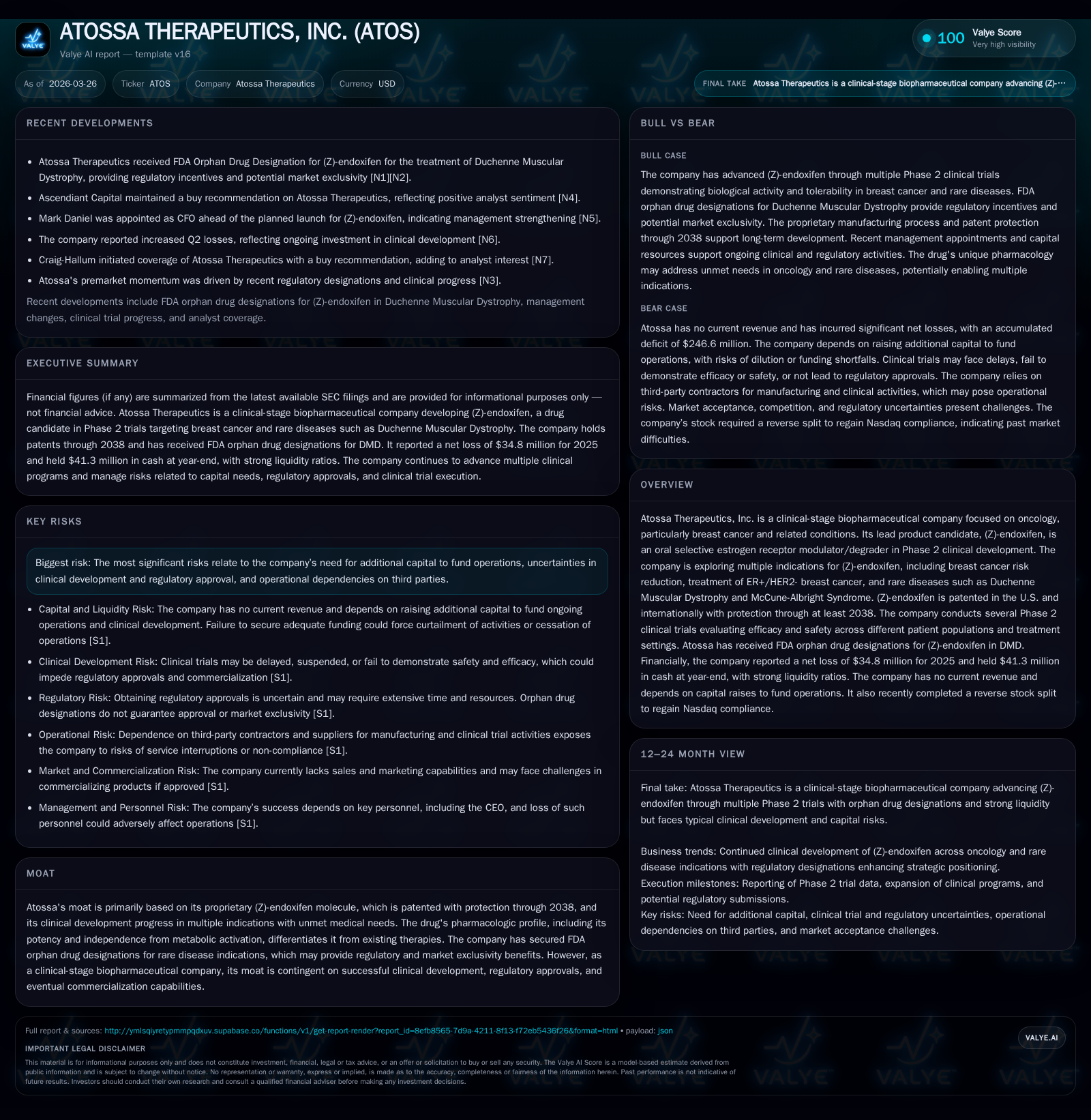
Atossa Therapeutics, a clinical-stage biopharmaceutical company, centers its pipeline on the oral selective estrogen receptor modulator/degrader (Z)-endoxifen, currently in Phase 2 trials targeting breast cancer and select rare diseases. Growth has been hampered by sustained operating losses driven by increased research and development investment. With patent protection secured until 2038 and orphan drug designations attained, Atossa’s prospects hinge on clinical advancement and capital availability. The company ended 2025 with $41 million cash, but continued negative cash flows underscore the need for additional funding to support operations beyond the next year.
Company Overview
Atossa Therapeutics, Inc. operates as a clinical-stage biopharmaceutical company with a focused portfolio on oncology and related conditions, prominently breast cancer. Its flagship candidate is oral (Z)-endoxifen, a selective estrogen receptor modulator/degrader (SERM/D), currently undergoing multiple Phase 2 clinical trials targeting several indications including breast cancer risk reduction, treatment of estrogen receptor positive/human epidermal growth factor receptor 2 negative (ER+/HER2-) breast cancer subtypes, and rare genetic disorders such as Duchenne Muscular Dystrophy (DMD) and McCune-Albright Syndrome [S1].
The (Z)-endoxifen molecule stands apart pharmacologically due to its higher potency relative to tamoxifen — it directly inhibits estrogen receptor signaling, induces degradation of estrogen receptors, and promotes apoptosis in ER+ breast cancer cells without requiring metabolic activation via CYP2D6 enzymes. This eliminates interpatient variability seen with tamoxifen therapeutics dependent on individual metabolism [S1].
Patents covering (Z)-endoxifen have been granted both in the United States and internationally, conferring protection extending through at least November 17, 2038, creating significant intellectual property moat potential if successfully commercialized [S1]. Additionally, the FDA has awarded orphan drug designations for use in DMD indication, which may afford regulatory exclusivity benefits [S1].
Historical Financial Performance
Financially, Atossa remains in pre-revenue status consistent with its early clinical stage profile. Revenue last meaningfully recorded was approximately $1,758 in fiscal years 2015 and 2016 before returning effectively to zero thereafter [F1]. The operating costs are dominated by research and development expenditures triggered by advancing clinical programs.
Operating losses have been mounting: operating income declined from -$27.6 million in 2024 to -$37.1 million for the full year 2025 — an increase of approximately 34.5% year-over-year [F1]. Correspondingly, net income worsened by roughly 36%, reaching a net loss of about $34.8 million in 2025 [F1]. Cash outflows from operating activities mirror this trend with cash burn intensifying from about $21 million in 2024 to nearly $29.8 million free cash flow deficit after accounting for minimal capex ($23 thousand) in 2025 [F1].
This pattern reflects a stepped-up investment phase characteristic of companies progressing through critical mid-stage clinical data readouts that require substantial funding before product approval or partnership acquisition [S11].
Historical performance (annual)
| FY | Net ($mm) | CFO ($mm) | OpInc ($mm) | Capex ($) | Net YoY |
|---|---|---|---|---|---|
| 2025 | -35 | -30 | -37 | 23000 | -36.3% |
| 2024 | -26 | -21 | -28 | 19000 | +15.3% |
| 2023 | -30 | -21 | -31 | 14000 | -11.6% |
| 2022 | -27 | -21 | -28 | 27000 |
Source: SEC companyfacts cache [F1].
Capital returns and efficiency (annual)
| FY | Buybacks ($) | FCF ($mm) | ROE% |
|---|---|---|---|
| 2025 | -30 | -88.4 | |
| 2024 | 0 | -21 | -35.7 |
| 2023 | 1475000 | -21 | -33.1 |
| 2022 | -21 | -22.9 |
Source: SEC companyfacts cache [F1].
Note: Revenues shown for earlier periods are minimal reflecting lack of commercial products.
Drivers of Past Performance
The losses correspond with Atossa's continued focus on bolstering its clinical trial infrastructure and expanding the patient cohorts across multiple indications for (Z)-endoxifen. Research and development spend escalated markedly from approximately $14.1 million in calendar year 2024 to $21.2 million in calendar year 2025 reflecting expansion of Phase 2 studies including adjuvant and neoadjuvant therapy trials as well as rare disease applications like DMD [S11]. Given that the CEO allocates significant time towards oversight of these initiatives as well as direct involvement in product development activities—and is included proportionally in R&D expense—management salary expenses contribute materially to this escalation [S11].
Operating expenses beyond R&D also include general administrative costs and compliance with extensive regulatory requirements governed by FDA statutes along with corresponding EU regulations for prospective international operations [S13][S25]. These regulatory complexities entail significant procedural investments not only prior to approval but carrying through post-market surveillance obligations.
Future Growth Prospects
Atossa's growth hinges crucially on several factors linked primarily to successful clinical advancement:
- Completion of Phase 2 trials demonstrating efficacy and safety across key therapeutic areas — this includes validation for breast cancer risk reduction as well as treatment efficacy against ER+/HER2- breast tumors resistant to conventional hormonal therapies given (Z)-endoxifen's ability to circumvent metabolic activation pathways.
- Expansion into orphan indications like DMD where regulatory incentives (orphan drug exclusivity) provide strategic market advantage if approved [S1].
- Potential collaborations or partnerships could augment resources or expedite commercialization efforts consistent with their business strategy emphasizing opportunistic alliances alongside internal development [S1].
However, growth may be constrained by:
- Ongoing capital requirements necessitating dilution or debt despite current cash reserves.
- Regulatory hurdles across multiple jurisdictions — European HTA assessments could influence pricing/reimbursement landscapes adversely while differing standards may complicate regulatory filings internationally [S9][S25].
- Competition from other biopharmaceutical firms developing SERMs/SERDs or other novel hormone receptor-targeted therapies with faster clinical timelines or broader indications [S17].
- Operational dependencies on third-party contract research organizations (CROs), manufacturers subject to quality controls and FDA/EMA inspections introduce execution risk that could delay trial completion or approval submission timelines [S24][S26].
Financial Position & Capital Allocation
Atossa concluded fiscal year 2025 with approximately $41.3 million in cash and equivalents against $8.3 million current liabilities yielding a strong current ratio of approximately 5.53x [F1][S22], indicating solid short-term liquidity.
Nonetheless, persistent negative free cash flow—approximately negative $29.8 million for the year—underscores that additional capital raises will be necessary to sustain operations beyond the medium term absent material changes such as licensing agreements or revenue generation upon approvals [F1][S22]. The company has historically utilized at-the-market offering agreements but saw no warrant activity during the last reported period indicating past reliance on equity issuance as primary funding avenue is currently paused or modulated pending developmental milestones [F1][S22].
No dividends or stock repurchases have been declared given cash preservation imperative aligned with R&D priorities—the last buyback documented was modest ($1.475 million) in fiscal year ending December 31, 2023 [F1]. Return metrics such as ROE remain deeply negative (-88%) consistent with heavy investiture predominating over any revenue inflow [F1]. The emphasis remains firmly on investing available capital almost exclusively into clinical advancement rather than shareholder distributions.
Regulatory & Compliance Landscape
Atossa’s operations are subject to rigorous regulatory oversight predominantly by the U.S. FDA under the Federal Food Drug and Cosmetics Act alongside extensive compliance requirements within European jurisdictions under EMA guidelines which affect clinical trial conduct, marketing authorization applications (MAA), manufacturing practices (GMP), pharmacovigilance obligations post-market release including safety update reporting obligations plus promotional restrictions tied closely to approved indications’ Summary Product Characteristics documents [S13][S25][S12]. These layers necessitate ongoing vigilance around adherence or risk sanctions including delays or suspensions impacting go-to-market timing.
Additionally noted risks encompass potential liability under federal laws governing healthcare fraud prevention — Anti-Kickback Statute implications impacting interactions with prescribing physicians — alongside consumer protection statutes relevant particularly where off-label promotion is prohibited [S4][S7][S8]. Data privacy regulations such as GDPR/UK GDPR also impose constraints on personal health data processing tied particularly to EU clinical trial participants which compel costly compliance measures adding non-trivial overheads especially amid evolving legislation related to AI-enabled technologies usage among vendor partners [S15][S16][S18][S29].
What To Watch Going Forward (Analysis)
Important developments moving forward would include:
- Completion and announcement of Phase 2 trial results which will signal whether efficacy benchmarks sufficient for advanced study phases or filing submissions have been met.
- Indications of formal partnerships or licensing deals which could supplement capital needs while broadening distribution capabilities.
- Updates on regulatory submissions especially those connected with obtaining orphan drug marketing approvals inside U.S. or promising key EU markets.
- Capital raise activity given burn rate exceeding current liquidity projections past next twelve months highlighting ongoing financing risk.
- Competitive positioning shifts especially regarding any newly emerging SERMs/SERDs targets impacting market dynamics within endocrine-driven breast cancer segments.
- Clarity around reimbursement pathways under evolving health technology assessment frameworks most notably within major EU countries under Health Technology Assessment Regulation effective since early January 2025 impacting pricing outlooks [S9].
Conclusion
Atossa Therapeutics sits at an inflection point typical for specialized early-stage biotech: their proprietary molecule brings clear scientific advantages supported by patent lifeline potentially extending beyond two decades enabling various oncological and rare disease applications pending positive clinical outcomes. However substantial losses reflect necessary heavy R&D expenditure supporting trial maturation while capital sufficiency pressures underscore execution risks inherent prior to revenue-generating product launches.
The next several quarters should clarify whether compelling efficacy data and regulatory advancements can materialize mitigating financial strain through partnership leverage or eventual commercialization upside. Until then investors must weigh promising pharmacologic differentiation against execution risks amplified by complex global regulatory ecosystems combined with structural financing requirements inherent within pre-revenue developmental companies.
Disclaimer: This analysis is based solely on publicly available information reviewed herein up to March 26, 2026 without offering investment advice or price forecasts.
Disclaimer: This is research-only, informational analysis and not investment advice. It may include AI-generated interpretation and general industry context. Always verify important details using primary sources.

Comments