
Range Capital Acquisition Corp. Probes Untapped Assets With $115 Million Trust Backing
As a newly formed SPAC, Range Capital Acquisition Corp. leverages its management expertise and trust account to seek undervalued assets across sectors without an identified target yet.
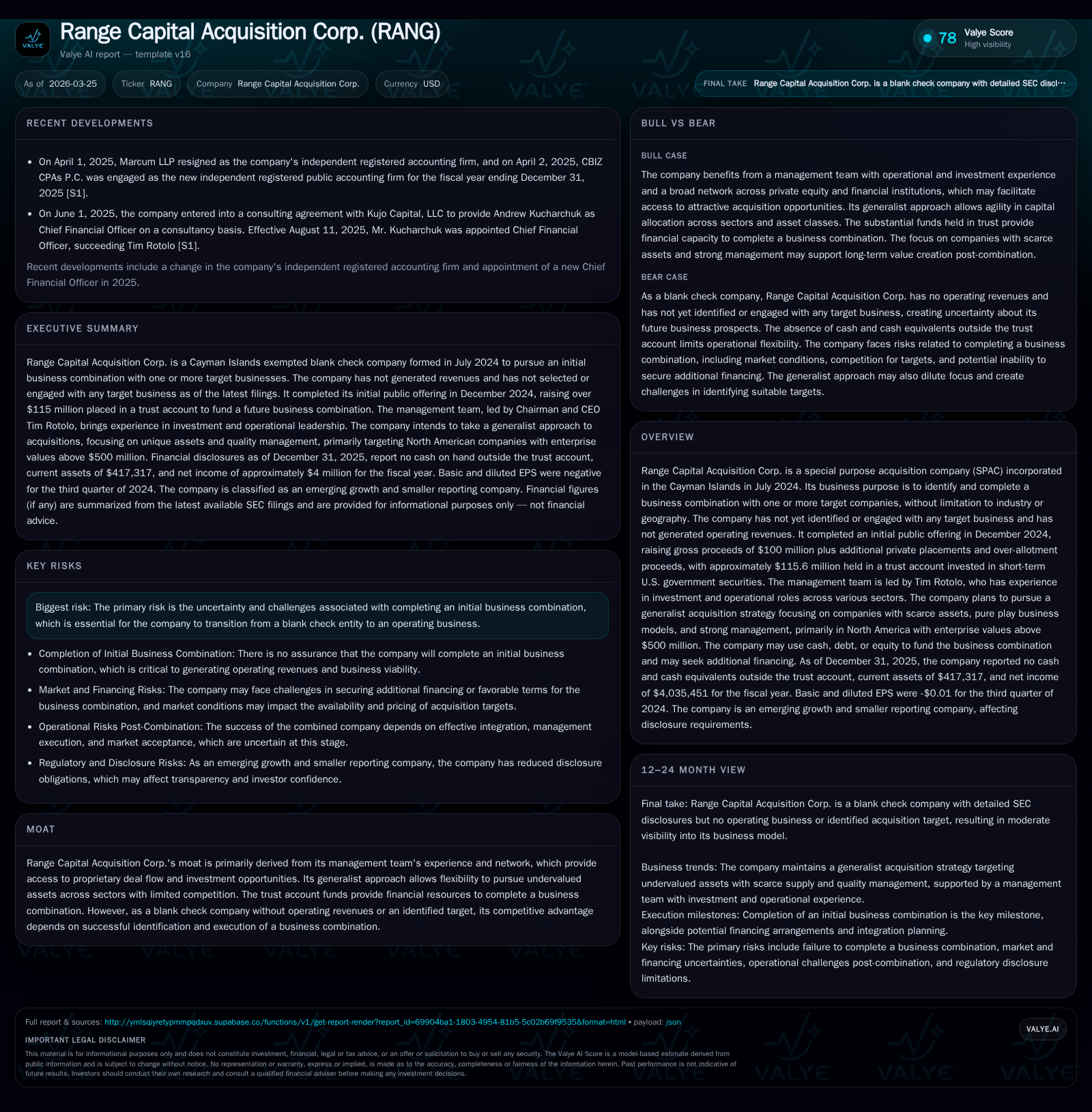
Range Capital Acquisition Corp., incorporated in mid-2024, completed its IPO in late 2024 raising gross proceeds exceeding $115 million, which reside in a trust account invested conservatively in U.S. government securities. The company operates as a blank check entity with no revenues, focusing on a generalist acquisition strategy aimed at scarce assets underpinned by an experienced leadership team led by Tim Rotolo. Financial performance thus far reflects typical SPAC operating costs and non-operating results, while the main challenge remains completing a business combination within prescribed timeframes. Investors should track developments around target identification, transaction structure, and shareholder redemption activity.
Launch Phase: IPO Execution and Capital Foundation
Range Capital Acquisition Corp., incorporated in July 2024 as a Cayman Islands exempted company, completed its initial public offering (IPO) on December 23, 2024, issuing 10 million units at $10 per unit. Each unit comprised one ordinary share and one right exercisable for one-tenth of an ordinary share upon completion of a business combination. Alongside this, simultaneous private placements totaling 400,000 units raised $4 million from sponsor-related entities and EarlyBirdCapital Inc. Furthermore, the underwriters fully exercised their over-allotment option on January 3, 2025, purchasing an additional 1.5 million units generating proceeds of $15 million; another private placement shortly following raised $375,000 [S3][S4][S7].
Net IPO proceeds aggregated approximately $115.6 million after pricing adjustments and placements were deposited into a trust account. This trust holds funds primarily in short-term U.S. government securities with maturities not exceeding 185 days or money market funds compliant with Rule 2a-7 under the Investment Company Act. The conservative investment approach shields principal pending deployment toward business combinations or shareholder distributions upon dissolution [S3][S7]. This war chest forms the cornerstone financial foundation enabling Range Capital to pursue transactions on favorable terms without reliance on immediate external financing.
Financial Footprint So Far: Early-Stage Performance Metrics
Reflecting its status as a special purpose acquisition company without operations or commercial revenues, Range Capital has incurred administrative and operating expenses related to legal fees, advisory costs, and organizational startup outlays.
Operating income declined from -$146,618 in fiscal year (FY) 2024 to -$802,565 in FY 2025, marking a -447% year-over-year change consistent with heightened preparatory activities inherent in SPAC life cycles [F1]. Despite operating losses, net income swung positively to $4,035,451 in FY 2025 from a minor loss in FY 2024 (-$39,474), driven mainly by non-operating items such as changes in fair value of warrant liabilities or gains tied to investments.
Cash flows from operations also deteriorated from -$334,275 in 2024 to -$587,281 in 2025 illustrating ongoing negative cash burn ahead of any acquisition-related transactions. Shareholders' equity contracted from $846,540 reported at year-end 2024 down to $210,695 at end of 2025 partly reflecting accounting adjustments associated with fair value measurements and possibly warrants [F1].
The resultant return on equity ratio computed from reported net income over equity stood extraordinarily high at approximately 1915%, underscoring how low equity bases combined with valuation changes yield statistical distortion unrepresentative of operational profitability but typical for blank-check entities [F1]. These figures are characteristic of the SPAC model wherein financial scale and actual earnings depend wholly upon successful business combinations.
Historical performance (annual)
| FY | Net ($mm) | CFO ($) | OpInc ($) | Net YoY |
|---|---|---|---|---|
| 2025 | 4 | -587281 | -802565 | +10323.1% |
| 2024 | 0 | -334275 | -146618 |
Source: SEC companyfacts cache [F1].
Capital returns and efficiency (annual)
| FY | ROE% |
|---|---|
| 2025 | 1915.3 |
| 2024 | -4.7 |
Source: SEC companyfacts cache [F1].
Table: Select Annual Financials showcasing normalized SPAC early-stage cash burn and valuation-driven net results
Management’s Strategic Edge: Experience and Network Leverage
At the helm is Chairman and CEO Tim Rotolo whose track record includes founding Lloyd Harbor Capital Management overseeing roughly $350 million assets under management (AUM) as of December 31, 2025. Rotolo's prior leadership roles encompassed public listings and operational oversight particularly focused on capital-constrained sectors such as energy equipment leasing and specialty finance platforms [S7].
Rotolo’s industry relationships funnel proprietary deal flow spanning family offices, private equity funds, hedge funds alongside legal and banking professionals situated across domestic and international markets providing Range Capital distinctive access to early-stage transaction opportunities typically unavailable via open auction processes [S7]. This network constitutes a critical advantage for sourcing quality targets amid competitive scarcity.
Generalist Approach to Asset Selection: Flexibility and Focus on Scarcity
Unlike sector-specific SPACs tethered to narrow themes that risk valuation compressions if sector outlook dims before deal closure; Range Capital embraces a broad mandate unrestricted by geography or industry verticals [S1][S12]. Its search gravitates toward "scarce assets" characterized by intrinsic uniqueness creating supply-demand imbalances ripe for premium valuation post-combination. Moreover it seeks "pure play" companies whose operational focus offers transparency over conglomerate-diversified entities prone to strategic dilution.
This opportunistic lens favors capital constrained industries often overlooked due to technical complexity or regulatory hesitancy such as segments within traditional energy transitioning amid renewables disruption or niche financial services domains lacking liquidity injection [S12]. The approach enhances agility permitting reallocation away from frothy sectors toward undervalued niches exhibiting durable demand frameworks.
Liquidity and Trust Account: The War Chest for Acquisitions
Funds amounting initially to approximately $10.05 per public share plus interest are secured within the Trust Account pending deployment at combination closing or liquidated back exactly to shareholders if no deal materializes within prescribed timelines (~24 months post-IPO) [S3][S7][S11].
By design these monies remain segregated invested conservatively in short-dated U.S Treasury securities compliant with high-grade money-market regulations until released pursuant to transparent proxy or tender offer procedures safeguarding public investors’ principal capital.
Though the company retains flexibility to supplement transaction funding through third-party debt or equity offerings concurrent with deal execution if beneficial; Range Capital currently maintains no arrangements nor obligations to raise such incremental capital thereby preserving initial structure simplicity but limiting leverage options [S4][S5].
Risks Inherent to Blank Check Entities and Execution Challenges
Range Capital’s trajectory hinges entirely on successfully identifying suitable private targets willing to enter into merger agreements amenable both commercially and regulatorily within defined windows after IPO closure [S2][S4][S5].
Factors clouding visibility include potential competition for quality candidates amid crowded SPAC markets; adverse sector cyclicality impacting valuations; possible need for costly bridge financing absent initial cash-only deals; complexities navigating shareholder redemption rights which can materially impact deal economics; as well as selection bias risks given management dual loyalties including related party entities pursuing similar objectives.
Additionally consideration must be given that forthcoming target companies may be developmental stage ventures or financially unstable requiring operational turnarounds increasing integration risks relative to seasoned businesses traditionally accessed through conventional IPOs.
Consequently these uncertainties underscore inherent volatility attached to such business models which typically trade on anticipated rather than demonstrated earnings capabilities pre-deal.
Capital Allocation Framework: No Dividends But Strategic Deployment Anticipated
Given zero revenue generation pre-business combination coupled with preservation mandates governing the Trust Account funds excluding return of capital distributions prior transaction success; Range Capital distributes no dividends nor engages in stock buybacks during this phase [S8][S11][F1].
Once an acquisition occurs capital deployment priority will pivot towards funding growth initiatives broadly defined encompassing working capital needs; servicing any assumed debt obligations arising coincidently; scaling operations incrementally via bolt-on acquisitions; and addressing operational expenditures tied directly or indirectly with newly public enterprise formation.
This reinvestment-heavy stance aligns investor expectations towards value accretion born primarily through strategic consolidation rather than yield generation thus defining shareholder returns predominantly through stock price appreciation post-combination.
Monitoring Milestones: What Investors Should Watch Next
Given absence of explicit forward guidance or disclosed target discussions presently public sources do not anchor precise forecast metrics thus necessitating attention toward qualitative event markers including:
- Official announcement of selected target(s) initiating proxy/regulatory filings reflecting negotiated terms,
- Disclosure of supporting third-party financing arrangements augmenting transaction structuring,
- Timing toward statutory deadlines implicating extension requests or liquidation scenarios,
- Shareholder redemption election statistics conveying market confidence signals,
- Appointment updates regarding deal advisors or changes among executive ranks which could presage shifting strategic directions.
Such milestones comprise critical intelligence inputs framing assessment horizons substantiating evolving valuation expectations while informing risk tolerances.
This analysis aims solely to present verified information extracted from SEC filings and structured financial data without provision of investment recommendations. Readers should consider all inherent uncertainties typical of blank check companies when evaluating such entities.
Disclaimer: This is research-only, informational analysis and not investment advice. It may include AI-generated interpretation and general industry context. Always verify important details using primary sources.

Comments