
Grayscale Sui Staking ETF’s Financial Positioning Amid Digital Asset Volatility
A focused analysis on GSUI's financial outcomes, operational infrastructure, and regulatory risks shaping its standing in the evolving digital asset marketplace.
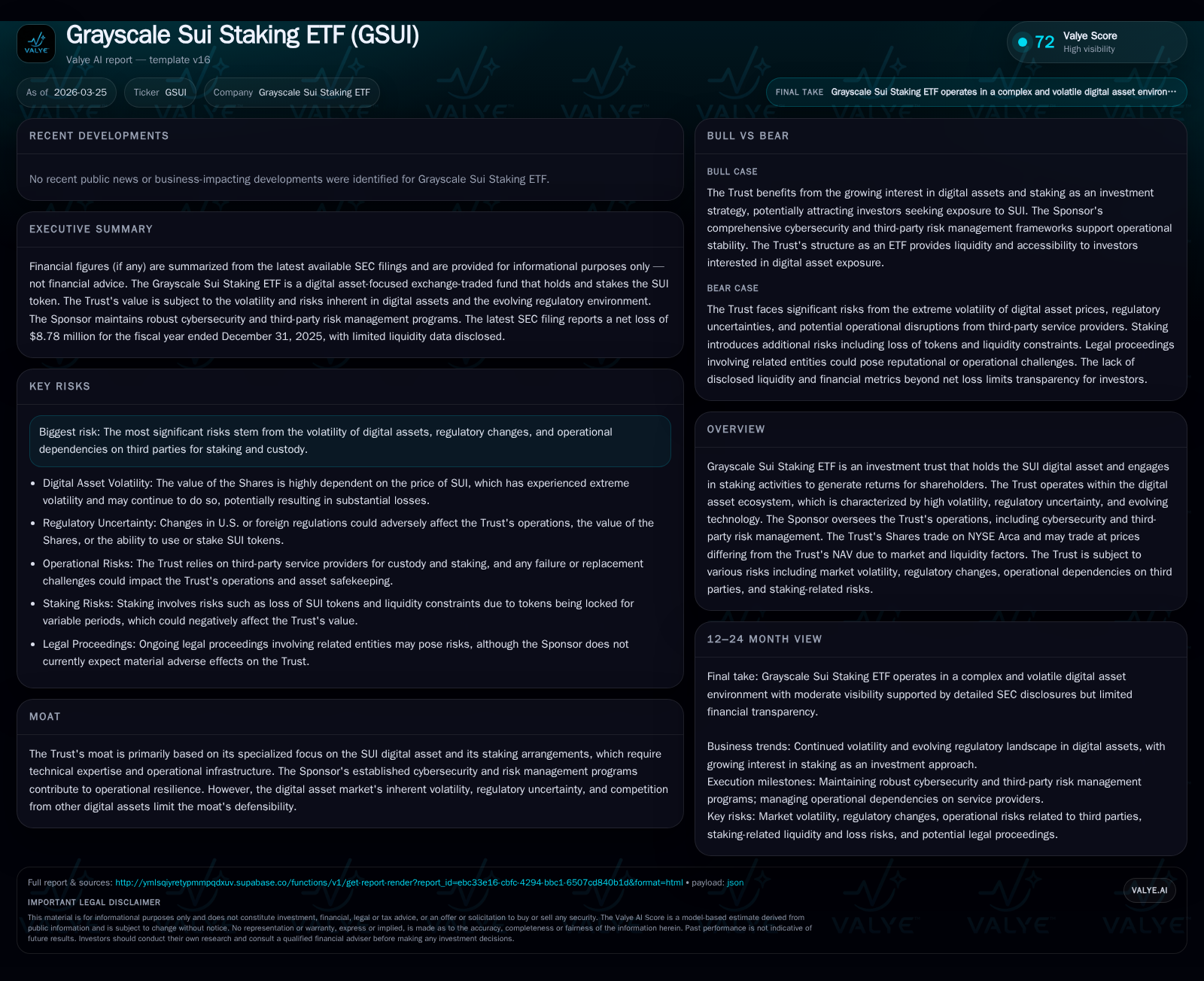
The Grayscale Sui Staking ETF (GSUI) operates within the volatile digital asset landscape by leveraging staking of the SUI token to generate returns. Its recent financial results reveal losses largely tied to fluctuations in SUI's market value, while staking operations and cybersecurity programs form integral pillars of operational resilience. Regulatory uncertainty—especially regarding classification of digital assets as securities and evolving money transmitter laws—presents significant potential headwinds. Investors should closely monitor regulatory developments, liquidity conditions, and technical staking execution as key variables affecting GSUI’s future performance.
Historical Financial Performance and Volatility Drivers
GSUI’s financial performance through fiscal year 2025 has been marked by significant net losses. According to the latest companyfacts data, the Trust posted a net income loss of approximately -$8.78 million at year-end 2025 [F1]. This outcome fundamentally reflects the extreme price volatility inherent in the underlying SUI digital asset. Such volatility translates directly into fluctuations in the Trust's net asset value (NAV) since GSUI's assets are fully backed by SUI tokens subject to market dynamics.
Given there are no multi-year net income figures publicly disclosed beyond this single point from [F1], revenue detail or margin analysis is unavailable. However, it is reasonable—based on the nature of digital asset investment vehicles—to attribute earnings swings mainly to price changes rather than operational income variability. No dividends or capital returns have been indicated which aligns with a structure focused on accumulation through staking rather than distributions.
Historical performance (annual)
| FY |
|---|
| 2025 |
Source: SEC companyfacts cache [F1].
Note: YoY change omitted due to single year data availability.
Evolving Regulatory Environment and Its Impact on GSUI
Regulatory developments represent one of the most formidable challenges facing GSUI. The U.S. Securities and Exchange Commission (SEC) disclosures highlight several risk vectors: potential classification of SUI as a security could trigger compliance mandates or lead to extraordinary expenses; money service business or money transmitter regulations may impose costly licensing requirements; evolving tax interpretations of digital assets might burden shareholders with unforeseen liabilities [S1][S3][S4].
Additionally, foreign jurisdictions' regulatory actions could restrict network operations or market access for SUI tokens, indirectly affecting GSUI’s underlying asset values [S4]. These regulatory uncertainties inject valuation risk premiums that investors must price in. The Trust acknowledges that any suspension in redemption mechanisms or failure by authorized participants to fulfill roles could exacerbate liquidity constraints [S6].
It is also pertinent that ongoing litigation involving affiliates such as Grayscale Operating LLC may impose indirect reputational or operational risks despite currently lacking direct material impact on GSUI [S3].
Staking Operations: Technical Expertise as a Competitive Moat
The Trust differentiates itself through its active participation in staking the underlying SUI tokens—a process that involves delegating coins to validator nodes securing the blockchain network while generating yield. Unlike passive holding strategies common among many crypto trusts, GSUI’s staking framework requires sophisticated technical infrastructure and continuous oversight.
Staking entails locking up digital assets for variable periods depending on network protocols which introduces liquidity considerations distinct from simple custody models. The operational complexity demands rigorous management of validator performance, delegation strategies, and risk mitigation against slashing or downtime events that might affect token holdings. This expertise forms part of GSUI’s defensive moat but is counterbalanced by market competition from emerging blockchain platforms offering similar yield opportunities.
Sponsor’s Cybersecurity Strategy and Third-Party Risk Oversight
Cybersecurity forms a cornerstone of GSUI’s operational resilience. Supervised by an in-house Chief Information Security Officer (CISO) with over 15 years' experience in financial services risk management, the Sponsor administers a comprehensive cyber risk management program reviewed quarterly by an Enterprise Risk Committee including senior managers [S1][S5][S7].
This program involves annual independent cyber risk assessments encompassing penetration testing, vulnerability scanning, and business continuity evaluations. Regular security awareness training—including mandatory employee onboarding sessions and phishing simulations—reinforce adherence to information security policies.
In parallel, third-party service providers essential for staking operations and custody undergo strict risk assessments including SOC report reviews and onsite audits where warranted [S5]. Changes in third-party risks receive quarterly ERC reporting ensuring transparency at the board level.
Despite no material cybersecurity incidents identified during 2025 that impacted business strategy or financial condition have been reported to date [S5], inherent risks remain given threat evolution.
Liquidity Dynamics and Market Pricing Considerations
GSUI shares trade on NYSE Arca but underlying SUI tokens trade continuously on digital asset markets operating across different time zones and schedules. This non-concurrent trading can lead to significant divergences between the Trust’s NAV per share (calculated based on real-time SUI prices) and secondary market prices of shares [S6].
The creation/redemption mechanism designed to keep share prices aligned with NAV depends heavily on Authorized Participants who perform share creation/redemption transactions. Should these parties cease their functions or the Liquidity Engager fails to engage liquidity providers effectively, market spreads could widen materially [S6].
Further complicating matters is the Trust's limited capacity for in-kind creations/redemptions which removes an arbitrage channel present in traditional ETFs. Temporary suspensions of redemption programs exacerbate discount risk relative to NAV. Investors need vigilance around trading volumes and bid-ask spreads as proxies for underlying liquidity health.
Capital Allocation, Dividend Policy, and Investment Returns
GSUI does not currently exhibit dividend distributions or share repurchase activities per available filings [F1]. Given its reported net losses—$8.78 million in 2025—it aligns that capital generated through staking activities is retained within trust operations rather than returned as cash flow distributions.
This reinvestment profile suits the Trust’s strategy aiming to maximize returns through ongoing participation in network validation rather than income payout. Lack of explicit return ratios such as ROE limits precise evaluation but custodial accounting indicates a structure favoring growth/accumulation amid volatile underlying asset value dynamics.
Legal Challenges Surrounding Affiliates and Future Concerns
GSUI itself is not party to ongoing litigation but former affiliate Grayscale Operating LLC faced legal proceedings connected with bankruptcy court actions initiated by Genesis Global Capital concerning preferential transfers prior to Genesis’s bankruptcy filing [S3]. Allegations involve cryptocurrency assets previously held by Grayscale subsidiaries but have yet to materially impact the trust's results.
Still, these disputes introduce reputational risks indirectly relevant for shareholder perception. Continued monitoring of litigation developments remains prudent given potential downstream impacts should outcomes shift significantly.
Growth Catalysts, Constraints, and What Investors Should Monitor
Looking ahead, GSUI’s growth prospects depend substantially on favorable developments in blockchain technology supporting SUI adoption along with broader acceptance of proof-of-stake networks incentivized via token staking frameworks [S1]. Improvements in protocol scalability or enhancements enabling fluid unbonding periods could further enhance value propositions.
Conversely, tightening regulatory scrutiny—particularly determinations classifying digital assets as securities—or emergence of competing ecosystems offering improved yield or liquidity options pose clear growth ceilings. Competitive pressure from expanded digital asset offerings requires careful tracking alongside legislative progress affecting licensing and taxation.
Investor attention should prioritize:
- Regulatory updates from SEC/federal agencies affecting token classification,
- Network-level developments influencing staking rewards and lockup terms,
- Market liquidity trends evidenced by trading spreads,
- Resolution or escalation of affiliated legal proceedings.
Synthesis: Balancing Opportunity with Structural Risks
Grayscale Sui Staking ETF occupies a niche combining direct exposure to a cutting-edge digital asset with active yield generation through technically demanding staking arrangements. Its sizable net losses underscore how deeply intertwined performance is with volatile market prices for SUI tokens rather than operational failings.
Operationally robust governance frameworks augmented by expert cybersecurity programs and rigorous third-party oversight lend resilience amidst an unpredictable environment. Nevertheless, regulatory ambiguity—ranging from securities status to money transmitter compliance—and dependency on key intermediaries create substantial structural vulnerabilities.
For analysts evaluating GSUI’s position within digital asset investment options, appreciating this confluence of high-growth potential from innovative blockchain validation juxtaposed against persistent volatility, legal contingencies, and liquidity intricacies is vital. The Trust exemplifies how advanced staking infrastructure may differentiate a product structurally but cannot insulate from macro regulatory or market forces shaping investor outcomes.
This analysis is based solely on information available from official filings dated March 24, 2026 ([F1], [S1]-[S9]) and company meta disclosure as of March 25, 2026. It aims to provide an informed perspective without recommending investment actions.
Disclaimer: This is research-only, informational analysis and not investment advice. It may include AI-generated interpretation and general industry context. Always verify important details using primary sources.

Comments