
Bladex Drives Latin American Trade Finance Growth with Strategic IT Investments
Bladex’s latest quarterly report reveals asset expansions and elevated IT spend as pillars for its regional trade finance leadership.
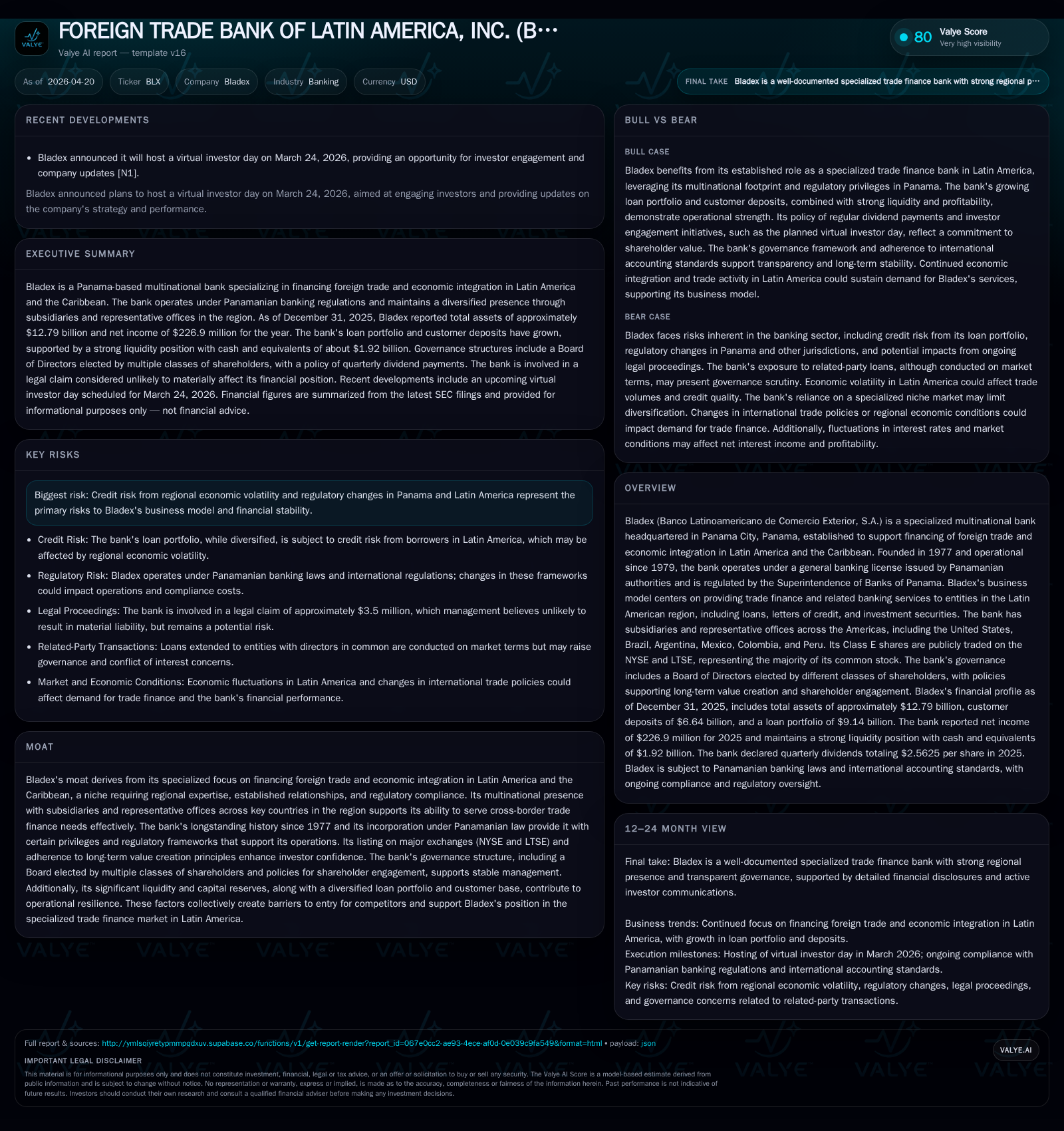
In the March 2026 quarter, Foreign Trade Bank of Latin America (Bladex) reported growth in assets and loan portfolios alongside a strategic surge in technology investments, particularly in AI, supporting its specialized trade finance niche. Bladex’s multinational presence and regulatory expertise underpin its dominant position in Latin America’s cross-border trade financing sector. While regional economic volatility poses risk, targeted investments in data infrastructure and digital capabilities aim to lower funding costs and expand non-interest income streams. Monitoring execution of AI initiatives, loan syndication growth, and deposit franchise evolution will be key near-term operational indicators.
Recent Quarterly Update: Operating Momentum and Strategic Shifts
Bladex's interim condensed financial statements as of December 31, 2025 show total assets reaching $12.79 billion, up from $11.86 billion a year earlier [S2]. This growth was supported by an increase in the loans portfolio to $9.14 billion (+9%) and investment securities rising to $1.43 billion (+19%), reflecting both expansion in commercial lending and Treasury portfolio diversification [S2]. Customer deposits grew sharply by approximately 22% to $6.64 billion, marking a strategic transition towards higher reliance on stable deposit funding which lowers cost of funds compared to wholesale borrowings [S2][S5]. Notably, hedging derivative assets surged to nearly $70 million from $22 million a year prior, indicating enhanced risk management sophistication.
Critically, Bladex strategically elevated its IT expenditure to about 7% of revenues compared with just 2% four years ago [S3]. This substantial increase targets infrastructure upgrades alongside the deployment of AI-driven tools aimed at capturing micro-efficiencies across operations as well as improving client service interfaces [S3]. Partnerships with technology vendors such as Nasdaq and CGI underpin this digital transformation via agile delivery squads managing prioritized initiatives under robust governance frameworks [S3]. This investment signals a clear pivot emphasizing scalability of trade finance operations through automation and advanced data analytics.
Specialized Trade Finance Model and Product Suite
Bladex operates as a niche multinational bank focused exclusively on financing foreign trade within Latin America and the Caribbean [S1]. Founded in the late 1970s, it maintains a Panamanian general banking license subject to local regulation by the Superintendence of Banks [S1]. The bank’s main product suite includes bilateral short- and medium-term loans tailored for cross-border commerce; confirmed and standby letters of credit; financial guarantees; syndications; and investment-grade securities aligned with regional credit risk profiles [S1].
Its role as a specialist financer demands deep market knowledge across diverse legal frameworks, currency regimes, and sovereign risk landscapes unique to Latin America. These complexities necessitate high-touch relationship management with corporate clients as well as correspondent banks throughout multiple countries including Brazil, Argentina, Mexico, Colombia, and Peru where Bladex maintains subsidiaries or offices [S1]. The Bank also supplements balance sheet lending through contingent liabilities such as letters of credit that facilitate trade flows without immediate on-balance-sheet exposure but capture fee income streams [S1][S20].
Competitive Positioning within Latin American Financial Services
The regional competitive landscape features few banks with comparable cross-border trade specialization backed by pan-regional licenses and integrated local presence. This creates meaningful entry barriers stemming from multilayered compliance requirements across jurisdictions plus requisite understanding of political risks endemic to the region [S1].
Liquidity conditions influence pricing power materially given the dollarized nature of much trade finance activity—the availability of U.S. dollar liquidity determines spreads achievable over cost of capital for loans extended [S1][S3]. Bladex's strategy emphasizes cultivating long-standing client relationships that create switching costs through transaction complexity entanglements and bundled offerings integrating treasury management solutions [S3]. The bank’s syndication desk has notably scaled sevenfold since 2021 highlighting growing market footprint in project finance transactions requiring tailored risk structuring [S10].
IT, Data, and AI: Modernizing Core Capabilities to Enhance Efficiency
The step-change in IT investment aligns with Bladex’s ambition to reduce operating costs while simultaneously broadening non-interest income avenues via enhanced product digitalization [S3]. Current spend allocation priorities focus on core infrastructure modernization (19%), data platform consolidation (18%), deployment of high-impact AI use cases (23%), with remaining funds supporting incremental application development (34%) [S3].
These investments manifest through agile teams collaborating closely with vendors recognized for advanced fintech capabilities—Nasdaq provides market data integration while CGI delivers enterprise transformation expertise [S3]. Selected AI initiatives focus on automating document processing for letters of credit workflows and optimally pricing loan syndications leveraging advanced analytics—all expected to deliver measurable ROI by reducing manual touchpoints and improving speed-to-market.
Growth Catalysts and Constraints in Regional Trade Finance
Demand drivers are primarily structural: ongoing integration efforts within Latin American economies foster increased intra-regional trade volumes which require financing products adapted for complexity such as multi-currency letters of credit and supply chain invoice financing programs operated through third-party platforms (~USD450 million scale) [S16][S10]. Additionally, global supply chain realignments post-pandemic elevate cross-border financing needs while project finance exposures grow due to infrastructure development priorities.
However, Bladex must navigate notable downside risks including macroeconomic volatility impacting borrower creditworthiness—commodity price fluctuations tied to geopolitical tensions challenge cash flow predictability for many clients [S1][S6][S7]. Furthermore, fluctuations in U.S. dollar liquidity availability can compress net interest margins due to more intense competition or regulation-induced capital constraints [S1][S5]. The bank’s conservative credit risk approach featuring Stage 2/3 provisions signals proactive management but also constraints incremental profit expansion potential during cyclical downturns.
Key Milestones and Forward-Looking Indicators
Critical near-term execution points include successful delivery of AI-enabled process automations that will validate anticipated efficiency uplifts starting mid-2026 onward [S3]. Monitoring quarterly loan origination volumes—especially within syndicated project financings—and breadth of customer deposit growth will offer insight into commercial traction sustaining balance sheet momentum [S2][S16]. Additionally, tracking net interest margin stabilization amid evolving interest rate environments combined with fee income contributions from letter-of-credit transactions will inform margin expansion potential.
Management commentary underscores vigilance regarding geopolitical risks such as Middle East tensions affecting energy commodity prices plus ongoing pandemic-related uncertainties that could disrupt client sectors or complicate receivables collections [S1][S6]. Regulatory developments around Basel III capital guidelines remain supportive but require continued capital buffer maintenance including the recent $198 million AT1 instrument issuance classified as other equity instruments bolstering Tier 1 capital ratios [S5][S9][S29].
Financial Overview: Capital Structure, Liquidity, and Performance
Bladex maintains a solid financial foundation characterized by:
- Total assets increased from $11.86 billion in December 2024 to $12.79 billion in December 2025 [+7.8%] driven by higher lending (+$758 million) and expanded investment securities (+$227 million) [S2].
- Customer deposits rose markedly from $5.46 billion to $6.64 billion (+21.6%), reducing dependence on borrowed funds which fell from $4.39 billion to $4.03 billion [-8.2%] enhancing liquidity stability [S2][S5].
- Equity advanced from $1.34 billion to $1.68 billion (+25%), boosted primarily by issuance of additional equity instruments ($198 million AT1 notes) supporting regulatory capital adequacy improvements (Tier-1 ratio at 17.4%, total capital at 15.5%) well above minimum requirements [S5][F1].
- Loan portfolio quality remains strong with low impaired credits (0.4%) supported by allowance coverage increasing proportionally ($12.13 million vs $5.38 million prior year), indicating prudent risk management despite upticks tied to select Stage-2 client exposures [S2][F1].
- Operating cash flow remains robust at ~$170 million free cash flow available after capex supporting dividend continuity without leverage strain historically (ROE approx 11.7%) [F1].
Historical performance (annual)
| FY | Rev ($mm) | Rev YoY |
|---|---|---|
| 2024 | 304 | +14.1% |
| 2023 | 266 | +59.7% |
| 2022 | 167 | +59.9% |
| 2021 | 104 |
Source: SEC companyfacts cache [F1].
This disciplined capital structure alongside enhanced deposit funding provides Bladex sufficient headroom for prudent selective loan growth aligned with its strategic objective targeting ~1.5x portfolio expansion by 2030 through technology-led efficiency gains and syndicated finance scaling outlined at Investor Day presentations [S3][N1].
Disclaimer: This analysis is based solely on publicly available SEC filings dated through April 2026 along with historical financial data snapshots per regulatory disclosures; it is intended for informational purposes only without any investment recommendation or price forecast.
Disclaimer: This is research-only, informational analysis and not investment advice. It may include AI-generated interpretation and general industry context. Always verify important details using primary sources.

Comments