
AMC Robotics Advances Vision AI and Robotics Shift With Strategic Partnerships
AMC Robotics updates on business combination, evolving revenue model, and strategic pivot to AI-enabled autonomous devices.
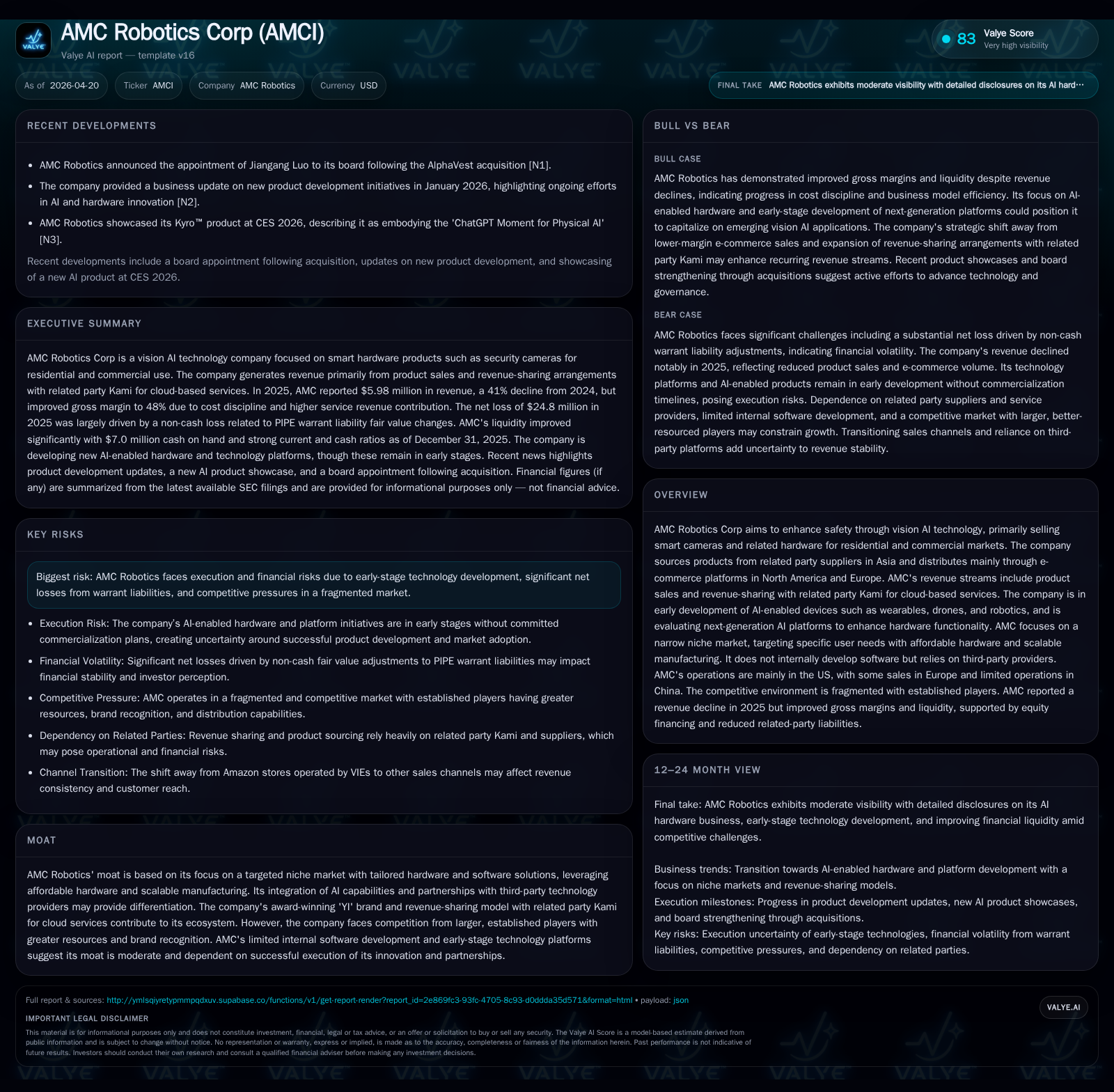
AMC Robotics Corp recently consummated its SPAC merger with AlphaVest Acquisition Corp, concluding significant structural changes including the deconsolidation of variable interest entities and infusion of $8 million PIPE financing. The company’s revenue mix is transitioning from volume-driven product sales of smart cameras toward higher-margin recurring revenue streams tied to intelligent cloud services via its related party, Kami Vision. Early-stage development initiatives in AI-enabled wearables, drones, and robotics underline AMC’s ambition to evolve beyond hardware into a broader intelligent automation ecosystem amid a fragmented competitive landscape dominated by resource-rich incumbents. While financial results show improved gross margins and reduced operating losses in 2025, the company faces execution and market risks in scaling next-generation AI platforms and sustaining growth without internal software development capabilities.
Recent Operating Update: Corporate Milestones and Implications
In April 2026, AMC Robotics filed an 8-K detailing critical near-term operational shifts that signal a strategic redirection of the company’s core identity [S3]. The highlight is the completion in December 2025 of a reverse recapitalization business combination with AlphaVest Acquisition Corp., which established AMC Robotics as a publicly listed entity while simultaneously generating approximately $8 million in PIPE financing [S1]. This capital infusion materially strengthened AMC's liquidity position and enabled repayment of previously extensive related-party liabilities, improving financial flexibility and reducing risk stemming from historical financing dependencies [S4].
Concurrently, AMC terminated contractual control over two variable interest entities (VIEs) — Xiaoyun and Yishijue — effective December 1, 2025. These VIEs had operated Amazon e-commerce store accounts critical for distribution in North America and Europe under authorization agreements expiring October 20, 2026 [S1]. The deconsolidation represents both an accounting shift—removing these entities from consolidation—and an operational one as AMC transitions sales channels away from these Chinese-structured VIE accounts toward other or self-operated platforms. This realignment could impact near-term sales flows given the reliance on such platforms but also reduces complexity associated with VIE arrangements.
Importantly, the company's revenue profile shifted markedly through 2025 due to these transitions. Product sales fell by approximately 41%, driven by deliberate scaling back of lower-margin inventory-heavy lines. In contrast, revenue-sharing income from its related party Kami Vision's cloud-based intelligent information services rose substantially to constitute almost half of total revenues by year-end [S1]. This evolution signals AMC’s emerging hybrid business model blending physical hardware sales with recurring revenues derived from downstream service monetization—a strategic pivot aligned with management’s stated intention to transition toward autonomous robotic systems and cloud-enabled security solutions.
Business Model and Product Portfolio: Hardware-Centric Security with Emerging AI
AMC Robotics currently operates a hardware-centric business model focused on affordable vision AI products principally consisting of smart cameras tailored for residential and small commercial markets distributed via e-commerce channels across the United States, Canada, and Europe [S15]. Their flagship “YI” brand includes the Dome Guard indoor/outdoor cameras alongside action cams and driving recorders sourced predominantly through affiliated Asian suppliers ensuring scalable manufacturing at cost-effective price points [S1], [S26]. The company does not internally develop proprietary software; instead it integrates third-party software stacks including AI components maintained by related party Kami Vision that enable complementary cloud services such as video storage, image processing analytics, alerts, detection functionalities, and intelligent automation features [S8], [S26].
Beyond core security cameras—where AMC has achieved recognized quality standards including industry awards—the company is incubating additional intelligent hardware categories in very early stages. These include IoT-enabled wearable devices like AI glasses plus drone platforms and robotic systems aimed at expanding addressable applications beyond traditional security surveillance into broader interactive safety environments [S7], [S15]. These products embody future-facing ambitions for embedded AI capabilities leveraging dual-chip designs for power efficiency combined with advanced computer vision models sourced externally but integrated into AMC's device ecosystem. However, timelines remain undefined; these innovations neither have concrete commercialization plans nor confirmed market entry dates amid still experimental R&D efforts primarily conducted via partner engagement rather than direct internal development [S7], [S15], [S19].
Overall AMC’s business model balances scalable mass-market hardware sales—primarily funneled through established e-commerce platforms—with an ascending layer of service-linked recurring revenues anchored by its symbiotic relationship with Kami Vision. This two-pronged approach aims to mitigate risks associated with inventory turnover fluctuations while enhancing long-run margins through sustainable revenue sharing arrangements.
Competitive Environment and Industry Structure: Navigating a Fragmented Market
The interactive security surveillance market is highly fragmented yet dominated by sizable incumbents such as Alarm.com, Google Nest (Alphabet), Amazon Blink, Honeywell International Inc., Eagle Eye Networks Inc., Eufy by Anker, and others who leverage substantial capital resources alongside broad brand recognition [S25]. Unlike multi-category conglomerates pursuing broad mass markets with integrated home automation suites and strong software ecosystems, AMC targets narrowly defined niche segments focusing on specific user needs where affordability coupled with specialized AI-capable hardware presents a differentiated value proposition.
AMC relies extensively on third-party software providers rather than building vertically integrated platforms. Its competitive moat thus depends largely on: (i) affordable hardware production rooted in relationships with related-party suppliers based primarily in Asia offering scale benefits; (ii) focus on narrow targeted use cases prioritizing simplicity and customization; (iii) integration partnerships that allow embedding advanced AI functionalities without the overhead developing them internally; (iv) distribution via accessible e-commerce channels reaching customers directly though one-off purchases; and (v) reputation consolidated through an award-winning product lineup such as "YI" branding recognized among affordable consumer-grade vision AI camera offerings.
However its commercial reach remains significantly constrained by lack of direct subscription offerings or full ecosystem ownership found at larger competitors. Furthermore, heavy dependence on third-party e-commerce platforms—whose authorization contracts expire late 2026—exposes AMC to channel concentration risk alongside the challenge to acquire sustainable sales traction actively managed independently post-authorization expiration. Brand awareness remains modest compared to dominant incumbents whose marketing investments dwarf those feasible for AMC at current scale.
Supply chain considerations also pose potential headwinds given sourcing dependency on affiliated manufacturers located primarily in China. Geopolitical tensions or component shortages typical in semiconductor-dependent industries could pressure production costs or delivery timelines adversely affecting competitive agility.
Growth Drivers: Evolution Toward Autonomous Robotics and Recurring Revenue Streams
A central pillar of AMC’s strategic growth plan rests on expanding beyond static hardware product sales into recurring revenue streams powered primarily through its related party Kami Vision’s cloud-based services platform. The company's revenue-sharing arrangement entitles AMC to approximately 30% share of the monetization proceeds generated from intelligent information services linked to users acquired via its camera hardware sales—including video storage subscriptions plus advanced analytics—producing a higher-margin income base that enhances profitability prospects relative to legacy volume-based product sales models [S1], [S10], [S26]. For full-year 2025 Kami accounted for roughly half of total revenue (52%), marking a sharp increase from prior year contributions (27%) signaling accelerating migration towards this hybrid revenue mix that management expects will further support margin expansion moving forward [S5], [N1].
On the technology front AMC’s nascent development pipeline includes exploratory efforts targeting AI robotics platforms intended for commercial deployment across industrial safety monitoring use cases as well as consumer-level wearable augmented reality glasses integrating vision AI capabilities designed to synergize with existing surveillance infrastructure technology stacks. Other candidate device classes include drones equipped with automated sensing functions aimed at extending situational awareness radius beyond fixed-point installations.
While these initiatives remain embryonic lacking firm roadmaps or deliverables within disclosed filings,[S7] they represent deliberate pilot investments positioning the company strategically within evolving IoT-enabled autonomous systems markets characterized by increased demand for intelligent automation combined with pervasive sensor data fusion capabilities. This reflects structural market growth potential distinct from cyclical consumer electronics spending trends; however technological execution risks remain material due to limited internal R&D scale.
Strategically then, AMC aims for incremental growth fueled by:
- Expanding recurring cloud-derived revenues buoyed by partner-driven subscription economics substituting historically volatile low-margin product turnover;
- Leveraging scalable manufacturing relationships enabling cost-efficient introduction of diversified new device categories beyond current smart camera portfolio;
- Broadening channel partnerships potentially into vertical-specific domains such as senior care management or commercial real estate security environments where tailored solutions can command premium pricing.
Challenges and Constraints: Early Technology Stage, Execution Risk, and Competitive Pressure
Despite promising directional improvements in gross margin profile (rising to an approximate 48% rate in fiscal 2025 versus a prior year's six percent),[F1], significant challenges threaten near-to-medium term momentum for AMC Robotics. Execution risk arises primarily because core innovation efforts around autonomous robotics platforms are still at conceptual stages without commercial-ready products or finalized timelines.[S7] Delays or technical setbacks here could defer anticipated margin accretion or expose funding gaps requiring external capital raises.
Financially acute volatility stems from non-cash warrant liabilities issued as part of PIPE transactions during the SPAC merger process valued initially near $14 million but subject to material fair value fluctuations reflected in net losses far exceeding operating results reported (-$24.8 million net loss in FY2025 despite slight operation loss reduction), underscoring elevated accounting complexity harming headline profitability figures.[F1], [S6]
Market constraints include:
- Intense competition against highly capitalized incumbents able to subsidize aggressive customer acquisition campaigns or bundle offerings within expansive smart home ecosystems;
- Dependence on external e-commerce platforms until October 2026 when existing contracts expire introduces channel vulnerability risking disruption if alternative direct-to-consumer paths are not fully operationalized timely;
- Limited proprietary control over software stack reduces ability to differentiate rapidly evolving feature sets required to sustain compelling customer value propositions against entrants investing heavily into native platform ecosystems.
Additionally customer concentration is notable: Kami Vision alone represented approximately half of total revenues in FY25 with even greater accounts receivable share (~78%), amplifying counterparty credit exposure concerns that require careful monitoring.[S26]
Key Monitoring Points: Upcoming Commercialization Timelines & Recurring Revenue Expansion
Investors should track several near-term milestones signaling whether AMC can realize its transition ambitions effectively:
- Completion dates for early-stage autonomous robotics prototypes advancing toward trial deployments or pilot installations;
- Degree of growth acceleration within recurring cloud-based revenues derived from Kami Vision indicative of strengthening subscription economics versus one-off product sale dependency;
- Successful migration off historical VIE-operated Amazon accounts toward independently owned e-commerce stores post-authorization expiry October 2026 without material disruption or loss of sales velocity;
- Potential announcements regarding strategic technology partnerships or selective acquisitions intended to bolster product innovation capabilities given limited internal software development;
- Continued capital management policies maintaining stable cash runway balanced against necessary R&D investments.
Positive developments across these dimensions will validate AMC's narrative framing of moving toward integrated autonomous systems supported by diverse revenue streams while preserving operational discipline.
Financial Profile Summary: Improving Margins Amid Legacy Losses
Financially,[F1] AMC reported total revenues declining sharply from approximately $10.2 million in FY2024 down to $6 million in FY2025 (-41%), primarily due to intentional contraction of lower-margin product lines offset somewhat by sharply increased revenue-sharing income tied to intelligent information services provided via Kami Vision.[S10] Gross profit surged proportionally leading to a dramatic gross margin improvement jumping from roughly six percent up to forty-eight percent reflecting more efficient inventory management along with favorable shift toward higher-margin service revenues.[F1]
Operating expenses remained relatively flat around $3.3 million while operating losses narrowed materially ($505K versus ~$2.55 million prior year). Nonetheless non-operating factors drove net loss steeply negative ($24.8 million), mainly attributed to warrant-related fair value accounting variations intrinsic to the SPAC merger financing framework.[F1]
Balance sheet positioning improved significantly due largely to completion of PIPE equity raise alongside enhanced working capital metrics including cash balances rising above $7 million supported by reduction in related party obligations providing stronger liquidity footing.[F1], [S4]
Operating cash flow deteriorated notably driven chiefly by working capital outflows related possibly to settlement timing effects rather than underlying operating decline suggesting prudence remains necessary regarding cash burn dynamics going forward.[F1]
Selected Financial Key Metrics — FY2024 vs FY2025:
Historical performance (annual)
| FY | Net ($mm) | CFO ($mm) | OpInc ($) | Net YoY |
|---|---|---|---|---|
| 2025 | -25 | -6 | -505166 | -1550.5% |
| 2024 | 2 | 0 | -870821 | -41.1% |
| 2023 | 3 | -1 | -676318 | +6920.8% |
| 2022 | 0 | -80806 |
Source: SEC companyfacts cache [F1].
Capital returns and efficiency (annual)
| FY | ROE% |
|---|---|
| 2025 | -238.0 |
| 2024 | -98.0 |
| 2023 | -894.1 |
| 2022 | -7.7 |
Source: SEC companyfacts cache [F1].
Overall AMC Robotics’ financial narrative is one of transitional rebalancing—shedding low-return inventory-driven product lines while fostering early-stage growth engines centered on differentiated cloud service revenues supported by strategic partnerships amid tightening operational overheads although burdened presently by non-cash accounting impacts arising from complex warrant instruments.
This analysis relies exclusively on disclosed filings without investment recommendations or inferred projections beyond presented data contextually framed within pertinent industry dynamics.
Disclaimer: This is research-only, informational analysis and not investment advice. It may include AI-generated interpretation and general industry context. Always verify important details using primary sources.

Comments