
Bally's Corp Strengthens Capital Structure via $1.1 Billion Term Loan Amid Operating Losses
Latest filings reveal Bally's ongoing liquidity management and operational challenges within a competitive gaming industry.
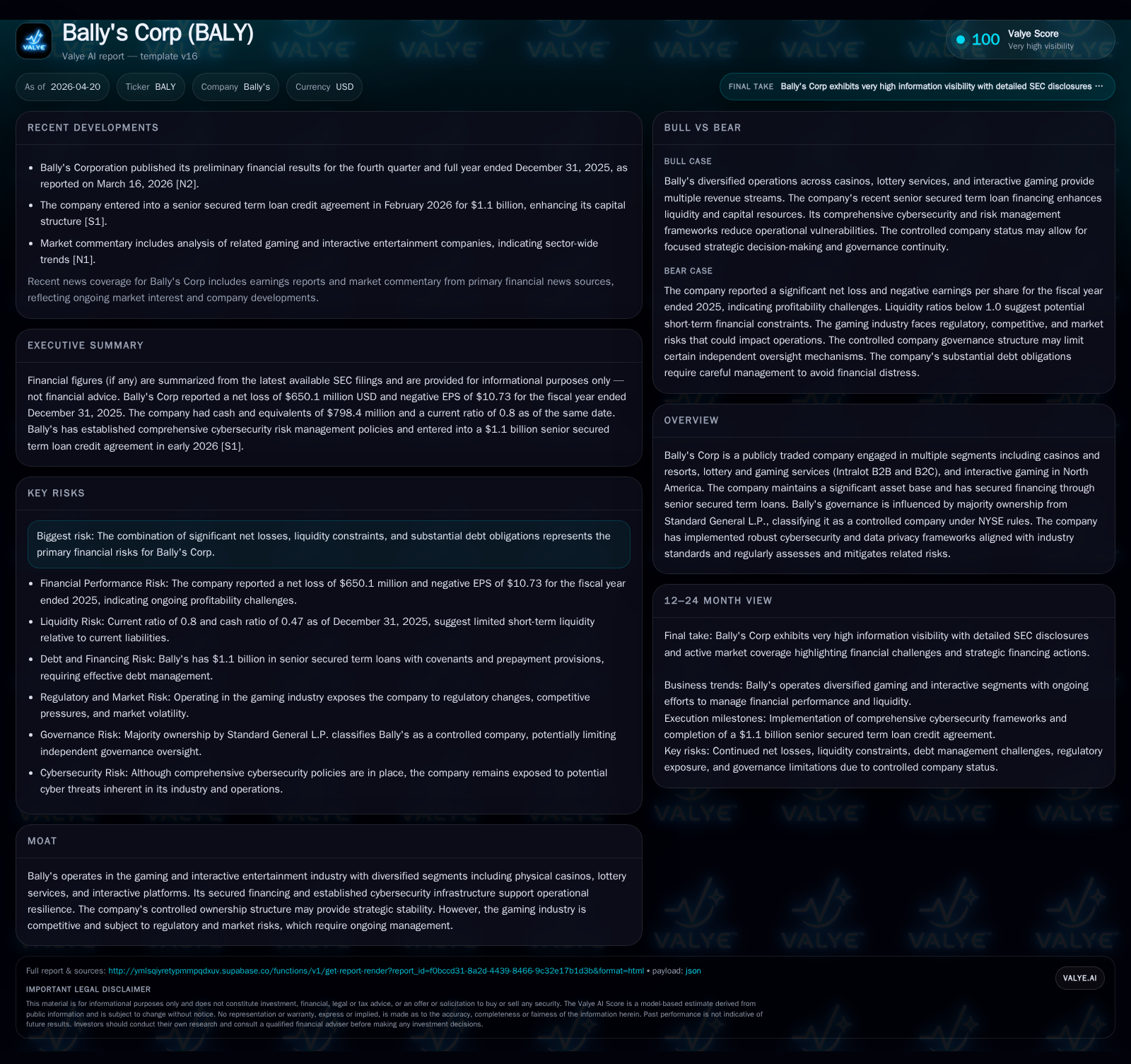
Bally's Corporation recently secured a $1.1 billion senior secured term loan to bolster liquidity and refinance existing debt, marking a critical development given its persistent operating losses and sizeable leverage. The company's diversified gaming portfolio spans physical casinos, lottery services, and interactive platforms, with a controlled ownership structure providing strategic stability. However, Bally's faces industry-wide headwinds including regulatory risks and competition. Near-term growth hinges on executing capacity expansions, managing debt service obligations, and capturing demand shifts in the evolving North American gaming market.
Recent Operating Update
Bally's Corporation's latest quarterly filing on November 12, 2025 ([S2]) highlighted ongoing operational challenges during strategic moves to shore up liquidity. Foremost among these is the February 11, 2026 entry into a $1.1 billion senior secured term loan facility ([S5], [S6], [S8], [S9], [S26]). This financing package includes a $600 million closing date term loan alongside a $500 million delayed draw term loan, maturing in five years but subject to earlier maturity contingent on outstanding unsecured bonds due in 2029.
The loans are secured by substantially all assets of Bally's and certain subsidiaries on a pari passu basis with the existing revolving credit facility. Interest rates are relatively high, with floors at 3% plus significant spreads (6.5%–7.5%), reflecting leveraged credit risk and market conditions for gaming companies. Mandatory prepayments are triggered under various scenarios including asset sales and extra debt issuance, with make-whole premiums declining over time ([S5], [S6], [S9]).
This refinancing follows a prior commitment letter amendment in December 2025 increasing commitments to these levels ([S12], [S14]), tied closely to the completed sale-leaseback of the Twin River Lincoln Casino Resort’s real estate assets ([S9]). Taken together, these moves reflect Bally's active efforts to extend maturities, obtain liquidity cushioning, and monetize fixed assets while retaining operational control.
Business Model
Bally’s Corp primarily generates revenue through three synergistic segments: traditional casino operations including resorts; lottery services facilitated by its stake in Intralot, offering B2B and B2C lottery solutions internationally; and interactive gaming platforms primarily targeting North American customers ([S1]). This multichannel approach aims to capture diversified demand across physical and digital entertainment channels.
Casinos represent core revenue drivers but require significant capital investment for facility maintenance, upgrades, and compliance. Lottery services provide recurring contractual revenues grounded in governmental agreements but can face regional regulatory changes affecting scale. Interactive gaming has been an area of targeted growth but remains competitive against well-capitalized peers such as DraftKings ([N2]) with shifting consumer adoption patterns.
Strategically, Bally’s leverages its controlled ownership by Standard General L.P., which simplifies decision-making but raises typical controlled-company scrutiny over governance transparency ([S1]). The company employs cybersecurity frameworks aligned with ISO standards (27001 for security management; 27701 for privacy) integrating threat assessments deeply into risk management practices; this positions Bally’s well within an industry increasingly vulnerable to data breaches ([S1]).
Industry Structure and Competitive Position
The gaming industry is marked by intense competition from regional casinos, online operators, lotteries, and new entrants blending technology-driven engagement models. Regulatory environments differ widely by jurisdiction impacting licensing and operational flexibility; Bally’s operates in multiple states demanding complex compliance efforts.
Bally’s scale via multiple properties and lottery contracts provides some insulation but also exposes it to regulatory shifts that competitors with fewer geographic bets might avoid more easily. The company’s integration of legacy casino operations with emerging digital channels reflects industry trends toward omni-channel experiences; however, noted peers such as DraftKings have invested more aggressively in interactive capabilities ([N2]).
Brand differentiation is moderate; physical casino assets like Tropicana Las Vegas command historical recognition but must compete on amenities and experience innovation. Lottery services via Intralot offer steady income critical to offsetting volatility in other segments.
Growth Drivers and Constraints
Growth levers include expansion of interactive gaming markets benefiting from legalizing sports betting across new jurisdictions, incremental same-store revenue improvements at physical casinos through enhanced customer loyalty initiatives, and selective asset monetization strategies including sale-leaseback transactions aimed at unlocking capital ([S9]).
Constraints include substantial leverage limiting investment agility—interest costs are high—and persistent operating losses indicate structural profitability challenges. Regulatory uncertainties remain salient; any tightening could reduce market access or increase compliance costs.
Additionally, customer behavior trends toward online gaming require continual platform investment just as competition intensifies from digital-native firms.
What to Watch Next
Key near-term company milestones include:
- Monitoring full utilization and repayment terms of the recently consummated $1.1 billion term loan facility,
- Performance trends in interactive segment revenue as legalized sports betting continues rollout,
- Outcomes from ongoing asset monetization initiatives beyond Twin River Lincoln casino,
- Management commentary on plans to address recurring operating losses,
- Regulatory developments at state or federal levels potentially impacting license renewals or market expansions.
Caution warranted around liquidity metrics given current ratio below unity (0.8) combined with sharply negative operating cash flow in FY2025 (down over 109% YoY) ([F1]), necessitating close observation of cash burn rates versus capital expenditures.
Financial Profile
Historical performance (annual)
| FY | Net ($mm) | CFO ($mm) | OpInc ($mm) | Capex ($mm) | Net YoY |
|---|---|---|---|---|---|
| 2025 | -650 | -11 | -278 | 168 | -14.5% |
| 2024 | -568 | 114 | -258 | 200 | -202.8% |
| 2023 | -187 | 189 | 104 | 311 | +55.9% |
| 2022 | -426 | 271 | -293 | 212 |
Source: SEC companyfacts cache [F1].
Capital returns and efficiency (annual)
| FY | Buybacks ($mm) | FCF ($mm) | ROE% |
|---|---|---|---|
| 2025 | -179 | -65.4 | |
| 2024 | 0 | -86 | -1837.3 |
| 2023 | 99 | -123 | -29.5 |
| 2022 | 153 | 59 | -52.8 |
Source: SEC companyfacts cache [F1].
Despite diversification efforts, Bally's financials reveal stress points that contextualize recent capital markets activities:
| FY | Operating Income (USD) | Net Income (USD) | CFO (USD) | Capex (USD) | Equity (USD) |
|---|---|---|---|---|---|
| 2025 | -277.7M | -650.1M | -11.0M | 167.9M | 994.7M |
| 2024 | -258.3M | -567.8M | 114.0M | 199.8M | 30.9M |
Operating income remains negative for multiple years reflecting ongoing expenses outpacing revenues despite scale improvements ([F1]). Net losses deepened nearly 14.5% YoY illustrating continued profitability hurdles.
Cash flow from operations turned negative recently whereas capital expenditures remain material but reduced from prior periods consistent with more conservative investment pacing.
The company's equity base expanded substantially by end of FY2025 compared to FY2024 – driven partly by capital raises or accounting adjustments tied to asset transactions ([F1]). However, heavy indebtedness encumbers flexibility as evidenced by mandatory covenants restricting dividends, additional borrowings, asset sales without consent ([S5], [S6]).
This financial posture underlines the importance of executing on refinancing strategy coupled with operational improvements to restore positive cash flow dynamics going forward.
Disclaimer
This analysis is for informational purposes only and does not constitute investment advice or recommendations regarding any securities discussed herein.
Disclaimer: This is research-only, informational analysis and not investment advice. It may include AI-generated interpretation and general industry context. Always verify important details using primary sources.

Comments