
Equus Total Return: Balancing Illiquidity Risks with Niche Private Equity Expertise
Equus Total Return’s latest 10-K/A filing highlights critical shifts in tax status and liquidity challenges shaping its targeted investment approach in small and middle market private companies.
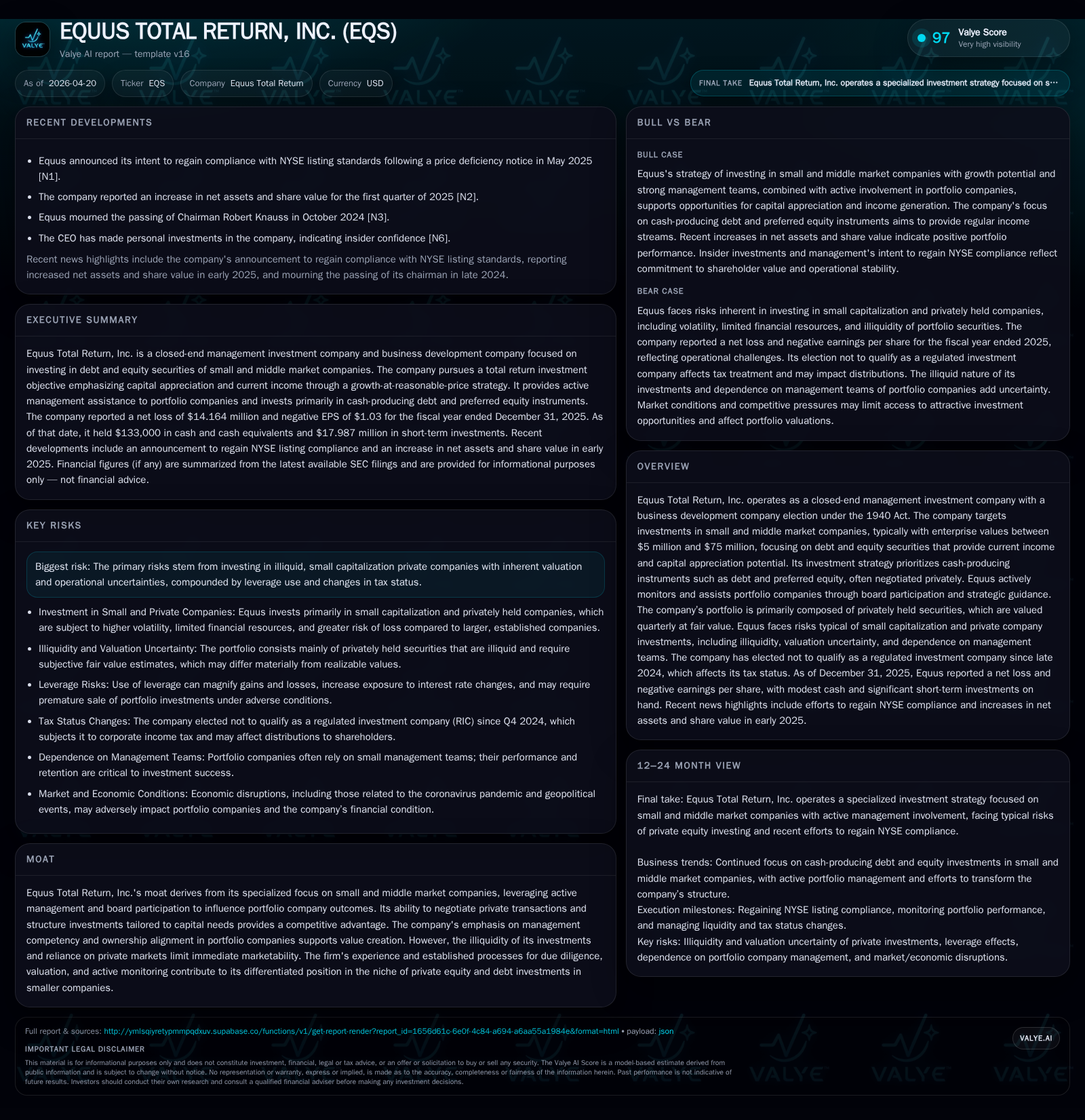
In its amended 2026 annual filing, Equus Total Return confirms its election to forgo Regulated Investment Company (RIC) status, exposing it to corporate-level taxation and underscoring the intricate balance between pursuing illiquid private investments and managing associated risks. The company specializes in privately negotiated debt and equity investments in small and middle market enterprises, leveraging active board participation to influence outcomes. While competition intensifies and liquidity constraints persist, Equus’s bespoke structuring and management assistance position it uniquely within the BDC space. Monitoring portfolio company performance and successful liquidity events will be pivotal for future operating stability.
Latest Annual Filing Spotlight: Key Near-Term Developments
Equus Total Return’s amended Form 10-K filed April 20, 2026 [S1] delivers insight into the firm's evolving operating landscape. A defining recent development is Equus’s election during Q4 2024 to cease qualifying as a Regulated Investment Company (RIC) under Subchapter M of the Internal Revenue Code. This shift exposes the company to regular U.S. corporate tax rates on net investment income and operating profits, increasing the effective tax burden compared to when dividends could pass-through untaxed at the entity level. Though not required to be a RIC for Business Development Companies (BDCs), the change signals a strategic realignment possibly tied to broader transformation plans or market positioning [S1][S19].
Simultaneously, liquidity considerations continue to challenge the firm due to its portfolio concentration in illiquid private securities across small capitalization firms. The valuations of these assets rely heavily on fair value estimates quarterly determined by management subjectively, sometimes with limited third-party input. As a consequence, Equus flags potential episodes of significant NAV volatility should portfolio companies fail to meet business plans or financing arrangements—exposing investors to valuation uncertainty typical of niche private equity strategies [S1][S13][S14]. The governance framework around affiliated transactions remains rigorous, requiring approval from independent directors or the SEC depending on counterparty relationships, underscoring regulatory compliance burdens [S1][S19].
Finally, borrowing capacity is constrained by regulatory asset coverage requirements under the 1940 Act. Equus has historically accessed short-term leverage instruments but notes difficulties raising financing given the illiquid nature of underlying collateral, amplifying potential risks tied to margin pressures or forced sales [S3][S4].
Equus’s Investment Approach: Targeting Small and Middle Market Private Entities
Equus’s core business model centers on deploying capital into proprietary debt and equity placements within companies whose total enterprise values typically range between $5 million and $75 million [S1]. Such enterprises often exhibit characteristics diverging from public company norms—namely shorter operating histories, limited scale, narrower product lines, concentrated management teams, and heightened vulnerability to competitive and economic headwinds [S1]. This segment embodies more cyclical risk exposures but also structural opportunity due to fewer competitors willing or capable of specialized small-to-mid-market engagement [S9][S21].
The firm favors cash-yielding instruments including subordinated debt, convertible debt blended with warrants, preferred equity featuring dividend streams alongside capital upside potential through warrant exercises. These structures aim at producing current income which offsets risk while retaining growth optionality [S1][S7]. A deliberate tension exists between holding loans to maturity—supporting stable accrual accounting—and marking investments quarterly at fair value reflective of probable near-term realizability. Equus balances this by maintaining yield impairment analyses routinely [S12].
A distinctive feature is Equus’s emphasis on active involvement post-investment—providing substantial managerial assistance consistent with BDC regulations under the Investment Company Act of 1940. This includes occupying board seats or equivalent governance roles permitting strategic guidance on capital structure optimization, operational budgeting, acquisition strategy alignment, and eventual exit planning [S6][S7]. Such hands-on stewardship enhances monitoring granularity while fostering alignment through crafted incentive mechanisms promoting shared upside between portfolio firms’ leadership and Equus itself [S3].
Competitive Edge From Active Management and Customized Deal Structuring
In contrast to passive funds or syndicated lenders who may spread capitals thinly across standardized products, Equus employs a bespoke structuring approach for each deal negotiated directly with issuers or owners—leveraging relationships often unavailable in public markets [S6]. This approach enables tailored solutions balancing issuer capital needs against risk-return dynamics prioritized by Equus such as covenants enforcing affirmative business conduct alongside downside foreclosure safeguards when justified [S15].
Due diligence remains a cornerstone reliant largely on proprietary research encompassing historical financial audits, forward budgets scrutiny, onsite visits inclusive of workforce interviews as well as vendor/customer feedback—a multidimensional process sometimes augmented by external consultants when complexity dictates [S5][S6]. Though inherently subjective given sparse public disclosures typical of private entities, this deep dive attempts early identification of operational red flags potentially imperiling returns.
Board participation provides dual benefits: operational leverage over underperforming assets via direct influence plus enhanced exit timing control given seats often confer visibility into prospective sales or recapitalizations favorable for realizing appreciation gains. However, this model entails reliance on management quality from smaller companies—a known bottleneck affecting stability if key personnel turnover occurs abruptly [S1].
Industry Environment: Challenges in Financing and Valuation of Illiquid Assets
Operating within small capitalization private company finance imposes structural hurdles: absence of centralized exchanges eliminates observable market prices necessitating reliance on fair value methodologies that are inherently estimative rather than definitive [S13][S28]. Changes in portfolio company fortunes can dramatically affect valuations within short timeframes posing trading NAV volatility distinct from more liquid asset classes.
Leverage utilization remains permissible up to regulatory limits but historically limited due to scant availability from financial institutions unwilling to lend against such illiquid portfolios [S4][S20]. The cost of such debt instruments often exceeds yields earned on underlying investments narrowing spreads vital for positive net investment income generation. Additionally, significant junior lien positions elevate risk if senior creditors exercise control over collateral disposition after default scenarios arise—inhibiting realization prospects for Equus [S18].
Competition escalates as more capital providers with deeper pockets target this mid-market niche amid persistently low interest rate environments prompting risk appetite expansion elsewhere. Larger firms benefit from scale advantages enabling multiple layers of diversification not available to more concentrated vehicles like Equus—pressing margins downward on pricing power absent clear differentiation [S9][S21].
Growth Catalysts and Potential Constraints
Potential growth drivers include leveraging sectoral shifts towards industries with resilient cash flows such as energy-related holdings evidenced by increased concentration in oil & gas royalty interests recently discussed by management [S23][S27]. Increasing size thresholds for investee companies hint at an evolving strategy seeking scalable opportunities within the mid-market bracket.
Follow-on investing capabilities allow supporting existing portfolio firms through expansions or recovery phases thereby safeguarding prior commitments and maintaining pro-rata ownership enhancing long-term returns potential [S24]. Moreover, governance controls around affiliated party dealings ensure fiduciary standards preserving shareholder interests amid complex transaction tubes.
Conversely, internal constraints stem from funding limitations imposed by borrowing capacity governed tightly by asset coverage ratios mandated under the 1940 Act [S4][S20] coupled with higher tax burdens post-RIC election withdrawal diminishing distributable earnings availability currently underpinning cash returns attraction. Economic downturns disproportionately depress smaller companies’ survivability challenging capital preservation efforts alongside valuation precision risks exacerbated during market stress periods creating possible mark-to-market impairments impacting reported earnings unfavorably [S26].[N/A]
Regulatory uncertainties associated with potential transformation plans towards becoming an operating company or permanent capital vehicle create additional execution risks while potentially altering historic investment orientations fundamentally requiring careful navigation of shareholder approvals [S17][S25][S27].
Upcoming Milestones and Indicators to Monitor
Investor attention should focus on developments regarding any renewed attempt at RIC re-qualification which would restore pass-through taxation benefits influencing net distribution profiles significantly [S19]. Additionally critical will be updates on affiliated transactions’ frequency and approvals indicating governance rigor.
Portfolio performance trajectories reflecting refinancing success amidst credit markets retrenchment will signal resilience or stress manifestations impacting liquidity constellation directly linked with dividend sustainability outlooks.[S1][S27]
Equally important are any discrete announcements around plans to divest portfolio assets strategically aiming at unlocking trapped values versus forced sale scenarios prompted by leverage covenant breaches or financing shortfalls which collectively chart trajectory for near-term shareholder returns clarity.[S23]
Financial Summary: Performance Snapshot and Capital Structure Review
Historical performance (annual)
| FY | Net ($mm) | CFO ($mm) | Net YoY |
|---|---|---|---|
| 2025 | -14 | -2 | +24.6% |
| 2024 | -19 | 38 | -245.0% |
| 2023 | 13 | -51 | +1248.0% |
| 2022 | -1 | -8 |
Source: SEC companyfacts cache [F1].
Capital returns and efficiency (annual)
| FY | ROE% |
|---|---|
| 2025 | -85.5 |
| 2024 | -51.6 |
| 2023 | 26.8 |
| 2022 | -3.2 |
Source: SEC companyfacts cache [F1].
Equus’s recent financial metrics confirm operational headwinds aligned with strategic transitions documented in SEC filings. Net income posted losses amounting to approximately -$14.16 million for fiscal year ending December 31, 2025 improving modestly from -$18.78 million reported in 2024 conveying some stabilization yet continuation of negative profitability trends persisting over multiple years corroborates elevated investment risk profile typical among small company focused BDCs [F1].[N/A]
Operating cash flow swung back into negative territory at -$2.13 million after an anomalous $38.2 million positive cash inflow previously recorded reflecting volatile cash generation consistent with realizations timing variability inherent in private lending operations.[F1]
Concurrently total shareholders’ equity diminished sharply from $36.37 million in 2024 down to $16.57 million year-end 2025 underscoring magnitude of accumulated losses eroding base although preservation efforts remain evident.[F1]
Liquidity constraints manifest distinctly via minimal cash & equivalents balance standing at just $133 thousand posing operational runway questions particularly absent revolving credit facilities noted as expired[S3][F1]. Capital structure remains conservative relative to allowable leverage thresholds but reliance predominantly on internal sources constrains investment scaling.[S4]
Overall financial posture evidences cautious calibration balancing illiquid asset deployment against emergent tax impacts plus funding complexities while needing focus on driving portfolio performance improvements aiding recovery toward profitable steady-state operations.
This report is intended solely for informational purposes based on available information as of April 20, 2026. It does not offer investment advice or recommendations concerning securities or strategies mentioned herein.
Disclaimer: This is research-only, informational analysis and not investment advice. It may include AI-generated interpretation and general industry context. Always verify important details using primary sources.

Comments