
MIND Technology Advances Survey Solutions Amid Capacity Expansion and Demand Recovery
Recent facility expansions and order backlog growth reflect operational momentum in MIND Technology's niche marine seismic equipment market.
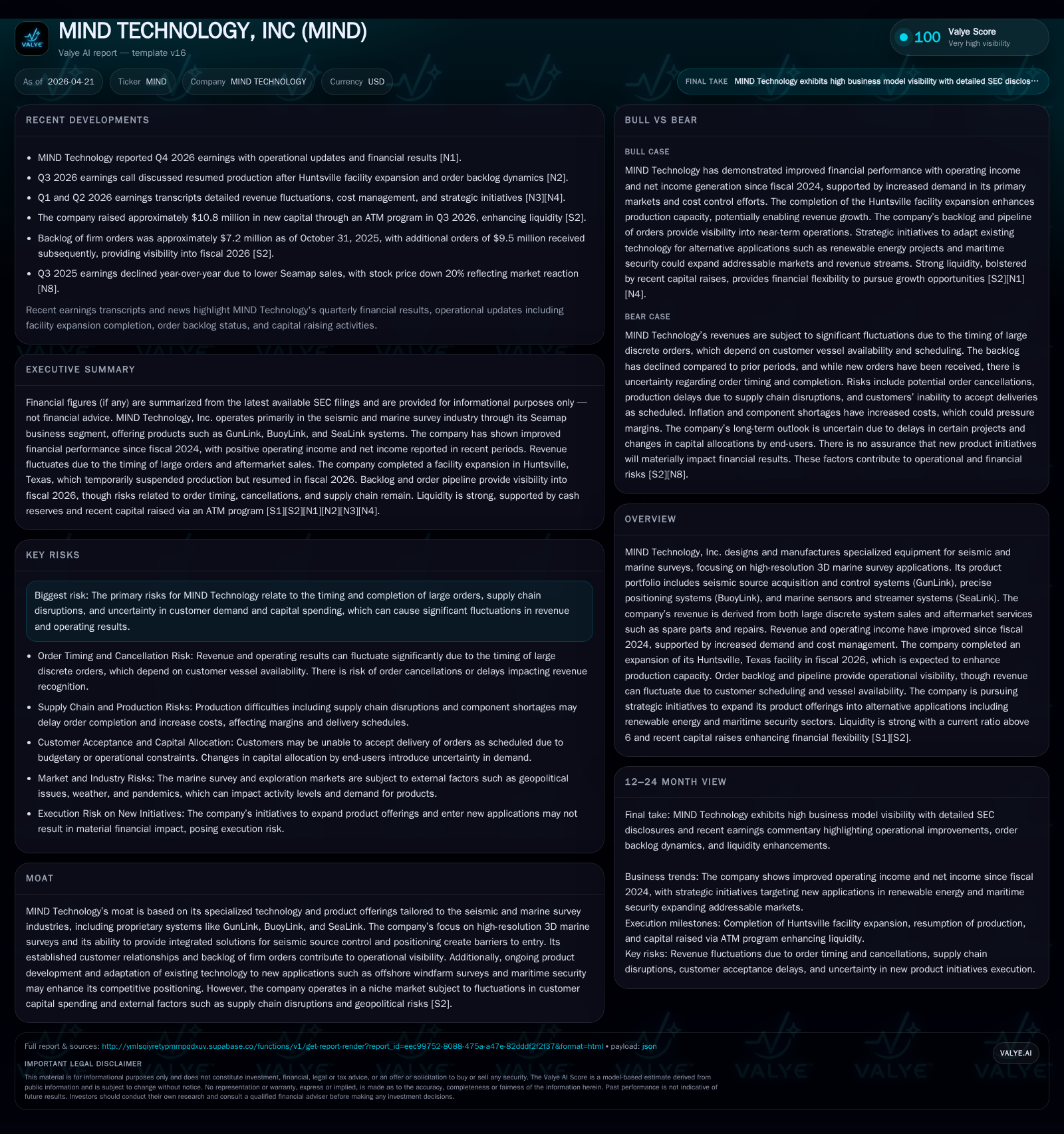
MIND Technology reported fiscal 2026 results underscored by completed capacity expansion at its Huntsville, Texas facility, enhancing production capabilities. Though revenue recognition remains subject to typical customer scheduling fluctuations, a growing order backlog signals recovering demand. The company's business model combines large project sales with steady aftermarket service revenues, leveraging proprietary seismic survey technologies. Growth opportunities include offshore windfarm survey applications, balanced against risks from project timing variability and supply chain uncertainties.
Recent Operating Update: Quarterly Results and Facility Expansion
In April 2026’s Form 8-K [S3], MIND Technology announced its fiscal Q4 and full-year results for the period ending January 31, 2026. A pivotal highlight was the completion of the expansion of its production and repair facility in Huntsville, Texas—initiated during fiscal 2025—and now fully operational as of the second quarter of fiscal 2026 [S9]. This capacity increase is expected to elevate production throughput and service capabilities, underpinning revenue growth in subsequent quarters.
The company experienced typical quarter-to-quarter variability in revenue recognition due to customer-driven scheduling tied to vessel availability for installations. Nevertheless, a key positive development was the receipt of approximately $9.5 million in additional firm orders after the close of Q3 fiscal 2026, bolstering the order backlog beyond the $7.2 million reported at October 31, 2025 [S9]. Management’s commentary corroborates that a meaningful portion of this backlog is slated for completion within fiscal 2026, enhancing operational visibility.
While these developments signal momentum recovery following prior disruptions owing to the Huntsville facility expansion downtime, MIND acknowledges ongoing external uncertainties including capital spending shifts by clients and supply chain challenges that may impact delivery schedules.
Business Model: Product Suite and Recurring Aftermarket Value
MIND Technology generates revenue primarily through the design, manufacture, and sale of specialized marine seismic survey equipment alongside aftermarket services. Its portfolio focuses on three core product lines: GunLink for seismic source acquisition/control; BuoyLink for precise RGPS-based positioning of seismic sources and streamers; and SeaLink offering marine sensors and solid streamer systems optimized for high-resolution 3D surveys [S1][S2].
This product mix enables a dual revenue approach: sizable discrete system sales which are typically large one-off projects aligned with vessel deployment schedules coexist with recurring aftermarket revenues comprising spare parts sales, repairs, calibration services, and software support [S12]. The aftermarket component provides relative stability against the inherently lumpy nature of large project orders.
Strategically, these proprietary technologies collectively address critical pain points in marine survey operations—system integration complexity, accurate source control timing, positioning precision—and have established MIND’s reputation within specialized geophysical survey markets. Maintaining enduring customer relationships underpins this recurring aftermarket model.
Industry Structure: Competitive Niche Dynamics and Customer Dependencies
MIND operates in a niche industry where barriers stem from specialized technological know-how and system integration capabilities needed for high-fidelity marine seismic data acquisition [S1]. Few competitors possess comparable end-to-end product suites covering source control to streamer sensor systems calibrated for complex ocean survey conditions.
Sales cycles are protracted given dependency on vessel deployment schedules controlled by clients who are often oil & gas exploration firms or increasingly offshore wind developers [S2]. This dynamic injects demand volatility and uneven revenue patterns across quarters.
Capital expenditure constraints at customers coupled with geopolitical risks can delay or reduce orders. Additionally, supply chain disruptions pertaining to specialized electronic components pose potential bottlenecks [S7]. Moreover, currency exposures from multi-jurisdictional operations introduce minor translation risks though managed through natural hedging [S28].
Growth Drivers: Backlog Recovery, Production Scale, and New Markets
The recent Huntsville expansion equips MIND with enhanced manufacturing capacity expected to accelerate backlog fulfillment [S9]. Receipt of $9.5 million new orders post-Q3 signals improved market tolerance for capital investments amid recovering upstream activity.
Furthermore, MIND is exploring extensions into adjacent sectors such as offshore windfarm surveying where environmental regulations require detailed sub-seabed mapping—a logical application for their existing tech stack with modest adaptation costs [N1]. Similar growth potential exists in maritime security realms where marine sensor platforms can be repurposed.
This diversification could partially mitigate cyclicality stemming from traditional oil & gas exploration spending dips. Continued R&D investment into next-generation streamer systems also hints at keeping product offerings technically ahead [S6].
Growth Constraints: Project Timing, Capital Spending Volatility, and Supply Risks
Despite positive backlog movements, near-term execution risks persist due to lumpy order inflows dictated by client vessel schedules which are frequently shifted or delayed [S9][S2]. Such timing unpredictability complicates short-run forecasting.
Customer capital spending discretion amid macroeconomic or geopolitical uncertainties remains a material risk factor affecting new contract availability. Supply chain fragility around critical components continues to threaten scheduled completions as noted by management disclosures [S7].
While cost structures include significant variable elements allowing some flexibility in response to volume changes (raw materials, personnel), fixed overhead related to expanded facilities may strain margins if top-line growth falters unexpectedly [S2][S9].
What to Watch: Order Flows, Capacity Utilization, and New Product Developments
Investor attention should focus on subsequent quarterly bookings vis-à-vis backlog depletion rates as indicators of sustained demand improvement bearing out from recent wins [N1][S9]. Monitoring how effectively Huntsville operations reach targeted utilization rates will also be instructive in validating expected revenue scaling.
Additionally, progress toward commercializing next-generation streamer products remains critical given its contribution to long-term competitiveness amid evolving technical standards in marine seismic acquisition [S6].
Broader sectoral capital expenditure trends among primary customers—energy exploration firms transitioning investments toward renewables—will be key demand fate drivers going into fiscal 2027.
Financial Snapshot: Profitability, Liquidity, and Cash Flow Trends
The company’s fiscal year ended January 31, 2026 shows revenues modestly increased by approximately 7.5% year-over-year yet operating income declined about 58% compared to FY2025 ($2.86M vs $6.82M) due mainly to shifts in gross profit mix influenced by order timing variability ([F1]). Net income stood at $750K versus $5.07M previously reflecting margin pressure.
Operating cash flow recovered strongly ($2.59M vs $0.65M), highlighting improved collections and inventory management post-facility expansion disruptions. Capital expenditures rose around 52% reflecting investments into facility upgrades totaling roughly $663K ([F1]).
Liquidity remains robust with cash reserves exceeding $19 million maintaining a healthy current ratio above 6x ([F1]). The balance sheet shows no indebtedness offering financial flexibility going forward.
General administrative expenses rose due chiefly to higher stock-based compensation expense although management continues headcount discipline efforts [S2][S6]. Adjusted EBITDA remains positive evidencing core business cash generation capability despite near-term margin challenges.
Overall market visibility appears improved albeit with acknowledged macro-related risk factors warranting conservative outlook assumptions from here.
Historical performance (annual)
| FY | Net ($mm) | CFO ($mm) | OpInc ($mm) | Capex ($) | Net YoY |
|---|---|---|---|---|---|
| 2026 | 1 | 3 | 3 | 663000 | -85.2% |
| 2025 | 5 | 1 | 7 | 437000 | +1751.8% |
| 2024 | 0 | -5 | 1 | 241000 | +103.1% |
| 2023 | -9 | -3 | -8 | 570000 |
Source: SEC companyfacts cache [F1].
Capital returns and efficiency (annual)
| FY | Buybacks ($) | FCF ($mm) | ROE% |
|---|---|---|---|
| 2026 | 2 | 1.8 | |
| 2025 | 0 | 18.6 | |
| 2024 | 0 | -5 | 1.2 |
| 2023 | 1000 | -3 | -38.3 |
Source: SEC companyfacts cache [F1].
This financial snapshot substantiates management's narrative of an operational turnaround supported by capacity enhancement even as profitability normalizes following prior-year cyclical peaks.
Disclaimer: This report is for informational purposes only derived from publicly available SEC filings and secondary sources; it does not constitute investment advice.
Disclaimer: This is research-only, informational analysis and not investment advice. It may include AI-generated interpretation and general industry context. Always verify important details using primary sources.

Comments