
Braskem’s Strategic Supply Ties and Margin Pressures Shape 2026 Outlook
Recent quarterly disclosures emphasize Braskem's reliance on Petrobras contracts amid volatile feedstock markets and unresolved regulatory hurdles.
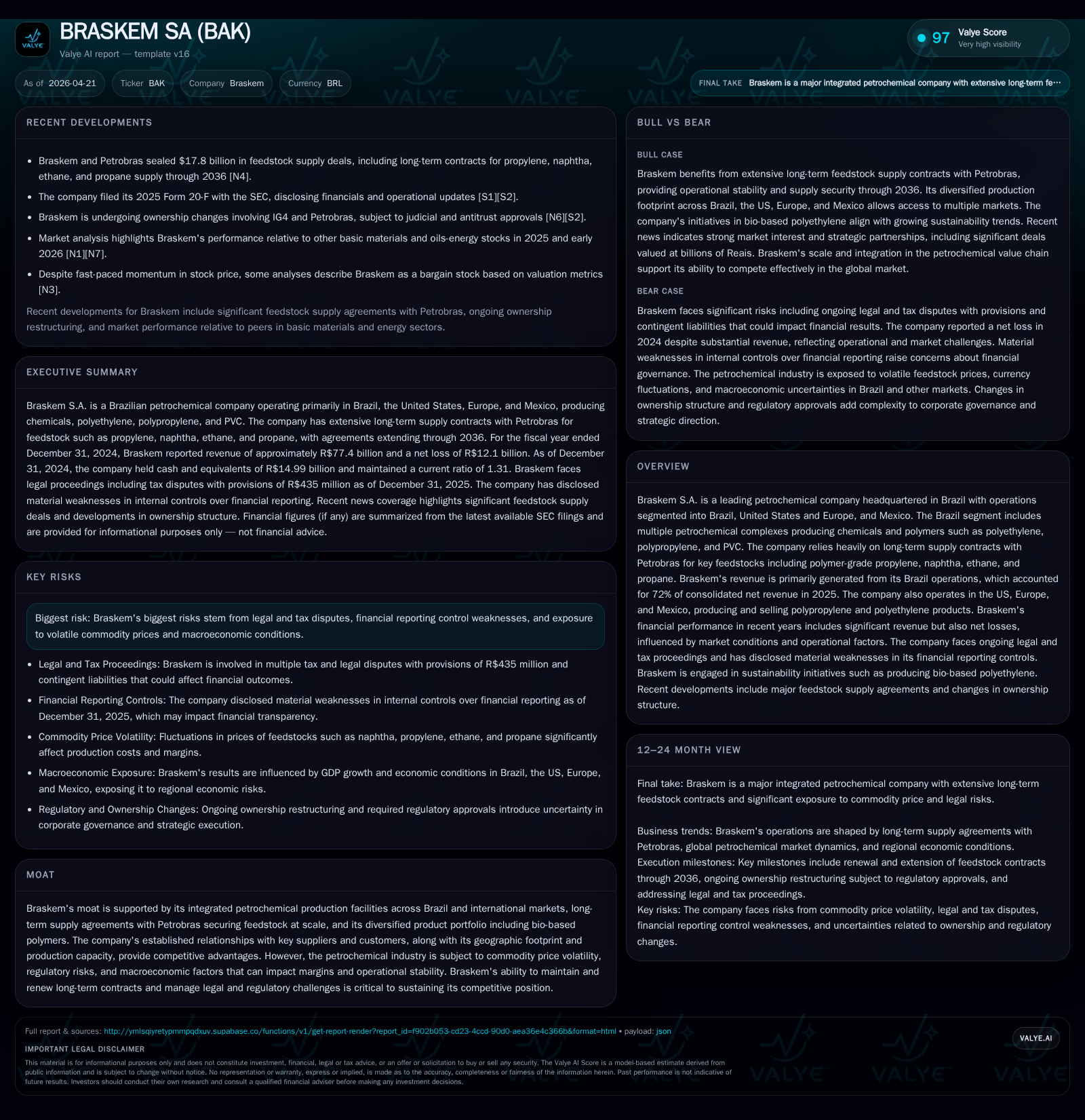
Braskem’s latest quarterly filings highlight critical developments including a judicial share transaction agreement affecting major ownership stakes and pending European Commission approval under the Foreign Subsidies Regulation (FSR). The company’s core business in Brazil, generating about 72% of revenues, depends heavily on long-term polymer-grade propylene supply contracts with Petrobras, several of which face expiration or renewal windows through 2029. While Braskem benefits from integrated petrochemical assets across Brazil and international segments, its margins remain pressured by volatile raw material prices, especially naphtha and propylene, compounded by macroeconomic shifts and currency fluctuations. Legal and tax contingencies represent ongoing risks that cloud operational cash flow visibility. Key upcoming catalysts include contract renewal outcomes for the REDUC refinery feedstock supply expiring in May 2026 and potential European regulatory clearance impacting growth initiatives.
Latest Operational Review: Insights from the April 2026 Quarterly Filing
Braskem’s April 2026 Form 6-K filings provide crucial near-term updates shaping its operational outlook. Of particular note is the announcement dated April 19 of a judicial share purchase and sale agreement involving Novonor and affiliated investment funds representing roughly 50.1% of common shares and approximately 34.3% of total share capital [S3]. This transaction signals ongoing ownership restructuring subject to precedent conditions but may impact governance dynamics. Concurrently, Braskem disclosed that while antitrust approvals for multiple jurisdictions including Brazil, Mexico, US, and the EU have been obtained for respective transactions, final clearance remains pending from the European Commission regarding Foreign Subsidies Regulation (FSR) compliance [S3]. This approval bottleneck could delay strategic transactions or expansions reliant on regulatory greenlights.
The company also filed its comprehensive 2025 Form 20-F aligning governance protocols but confirming persistent material weaknesses in internal financial reporting controls. Key weaknesses relate to assessment controls over debt covenants at its Mexican subsidiary Braskem Idesa, insufficient rigor around impairment reviews of fixed assets including goodwill, and deficiencies in recognition processes associated with legal contingencies [S1]. These control lapses raise caution over financial statement reliability until remediated.
Braskem’s Business Model: Integrated Petrochemical Production Anchored by Petrobras Contracts
Braskem’s revenue generation is tightly tied to its integrated petrochemical manufacturing facilities predominantly located across Brazil, with additional production platforms in the US/Europe and Mexico [S6], collectively producing polyethylene (PE), polypropylene (PP), polyvinyl chloride (PVC), and specialty bio-based polymers such as PE I'm Green™. In 2025, Brazil accounted for approximately 72% of consolidated net revenues [S6], underpinning its reliance on this geography.
Central to Braskem’s business model is feedstock procurement secured via long-term purchase contracts with Petrobras for polymer-grade propylene sourced from multiple refiners including REPLAN, REVAP, REPAR, REDUC, and RECAP [S1]. These agreements predominantly extend from a base start date of January 1, 2022 through staggered expirations mainly clustered around May 2026 (REDUC and RECAP) through to June/December 2028-29 for other terminals.
The REDUC contract’s impending expiration on May 17, 2026 presents a material cost risk; this supply delivers roughly 100 kton/year feeding PP5 unit in Rio de Janeiro with associated transaction volumes valued at R$391 million in fiscal year 2025 [S1]. Disruptions or unfavorable renegotiation terms here would exert direct pressure on feedstock cost stability given limited alternative proximate sources. The value locked under all these agreements cumulatively amounts to several billion Reais spread across polymer grade propylene commitments.
This tightly integrated supply chain infrastructure offers Braskem scale economies but embeds dependency risk as feedstock pricing directly influences margin elasticity given petrochemicals’ commodity-linked product pricing dynamics.
Competitive Landscape and Industry Dynamics Impacting Braskem
Braskem operates within an industry characterized by regional segmentation yet linked globally by aromatic feedstock pricing trends centered on naphtha and olefin derivatives such as propylene. Its footprint spans Brazil's large petrochemical complexes—Camacari (Bahia), Triunfo (Rio Grande do Sul), Capuava (São Paulo), Duque de Caxias (Rio de Janeiro)—combined with international facilities focused on polypropylene production in the US/Germany plus ethylene derivatives in Mexico [S6].
Pricing power remains constrained due to exposure to volatile raw material costs; naphtha ARA pricing fluctuated sharply between $505-$654 per ton during full-year 2025 compared to $612-$710 per ton in prior year [S1] while US propylene has experienced even wider swings from $672 up to $1,058 per ton in the same period [S1]. These fluctuations propagate through resin prices which are dollar-denominated internationally but must be translated under local currency regimes—in Braskem's case primarily Brazilian Real which appreciated by approximately +11% against USD during calendar year 2025 [S1]. The mix of foreign currency exposure combined with regional regulatory frameworks creates layered complexity around pricing pass-through.
Operationally, capacity utilization—the metric reflecting actual production relative to maximum capability—declined approximately four percentage points compared with prior year largely due to demand softness necessitating production adjustments alongside scheduled maintenance downtime at Bahia complex completed early 2026 [S1]. This reduction signals cyclical softness alongside possible structural market saturation or competitive incursion challenges.
Regulatory risk manifests notably through pending approvals under Europe’s Foreign Subsidies Regulation that restricts subsidization across borders potentially reshaping competitive alignments or merger conditions [S3]. Additionally, environmental compliance pressures persist given litigations linked to geotechnical incidents surrounding manufacturing sites compounding reputational risk factors [S10].
Growth Prospects and Constraints: Commodity Volatility, Legal Risks, and Market Demand
Growth trajectories for Braskem are shaped unevenly by macroeconomic factors within operating regions. GDP growth rates slowed modestly across primary markets—Brazil at +2.3%, US +2.1%, Eurozone +1.5%, with Mexico lagging at just +0.8% according to local statistical bodies [S1]. Lower economic expansion shades demand prospects for polymers used extensively across construction, packaging, automotive sectors.
Commodity input volatility—as reflected in raw material global price gyrations—exerts pronounced margin pressure. Feedstock costs are pivotal determinant variables given high input intensity of petrochemical value chains accounting for a dominant share of operating costs versus relatively muted product differentiation capability.
Legal risks compound earnings uncertainty with active tax disputes aggregating provisions exceeding several hundred million Reais alongside broader civil claims linked to environmental remediation liabilities [S10][S22]. These contingencies weigh heavily on capital allocation decisions.
Capital expenditures remain calibrated toward maintaining operability rather than expansion given prevailing clouded visibility around regulatory clearances for growth capital deployments compounded by internal control remediation imperatives [S1][S13]. Demand-side signals remain mixed with incremental growth chances tied more closely to bio-based polymer development areas providing a modest differentiation edge but not offsetting scale-driven commodity market cyclicality fully.
Catalysts to Watch: Regulatory Approvals, Contract Renewals, and Legal Proceedings
Investors should monitor several high-impact upcoming events that can recalibrate Braskem’s operating profile:
- Foreign Subsidies Regulation Approval: The still-pending European Commission decision constitutes the last jurisdictional hurdle before full antitrust clearance can be declared official affecting cross-border transactions or alliances [S3].
- Petrobras Polymer-grade Propylene Contract Renewals: Of particular note are contracts expiring mid-2026 like REDUC (May) requiring timely renewal to preserve feedstock security crucial for downstream polypropylene operations at Rio de Janeiro plant PP5 [S1].
- Legal & Tax Dispute Resolutions: Outcomes from ongoing tax lawsuits including PIS/COFINS credits issues will influence provisioning levels directly impacting cash flows [S10][S22].
- Internal Control Enhancements: Management activity around rectifying identified control weaknesses particularly related to asset impairment evaluations and debt covenant monitoring provide insight into future transparency improvements [S1].
These milestones serve as markers enabling reassessment of operational risks versus strategic growth levers.
Supporting Financial Data: Revenue Trends, Profitability Challenges, and Liquidity
Braskem posted nominal revenue growth of roughly +9.7% from FY2023 to FY2024 reaching BRL ~77.4 billion reflecting partial recovery post pandemic-induced disruptions but profitability remained challenged with net losses deepening sharply from -BRL4.89 billion in FY2023 to -BRL12.05 billion in FY2024 evidencing rising cost burdens and impairment provisions [F1].
Equity deteriorated notably turning negative at approx -BRL4.28 billion by end FY2024 from positive BRL3.28 billion prior year consistent with loss absorption exceeding retained earnings levels [F1]. Liquidity measured through cash & equivalents remained solid at BRL14.98 billion assisting short-term operational continuity whilst banking relationships support working capital needs given cyclicality pressure points [F1].
The combined financial narrative underscores pressure points aligned with feedstock cost volatility ripple effects exacerbated by legal contingencies causing impairments without yet translating into sustained margin recovery or free cash flow generation enhancements.
Historical performance (annual)
| FY | Rev ($bn) | Net ($bn) | Rev YoY | Net YoY |
|---|---|---|---|---|
| 2024 | 77.4 | -12.1 | +9.7% | -146.5% |
| 2023 | 70.6 | -4.9 | -26.9% | -496.1% |
| 2022 | 96.5 | -0.8 | -8.6% | -105.9% |
| 2021 | 105.6 | 14.0 |
Source: SEC companyfacts cache [F1].
Capital returns and efficiency (annual)
| FY | Div ($bn) | ROE% |
|---|---|---|
| 2024 | 281.7 | |
| 2023 | 6.0 | -149.1 |
| 2022 | -6.0 | -13.4 |
| 2021 | 225.0 |
Source: SEC companyfacts cache [F1].
In summary, while Braskem retains structural advantages via vertical integration anchored by longstanding Petrobras supply ties securing cost competitiveness domestically combined with geographical diversification into Americas and Europe polymer markets,[S1][S6], current performance is tethered tightly to commodity market swings alongside unresolved regulatory approvals and embedded legal/tax risks.[S10][S20] Near-term outlook sensitivity revolves principally around feedstock contract renewals—especially REDUC—and finalization of European FSR clearance which influence both operational stability and capacity for strategic investments.
This analysis integrates public SEC filings as primary source documents reflecting factual company disclosures without investment recommendations or price forecasts.
Disclaimer: This is research-only, informational analysis and not investment advice. It may include AI-generated interpretation and general industry context. Always verify important details using primary sources.

Comments