
Macro Bank’s 2026 Shareholder Decisions and Dividend Strategy Reflect Argentine Market Realities
Banco Macro’s recent shareholder meeting approvals signal governance continuity and prudent dividend planning within Argentina’s regulatory framework.
In its latest quarterly Form 6-K filings, Macro Bank Inc. reported decisive shareholder resolutions delegating board remuneration allocation and approving dividend distributions consistent with Central Bank guidelines. These governance actions reaffirm operational steadiness amid Argentina’s complex regulatory environment. The bank’s business model leverages diverse retail and corporate banking products, operating within a competitive but tightly regulated financial sector that both enables structural advantages and imposes constraints. Moving forward, monitoring Central Bank dividend authorizations and the bank’s execution on capital management will be critical to assess operational resilience.
Recent Shareholder Meeting and Governance Actions
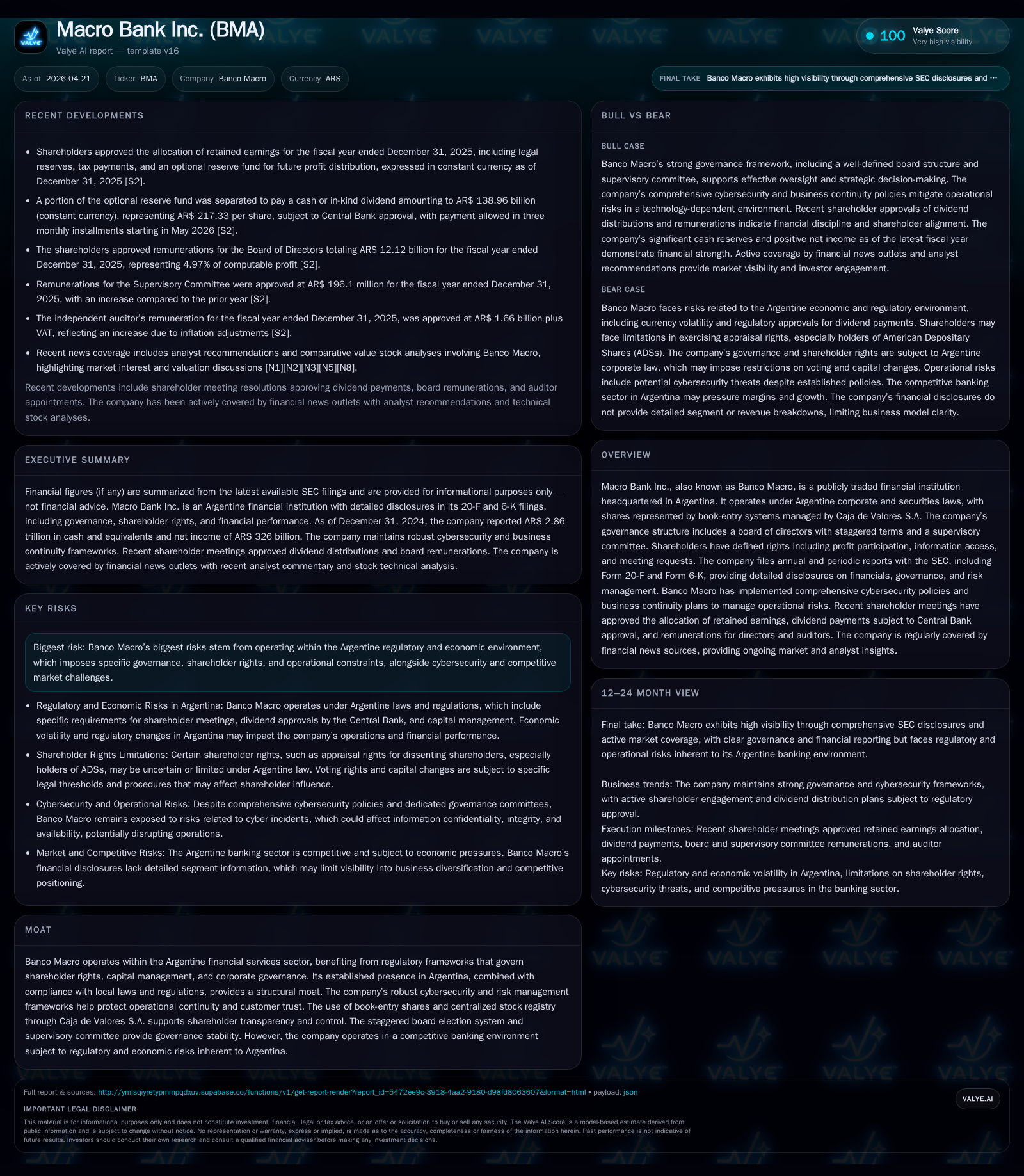
Macro Bank Inc.’s April 2026 Shareholders’ Meeting outcomes, documented in the latest Form 6-K filings dated April 9 and 10, demonstrate clear shareholder endorsement for governance measures aimed at operational continuity. With over 400 million votes cast in favor, the meeting resolved to delegate the allocation of remuneration for each member of the Board of Directors as well as the Supervisory Committee to the Board itself [S2]. This delegation reflects a trust in established leadership arrangements while streamlining compensation decision processes.
Significantly, shareholders approved a detailed application of retained earnings for fiscal year ending December 31, 2025 amounting to AR$290.4 billion expressed in constant currency [S2, S18]. The allocation framework sets AR$57.9 billion into the mandatory Legal Reserve Fund, AR$13.7 billion corresponding to Personal Asset Tax liabilities on business entities, with a prevailing AR$218.9 billion committed to an Optional Reserve Fund for Future Distribution of Profits. This reserve underpins an impending cash or in-kind dividend payment structure subject to Banco Central de la República Argentina (BCRA) authorization [S2].
A further resolution separates AR$139 billion from this Optional Reserve Fund (constant currency basis) toward dividends equivalent to AR$217.33 per share, to be distributed in three equal non-cumulative monthly installments beginning May 2026 per BCRA Communiqué “A” 8410 provisions [S2, S24]. The sizable dividend distribution underscores a cautious yet shareholder-aligned profit deployment balancing liquidity preservation with return expectations.
Operational Impact of Recent Board and Committee Resolutions
The Shareholders’ Meeting validated Board and Supervisory Committee performance during the prior fiscal year by approving their actions with robust voting parallels [S2]. Banco Macro’s governance architecture includes staggered three-year board terms ensuring continuity whilst allowing periodic renewal—12 directors including independent appointees serve under this model [S3]. The Supervisory Committee comprises seasoned syndics actively overseeing risk management adherence, audit integrity, and regulatory compliance.
Per the annual Form 20-F disclosures dated April 20, 2026, internal controls extend prominently into cybersecurity frameworks where forensic investigative procedures are institutionalized for incident response [S1]. Senior executives including a dedicated Chief Information Security Officer oversee technology risk exposure management continually reporting to the Board. These operational protocols form a robust defense mechanism against system disruptions vital to sustaining customer trust in a regional marketplace subject to both technological threats and stringent regulators.
Banco Macro’s Business Model and Service Offering in Argentina
Banco Macro derives revenues principally through diversified retail banking services including deposit gathering, consumer loans, SME lending alongside corporate financing solutions adapted specifically for Argentina's economic context [S1]. Customer segments span individuals relying on comprehensive transactional banking supported by digital access platforms, companies seeking credit facilities backed by risk-adjusted parameters enforced by the bank’s credit underwriting discipline.
The use of book-entry shares managed centrally by Caja de Valores S.A. promotes transparency among shareholders while underpinning corporate governance stability [S1]. Revenues are thus generated from interest income on loan portfolios, fee-based services connected to transactional operations, foreign exchange activities given Argentina's unique currency environment, plus treasury operations balancing liquidity with capital adequacy requirements. Such a multifaceted business model is tailored not only to fulfill local banking demands but also to navigate inflationary pressures characteristic of the Argentine economy.
Competitive Environment and Regulatory Factors Influencing Positioning
Banco Macro operates amidst intense competition from domestic banks such as Banco Galicia or BBVA Argentina complemented by smaller regional players competing for retail deposits. However, Argentina's banking sector is heavily regulated; policies enacted by the Central Bank impose rigorous controls over capital buffers, dividend distributions, loan provisioning, and foreign currency exposure [S1], [S23]. These frameworks indirectly constrain pricing power while incentivizing prudent risk management—both mitigating systemic risks but limiting aggressive expansion strategies.
The dual-class share system provides differential voting rights where Class A shares carry five votes each while Class B hold one vote per share—a structure designed under Argentine law yet balanced by statutory protections for minority shareholders especially concerning major corporate actions such as mergers or capital reductions [S1],[S9]. Dividends require BCRA approval which entails compliance with Communiqués setting payout ceilings tied to net income after reserves—a critical factor tempering immediate profit distributions despite apparent liquidity [S2],[S24].
Regulatory mandates also extend to governance processes encompassing audit committee functions reviewing auditor independence along with control systems evaluations fostering transparency—a moat reinforcing stakeholder alignment amid economic uncertainties prevalent in Argentina [S1].
Growth Opportunities and Constraints Within the Argentine Banking Sector
While inflationary volatility and currency fluctuations impose tangible growth constraints, structural trends favor incremental penetration of banking products driven by digital adoption acceleration post-pandemic-era shifts [N1],[N2]. Banco Macro's extensive branch network combined with focused investments in technology-driven customer engagement platforms offers potential to deepen wallet share notably within underbanked demographics.
Optional Reserve Funds increase capital buffer capacity affording flexibility in future profit distribution which may serve either organic growth funding or cushion regulatory shocks [S17],. However, cyclical economic headwinds—including GDP fluctuations linked to agricultural commodity dependencies—and strict BCRA-imposed dividend ceilings restrain near-term top-line expansion velocity.
Growth trajectories hence appear structurally moderate rather than exponential; Banco Macro’s strategic conservatism evidenced in cautious retained earnings deployment highlights commitment toward sustainable long-term stakeholder value generation rather than aggressive market share grabs [F1],[S1].
Upcoming Milestones and Market Indicators to Watch
Key forthcoming developments include pending BCRA authorization for declared dividends which will serve as immediate liquidity indicators reflective of regulatory comfort with Banco Macro’s capital adequacy levels [S24]. Subsequent shareholders meetings scheduled annually will revisit director nominations potentially influencing governance dynamics alongside capital allocation policies.
Quarterly earnings releases subsequent to April filings will reveal execution consistency particularly within net interest margins amid evolving macroeconomic conditions. Monitoring shifts in reserve fund utilization will provide early signals on management's strategic flexibility facing Argentina’s economic cycles [S2],[S4].
Given regulatory constraints shaping payout timing—as exemplified by mandated staggered installments—investor attention should focus on declared versus realized distributions alongside evolving Central Bank policy statements communicating changes permissible under communication "A" series nuances affecting all Argentine financial institutions.
Financial Review: Profitability, Capital Allocation, and Dividend Trends
Banco Macro’s latest publicly available fiscal year data records net income at approximately AR$326 billion for FY2024 representing a notable decline from FY2023 levels—a roughly -44% year-over-year decrease attributable predominantly to macroeconomic headwinds including inflation volatility impacting interest spreads [F1]. Equity stands near AR$4 trillion reflecting considerable balance sheet growth.
Nonetheless, return on equity maintains an approximate 8.1% mark suggesting retention of moderately healthy profitability parameters amidst challenging externalities [F1]. Dividend disbursements have scaled consistent with approved reserves (AR$614 billion dividends paid FY2024 versus markedly lower payouts prior years), corroborating shareholder-aligned capital stewardship executed within strict Central Bank distributions ceilings promulgated via communiqués "A" series approvals requiring pre-distribution authorization [F1],[S2],[S24].
Cash equivalents exceed AR$2.86 trillion supporting ample liquidity; however, reliance on favorable regulatory determinations remains integral before profit remittances can commence effectively. The measured approach—balancing payouts with retention—highlights pragmatic financial management mindful of domestic uncertainties inherent in Argentine markets.
This analysis synthesizes official SEC filings up to April 2026 alongside credible market commentary without providing investment advice or forecasts. Figures cited are sourced directly from reported filings or authoritative company disclosures as specified.
Disclaimer: This is research-only, informational analysis and not investment advice. It may include AI-generated interpretation and general industry context. Always verify important details using primary sources.

Comments