
AMCON Distributing’s Q2 2026 Update Highlights Margin Pressures Amid Scale-Driven Wholesale Growth
Latest quarter reveals operational resilience tempered by profitability challenges in a competitive wholesale and specialty retail market.
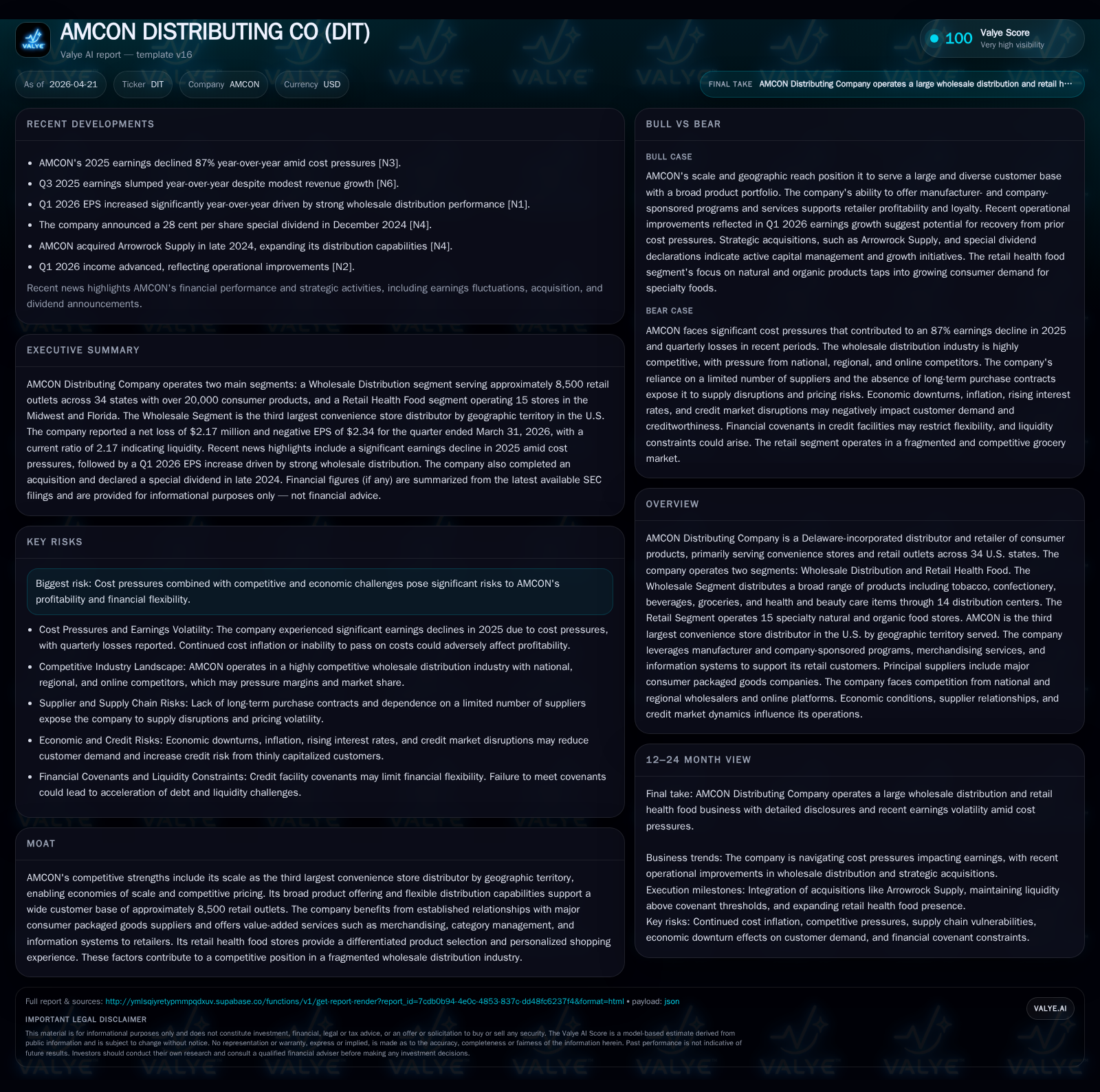
AMCON Distributing reported its second fiscal quarter ended March 31, 2026, reflecting continued revenue growth primarily from its extensive wholesale distribution network serving over 8,500 retail outlets. Despite this scale advantage and broad product offering, rising cost pressures have compressed operating income notably compared to prior years. AMCON's dual-segment model—wholesale convenience store distribution and retail health food stores—positions it well strategically, but regulatory challenges, shifting cigarette demand, and competitive intensity in both segments underscore near-term growth constraints. Key upcoming factors include navigating evolving tobacco regulations, maintaining supplier programs, and managing labor dynamics amid supply chain complexities.
Recent Operating Update
AMCON Distributing Co released its latest quarterly report on April 20, 2026 ([S2],[S3]), covering fiscal Q2 ended March 31, 2026. While the detailed quarterly financials are limited in the excerpts provided, the accompanying press release emphasized sustained top-line growth underpinning the company’s broad distribution reach spanning 34 U.S. states. This update reconfirms AMCON's positioning as a significant player in the convenience store wholesale distribution sector.
The report highlights that despite revenue resilience driven by their core wholesale segment, profitability has faced notable pressure. Earlier annual filings showed operating income contraction of over 30% year-over-year into fiscal 2025 ([F1]). This suggests ongoing margin compression attributable to rising costs—likely from inflationary input pressures including fuel, labor, and regulatory compliance—as well as competitive pricing dynamics.
Business Model Analysis
AMCON operates through two distinct but complementary business segments: Wholesale Distribution and Retail Health Food.
Wholesale Distribution Segment
This segment is the cornerstone of AMCON’s operations. It comprises distribution of more than 20,000 consumer products including cigarettes (approximately 61% of consolidated revenues in fiscal 2025), tobacco products, candy, beverages, groceries, health and beauty care items, paper goods, frozen/refrigerated foods, and institutional foodservice supplies ([S4],[S5]). The company serves roughly 8,500 retail outlets such as convenience stores, grocery chains, liquor stores, drug stores, and tobacco shops.
AMCON’s wholesale arm is built around an extensive network of 14 distribution centers totaling approximately 1.7 million square feet across states in key regions: Central U.S., Rocky Mountains, Great Lakes, Mid-South/Mid-Atlantic ([S4],[S26]). The scale ranks AMCON as the third largest U.S. convenience store distributor by geographic territory served ([S5],[S9]). This sizable footprint yields economies of scale enabling favorable purchasing leverage with major suppliers including Altria, RJ Reynolds (leading tobacco manufacturers), Hershey, Kraft Heinz, Mars Wrigley (CPG giants), General Mills, Procter & Gamble among others.
Value is added beyond physical distribution through manufacturer- and company-sponsored sales/marketing programs targeting optimal retailer inventory levels and sales maximization. Merchandising support services and proprietary information systems provide data-driven category management insights fostering retailer loyalty ([S4],[S8]). Furthermore, AMCON markets a portfolio of private label products enhancing margin opportunities.
Retail Health Food Segment
Operating 15 specialty natural/organic grocery stores under banners such as Chamberlin’s Natural Foods and Earth Origins Market principally located in the Midwest and Florida ([S4],[S5]), AMCON taps into structural demand for health-conscious foods driven by consumer trends like clean eating and preventative wellness ([S8]). The segment offers broad organic product selections supported by trained associates delivering personalized shopper experiences.
Yet this segment contends with a highly fragmented but intensely competitive environment featuring deep-pocketed national chains (Whole Foods/Amazon), Sprouts Farmers Market, regional grocers as well as mass merchandisers like Target and Walmart expanding into natural categories ([S9]).
Industry Structure & Competitive Position
Wholesale distribution for convenience stores remains highly fragmented nationally with numerous regional players competing alongside major firms such as McLane Co. Inc. and Performance Food Group ([S9]). Strong price competition coexists with service differentiation driven by breadth of product lines and frequency/reliability of delivery.
AMCON leverages its geographic scale—the third largest distributor footprint—to gain comparative pricing advantages while supporting complex multi-territory chain accounts ([S9]). This combination allows it to offer customized retail solutions uncommon among smaller operators.
The company faces disruption threats from evolving retail supply models including manufacturers’ possible moves toward direct distribution which could reduce intermediary wholesaler roles ([S19]). Increased digital channel penetration by e-commerce platforms like Amazon poses additional long-term supply chain competitive risks.
On the retail side, AMCON operates within an increasingly consolidated natural foods space where brand loyalty is vital but price competition with large grocers is fierce ([S9],[S26]).
Growth Drivers & Constraints
Structural Growth Drivers:
- Consumer Demand for Convenience Products: Street-level demand for cigarettes/tobacco continues to decline structurally but remains significant; sales beyond tobacco in candy/beverages/groceries help diversify revenue sources ([S27],[S28]).
- Health Consciousness: Organic/natural foods retail benefits from secular trends toward health/wellness that support steady demand growth ([S8],[S26]).
- Manufacturer Programs: Strong partnerships enable support programs increasing retailer stickiness.
- Technology Investments: Planned enhancements in customer-facing IT applications aim to improve ordering efficiency & category insights ([S10]).
- Acquisition Opportunities: Medium-to-long term strategy includes acquisitions to expand geographic footprint or product portfolio ([S10]).
Constraints:
- Regulatory Risks: Increasing FDA regulation on tobacco/vaping products imposes operational costs; potential product bans could reduce volume significantly ([S7],[S16],[S27]).
- Price Competition: Industry-wide pressure limits margin improvement opportunities given commoditized product categories ([S9],[S12]).
- Labor Challenges: Union contracts with drivers (~30 employees) expiring in late 2026 pose potential disruptions; tight labor market raises retention costs ([S18]).
- Supply Chain Risks: Dependence on suppliers without binding long-term contracts exposes risk to availability disruptions from external shocks (strike risk, pandemics) or geopolitical issues affecting tariffs ([S19],[S12]).
- Capital Access Limitations: Rising borrowing costs in credit markets coupled with covenant restrictions may constrain funding needed for growth investments or acquisitions ([S6],[S14],[F1]).
- Declining Cigarette Demand: Downtrend in cigarette consumption impacts ~60% revenue concentration; growth has to come from non-tobacco categories or retail segment expansion ([S27],[S28]).
What to Watch Next
Key monitoring points include:
- FDA Regulatory Developments impacting tobacco/vaping product distribution that could materially alter volume or supplier relationships.
- Wholesale Margin Trends — any stabilization or further erosion given input cost pass-through ability will affect profitability outlook.
- Labor Negotiations outcome regarding unionized drivers scheduled for renewal in November 2026 with risks of strike or wage increases.
- Retail Segment Expansion Plans particularly whether new store openings or acquisitions can enhance competitive positioning versus major national chains.
- Supplier Program Stability — retention or loss of key manufacturer promotional programs impacting sales incentives.
- Capital Market Access — ability to fund capex/investments within existing revolving credit facility covenants amid adverse economic conditions.
- Product Mix Evolution — shifts towards higher margin categories outside traditional cigarette dominance could influence future returns.
Financial Profile (Supporting Evidence)
Historical performance (annual)
| FY | Net ($mm) | CFO ($mm) | OpInc ($mm) | Capex ($mm) | Net YoY |
|---|---|---|---|---|---|
| 2025 | 1 | 19 | 13 | 9 | -86.9% |
| 2024 | 4 | 68 | 18 | 20 | -62.6% |
| 2023 | 12 | 20 | 26 | 12 | -30.4% |
| 2022 | 17 | 23 | 23 | 15 |
Source: SEC companyfacts cache [F1].
Capital returns and efficiency (annual)
| FY | Div ($mm) | Buybacks ($) | FCF ($mm) |
|---|---|---|---|
| 2025 | 1 | 1133095 | 10 |
| 2024 | 1 | 404876 | 47 |
| 2023 | 4 | 404876 | 8 |
| 2022 | 3 | 5738 | 8 |
Source: SEC companyfacts cache [F1].
Over recent fiscal years ending September 30:
- Revenue increased approximately +5.3% year-over-year into FY2025 at ~$1.39 billion [F1].
- Operating income declined sharply by -30% YoY into FY2025 at ~$12.6 million reflecting intensifying margin pressures [F1].
- Net income fell considerably (-86.9%) to just $0.57 million indicating near breakeven profitability [F1].
- Operating cash flow decreased by -72.5% over the same period while capital expenditures were cut nearly in half (-56%) suggesting cautious investment posture [F1].
- Equity base shows modest growth reflecting retained earnings accumulation albeit net income weakness [F1].
- Current ratio at Q2 end (March 31, 2026) stood comfortably at ~2.17 indicating healthy short-term liquidity with current assets roughly double current liabilities [F1].
- Dividend distributions remain modest relative to earnings showing restrained capital returns [F1].
The financial snapshot illustrates a company generating substantial top-line throughput but facing strong earnings headwinds likely attributable to cost inflation (fuel/labor), compliance burdens related to regulation especially in tobacco products, competitive pricing environments limiting markup flexibility and transient supply chain stresses impacting working capital needs.
This analysis synthesizes AMCON Distributing Company's most recent public filings emphasizing its strategic positioning within wholesale consumer goods distribution specialized towards convenience retailing complemented by a niche retail health food business line. While AMCON benefits from scale advantages and multi-product vendor programs providing wide coverage benefits to customers across geographically diverse markets, it confronts multiple cyclical headwinds stemming from regulation tightening especially over tobacco-related categories alongside structural shifts in consumer behavior away from cigarettes toward healthier lifestyles benefiting the retail segment but not fully offsetting pressure across wholesale profitability metrics.
Monitoring regulatory developments impacting tobacco product handling as well as execution efficacy on cost control initiatives amidst competitive market dynamics will be crucial to assessing near-to-medium term performance trajectories going forward.
Disclaimer: This is research-only, informational analysis and not investment advice. It may include AI-generated interpretation and general industry context. Always verify important details using primary sources.

Comments