
Elong Power's Integration Focus and Supply Chain Strategy Amid Odysseys in Market Compliance
Elong Power advances an asset-light, AI-driven battery storage model through strategic Nasdaq listing shifts and operational streamlining.
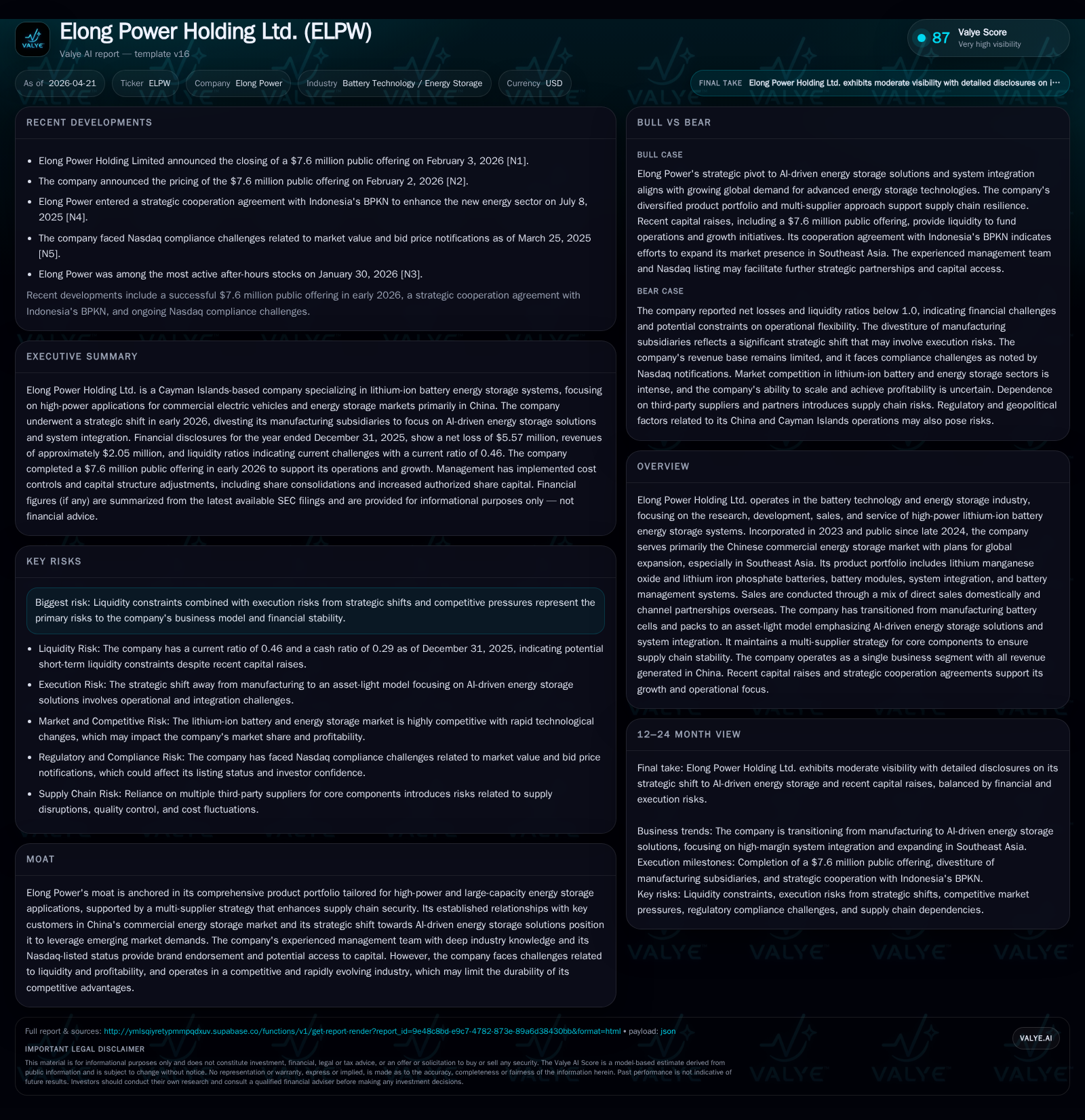
In Q1 2026, Elong Power Holding Ltd. executed key financial restructurings including a loan settlement with its CEO, disposal of loss-making manufacturing subsidiaries, and a $13 million equity raise. The company completed its transition from battery manufacturing to an asset-light technology integrator specializing in AI-enabled lithium-ion energy storage systems. Operating within China's expanding commercial battery storage market with ambitions to grow in Southeast Asia, Elong Power leverages a multi-supplier procurement strategy to mitigate supply risks amid volatile raw material costs. Despite improving operating losses and strategic pivots, liquidity constraints and reliance on partner-developed technologies remain notable challenges as the company seeks execution on backlog contracts and Nasdaq Capital Market compliance.
Latest Operational Footprint: Q1 2026 Updates and Market Actions
Elong Power Holding Ltd.’s latest quarterly filings released in April 2026 reveal a series of significant actions aimed at stabilizing the company’s liquidity position and reinforcing listing compliance on Nasdaq. In particular, the company resolved a $117,076 loan (plus accrued interest) initially extended by CEO Xiaodan Liu to its Hong Kong subsidiary through a partial settlement involving a stock issuance worth approximately $15,600 to an entity controlled by Ms. Liu [S2]. This move reduces related-party debt exposure while bolstering equity.
Concurrently, Elong Power executed two reverse stock splits—16-for-1 in December 2025 followed by an 80-for-1 split in March 2026—to combat continued share price pressure that jeopardized its Nasdaq Global Market listing. These actions culminated in approval from Nasdaq to transfer trading to the Nasdaq Capital Market on April 1, 2026 [S3]. The shift addresses minimum market value of listed securities requirements and helps preserve public trading status without dilution.
Structurally pivotal was the company’s divestiture of Elong Power International Co., Limited and subsidiaries (a group primarily engaged in battery cell manufacturing) during Q1 2026 [S1,S15]. The disposal closed March 17, 2026, at a symbolic purchase price of $10,000 but recognized an accounting gain of roughly $19.1 million due to negative net liabilities carried on the books. This asset-light pivot removes consistently loss-leading operations and is expected to improve working capital availability for ongoing core enterprises in the near term.
Complementing these liquidity maneuvers was a successful equity financing round completed February 2026 raising net proceeds around $13 million after expenses [S1]. Together with tightened expense management reported for fiscal year ending 2025, these steps suggest management’s priority on shoring up financial headroom while progressing operational transformation.
Evolving Business Model: From Battery Manufacture to AI-Driven Energy Storage Systems
Since its inception in August 2023 and culminating post-SPAC listing in late 2024 [S1], Elong Power has strategically evolved away from vertically integrated lithium battery manufacturing into a technology-centric energy storage solutions provider focused on system integration powered by advanced AI capabilities embedded by OEM/ODM partners.
Under this asset-light paradigm, Elong no longer produces cells or packs internally but coordinates procurement across multiple qualified suppliers with globally recognized certifications, ensuring quality while optimizing cost dynamics [S8,S10]. The company's competitive edge stems from sophisticated technical evaluation competencies, integrating high-precision battery management systems (BMS), thermal safety controls, and AI algorithms developed externally but bundled under Elong’s brand umbrella.
This transition allows nimble scalability centered on design, sales expertise, deployment services, and after-sales support rather than capital-intensive production facilities. It also aligns well with expanding demand for lithium manganese oxide (LMO) and lithium iron phosphate (LFP) chemistries prevalent in China’s high-power industrial sectors. The emphasis on AI-enhanced system management anticipates rising customer appetite for smarter battery solutions capable of delivering improved safety, efficiency, and lifecycle performance.
Competitive Landscape: Supply Chain, Product Portfolio, and Market Opportunities
The commercial lithium-ion energy storage sector where Elong operates is characterized by rapid innovation cycles paired with intense raw material cost volatility affecting margins industry-wide. A central tenet of Elong’s resilience strategy is its diversified multi-supplier approach that mitigates risk associated with single-source dependency on critical inputs such as lithium carbonate or cobalt derivatives [S11]. This supply chain architecture also facilitates flexibility in adjusting sourcing based on market pricing fluctuations.
Domestically positioned as a supplier to reputed commercial vehicle makers and industrial equipment companies like Yutong Bus and Zoomlion Heavy Industry [S12], Elong has fostered deep customer relationships crucial for recurring demand. Sales to Chinese grid-side energy storage markets complement growing overseas channels focused primarily on Southeast Asian residential and commercial-industrial segments where channel partnerships accelerate reach with lower direct selling costs.
Product differentiation hinges notably on AI-enabled BMS systems that enhance real-time monitoring accuracy and predictive analytics capabilities—features increasingly sought after as customers confront stringent safety regulations coupled with operational cost pressures. However, these technological advantages depend heavily on partner innovations given Elong’s non-developing stance regarding core BMS tech [S10], potentially limiting proprietary moat depth.
Growth Levers: Contract Execution, Global Expansion, and Technology Integration
A highlight underpinning anticipated revenue growth is a substantial RMB480 million ($67.6 million) contract signed in May 2024 with Nengjian Henan Urban Construction Engineering Co., Ltd., which was delayed pending governmental approvals but now slated for delivery commencement June 2026 [S1]. While deferrals represent execution risk tied to regulatory dependencies beyond Elong’s direct control, successful fulfillment could provide critical scale validation.
Complementary progress includes commercialization of prototype-qualified solutions for a smaller RMB80 million ($11.3 million) agreement with Beijing Xinyuanhengyuan Technology Development Co., Ltd., evidenced by initial deliveries generating first recognized revenues albeit modest [$19K] in fiscal year 2025 [S1].
Geographically, while China remains the mainstay revenue source today—comprising virtually all reported sales—the company explicitly targets Southeast Asia for global expansion leveraging its channel cooperation model there . Given rising electrification trends regionally combined with burgeoning AI data center demands globally propelling energy storage uptake [S16], this market entry strategy is well aligned with structural growth drivers.
Technology integration further supports scale through enhanced supply chain coordination aligned with medium-to-long-term demand forecasts [S16]. Yet reliance on OEM/ODM partners for technology ownership necessitates vigilant partner selection as well as continuous reinforcement of integration services capability.
Key Constraints: Liquidity Pressures and Execution Risks
Despite evident progress narrowing operating losses almost 95% year-over-year—from roughly $29 million loss in FY2024 to about $1.5 million loss FY2025—and cutting net losses by over 81% [F1], Elong continues to face liquidity challenges highlighted by a current ratio under 0.5 at fiscal year-end December 31, 2025 [F1], banking working capital deficits that constrain operating flexibility.
Cash burn remains negative with operating cash flow around -$2.7 million annually despite reduced magnitude [F1], reflecting ongoing investment in inventory build-up ahead of scaled deliveries plus costs sustained during business model transition phases.
Dependency on partner-developed BMS technology carries inherent execution uncertainties linked to innovation cycles outside direct control; any delays or technology gaps could erode competitive positioning or raise substitute threats. Concurrently, Nasdaqlisted compliance dynamics have imposed governance and capital structure pressures resulting in reverse splits which dilute shareholder base attractiveness despite preserving market access [S3].
Market competition intensifies sharply as global battery storage sees inflows from large incumbent manufacturers plus agile startups focusing on AI approaches presenting continuous benchmarking challenges for product relevance maintenance.
Forward Watch: Milestones and Indicators to Gauge Progress
Analysts tracking Elong Power should focus keenly on developments such as:
- Start-of-delivery execution timeline for the RMB480M Nengjian Henan contract, now expected mid-2026;
- Quarterly revenue progression notably from the Beijing Xinyuanhengyuan contract following prototype validation milestones;
- Additional financing rounds or balance sheet strengthening moves indicative of further liquidity management;
- Management disclosures regarding ASEAN market penetration progress alongside channel partnership expansions;
- New OEM collaborations or upgrades announced enhancing the AI-driven BMS technology stack deployment;
- Supply chain integrity signals amid global raw materials pricing volatility impacting procurement costs;
- Regulatory updates affecting product certification or government approval processes that impact delivery schedules.
These indicators collectively will shed light on how successfully Elong can convert strategic positioning into tangible scale economics amid evolving market contexts.
Financial Snapshot: Profitability Trajectory and Balance Sheet Status
Elong Power’s audited results for FY2025 summarized below illustrate operating improvements yet highlight ongoing capital constraints:
Historical performance (annual)
| FY | Net ($mm) | CFO ($mm) | OpInc ($mm) | Capex ($) | Net YoY |
|---|---|---|---|---|---|
| 2025 | -6 | -3 | -1 | 160911 | +81.5% |
| 2024 | -30 | -3 | -29 | 976 |
Source: SEC companyfacts cache [F1].
Capital returns and efficiency (annual)
| FY | FCF ($mm) | ROE% |
|---|---|---|
| 2025 | -3 | 24.5 |
| 2024 | -3 | 183.1 |
Source: SEC companyfacts cache [F1].
Source: SEC filings years ending Dec '24 & Dec '25 consolidated reported figures; all USD [F1]
Though revenue generation commenced only recently reflecting nascent trading activities rather than manufacturing sales streams (following divestitures), gross margin stands modest near ~4%. Operating income improved steeply owing largely to eliminating heavy losses from discontinued operations via disposal actions combined with stricter expense control measures including reduced professional fees offsetting increased staff costs [S21].
Capital expenditure remained minimal consistent with asset-light shifts mainly invested towards selective R&D support rather than physical assets acquisition [F1]. Nevertheless, negative cash flow from operations combined with large accumulated deficit (~$74.5m) require continuing prudent capital stewardship alongside bolstered investor confidence encouraged by recent financing success ($13m net raised Feb ‘26) [S18,S22].
The company maintained readiness for going concern classification relief based on these financing inflows coupled with anticipated project proceeds expected during mid-to-late 2026 providing glide path liquidity sufficiency assurances [S22]. Yet working capital remains constrained given current liabilities more than twice current assets (<0.5 ratio), necessitating careful financial management moving forward.
This analysis is based solely on publicly available SEC filings up to April 20, 2026, supplemented by Valye News sector expertise; it does not constitute investment advice.
Disclaimer: This is research-only, informational analysis and not investment advice. It may include AI-generated interpretation and general industry context. Always verify important details using primary sources.

Comments