
TDH Holdings Shifts to Commercial Real Estate with Growth Amid Past Operational Disruptions
The company’s strategic pivot to commercial real estate management marks a decisive shift following operational challenges in pet food and restaurant segments.
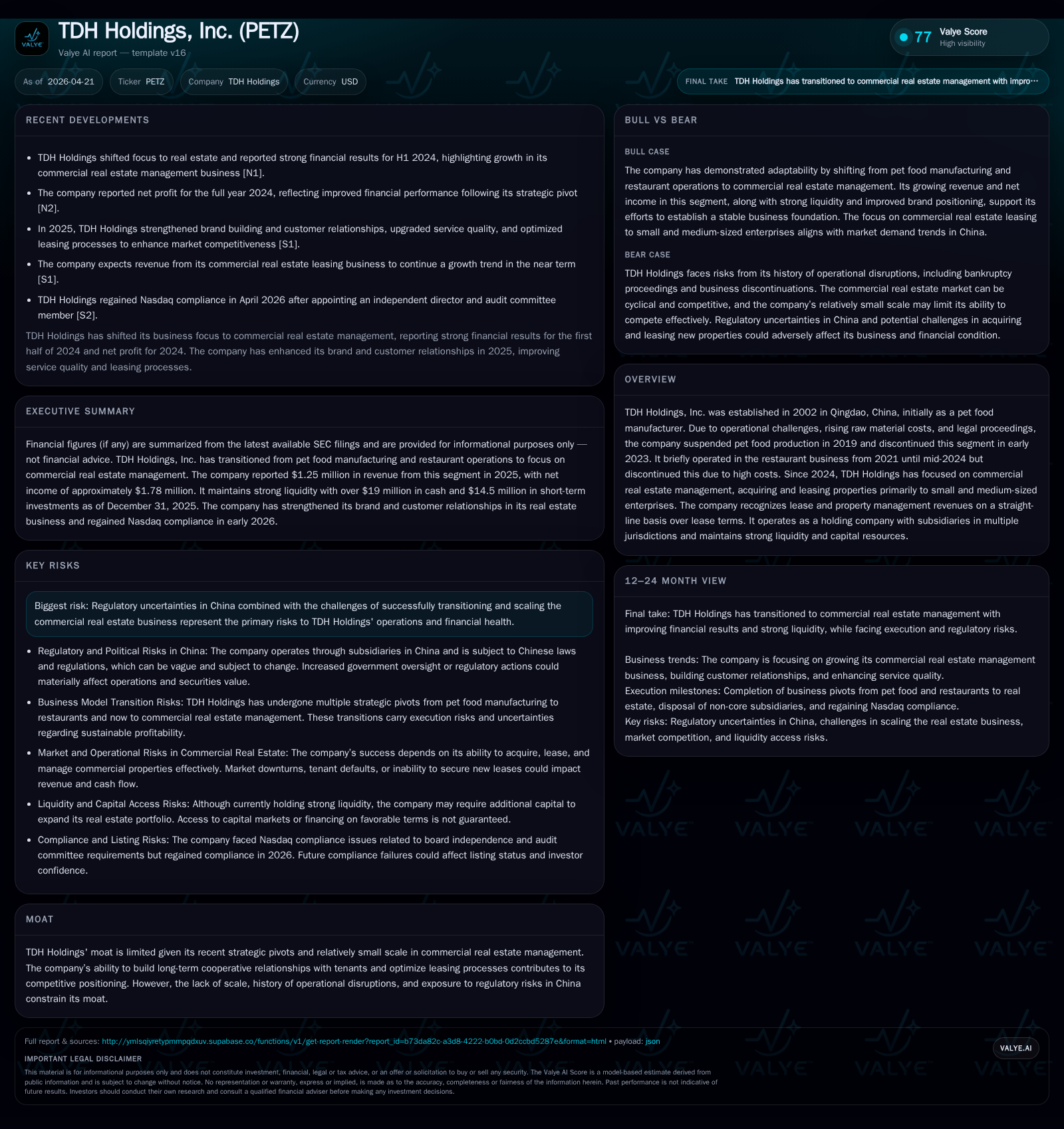
TDH Holdings, originally a pet food manufacturer, has transitioned fully into commercial real estate management since discontinuing its previous segments. Its latest quarterly filing in April 2026 confirms Nasdaq compliance after board restructuring, indicating governance stabilization. The commercial real estate business is nascent but growing revenue more than 120% year-over-year, driven by leasing to SMEs amid favorable demand. Despite improvements, TDH faces constraints from limited scale, regulatory risks in China, and lingering operating losses that temper near-term profitability.
Recent Operating Update
TDH Holdings' most recent significant development occurred in April 2026 with its Form 6-K filings ([S2], [S3]). The company successfully addressed a Nasdaq listing compliance issue regarding independent director and audit committee membership by appointing Mr. Xu Luo, who brings extensive experience managing real estate business operations at Beijing Jingdong Lianhang Real Estate Consultants Co., Ltd. This governance enhancement closes prior regulatory concerns and stabilizes public filing status.
This governance restoration matters now as it strengthens TDH's market credibility during an ongoing strategic repositioning towards commercial real estate management. The containment of listing risk removes an overhang that could impede financing or investor confidence.
Business Model
Originally founded in 2002 as a pet food manufacturer based in Qingdao, PRC ([S1]), TDH Holdings abandoned this segment due to escalating raw material costs, operational inefficiencies, and legal disputes culminating in bankruptcy proceedings of its production subsidiary by early 2023. A brief venture into the restaurant business starting late 2021 was also terminated by mid-2024 owing to high costs and insufficient profitability.
The current core business model centers on acquiring, leasing, and managing commercial real estate properties targeted primarily at small and medium-sized enterprises (SMEs) in China ([S1], [S19]). Revenue recognition follows a straight-line method over lease terms providing stable rental income streams.
TDH operates as a holding company with multiple subsidiaries across Hong Kong, PRC, and the US for property operations and management ([S1]). This structure supports diversification of legal jurisdictional risks but also increases administrative complexity.
Commercial real estate management offers recurring revenue potential with less capital intensity compared to direct property development. The model’s strengths lie in building durable tenant relationships through enhanced service quality and streamlined leasing processes as emphasized in recent corporate disclosures ([S23], [S24]). However, limited scale constrains pricing power and cost absorption capacity.
Industry Structure and Competitive Position
The Chinese commercial real estate sector servicing SMEs is competitive yet fragmented. Demand from smaller firms seeking leased office or retail space remains robust given their preference against large CAPEX commitments for owned premises. This structural demand underpins TDH’s choice to pivot into leasing management.
TDH’s competitive positioning is modest; it lacks the scale or brand prominence of established regional players or state-backed property groups (). Nonetheless, focused efforts on customer service improvement and leasing efficiency enhancements may foster incremental market share gains.
Regulatory scrutiny over foreign-invested enterprises operating within China introduces an additional layer of risk impacting cross-border capital movements and expansion flexibility ([S21], [S22]). Compliance with SAFE regulations on RMB capital usage may limit reinvestment agility compared to domestic peers.
Growth Drivers and Constraints
Growth Drivers
- Structural demand growth from SMEs creating stable leasing opportunities.
- Incremental acquisitions of commercial properties bolster revenue base post-2024 initiation ([S1],[S19]).
- Strengthened brand image through service upgrades enhances tenant retention potential ([S23], [N1]).
- Regulatory clearance for Nasdaq listing compliance facilitates smoother access to external capital markets if needed.
Growth Constraints
- Historical operational disruptions create legacy reputational headwinds.
- Small scale limits economies of scale; cost structure needs optimization.
- Regulatory constraints around foreign capital flows potentially restrict growth investments ([S22]).
- Margin volatility caused by classification changes in expenses signals ongoing operational integration challenges.
What To Watch Next
Key future milestones include:
- Quarterly updates revealing progress in leasing portfolio expansion beyond the $1.25 million revenue mark achieved in 2025.
- Trends in gross margin stabilization reflecting improved cost allocation or operational efficiencies.
- News regarding further board strengthening or strategic partnerships enhancing market position.
- Disclosures related to regulatory developments impacting foreign investment and cross-border capital flows relevant to TDH’s expansion plans.
- Management commentary clarifying plans for leveraging liquidity reserves toward accretive acquisitions or scaling organic operations.
Monitoring these markers will reveal whether TDH can transition from tactical recovery into sustained growth mode within the commercial real estate sector.
Financial Profile Contextualization
Historical performance (annual)
| FY | Rev ($mm) | Net ($mm) | CFO ($mm) | OpInc ($mm) | Rev YoY | Net YoY |
|---|---|---|---|---|---|---|
| 2025 | 1 | 2 | -2 | -2 | +122.0% | -33.0% |
| 2024 | 1 | 3 | 0 | -2 | -82.2% | +111.4% |
| 2023 | 3 | -24 | -2 | -6 | +2.5% | -3039.7% |
| 2022 | 3 | 1 | -2 | -3 |
Source: SEC companyfacts cache [F1].
Capital returns and efficiency (annual)
| FY | FCF ($mm) | ROE% |
|---|---|---|
| 2025 | -2 | 5.9 |
| 2024 | -2 | 9.8 |
| 2023 | -3 | -96.0 |
| 2022 | 3.9 |
Source: SEC companyfacts cache [F1].
According to the latest audited financials for FY2025 ([F1], [S1], [S4]–[S6]):
- Revenue from continuing operations (commercial real estate) rose to approximately $1.25 million, up 122% from $563k in 2024, reflecting early traction
- Operating income remains negative at -$1.83 million but shows marginal improvement versus -$1.83 million loss in prior year
- Net income reported at a positive $1.80 million largely due to non-operating gains including fair value adjustments on short-term investments
- Cash & cash equivalents stand strong at $19.16 million; additionally holding $14.53 million in liquid short-term investments provides ample liquidity buffer
- Operating cash flow is negative ($1.78 million), signaling working capital and expense deployment ahead of positive operational cash generation
- Capital expenditures contracted sharply from $1.88 million in 2024 to $244k in 2025 as investment phase slows
- Equity base expanded to approximately $30.6 million providing substantial capitalization
Margin analysis reveals fluctuation: gross margin dropped slightly below zero (-0.94%) due mainly to reclassified service costs; however prior year margin improved significantly from deeply negative figures when petfood dominated revenue mix ([S9],[S10],[S11]). Operating expense ratio decreased indicating improved cost control despite higher selling expenses incurred from expanded sales activity.
Overall financials suggest TDH is navigating a challenging transition with meaningful liquidity cushioning but still requires positive operating leverage realization to achieve sustainable profitability.
This analysis is prepared solely for informational purposes without investment recommendations. All financial data are drawn exclusively from referenced filings and legitimate sources as of specified dates.
Disclaimer: This is research-only, informational analysis and not investment advice. It may include AI-generated interpretation and general industry context. Always verify important details using primary sources.

Comments