
Brainsway Capitalizes on U.S. Payer Expansion and Clinical Milestones in Neurostimulation Therapy
Recent quarterly disclosures highlight key FDA clearance expansions and milestone-driven strategic investments that underpin Brainsway’s deepening footprint in U.S. neurostimulation markets.
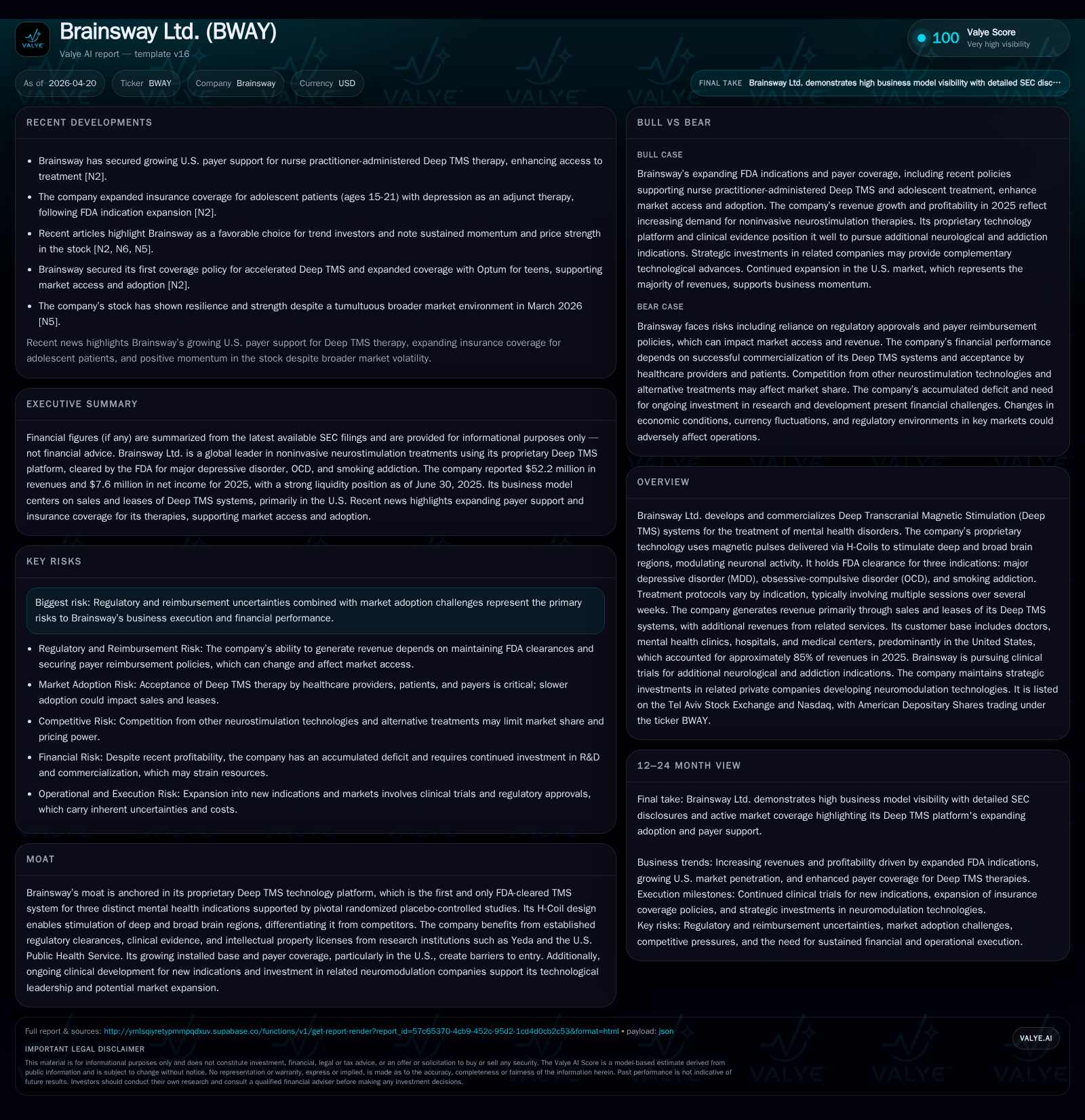
Brainsway’s April 2026 quarterly filing reveals expanded U.S. payer reimbursement, including nurse practitioner-administered TMS therapy, driving broader clinical adoption and revenue momentum. The company also completed a $6 million milestone-based investment in neuromodulation startup Neurolief following FDA approval of its Proliv™Rx system, reinforcing a strategy of innovation pipeline expansion. With multiple FDA-cleared indications for its proprietary Deep TMS platform and accelerating marketing efforts, Brainsway is leveraging regulatory advances and partnerships to scale its treatment of mental health disorders in a predominantly U.S.-centered revenue base. Financially, the strong top-line growth and improved profitability reflect growing system sales and leases supported by an entrenched installed base and payer coverage.
Latest Operational Update: Key Developments from Q1 2026 Filing
Brainsway's latest Form 6-K filings dated April 15 and March 26, 2026 underscore pivotal near-term operational advancements critical to sustaining growth momentum [S2][S3]. Foremost among these is the expanded support by U.S. payers permitting nurse practitioners to administer Deep TMS treatments—a shift that significantly widens patient access beyond psychiatrists and specialized physicians to mid-level providers. This policy development aligns with ongoing efforts to reduce barriers in mental health services delivery and signals growing acceptance of TMS therapy in mainstream care.
Additionally, Brainsway completed a milestone-based second tranche investment of $6 million into Neurolief Ltd., an Israeli neuromodulation startup whose Proliv™Rx system gained FDA clearance for treatment-resistant major depressive disorder (MDD). This capital deployment exemplifies Brainsway's strategic approach to augmenting its innovation pipeline through targeted equity stakes in emerging technology platforms with complementary mechanisms [S3].
Regulatory progress also shapes the company's near-term growth outlook: recent FDA clearances have extended Deep TMS use to adolescent patients aged 15–21 as adjunctive therapy for depression (November 2025), broadened the late-life depression indication up to age 86 (2024), and approved accelerated MDD treatment protocols facilitating shorter therapy durations [S1]. These label expansions enhance market reach by addressing new demographics while promising efficiency gains appealing to clinicians.
Technical Innovation and Business Model: The Deep TMS Platform
Brainsway's core value proposition centers on its proprietary Deep Transcranial Magnetic Stimulation (Deep TMS) technology featuring unique H-Coils designed to stimulate deeper and broader brain regions than traditional figure-8 coils [S1]. This capability underpins the company’s three separate FDA-cleared indications—treatment-resistant major depressive disorder (including anxious depression), obsessive-compulsive disorder (OCD), and smoking addiction—each validated by pivotal randomized controlled trials affirming clinical efficacy.
The treatment protocols administered using Brainsway’s systems are typically office-based involving multiple sessions spanning weeks; for example, MDD therapy requires about 20 sessions over four weeks followed by maintenance sessions [S1]. The platform’s modular design allows use of different H-Coils tailored per indication, enhancing utility across diverse neuropsychiatric conditions.
Financially, Brainsway generates revenues mainly through two models in the U.S.: outright sales of Deep TMS systems at fixed prices and fixed-fee lease agreements generally spanning 48–60 months [S1]. Leased systems remain company-owned with depreciation constituting a significant portion of cost of revenues—a factor that helps optimize margins given recurring usage fees possible under some contracts [S11]. Ancillary revenue arises from extended warranty contracts and potential variable usage fees depending on session volume. The ability to bundle multiple indication-specific helmets on single systems facilitates cross-selling opportunities.
Competitive Positioning Within the Neurostimulation Industry
Brainsway operates in a specialist neurostimulation market where differentiation emerges from technological uniqueness, regulatory clearances, clinical evidence robustness, and payer acceptance. Its patented H-Coil designs supported by long-standing intellectual property licenses from institutions like Yeda Research & Development Company Limited and the U.S. Public Health Service establish formidable entry barriers [S16][S22].
The company currently commands a substantial U.S. commercial presence accounting for approximately 85% of total revenues in 2025 [F1][S4]. This concentration reflects both the size of the U.S. mental health market and payer infrastructure enabling insurance reimbursement—which remains uneven globally—intensifying competitive advantage domestically.
Competitors predominantly offer traditional figure-8 coil TMS devices that stimulate more superficial cortical areas potentially limiting therapeutic range compared to Deep TMS's broader brain network targeting. Furthermore, Brainsway’s triple indication FDA approvals provide market exclusivity corridors less accessible to rivals restricted by singular indications or less extensive data packages.
Established distribution agreements globally complement direct U.S. sales but remain secondary revenue contributors; commercial ramp in territories like Japan appears nascent pending regulatory developments [S23].
Demand Drivers and Growth Constraints Ahead
The principal demand drivers for Brainsway’s Deep TMS systems stem from expanding insurance coverage—highlighted recently by inclusion of nurse practitioners billing privileges—which can substantially amplify prescribing flexibility and patient throughput [S2]. Concurrent societal trends such as increasing awareness of mental health disorders like depression, OCD, nicotine dependence, as well as opioid addiction risks heighten underlying therapy demand.
On the innovation front, ongoing clinical trials exploring neurological indications including fatigue in multiple sclerosis as well as addictions beyond smoking substantiate prospects for future growth avenues [S1][N5]. However, adoption rates may vary due to clinician inertia or payer skepticism regarding emerging protocols or new indications.
Cost sensitivity among insurers poses another significant constraint; high upfront equipment costs combined with reimbursement delays could temper uptake despite demonstrated efficacy. Regulatory landscapes outside the United States introduce variability in market accessibility requiring navigation via localized studies or partnerships.
Strategic Partnerships and Clinical Pipeline Progress
Brainsway’s strategy embraces not only internal development but also targeted investments into promising neuromodulation startups exemplified by its staged funding in Neurolief Ltd.—where FDA approval milestones trigger capital deployments—illustrating a dual objective to foster complementary technology ecosystems while securing optionality on breakthrough therapies [S3][S12][S13]. Other such investments include stakes in Stella MSO LLC, Axis Management Company Inc., Tangient ATX Inc., among others constituting a diversified portfolio supporting adjacent digital health capabilities.
Parallel to external equity interests are planned advanced clinical trials aimed at extending Deep TMS applications into other psychiatric, neurological, and addiction domains thereby potentially transforming existing treatment paradigms with noninvasive neuromodulation solutions [S7][N3]. Such developments are intended to sustain technological leadership against both incumbent figure-8 coil competitors and emergent therapeutic modalities such as ketamine infusions or digital therapeutics.
Upcoming Milestones and Execution Risks
Critical upcoming milestones include completion—and eventual regulatory filings—of confirmatory clinical trials targeting novel indications within neurological disease subsets (e.g., multiple sclerosis fatigue) alongside further label update requests possibly expanding age ranges or comorbid condition claims beyond currently approved labels [S1][S16]. Insurance contract rollouts incorporating recent reimbursement expansions will also serve as tangible markers validating adoption assumptions.
Execution risks centralize on maintaining pace with evolving regulatory expectations, ensuring timely clinical trial enrollments amid increasingly competitive research landscapes and managing costs associated with expanded R&D initiatives [S16][N8]. Additionally, any adverse shifts in payer policies or slow diffusion among prescribers could hinder topline acceleration thus impacting profitability trajectories.[S16]
Competitive pressures remain acute given rival device manufacturers deploying alternative stimulation technologies or seeking novel modalities potentially encroaching on niche patient cohorts served presently by Deep TMS.
Financial Performance and Capital Structure Overview
Corroborating its operational progress, Brainsway posted robust financial results indicating scalability of its business model [F1][S5]. Revenues surged approximately 27.3% year-over-year to $52.2 million for full-year 2025 from $41.0 million in 2024 driven largely by increased sales volumes coupled with growing lease revenues which together comprised about two-thirds combined revenue share [S5][F1].
Gross margin stability has been maintained despite rising volume-related costs primarily attributable to manufacturing scale efficiencies offsetting material inflation trends [S7][F1]. Meanwhile, research & development expenditure increased by roughly one-third reflecting intensified headcount additions plus amplified clinical trial activity supporting longer-term product development objectives [S9][F1].
Sales & marketing outlays rose moderately aligning with expanded commercial personnel while general & administrative costs reflected currency fluctuations but remained controlled relative to revenues [S7]. Operating income reached positive territory at $7.6 million net income in FY2025 versus $2.9 million net profit one year earlier denoting improving profitability leverage facilitated by operating expense discipline alongside top-line growth [F1][S7].
As of mid-2025, Brainsway held $67.9 million cash equivalents providing multi-year liquidity runway accommodating ongoing R&D investment without immediate financing needs; equity base benefitted from prior strategic private placements fueling balance sheet strength [F1][S8][S12].[F1]
| FY | Revenue (USD '000) | Net Income (USD '000) | Rev YoY % | Net Income YoY % |
|---|---|---|---|---|
| 2025 | 52,225 | 7,600 | +27% | +170% |
| 2024 | 41,016 | 2,921 | +29% | - |
| 2023 | 31,785 | -4,197 |
Historical performance (annual)
| FY | Rev ($mm) | Net ($mm) | Rev YoY | Net YoY |
|---|---|---|---|---|
| 2024 | 41 | 3 | +29.0% | +169.6% |
| 2023 | 32 | -4 | +17.0% | +68.6% |
| 2022 | 27 | -13 | -8.4% | -106.6% |
| 2021 | 30 | -6 |
Source: SEC companyfacts cache [F1].
Capital returns and efficiency (annual)
| FY | ROE% |
|---|---|
| 2024 | 4.7 |
| 2023 | -10.1 |
| 2022 | -29.4 |
| 2021 | -11.3 |
Source: SEC companyfacts cache [F1].
The capital structure remains prudent with no material debt burden disclosed; royalties payable related to Israel Innovation Authority grants mandate ongoing consideration but are manageable within cash flow frameworks [S15][S21].
Disclaimer
This analysis is provided solely for informational purposes based on publicly available SEC filings as of April 20, 2026. It does not constitute investment advice or recommendations. Readers should consider this report alongside other relevant sources before making any financial decisions.
Disclaimer: This is research-only, informational analysis and not investment advice. It may include AI-generated interpretation and general industry context. Always verify important details using primary sources.

Comments