
Badger Meter’s Q1 Miss Highlights AMI Growth Execution and Margin Pressures
Q1 2026 earnings reveal challenges in revenue momentum despite strong product portfolio in utility water metering.
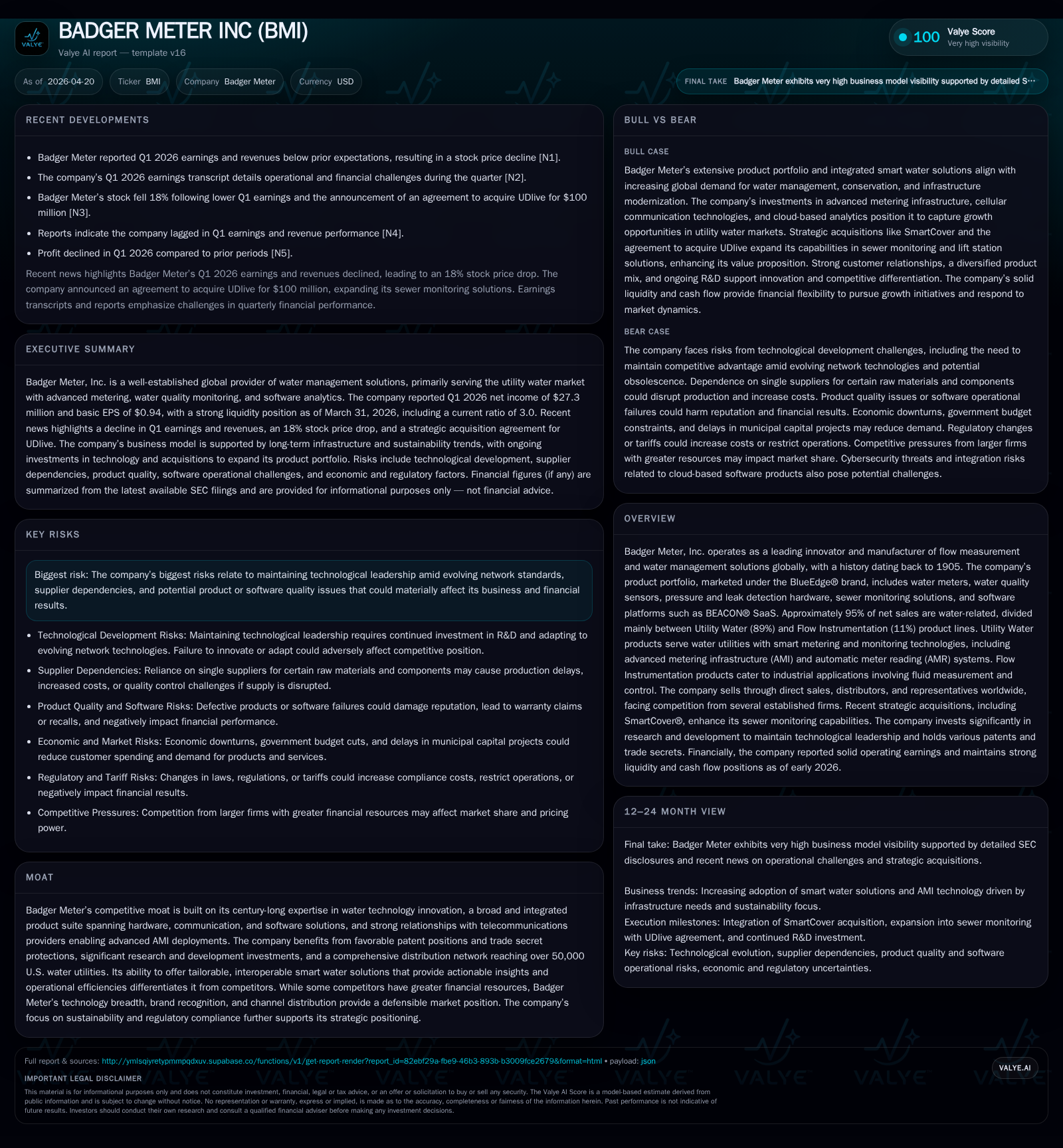
Badger Meter reported Q1 2026 results below consensus amid weaker order trends, impacting the near-term growth trajectory for its Advanced Metering Infrastructure (AMI) solutions. The company's century-old expertise, diverse BlueEdge® product suite, and integration of hardware and SaaS offerings position it well in a structurally growing market driven by infrastructure needs and sustainability mandates. However, rising costs, supply chain complexities, and gradual tariff impacts exert margin pressure while competition intensifies in the smart water metering space. Upcoming execution on backlog conversion, integration of recent sewer monitoring acquisitions, and continued AMI penetrations remain critical to restoring growth visibility.
Recent Operating Update
Badger Meter's latest quarterly filing (10-Q dated April 20, 2026) reveals a disappointing Q1 2026 performance characterized by revenue and profit misses versus analyst expectations [S2][N2]. Management cited softer demand in the Utility Water segment—the company's flagship business representing nearly 90% of sales—which manifested as slower than expected deployment of Advanced Metering Infrastructure (AMI) projects amidst broader macroeconomic uncertainty. A press release accompanying the Q1 results also disclosed an agreement to acquire UDlive for approximately $100 million [N1], signaling continued strategic emphasis on augmenting software-enabled water management solutions.
The filing did not report material changes to risk factors [S2], maintaining emphasis on technological innovation risks tied to evolving cellular standards crucial for the ORION® family of endpoints and on supply chain constraints. Cost pressures remain evident from tariffs enacted since 2025, which management offsets through price increases and leveraging regional manufacturing footprints underpinned by USMCA trade provisions [S1].
Business Model
Founded in 1905, Badger Meter generates approximately 95% of its net sales from water-related products divided into two main lines: Utility Water (89%) and Flow Instrumentation (11%) [S1]. The core revenue driver is the Utility Water segment which offers smart metering solutions including durable water meters complemented by integrated communication radios (ORION® endpoints) and digital platforms like BEACON®, a SaaS suite delivering analytics for operational insights.
Customers are primarily municipal utilities that rely on accurate flow measurement data to bill consumers reliably while reducing non-revenue water losses through leak detection and pressure management. The shift from mechanical to ultrasonic meters represents a valuable upgrade cycle that Badger Meter has leveraged with more than a decade of market-proven reliability. AMI adoption is a structural growth vector enabling utilities to collect frequent interval data remotely without manual meter reading labor costs.
The Flow Instrumentation business serves broader industrial markets requiring precision fluid measurement across applications including HVAC systems and sustainability-focused corporate clients. Product sales occur mainly through representatives and OEMs under specialized certifications.
Ancillary revenues arise from training, installation oversight, project management, and maintenance services—critical as customers aim to extract maximal value from complex technology deployments amidst workforce demographic shifts [S1][S24]. Strategic acquisitions such as SmartCover expand offerings into sewer monitoring for overflow prevention and lift station control [S1].
Industry Structure and Competitive Position
The smart water metering industry is consolidating around integrated hardware-software ecosystems capable of addressing regulatory requirements aligned with climate resilience agendas globally. Badger Meter's moat derives from its broad patented technology portfolio spanning meters, sensors (pressure, leak detection), communication endpoints, plus proprietary cloud software offering actionable insights [S1]. This integrated BlueEdge® solution caters comprehensively to over 50,000 U.S. water utilities.
Competition remains intense with notable peers including Sensus (Xylem), Neptune (Roper Technologies), Itron, Aclara (Hubbell), Mueller Water Products, Kamstrup among others offering partial overlaps in hardware or software components [S18]. Although some competitors wield greater financial resources, Badger Meter's century-long brand equity combined with robust telecom partnerships (AT&T, Verizon) fuel differentiated infrastructure-free AMI deployment advantages [S1].
In Flow Instrumentation markets, fragmentation persists due to diverse industrial end-markets served by competitors such as Emerson Electric, Krohne Messtechnik, Endress+Hauser, Yokogawa Electric and Cameron International. Here Badger Meter focuses on niche specialized applications emphasizing accuracy linked to water/wastewater treatment.
Growth Drivers and Constraints
Structural Growth Drivers:
- Infrastructure Renewal Needs: Aging U.S. water infrastructure necessitates modernization initiatives incorporating smart meters for operational efficiency.
- Regulatory Mandates: Increasing water quality monitoring requirements drive demand for optical sensor-based real-time data collection solutions.
- Sustainability Focus: Utility emphasis on reducing non-revenue water elevates ultrasonic meter adoption.
- AMI Push: Approximately 40% meter conversion rate today; further penetration expected as utilities seek granular consumption data to manage resources.
- Data Analytics Transition: SaaS platforms like BEACON® enhance customer engagement and amplify value beyond hardware installation.
- Acquisitions: Targeted M&A expands into sewer line monitoring leveraging SmartCover technology; recent UDlive deal signals push toward digital software services.
Growth Constraints:
- Economic Cyclicality: Capital spending deferral risks persist given municipal budgeting pressures under inflationary environments.
- Tariff Pressures: Ongoing tariffs raise raw material costs; partial mitigation via geographic footprint adjustments but overall margin headwinds remain [S1].
- Network Evolution Risks: Reliance on external telecom networks subjects ORION Cellular radios to sunset risks requiring ongoing tech adaptations [S21].
- Supply Chain Dependencies: Single-source microprocessors and casting suppliers pose availability challenges disrupting timely deliveries [S16].
- Competitive Pricing: Moderate-to-strong competition limits pricing power particularly in commodity meter replacements.
- Quality Control Imperatives: Extended meter life warranty commitments heighten exposure to recalls or warranty claims if quality lapses occur [S21].
What to Watch Next
Following Q1 underperformance, key indicators will be:
- Backlog Conversion Rates: Timely fulfillment of existing orders to stabilize near-term revenue momentum amid slowing new order intake.
- Integration Progress: Effective assimilation of SmartCover’s sewer monitoring products influencing cross-selling opportunities within existing customer base.
- SaaS Adoption Trends: Subscription revenue growth on digital platforms providing margin lift.
- Tariff Impact Evolution: Ability to pass through costs amid evolving trade policies without adverse volume loss.
- Network Tech Transitions: Updates or new relationships with telecom providers offsetting cellular standard sunsets affecting AMI radios.
- Customer Spending Patterns: Municipal budget cycles reflecting economic conditions influencing capital replacement rates.
Guidance commentary in upcoming quarters will clarify management’s outlook adjustments in light of Q1 softness [N3]. Continued announcements concerning further acquisitions or partnerships could reshape strategic positioning beyond core metering hardware.
Financial Profile (Supporting Context)
Historical performance (annual)
| FY | Net ($mm) | CFO ($mm) | OpInc ($mm) | Capex ($mm) | Net YoY |
|---|---|---|---|---|---|
| 2025 | 34 | 184 | 183 | 14 | +9.3% |
| 2024 | 31 | 155 | 158 | 13 | +24.3% |
| 2023 | 25 | 110 | 118 | 12 | +40.9% |
| 2022 | 18 | 82 | 87 | 6 |
Source: SEC companyfacts cache [F1].
Capital returns and efficiency (annual)
| FY | Div ($mm) | Buybacks ($mm) | FCF ($mm) |
|---|---|---|---|
| 2025 | 44 | 15 | 170 |
| 2024 | 36 | 0 | 142 |
| 2023 | 29 | 0 | 98 |
| 2022 | 25 | 0 | 77 |
Source: SEC companyfacts cache [F1].
Badger Meter reported full-year operating income reaching $183.4 million in 2025 compared with $157.9 million the prior year indicating a robust upward trend (+16.1% YoY) supported by favorable product mix particularly ultrasonic meters and cellular radio sales [F1]. Net income increased moderately by +9.3% YoY to $33.6 million despite incremental amortization costs related to acquisitions.
Operating cash flow rose strongly +18.5% YoY to nearly $183.7 million facilitating capital expenditures of approximately $14 million (up 9%) aligned with R&D investments ($21.6 million annually) aimed at sustaining technology leadership [F1][S13]. The company maintains a strong balance sheet with over $226 million net cash position at year-end 2025 along with ample undrawn credit facilities ensuring financial flexibility [F1][S4]. Dividends totaled $43.5 million in FY25 alongside share repurchases resumed after hiatus totaling $15 million highlighting shareholder return discipline balanced against growth investments [F1].
Current ratio stood around a healthy ~3 indicating conservative working capital management despite elevated inventory levels stemming partly from strategic acquisitions [F1][S5]. Gross margins improved benefiting from higher-value SaaS contributions though margin expansion faced offsetting pressures from tariff-related input cost increases requiring price hikes [S13].
Coming quarters will test resilience as the company navigates mixed demand signals while continuing capex-funded innovation cycles central to sustaining competitive differentiation within an increasingly software-driven market paradigm.
This analysis incorporates information available up to April 20, 2026 including SEC filings (10-K/10-Q/8-K) alongside public news sources; however it does not constitute investment advice or recommendations regarding trading or ownership decisions related to Badger Meter Inc.
Disclaimer: This is research-only, informational analysis and not investment advice. It may include AI-generated interpretation and general industry context. Always verify important details using primary sources.

Comments