
TSMC Advances Growth with New Agenda Changes and Robust Technology Leadership
TSMC's latest board agenda revisions and quarterly results underscore its strategic capital flexibility and technology moat.
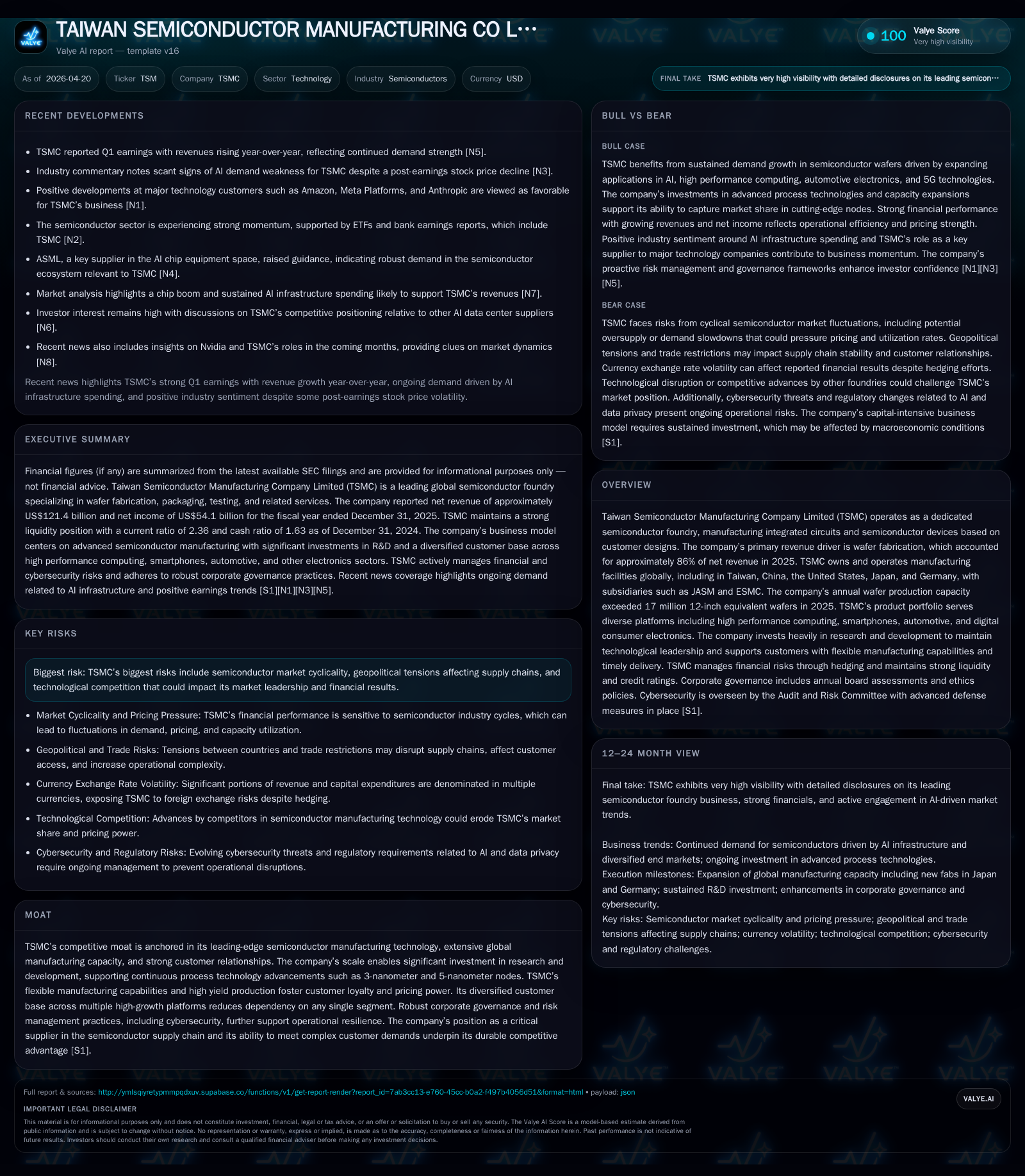
In April 2026, TSMC’s board approved key revisions to the agenda for its Annual Shareholders’ Meeting, notably introducing unsecured corporate bond issuance to enhance capital flexibility. The latest quarterly disclosures reveal sustained momentum in wafer fabrication capacity and pricing power driven by advanced nodes such as 3nm and 5nm. TSMC continues to leverage its leading-edge technology and diversified global footprint across Taiwan, the U.S., Japan, China, and Europe to serve high-growth markets like AI, smartphones, and automotive. Risks from semiconductor cyclicality and geopolitical factors persist, but strong governance and robust R&D investments underpin a durable competitive advantage. Financially, TSMC reported significant revenue and net income growth in 2025, supporting ongoing capacity expansion and shareholder returns.
Revised Agenda Highlights from Latest Board Meeting and Operational Implications
On April 17, 2026, TSMC’s Board of Directors held a special meeting where they approved updates to the agenda for the forthcoming Annual Shareholders’ Meeting. Key items included reporting the company’s business performance for 2025, earnings distribution details, directors' compensation disclosures, employees’ profit-sharing bonuses, and notably the proposal for issuing unsecured corporate bonds [S2]. This decision signals a strategic readiness to augment capital structure flexibility beyond traditional equity or bank financing mechanisms.
The inclusion of unsecured bond issuance represents a calibrated move by TSMC to manage liquidity prudently while supporting expansive capital expenditure plans aligned with technology advancement. This governance evolution underscores the company's proactive risk management orientation in a capital-intensive industry where scale investment underpins competitive positioning.
Foundry Business Model: Core Revenue Drivers and Differentiators
TSMC operates primarily as a dedicated semiconductor foundry focusing on manufacturing ICs based on customer designs—its dominant source of revenue is wafer fabrication which accounted for about 86% of net revenue in 2025 [S1,S4]. The company owns a broad global manufacturing footprint spanning Taiwan (the largest asset base), the United States (TSMC Washington), Japan, China (TSMC Nanjing), Germany, among others.
Annual wafer production capacity exceeded 17 million units measured in 12-inch equivalent wafers during 2025 with shipments reaching roughly 15 million wafers in that same period [S4,S11]. These scale operations enable TSMC to flexibly allocate capacity across end-markets ranging from high-performance computing (HPC) platforms and smartphones to automotive electronics.
Pricing strategies reflect market conditions but are underpinned by customer valuation of TSMC’s flexible manufacturing capabilities coupled with timely delivery of high yield products—a combination fostering pricing power often elusive in commoditized segments [S1,S28]. Critical to this business model is the ability to continually invest heavily in new fabs and process technologies while sustaining operational efficiency.
Technology Leadership as TSMC’s Economic Moat
A significant pillar of TSMC's sustainable competitive advantage is its sustained investment in cutting-edge technology development. In 2025 alone, research and development expenses surged by around 20.7%, reflecting focused research efforts on process nodes including advanced 3-nanometer (nm) and 5-nm technologies [S7].
This level of R&D capital intensity is essential not only for pioneering new node transitions but also for ensuring manufacturing sophistication that translates into superior yield rates—imperative for customer retention given the substantial switching costs inherent in qualifying new foundries at advanced nodes.
Continuous innovation enables TSMC to charge premium prices relative to peers while maintaining healthy margins despite cyclical headwinds characteristic of semiconductor industry dynamics [S1,S7]. The technological moat functions as an effective barrier against emerging competitors who face prohibitive scale and expertise hurdles.
Competitive Positioning within a Complex Semiconductor Ecosystem
Within an increasingly fragmented semiconductor foundry landscape impacted by geopolitical shifts—including cross-strait tensions involving Taiwan—TSMC maintains resilience through diversification both geographically and by customer base composition.
Its major customers typically represent less than 20% of total net revenues individually; notable though is Customer A contributing approximately 19% in 2025 followed by others around mid-teens percentages [S4,S15]. This spread dilutes dependency risk yet underscores importance of sustained key account relationships.
The company’s manufacturing presence across Taiwan (largest asset concentration), United States (wholly-owned subsidiary TSMC Washington), Japan, China, and Europe spreads operational risk exposure albeit geopolitics remain a latent risk factor influencing supply chain continuity plans [S4,S17]. Robust corporate governance structures including cybersecurity defenses bolster operational resilience amidst such uncertainties [S1].
Growth Catalysts Amid Secular Demand and Innovation Trends
Demand drivers are notably buoyed by secular accelerations in AI infrastructure spending post-earnings announcements showing scant evidence of AI-related softness [N2,N14]. Persistent growth in HPC chip consumption alongside smartphone technology refresh cycles benefits TSMC’s wafer fab utilization rates.
Additionally, ramp up in automotive electronics—both traditional combustion engine enhancements and electric vehicle semiconductors—further amplifies demand diversity beyond purely cyclical segments.
Complementary ecosystem investments such as ASML's equipment upgrades reinforce confidence in ongoing capacity expansions while embedding process node innovations critical for maintaining technological leadership [N3,N5].
Risks from Cyclicality, Geopolitics, and Technological Competition
Despite long-term growth prospects, TSMC faces inherent semiconductor industry cyclicality driven by fluctuating end-market demand patterns potentially moderating near-term expansion efforts [S1]. Fluctuations impact inventory valuations and margin stability given high fixed cost structures associated with fabs.
Geopolitical risks—especially those connected to cross-strait relations—pose operational uncertainties that could disrupt manufacturing continuity or limit flexible allocation between subsidiaries within greater China versus other jurisdictions [S17].
Moreover, ongoing patent litigation matters present contingent liabilities although current impacts remain indeterminate pending legal resolution timelines [S17]. Emerging foundries investing aggressively in advanced process technologies may intensify competitive pressures requiring vigilant innovation sustainment.
Forward-Looking: Key Monitorables from Guidance and Industry Signals
Upcoming milestones include the outcome of the proposed unsecured bond issuance at the Annual Shareholders’ Meeting which will materially affect financing options over the medium term [S2]. Investor focus also centers on updated guidance reflecting order backlog changes influenced by AI-related demand trajectory insights shared post-Q1 results [N10].
Technological pipeline disclosures regarding next-generation node progression (e.g., movement towards angstrom-level processes) will be critical markers validating continued innovation momentum essential for maintaining customer commitment [S2,N10].
Close monitoring of supply chain developments amid geopolitical flux remains essential alongside shifts in major customer order patterns especially given their significant share contributions.
Financial Performance Snapshot and Capital Allocation Evaluation
TSMC reported robust financial performance for fiscal year ended December 31, 2025. Net revenue surged by approximately +31.6% year-over-year driven primarily by wafer shipment volume increases (~15 million wafers shipped) combined with higher average selling prices supported by advanced node adoption [S3,S11,F1]. Gross margin improved markedly to nearly 60% facilitated by better capacity utilization and cost efficiencies despite unfavorable FX movements versus USD [S11].
Operating expenses increased moderately (+14.8%), heavily weighted towards R&D which rose +20.7%, aligning with strategic priorities on technology leadership [S7,S11]. Consequently operating income expanded over +46%, solidifying profitability gains.
Net income attributable to shareholders rose similarly by about +46.5% year-over-year reflecting both operating leverage improvements and favorable non-operating factors including higher interest income [S20,F1].
Liquidity remains strong—with cash plus equivalents exceeding $64B USD as of December 2024—and current ratio around 2.36 attesting to prudent short-term financial management consistent with large-scale capital expenditure requirements typical of leading foundry businesses [F1,S5].
Capital return policies continue via substantial dividends complemented now by potential bond issuances expanding funding channels without diluting equity—which should support continued investment cadence alongside disciplined shareholder remuneration programs [S9,S26,F1].
Historical performance (annual)
| FY | Rev ($bn) | Net ($bn) | Rev YoY | Net YoY |
|---|---|---|---|---|
| 2024 | 88.3 | 35.3 | +25.0% | +27.0% |
| 2023 | 70.6 | 27.8 | -4.2% | -14.0% |
| 2022 | 73.7 | 32.3 | +28.7% | +51.2% |
| 2021 | 57.2 | 21.4 |
Source: SEC companyfacts cache [F1].
Capital returns and efficiency (annual)
| FY | Div ($bn) | ROE% |
|---|---|---|
| 2024 | 414.9 | 27.0 |
| 2023 | 317.7 | 24.6 |
| 2022 | 285.2 | 34.0 |
| 2021 | 278.8 | 27.6 |
Source: SEC companyfacts cache [F1].
This financial backdrop denotes a healthy capital structure capable of underwriting ambitious R&D investments alongside steady shareholder rewards amidst prevailing sector volatility.
The above analysis incorporates detailed SEC filings up to April 17-18, 2026 complemented by recent industry news commentary as of April 20, providing an integrated perspective on Taiwan Semiconductor Manufacturing Company Limited's current strategic posture supported by quantitative evidence without prescriptive investment advice.
Disclaimer: This is research-only, informational analysis and not investment advice. It may include AI-generated interpretation and general industry context. Always verify important details using primary sources.

Comments