
Boxlight Corp's Financial Tightrope and Market Reach in Education Technology
Boxlight leverages its integrated education technology portfolio and global channels while navigating significant financial covenant and liquidity pressures.
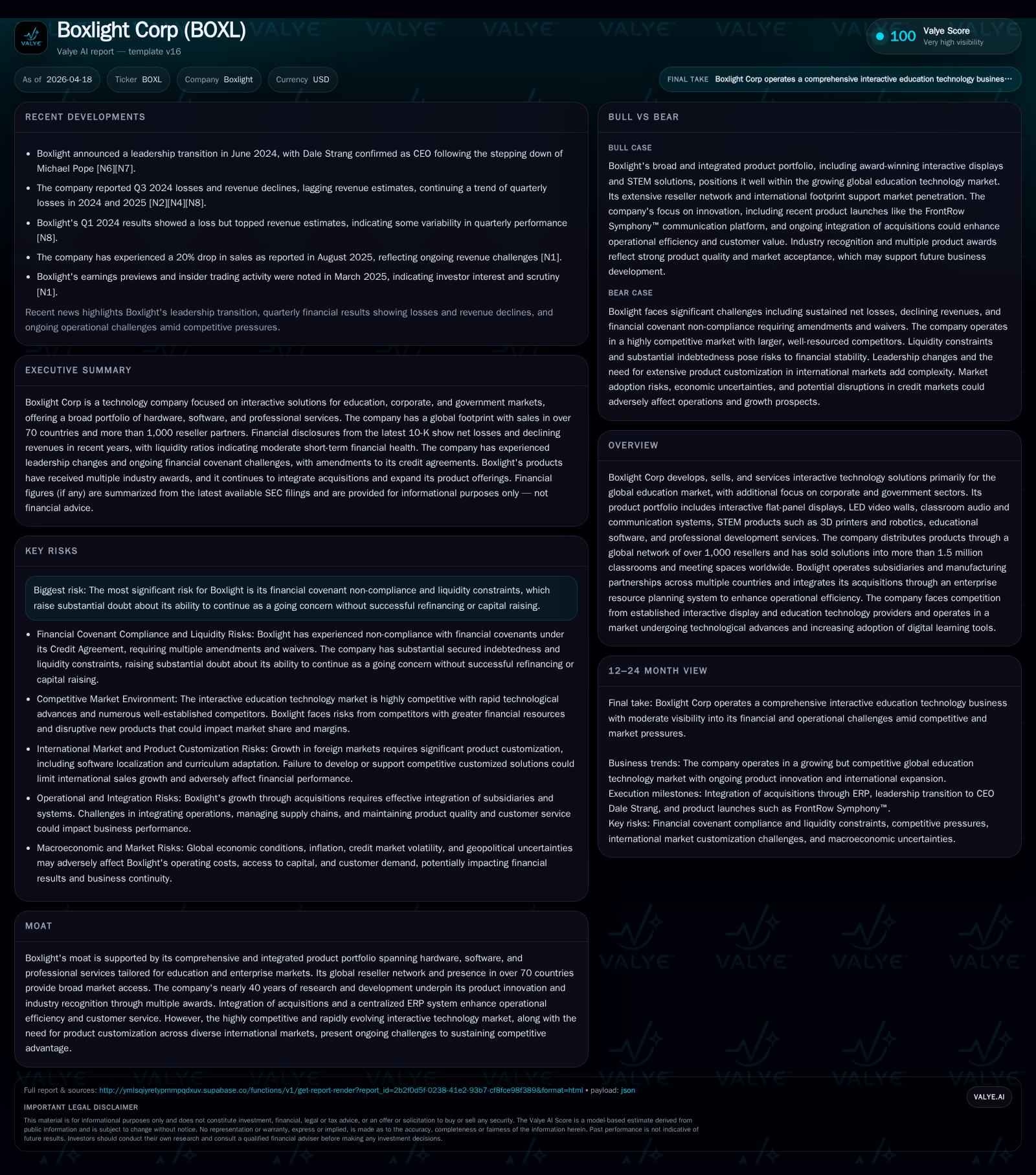
Boxlight Corp stands as a near-40 year innovator in interactive educational technology, offering a comprehensive suite of hardware, software, and STEM products across more than 1.5 million classrooms worldwide through over 1,000 resellers. The company’s historical revenue growth reflects ongoing product diversification and market penetration. However, persistent operating losses and substantial indebtedness have led to frequent covenant breaches and liquidity constraints, raising concerns about its ability to continue as a going concern without successful refinancing efforts. Strategic amendments to debt facilities illustrate active capital structure management as the company seeks operational stabilization amid evolving competitive and international market challenges.
Four Decades of Innovation: Historical Growth and Revenue Drivers
Boxlight Corp has leveraged nearly 40 years of research and development to build a comprehensive portfolio of interactive education technology solutions that resonate globally. The company's focus on interactive flat-panel displays plus STEM-related products like robotics and 3D printing has been a notable growth driver. From fiscal year (FY) 2016 to FY2017, Boxlight achieved revenue growth of roughly 26.4% ([F1]), underpinning the market acceptance of its diversified education technology offerings.
Awards such as inclusion in the Top 100 EdTech Companies by EdTech Digest in 2025 and multiple recognitions for product excellence ([S1], [S16]) validate market resonance with Boxlight’s evolving product suite. The expansion beyond core hardware into software solutions enabling whole class learning and professional development complements their hardware base.
Historical performance (annual)
| FY | Net ($mm) | CFO ($mm) | OpInc ($mm) | Net YoY |
|---|---|---|---|---|
| 2025 | -24 | -3 | -16 | +16.0% |
| 2024 | -28 | 0 | -19 | +27.6% |
| 2023 | -39 | 12 | -26 | -946.1% |
| 2022 | -4 | 1 | 3 |
Source: SEC companyfacts cache [F1].
Capital returns and efficiency (annual)
| FY | ROE% |
|---|---|
| 2025 | -1897.2 |
| 2024 | 219.7 |
| 2023 | -233.8 |
| 2022 | -7.2 |
Source: SEC companyfacts cache [F1].
YoY percentages reflect change versus prior recorded data where applicable; dollar values rounded to nearest thousand USD [F1].
Interactive Ecosystem: Product Lines Fueling Global Classroom Penetration
Boxlight offers a robust portfolio comprising interactive flat-panel displays—its core hardware—LED video walls for large-format collaboration spaces; classroom audio systems; media players; cameras; STEM-focused innovations including robotics kits and portable science labs; alongside a software suite designed to foster whole class engagement through assessment and collaboration capabilities ([S1], [S16]).
This integrated approach extends into professional training services for U.S.-based educational customers enhancing value delivery beyond just products. By bundling hardware with software and professional development services tailored for classroom educators and enterprise meeting environments alike—the company creates synergies frequently described in sector vernacular as "interactive display ecosystem" or "classroom software suite integration." This strategy aims at establishing itself as a single-source provider addressing diverse customer needs while supporting seamless inter-device connectivity—a necessity given the proliferation of bring-your-own-device trends noted in school districts ([S1]).
Global Footprint and Channel Partnerships: Expanding Market Access
Boxlight’s reach spans more than 70 countries supported by an extensive reseller network exceeding 1,000 partners globally ([S1], [S11], [S26], [S27]). This widespread channel strategy facilitates penetration not only in mature education markets but also emerging regions where tailored pricing models are often required due to budgetary limitations ([S26]).
The company relies on third-party logistics partners (3PLs) managed through regional hubs including Atlanta (U.S.) and London (Europe) enabling optimized freight costs and shorter lead times ([S11]). Manufacturing partnerships use original design manufacturers (ODMs) across the US, Taiwan, China, Germany and Turkey — reflecting a global supply chain that supports cost-effective production adhering to Boxlight’s engineering specifications.
However international expansion faces headwinds such as software localization complexity stemming from multilingual support requirements and curriculum-specific content adaptations necessary for broad acceptance ([S26]). These factors complicate scalability despite the significant reseller footprint.
Financial Covenant Pressure and Liquidity Breakdown
Boxlight’s capital structure reveals increasing stress with reported indebtedness approximately $32 million under secured term loans as of December 31, 2025 ([F1], [S4]-[S10]). The Credit Agreement governing these loans includes covenants related to minimum EBITDA coverage ratios and borrowing base requirements which have repeatedly been breached in recent years necessitating multiple formal amendments—including waivers for borrowing base defaults—and bridge loans totaling several millions ([S4]-[S10]).
Interest expense parameters transitioned from LIBOR-linked rates to SOFR benchmarks by mid-2023 via a fourth amendment reflecting broader financial market shifts ([S6]). Despite these adjustments favorable to cash flow preservation efforts like absence of prepayment penalties on early repayments (e.g., $3 million loan settled July 2023) contractually mandated quarterly principal increases plus shifting from quarterly to monthly interest payments increase near-term liquidity demands ([S7], [S8]).
A December 2025 amendment extended the overall loan maturity date from end-2025 to April 2027 but replaced the Senior Leverage Ratio covenant with minimum EBITDA requirements commencing Q1 2026 — an attempt to reconcile compliance expectations with Boxlight’s operating realities ([S8]). The current ratio stood at a modestly healthy 1.62 at the end of FY25 based on reported current assets vs liabilities; however ongoing negative operating cash flows together with covenant non-compliance cast doubt on sustained liquidity sufficiency ([F1]).
Strategic Responses to Capital Structure and Refinancing Hurdles
In reaction to these pressures Boxlight has actively reshaped debt terms including warrant repricings—from original exercise price over $480 down to approximately $264 per share triggered by equity raises—and expanded registration rights facilitating future equity sales pledged for debt reduction ([S4], [S5]).
Bridge loans provided incremental working capital but imposed fees amounting to approximately 6% of borrowings which have been fully repaid mitigating penalty risks ([S6], [S10]). Voluntary prepayments without premium further illustrate attempts at deleveraging when feasible ([S6]). These moves aim at rebuilding lender confidence but rely heavily on continuous compliance monitoring.
Equity issuance activity notably included private placements coupled with warrant combinations designed strategically both as capital infusion sources and structural volatility buffers attributable partly to existing warrant arrangements penalizing low-priced share sales ([S8], [S24]).
Future Headwinds and Opportunities in Education Technology Demand
While the growing global emphasis on digital classrooms—and accelerating trajectory toward replacing legacy interactive whiteboards with affordable one-piece flat-panel solutions—bodes well qualitatively for Boxlight’s longer-term demand prospects ([S16]), several headwinds persist.
Competition intensifies from established interactive display providers like SMART Technologies alongside multinational consumer electronics firms expanding into education-specific offerings ([S9]). Budget cycles impacting school districts’ weighting of capital expenditure priorities create timing volatility exacerbated during economic uncertainty periods such as those induced by geopolitical tensions or inflationary pressures ([S19]).
International growth requires costly product customization especially around software localization including language support for diverse alphabets plus curriculum alignment necessitating sustained investment impacting margins—particularly relevant when penetrating price-sensitive emerging markets requiring aggressive pricing strategies resulting in margin compression risks ([S26]).
Effective orchestration of acquisitions through a centralized ERP system fosters operational consistency but adds integration workload that could slow agility if not managed tightly—a typical challenge within tech companies scaling rapidly globally ([S11]).
Key Metrics to Watch: Operating Income, Cash Flows, and Equity Position
Boxlight's financial statements reveal persistent operating losses despite margin improvements: FY25 operating loss narrowed approximately 15.9% year-over-year from -$19.5 million to -$16.4 million while net loss improvement was commensurate at roughly -$23.8 million compared to prior year’s -$28.3 million ([F1]). Nonetheless negative free cash flow—estimated at close to -$3.4 million factoring cash flow from operations less capex—reveals continued cash consumption threatening runway extension absent fresh capital infusions or operational turnaround ([F1] analysis).
A stark signal lies in shareholder equity contraction from positive $51.9 million in FY22 down sharply through negative territory before marginally recovering near break-even at about $1.25 million by end FY25 reflecting cumulative losses eroding net assets leaving minimal buffer against creditor claims or external shocks ([F1]). Return on equity remains deeply negative — approximating -1897% in FY25 illustrating severe capital erosion.
Capital Allocation and Shareholder Returns under Strained Conditions
In light of ongoing operating deficits combined with credit agreement breaches Boxlight currently does not pay dividends nor conduct share buybacks focusing instead on liquidity preservation priorities critical for survival under existing capital stresses ([F1], [S1]).
Strategic capital allocation has centered around equity issuances intended primarily to shore up balance sheet resilience rather than shareholder distributions with any discretionary free cash flow likely directed toward debt service obligations or reinvestment into product innovation needed to sustain competitiveness amid rapidly evolving edtech landscape.
The company’s commitment toward maintaining operational continuity given going concern doubts reflects prudent stewardship focused on restructuring rather than short-term returns although eventual restoration of shareholder distributions would depend heavily upon achieving profitable scale alongside covenant stability.
This analysis is based solely on publicly filed SEC documents as of April 18th, 2026 [F1], [S#]. It does not constitute investment advice but aims for candid evaluation combining financial data with business context within interactive educational technology markets.
Disclaimer: This is research-only, informational analysis and not investment advice. It may include AI-generated interpretation and general industry context. Always verify important details using primary sources.

Comments