
Veea Inc.’s Hybrid Edge-Cloud Platform Grows Modestly Despite Persistent Operating Losses
Veea advances edge AI computing through patented hyperconverged infrastructure amid challenging financial and market dynamics.
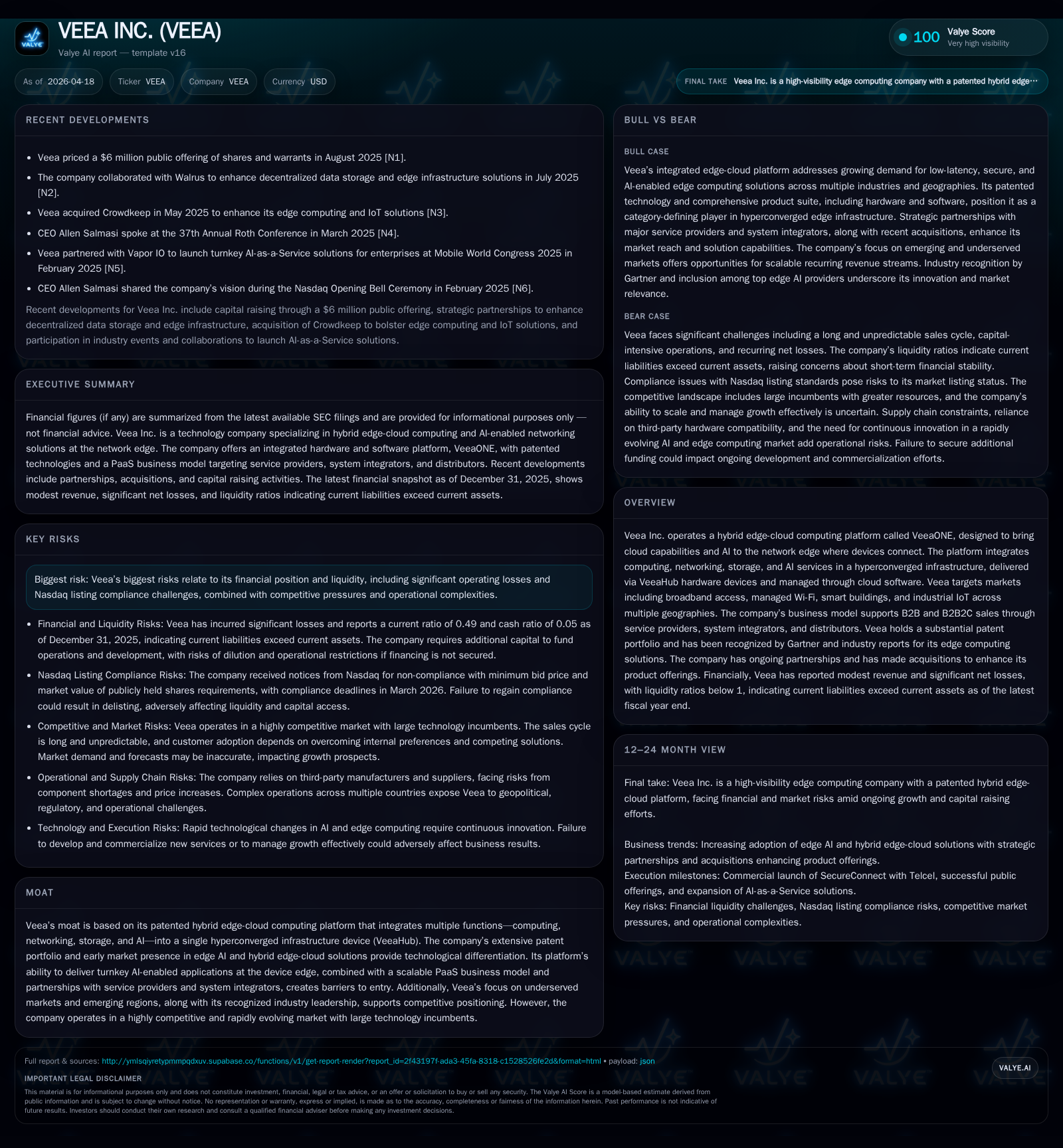
Veea Inc. operates a differentiated hybrid edge-cloud platform, VeeaONE, integrating computing, networking, storage, and AI at the device edge via its VeeaHub hardware. The company has demonstrated modest revenue growth but continues to incur significant operating and net losses compounded by a challenging capital structure and Nasdaq listing risks. Its growth strategy targets emerging markets and underserved segments with service providers and system integrators, leveraging its extensive patent portfolio and AI-enabled edge applications. Key risks include financial sustainability, intense competition from tech incumbents, long sales cycles, and regulatory complexities. Monitoring capital raises and customer adoption of turnkey edge solutions will be critical milestones.
Company Overview
Veea Inc., formerly Plum Acquisition Corp. I before completion of its business combination in September 2024, operates an innovative hybrid edge-cloud computing platform called VeeaONE designed specifically to extend cloud capabilities and artificial intelligence (AI) to the "device edge" — the network perimeter where end devices connect.
The platform is embodied primarily in the VeeaHub family of products: compact hyperconverged hardware devices integrating Linux-based servers supporting virtualized environments through secured Docker® containers; multi-access communications including Wi-Fi AP with mesh routing; firewall functionalities; IoT gateways; NVMe storage; and cellular modules supporting both 4G LTE and 5G fixed wireless access (FWA) [S1,S4,S22].
This integrated approach allows delivery of turnkey Edge AI applications—everything from enhanced security surveillance to inventory management—managed centrally via cloud software using a PaaS model that supports multiple customer segments across broadband access providers, managed Wi-Fi services, smart buildings/warehouses/retail environments, industrial IoT deployments, and private networks [S4,S19]. The solution emphasizes low latency for real-time decision-making, bandwidth efficiency, mission-critical "always-on" availability, contextual awareness (people/devices/things), multi-tenant cloud management options and strong cybersecurity aided by agentic AI models deployed directly at the edge.
Historical Financial Performance
Despite its technological differentiation, Veea's financial performance to date reflects typical challenges faced by early-stage innovators in capital-intensive fields such as edge computing hardware/software convergence.
Historical performance (annual)
| FY | Rev ($) | Net ($mm) | CFO ($mm) | OpInc ($mm) | Rev YoY | Net YoY |
|---|---|---|---|---|---|---|
| 2025 | 222018 | -7 | -15 | -19 | +56.6% | +86.0% |
| 2024 | 141760 | -48 | -26 | -84 | -136818.7% | |
| 2023 | 0 | -1 | -3 | -100.3% | ||
| 2022 | 11 | -1 | -4 |
Source: SEC companyfacts cache [F1].
Capital returns and efficiency (annual)
| FY | FCF ($mm) | ROE% |
|---|---|---|
| 2025 | -15 | 68.3 |
| 2024 | -26 | 279.3 |
| 2023 | 0.4 | |
| 2022 | -69.1 |
Source: SEC companyfacts cache [F1].
Source: [F1]
- Revenue increased noticeably by approximately 56.6% year-over-year from about $142K in FY2024 to $222K in FY2025; however top-line absolute levels remain very modest relative to costs.
- Operating income loss declined significantly by 77.6%, from an enormous $84M negative operating income in FY2024 toward $19M negative in FY2025—a marked improvement though still into deep red territory.
- Net loss similarly shrank dramatically by 86%, reflecting reduced operating expense run rates or one-time adjustments.
- Operating cash flows improved about 40% but stayed deeply negative at around $15.2M outflow.
- Capital expenditures fell sharply (about 82% YoY) from $46K to $8K.
- The balance sheet shows current liabilities considerably exceeding current assets with a current ratio well below parity (~0.49), indicating short-term liquidity pressure.
No dividend payments or stock buybacks have been made or are anticipated given ongoing investment needs and losses [F1]. Return on equity calculation is complicated by negative equity levels totaling nearly -$9.8M at FY2025-end.
Future Growth Prospects
Drivers:
- Veea aims to capitalize on several high-growth thematic trends including:
- Widespread demand for edge computing architectures that integrate AI at the device-level to reduce latency and bandwidth costs while enhancing privacy/security
- Expansion of managed broadband access services especially in emerging regions and underserved markets where fixed-wireless and hybrid network solutions are appealing
- Growing enterprise digital transformation using secure private networks built around converged IT/OT infrastructures incorporating smart building energy management or industrial analytics
- Continued deployment of carrier-class subscription managed Wi-Fi services leveraging mesh networking technologies
Product & Market Dynamics:
- The company continues R&D efforts focusing on network orchestration elasticity via AI optimization models that enable dynamic cloud-to-edge scaling as well as partial air-gapped deployments enhancing security boundaries between public cloud and device clusters.
- Veea leverages an extensive intellectual property portfolio (roughly 123 issued patents plus over 30 pending across multiple families), positioning itself uniquely amid commoditized hardware offerings through protection of its hyperconverged device engineering and integration methods [S21,S22].
- Its go-to-market is channel-centric: it partners with major service providers (mobile network operators MNOs/MSOs/ISPs), system integrators focused on enterprise digital transformation projects requiring customized edge solutions,and technology distributors specializing in telecom and security systems—fostering both B2B direct sales and B2B2C downstream reach [S4,S6,S9].
- Customer use cases emphasized include telecommunications broadband FWA rollout integrated tightly with embedded AI-driven cybersecurity alongside end application templates enabling rapid vertical market deployments such as loss prevention or inventory tracking leveraging federated machine learning models running on device clusters located near data sources [S19].
Growth Constraints:
- Market size estimates remain uncertain given novelty of fully hyperconverged hybrid edge-cloud category.
- Strong incumbent competition combined with rapid technological evolution demands continuous investment sustaining advantage.
- Sales cycles are lengthy owing to complex customer evaluation processes involving multiple stakeholders assessing technical fit against existing infrastructure investments plus financial commitment risk—as well as pilots offered at reduced/no cost without guaranteed conversions complicating near-term pipeline visibility [S8].
- Supply chain issues related to sourcing sophisticated components for VeeaHub devices from contract manufacturers in Taiwan/China add operational uncertainty especially under geopolitical tensions affecting trade policies or tariffs [S13,S24].
Forecasts / Milestones / Expectations
No explicit company guidance was provided for upcoming fiscal periods as of latest filings. Key developments investors should monitor include:
- Successful resolution of Nasdaq minimum bid price compliance issues by end-March 2026—which if unmet may lead to delisting threatening stock liquidity and future capital formation potential [S2].
- Signs of material customer wins driven by more widespread deployments across targeted industries (broadband access providers expanding FWA footprint or enterprises adopting converged private networks).
- Progress milestones achieved for R&D objectives surrounding elastic scaling AI models applied within VeeaONE platform that would broaden addressable use cases.
- Improvement in operating efficiency reducing net losses further toward break-even levels given heavy fixed costs tied to ongoing development/commercialization expenses.
Returns / Capital Allocation
Veea currently invests heavily into research & development as critical to sustaining competitive advantages through product innovation:
- R&D focuses stated explicitly on optimizing AI for network/application distribution at the edge including cloud-edge orchestration enhancements highlighting elastic scaling mechanisms alongside secure air-gapped deployment variants underscoring privacy/security aspects crucial for regulated customers [S25,S22].
Financially:
- Operating cash flow remains deeply negative (-$15.2M) because revenue generation has not scaled sufficiently relative to operating spend; capex is minimal (~$8K) reflecting asset-light business model beyond device production outsourcing [F1].
- Equity is negative (-$9.75M), indicating book value deficit partly due to accumulated losses over time which raises concerns about balance sheet strength absent successful capital raises.
- No dividends have been declared or paid given ongoing losses.
- Management warns that substantial additional funding will be required soon—and failure to raise capital may force curtailment of development/commercial efforts adversely impacting growth trajectories [S1,S25].
Competitive Position and Risks
Veea's moat derives mainly from its patent-protected hybrid Edge AI-cloud platform uniquely packaging compute/network/storage functionality combined with tailored AI-enabled cybersecurity applications delivered via compact hardware—a combination not matched by many competitors who often offer either pure software solutions or separate hardware components lacking hyperconvergence . Nonetheless risks loom large:
- Sustained operating losses coupled with fragile liquidity expose the company to dilution risks if future financing occurs at less favorable terms.
- Lengthy sales cycles constrain ability to generate stable revenues quickly while internal capacity must scale accordingly.
- Heavy reliance on third-party manufacturers subjects operational continuity to supply chain disruptions;
- Regulatory complexity spans telecommunications standards compliance; international trade restrictions including tariffs/export controls; data privacy laws impacting distributed processing architectures; and rising environmental/social/governance expectations—all represent incremental costs or barriers needing navigation carefully .
- Legal risks around intellectual property assertion—both defending against infringement claims and securing own patents—may require expensive litigation redirecting resources away from core execution tasks .
Summary Analysis
While Veea Inc.'s technological innovation addresses a pertinent need for hybrid edge-cloud integration augmented by sophisticated AI applications at the device level—thereby enabling new classes of broadband services plus enterprise digital transformation use cases—the company's financial performance reflects the classic early stage high-risk profile characterized by substantial losses amid early commercialization phases.
Its core competitive differentiator — a patented hyperconverged edge computing platform embedded within compact hardware devices managed through scalable cloud software — fulfills emerging market demand particularly within underpenetrated geographies using pervasive B2B distribution channels anchored on telecom providers and system integrators.
However prudent observation is warranted regarding execution risks linked to liquidity constraints evidenced by sizable negative cash flows coupled with a Nasdaq minimum bid price noncompliance notice threatening listing status absent rallying share prices soon. Operational factors such as protracted sales cycles typical for complex IT infrastructure procurements alongside supply dependencies further emphasize the need for stable funding continuity.
Strategically measurable milestones around customer adoption gains within target vertical markets plus validation of R&D progress on adaptive Elastic Edge AI orchestration models will be telling indicators pointing toward scalable commercial traction.
Disclaimer
This report is prepared solely for informational purposes based on publicly available sources including SEC filings as of April 2026 without any recommendation regarding investment decisions. Financial figures cited are historical results with no forecasted projections provided by company disclosures. Readers should independently verify facts before considering any related actions.
Disclaimer: This is research-only, informational analysis and not investment advice. It may include AI-generated interpretation and general industry context. Always verify important details using primary sources.

Comments