
RetinalGenix Technologies: Building an Integrated Platform for Early Eye Disease Detection and Treatment
RetinalGenix pursues a pioneering multi-pillar strategy combining genetic testing, retinal imaging, patient data systems, and pharmaceuticals amid severe liquidity challenges.
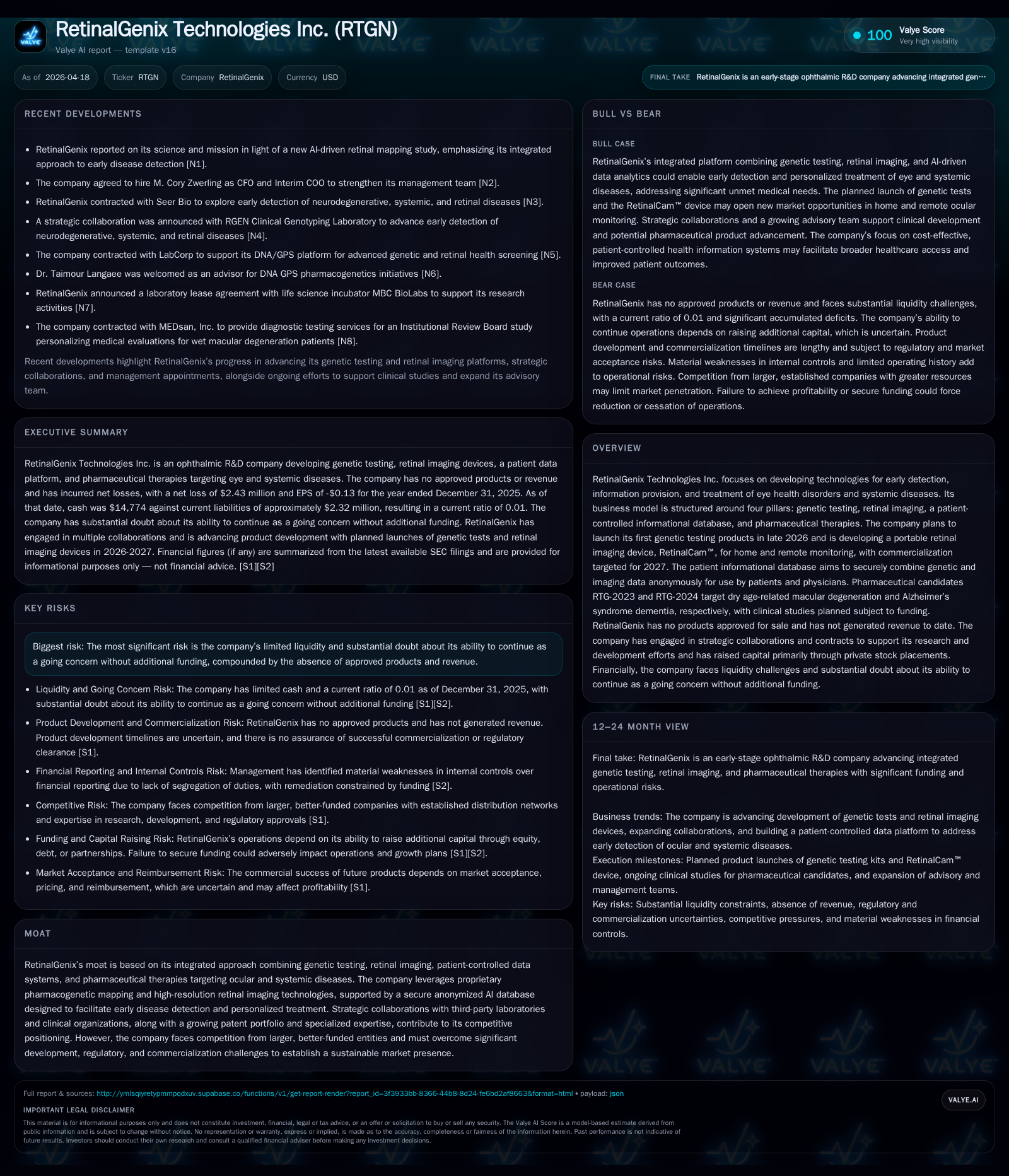
RetinalGenix Technologies Inc. integrates genetic assays, advanced retinal imaging, a patient-centric data platform, and pharmaceutical candidates targeting dry AMD and Alzheimer’s syndrome dementia. Despite innovation-driven progress including planned product launches in 2026-2027, the company faces critical liquidity constraints with minimal cash reserves and negative equity. Regulatory clearance uncertainty and substantial funding needs underscore significant near-term risks.
From Inception to Present: Examining RetinalGenix’s Growth Trajectory
Founded in November 2017, RetinalGenix Technologies Inc. has focused on research and development without generating commercial sales or revenue to date. Over four fiscal years through 2025 ([F1]), the company consistently recorded net losses driven by investment across its four strategic pillars.
Net loss improved by approximately 43.8% from $4.32 million in FY2024 to $2.43 million in FY2025 ([F1]). Operating cash flow also showed improvement with negative CFO narrowing by about 24.7% year-over-year to -$558k ([F1]). Despite these trends, accumulated deficit expanded to nearly $17.9 million by end-2025 ([F1],[S1]), reflecting a prolonged development phase absent revenue offset.
Historical performance (annual)
| FY | Net ($mm) | CFO ($) | Net YoY |
|---|---|---|---|
| 2025 | -2 | -558350 | +43.8% |
| 2024 | -4 | -741936 | -106.7% |
| 2023 | -2 | -348387 | +46.6% |
| 2022 | -4 | -199287 |
Source: SEC companyfacts cache [F1].
Capital returns and efficiency (annual)
| FY | ROE% |
|---|---|
| 2025 | 105.5 |
| 2024 | 295.4 |
| 2023 | 148.7 |
| 2022 | 366.1 |
Source: SEC companyfacts cache [F1].
Net income steadily improving but losses persist; equity remains negative highlighting erosion of shareholder capital.
Financial Snapshot: Liquidity Crisis Threatens Operational Continuity
As of December 31, 2025 ([F1],[S10]), RetinalGenix held only approximately $14,774 in current assets against about $2.32 million in current liabilities—a current ratio near zero (0.01). This indicates an inability to meet short-term obligations without immediate capital infusion.
Cash equivalents were reported at just $44 as of Q3 2023 ([F1]), underscoring severe treasury depletion. The filings express "substantial doubt" about the company's ability to continue as a going concern absent additional funding ([S10],[S2]).
The burn reflects ongoing R&D expenses across complex bio/pharma technologies combined with overheads managed mainly via consultants given no direct employees as of FY25 ([S6]). Efforts to raise funds through private placements remain open but have not yielded meaningful proceeds post-December 31st ([S10]).
The Four Pillars: Genetic Testing, Retinal Imaging Devices, Data Infrastructure & Therapeutics
Genetic Testing: Targeting late-2026 launch for oral swab-based GPS genetic tests designed for disease risk stratification and pharmacogenetic profiling related to wet AMD treatment response ([S1]). A second test for identifying positive responders is projected for release in 2027.
Retinal Imaging: Development of RetinalCam™, a portable retinal imaging device enabling home use without pupil dilation. Beta testing is scheduled for 2026 with intended commercialization by end-2027 ([S1]). This device supports remote patient monitoring with real-time physician alerts.
Patient Data Ecosystem: A secure anonymized database will integrate genetic profiles with retinal images providing patients and clinicians AI-powered early detection tools ([S1]).
Pharmaceutical Candidates: RTG-2023 targets dry age-related macular degeneration while RTG-2024 focuses on Alzheimer’s syndrome dementia therapies; both remain preclinical pending adequate funding ([S1]).
This integrated approach aligns molecular diagnostics with telehealth-enabled ocular imaging and therapeutics aimed at complex ocular-neurodegenerative conditions.
Commercial Vision & Regulatory Challenges Ahead
RetinalGenix plans FDA premarket notifications or clearances primarily via de novo or standard 510(k) pathways for genetic assays ([S4],[S7]). RetinalCam™ may initially be exempt from certain FDA requirements though policy changes could impose review delays ([S1]).
Pharmaceutical candidates require extensive clinical trials prior to regulatory submissions—an uncertain and costly process ([S15]). Pricing pressures from new U.S. legislation tightening drug costs add complexity ([S19],[S22]).
Successful navigation of these regulatory pathways will be critical given competitive ophthalmic diagnostic markets dominated by established players ([S14]).
Innovation Edge: Proprietary Pharmacogenetics & AI-Enabled Imaging Data Integration
RetinalGenix differentiates itself through proprietary pharmacogenetic mapping tailored for ophthalmic disease phenotyping combined with high-resolution wide-field retinal imaging optimized for non-mydriatic use ([S1]).
Its HIPAA-compliant patient data repository leverages AI analytics to detect subtle biomarkers predictive of disease progression or therapy response—positioning the company at the forefront of precision ophthalmology diagnostics ([S14]).
Combining genomic insights with AI-interpreted retinal images offers early intervention capabilities beyond traditional clinical exams.
Capital Structure & Governance Concerns Amid Liquidity Constraints
Negative equity deepened to approximately -$2.3 million at fiscal year-end 2025 reflecting cumulative operating deficits ([F1]). This constrains fundraising leverage amid challenging biotech capital markets.
Governance disruption occurred when CFO Michael Cory Zwerling resigned abruptly in March 2026 after under three months in role during a critical financing period ([S3],[S6]).
The company had no salaried employees as of December 31st 2025 relying heavily on external consultants and shared personnel arrangements with affiliates ([S6]), which reduces fixed costs but increases operational risks.
Future capital raises face dilution tradeoffs balanced against urgent working capital needs implied by the sub-unity current ratio metric ([F1],[S10]).
Outlook: Risks & Milestones to Monitor Closely
Key risks include uncertain FDA approval timelines amidst tightening regulatory scrutiny; pricing pressures from evolving healthcare reforms such as Most-Favored-Nation drug price models; limited human resources; intellectual property enforcement challenges; and dependence on external financing due to lack of product revenue ([S4],[S5],[S6],[S14],[S19]).
Upcoming milestones warrant close attention: later half of calendar year 2026 target for GPS genetic test launch; beta deployment followed by commercial rollout of RetinalCam™ in calendar year 2027; critical results from Pearl IRB blood biomarker genotyping study validating wet AMD responder assays; and successful capital raises exceeding $7 million earmarked for completing development pipelines per management guidance ([S1],[S2]).
Failure or delays on these fronts would heighten existential challenges for this emerging ophthalmic innovator.
Disclaimer: This analysis is based solely on publicly available SEC filings and associated financial data snapshots as of April 18th, 2026. It does not constitute investment advice but aims to objectively synthesize RetinalGenix Technologies Inc.’s operational trajectory amid stated risks.
Disclaimer: This is research-only, informational analysis and not investment advice. It may include AI-generated interpretation and general industry context. Always verify important details using primary sources.

Comments