
Tuniu Corp’s 2026 Playbook: Shareholder Returns and Market Positioning
Tuniu advances shareholder returns through ADS ratio adjustments and dividends while navigating China's competitive leisure travel market.
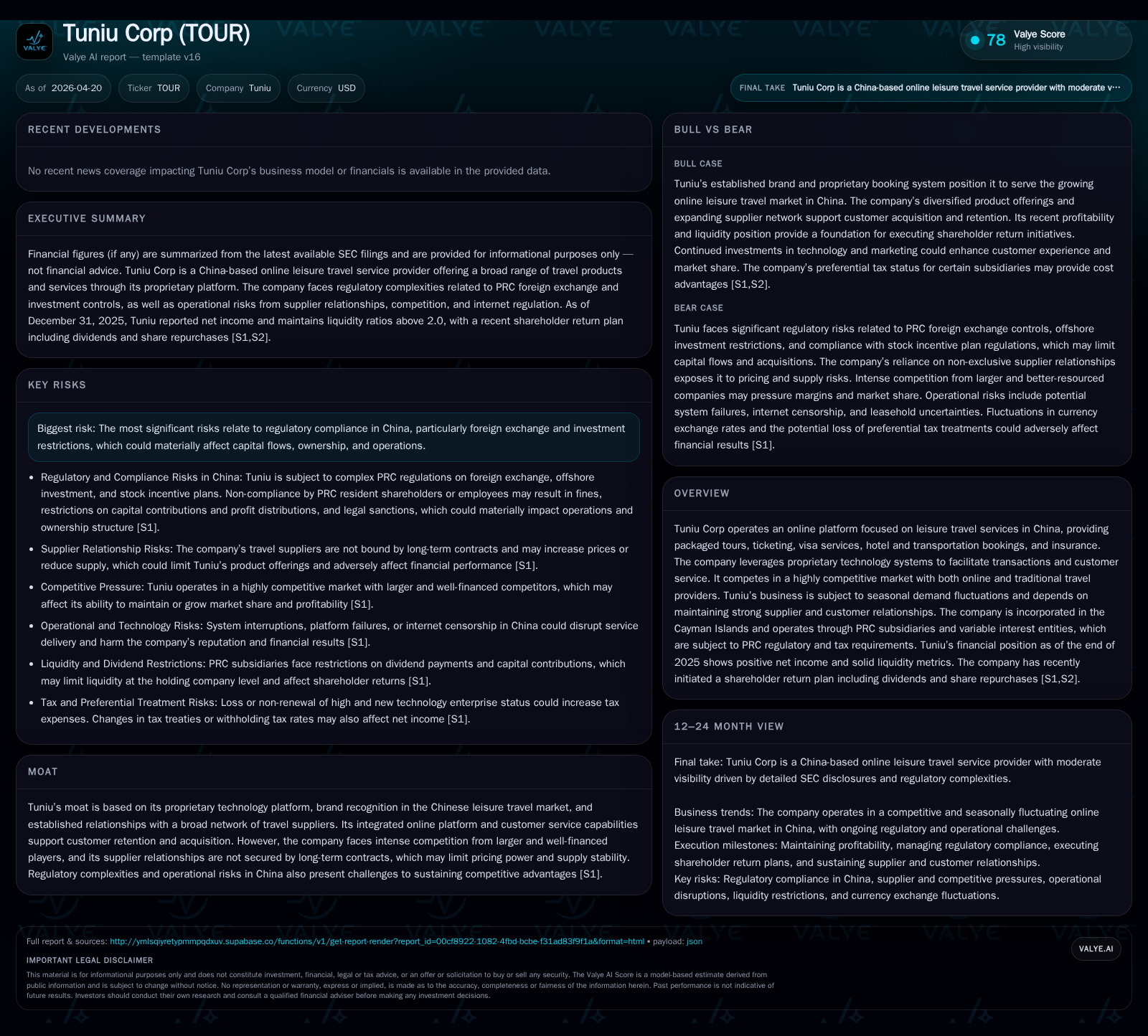
In Q1 2026, Tuniu Corp announced a strategic change to its ADS ratio alongside a renewed cash dividend, signaling an evolved capital return approach. The company operates a multifaceted online leisure travel platform in China, balancing strong proprietary technology and brand recognition against regulatory and competitive pressures. Growth drivers include post-pandemic travel demand rebound and platform improvements, while constraints stem from intense competition, regulatory oversight, and supplier contract limitations. Investors should monitor execution of the shareholder return plan, ADS ratio implementation, and quarterly demand trends tied to seasonality and regulation.
Q1 2026 Operational Highlights and Capital Deployment Announcements
Tuniu Corp’s latest quarterly disclosure on March 20, 2026 ([S2]) spotlights two critical capital strategic moves: approval of an American Depositary Share (ADS) ratio change and declaration of a cash dividend. Complementing this, an earlier March 5 filing ([S3]) detailed unaudited FY2025 financial results alongside initiation of a structured three-year shareholder return plan encompassing up to US$30 million dividends and US$20 million share repurchases. These moves reflect confidence in financial positioning while aiming to enhance shareholder value.
The ADS ratio adjustment generally implies increased liquidity or attractiveness of the shares for U.S. investors by changing how many ADSs represent one ordinary share; the precise adjustment terms were not detailed but represent tactical governance evolution. Concurrently, the declared dividend of US$0.0399 per ordinary share (record date May 4, 2026) is significantly higher than the prior year’s US$0.012 per share dividend ([S4], [S6]).
These capital return actions come despite complex external factors including competitive dynamics and regulatory challenges in China’s leisure travel sector. Management retains discretion over timing and quantum of returns based on ongoing performance.
Tuniu’s Leisure Travel Platform: Business Model and Customer Value Proposition
As outlined in the 20-F filing dated April 20, 2026 ([S1]), Tuniu operates an integrated online leisure travel platform targeting China’s domestic tourist base. The offering encompasses packaged tours supplemented by ticketing for attractions, visas, hotels, transport reservations (air/train/car rental), and insurance products. This breadth caters to evolving traveler preferences seeking convenience and bundled services.
Key to Tuniu’s model is its proprietary technology infrastructure enabling efficient end-to-end transaction processing, dynamic inventory management, customer service workflows, and data-driven marketing. Such systems facilitate scale benefits yet also require ongoing investment to maintain responsiveness amid shifting consumer demands.
Customer retention is tightly linked to quality of service delivery—a cornerstone evidenced by risk disclosures emphasizing reputational risk from subpar experiences ([S1], [S5]). Seasonal fluctuations are pronounced with Chinese New Year peaks followed by quieter quarters mirroring broader leisure industry cyclicality.
Supplier relationships underpin product quality but remain short-term or non-binding contracts without guaranteed exclusivity or pricing leverage ([S10]), limiting margin enhancement scope.
Competitive Dynamics within China’s Online Travel Sector
Tuniu’s competitive landscape is bifurcated between large online travel agencies (OTAs) like Trip.com Group (formerly Ctrip) and Qunar as well as entrenched traditional offline tour operators transitioning online. Despite historical partnerships—including a strategic cooperation agreement with JD.com which expired at end-2020 ([S1])—Tuniu must continuously defend market share against better-financed rivals that benefit from vast marketing budgets and ecosystem integrations.
Brand recognition is meaningful but under pressure from rivals' aggressive promotional spending driving up costs for search engine keywords and advertising placements ([S10]). This interplay erodes operating margins necessitating efficient marketing spend.
Switching costs remain moderate since consumer loyalty hinges on service consistency rather than contractual lock-ins. Supplier fragmentation means entrants could theoretically replicate offerings leveraging similar vendor pools unless technology or brand assets differentiate effectively.
PRC regulatory ambiguity regarding foreign listings further complicates the competitive posture by impacting capital availability relative to domestic players backed by Chinese institutional investors ([S8]).
Growth Enablers and Challenges Amid Regulatory and Market Pressures
Demand drivers align with structural rebounds in China’s outbound/inbound tourism post-COVID-19 disruptions, alongside government incentives encouraging domestic travel which benefits platforms like Tuniu ([S5], [S13]). Platform enhancements aimed at broadening departure city coverage and add-on services seek to deepen wallet share per user.
Conversely, regulatory constraints pose tangible hurdles. SAFE rules governing offshore holdings restrict smooth capital flow between Tuniu’s Cayman-incorporated parent structure and PRC subsidiaries ([S1], [S5]). Compliance obligations such as individual SAFE registrations expose operational risks if breached.
Data security regulations promulgated through multiple PRC agencies impose compliance costs with uncertainty over classification as critical infrastructure operators potentially triggering cybersecurity reviews before overseas listings can proceed ([S18]).
Moreover, competitive pricing pressures coupled with reliance on unstable supplier contracts limit margin expansion potential even amid volume growth.
Operational risks related to reputation damage from travel mishaps remain notable given direct customer contracts expose Tuniu to liability for supplier misfeasance ([S5], [S15]). Effective risk management here is critical for brand equity preservation.
Investor Considerations: What to Monitor in 2026
Key execution points include realization of the three-year shareholder return plan announced early 2026—whether dividends approach specified caps or share repurchases increase—particularly how the board exercises discretion considering evolving earnings trends ([S2], [S3], [S4]).
Implementation effectiveness of the ADS ratio change will be closely watched given its implication for trading liquidity and investor perception.
Operationally, indicators such as quarterly revenue growth rates aligned with China’s tourism seasonality will shed light on sustainable demand recovery versus transient spikes. Customer retention metrics linked explicitly to service quality improvements will be critical for assessing moat durability amid fierce competition ([S1]).
Regulatory developments surrounding SAFE registration compliance by shareholders or changes in foreign investment policy can materially impact capital deployment flexibility.
Finally, any announcements concerning renewed strategic partnerships or shifts away from historical alliances (e.g., JD.com) will signal adjustments in distribution channel strategy.
Financial Overview: Performance, Liquidity, and Capital Returns
According to companyfacts data derived from recent audited filings ([F1]), Tuniu reported revenue of approximately $327 million in FY2025—down by about 3.3% year-over-year—reflecting modest contraction after prior years' volatility. Operating income declined sharply by roughly 81.5% compared to FY2024 levels ($1.6 million vs $8.7 million), while net income contracted by about 57.9% but remained positive at $4.45 million.
Operating cash flow was negative $15.6 million reflecting working capital movements or investment outlays contrasting with prior positive cashflows; capital expenditures fell by around 37% year-over-year to roughly $1 million indicating restrained capex deployment.
Liquidity remains robust with cash & equivalents near $29.6 million at year-end yielding a current ratio exceeding 2.0—indicating sound short-term solvency.[F1]
Capital allocation reflects active buyback programs totaling nearly $7.3 million executed in FY2025 complementing initiated dividends consistent with stated shareholder return policies ([S3], [S4], [S22]). These moves confirm management's focus on deploying excess capital amidst constrained organic margin improvement potential.
Historical performance (annual)
| FY | Net ($mm) | CFO ($mm) | OpInc ($mm) | Capex ($) | Net YoY |
|---|---|---|---|---|---|
| 2025 | 4 | -16 | 2 | 1018000 | -57.9% |
| 2024 | 11 | 13 | 9 | 1618000 | +175.6% |
| 2023 | -14 | 33 | -14 | 1379000 | +50.1% |
| 2022 | -28 | -21 | -30 | 935000 |
Source: SEC companyfacts cache [F1].
Capital returns and efficiency (annual)
| FY | Buybacks ($mm) | FCF ($mm) | ROE% |
|---|---|---|---|
| 2025 | 7 | -17 | 3.0 |
| 2024 | 6 | 12 | 7.1 |
| 2023 | 31 | -9.6 | |
| 2022 | -22 | -17.5 |
Source: SEC companyfacts cache [F1].
Overall, financial data depict a company stabilizing after losses while prioritizing shareholder rewards over rapid reinvestment amid cyclical headwinds tied to China's evolving leisure travel recovery.
This analysis synthesizes Tuniu Corp's latest quarterly filings alongside annual disclosures into a cohesive narrative highlighting key operational shifts, business model dynamics, market positioning nuances, growth drivers/challenges specific to the Chinese OTA sector, investor-centric milestones to watch in 2026, and supporting financial context consistent with disclosed figures at fiscal year-end 2025.
This memorandum solely interprets public disclosures without providing investment recommendations or price forecasts.
Disclaimer: This is research-only, informational analysis and not investment advice. It may include AI-generated interpretation and general industry context. Always verify important details using primary sources.

Comments