
Jayud Global Logistics Raises Capital to Fuel Expansion Beyond China Borders
A recent $6.7 million equity raise and leadership shift underpin Jayud's strategic push into Southeast Asia amidst steady revenue growth and evolving logistics services.
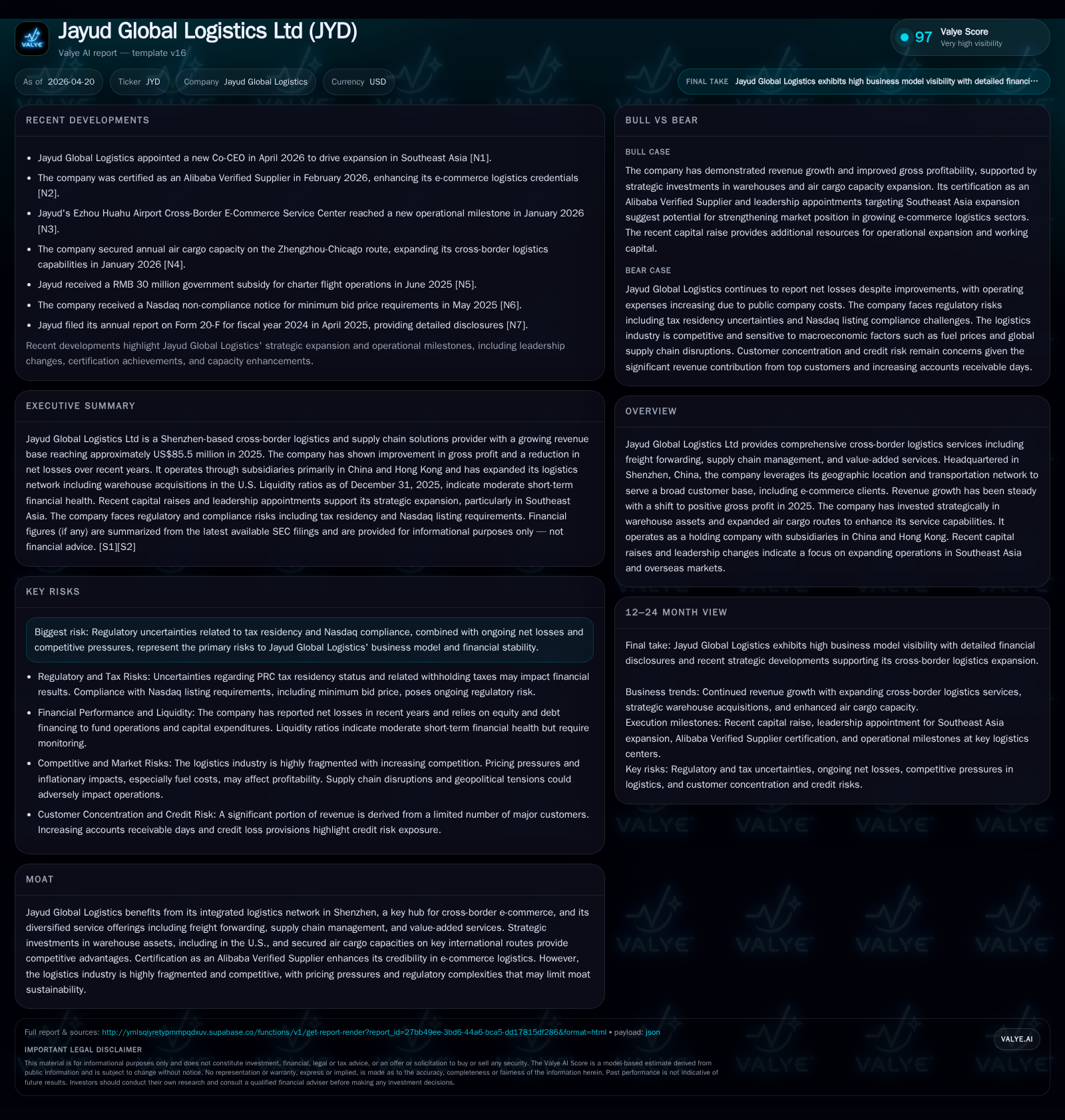
In March 2026, Jayud Global Logistics completed a registered direct offering raising approximately $6.73 million to fund overseas expansion and working capital needs. The capital infusion aligns with a new co-CEO appointment tasked with spearheading growth in Southeast Asia, complementing the firm’s growing service platform centered on freight forwarding, supply chain management, and value-added logistics from its Shenzhen base. While revenue increased by 8.7% year-over-year to $85.5 million in 2025, operating losses persist despite gross margin recovery, reflecting an industry under pressure from fragmentation, pricing constraints, and regulatory complexities. Strategic investments in warehousing assets, expanded air cargo routes, and certification credentials are key competitive levers as Jayud navigates market growth drivers and cross-border operational risks.
Latest Quarter Capital Raise Signals Expansion Intent
In March 2026, Jayud Global Logistics successfully closed a registered direct offering priced at $1.34 per share that raised gross proceeds of approximately $6.73 million before deduction of fees [S2]. This capital raise is earmarked for general corporate purposes with a particular focus on funding the expansion of its overseas business operations alongside supporting working capital needs. The timing coincides with Jayud’s strategic pivot to extend beyond its core Chinese market footprint particularly into Southeast Asia.
To ensure price stability post-offering, insiders including executive officers and directors agreed to a 30-day lock-up preventing share sales or equivalent dispositions [S2]. The financing agreement was facilitated by FT Global Capital which received a customary cash fee aligned with typical equity raises at roughly 4% plus related expenses [S2]. This incremental funding infusion bolsters Jayud’s ability to deploy resources behind infrastructure investment and regional penetration efforts under its newly announced leadership structure.
Business Model and Core Service Offerings
Jayud Global Logistics operates an integrated end-to-end cross-border supply chain platform anchored in Shenzhen, China, one of the country’s premier logistics hubs [S1]. Its primary revenue streams emanate from three interrelated segments: freight forwarding services; supply chain management; and other value-added services including customs brokerage [S1].
Strategically positioned in Shenzhen enables Jayud to leverage ocean, air, and overland transport networks for efficient multi-modal transit with reduced costs [S1]. The company serves a diverse customer base dominated by e-commerce firms engaged in cross-border trade, benefiting from the region’s dynamic commercial milieu [S1].
Jayud has progressively invested in warehouse assets, notably acquiring a majority stake in a Houston-based warehouse facility representing critical physical infrastructure for North American expansion [S1][S7]. It also expanded air cargo routes secured via charter flights supported by government subsidies that eased cost pressures on freight forwarding operations [S12]. Certification as an Alibaba Verified Supplier strengthens Jayud’s credibility in servicing e-commerce logistics customers requiring reliable cross-border delivery solutions .
Competitive Position in Cross-Border Logistics
The Chinese cross-border logistics sector is intensely competitive and fragmented, comprising many small players alongside select integrated providers like Jayud who cultivate moats through scale and service breadth [S1]. Jayud’s integrated multi-service offerings differentiate it somewhat by allowing end-to-end control over client supply chains which reduces reliance on third parties.
Its geographic advantage via Shenzhen—a major trade gateway—permits robust connectivity across oceanic ports and inland transportation routes. Investments in asset-heavy nodes such as warehousing facilities add tangible barriers to entry for competitors lacking similar capital commitments . Furthermore, air cargo route licenses coupled with operational efficiency gains enhance bargaining power versus smaller fragmented providers.
Nonetheless, pricing pressure is notable as customers negotiate aggressively amidst many choices [,]. Regulatory frameworks concerning foreign exchange controls and tax laws add complexity that can limit margin improvement potential (discussed later). Thus while Jayud has built some protective features around its model through resource control and certifications, these moats remain susceptible to external pressures inherent to logistics markets.
Growth Drivers in Supply Chain Management and E-Commerce Integration
Positive top-line momentum persists primarily driven by the supply chain management business which recorded an 11% revenue increase in 2025 reaching RMB264.3 million (US$37.6 million) [S1]. This uplift traces directly to increased trading volumes of electronic devices and chips which grew substantially from 76.2 million units in 2024 to 97.1 million units last year—a segment catalyzed by recent subsidiary formations focused on electronics import business lines [S1].
The overall revenue gain for the firm was +8.7% YoY reaching approximately $85.5 million in 2025 reflecting steady expansion across its customer base though total number declined modestly due to portfolio rationalization efforts [F1][S9]. Average revenue per customer improved markedly suggesting deeper penetration or higher-value contracts among existing clients [S9].
Enhanced marketing activities including event sponsorships combined with digital advertising aim at increasing brand presence particularly targeting e-commerce sectors further stimulate demand [S9]. Investment strategies prioritizing warehouses also provide capacity for scalable business processing as trade volumes grow.
Constraints: Regulatory Risks and Profitability Challenges
Despite encouraging revenue trends and gross profit recovery (+3.4% margin in 2025 after consecutive gross losses), Jayud remains unprofitable at the operating level with a reported loss of about $5.36 million for the year ending December 31, 2025—though this represents improvement versus prior years [F1][S1]. Increasing operating expenses (+41% year-over-year) underscore ongoing cost investments behind marketing payrolls and new service launches [S20].
Significant risks arise from uncertain PRC tax residency status that may interfere with Nasdaq listing compliance underscoring regulatory vulnerabilities embedded within its offshore holding company structure juxtaposed against mainland operations . Foreign exchange controls impose limits on transferring funds between subsidiaries restricting operational liquidity deployment flexibility potentially delaying investments or dividends upstream [S13][S14].
Competition remains fierce within the fragmented sector constraining pricing power despite asset investments that typically underpin margin gains elsewhere [S12]. Externally driven geopolitical uncertainties such as trade tensions or pandemic-related disruptions also impose cyclical headwinds affecting volume demand globally .
Leadership Changes and Southeast Asia Market Entry
Complementing the capital raise is a notable leadership appointment revealed shortly after quarter-end: Jayud appointed a new Co-CEO tasked explicitly with driving strategy focused on Southeast Asian markets expansion efforts commencing immediately post-approval (April 2026) [N1].
This executive infusion aims at accelerating overseas growth ambitions through enhanced operational rigor combined with targeted marketing campaigns aligned with regional customer acquisition priorities—areas where localized expertise can unlock differentiated access ahead of broadly competitive peers operating mainly inside China proper [N1].
Financial Overview: Revenue Growth Against Operating Losses
Jayud's financial trajectory reflects gradual recovery yet sustained challenges typical of growth-stage integrated logistics providers:
- Revenue advanced from approximately $70.3 million (RMB702.7M USD equivalent) in 2023 to $78.6 million in 2024 (+11%) then to $85.5 million (+8.7%) in 2025 evidencing steady top-line expansion driven principally by supply chain management segment gains [F1][S1]
- Gross profit shifted from negative RMB15.9M ($2.3M loss) in 2023 through negative RMB11.2M (about $1.62M loss) for 2024 to positive RMB20.1M ($2.9M profit) by end-2025 evidencing cost management improvement including government subsidy impacts on freight costs [F1][S20]
- Despite gross profit improvements operating income remained negative at -$5.36 million for FY2025 improving from -$7.25M loss prior year indicating ongoing investment-driven expenses particularly selling & administrative overheads growing +41% YoY reflecting scaling efforts [F1][S20]
- Net income mirrors this trend moving from -$10.2M in FY23 through -$6.9M FY24 to -$5.06M FY25 showing reduction of net losses at roughly similar rates consistent with operational leverage build-up though profitability remains elusive financially [F1]
- Operating cash flow remains negative though improving (-$13.56 million FY24 vs -$5.12M FY25), indicative of continued working capital absorption related to accounts receivable buildouts amid expanding revenues while capex investments increased >600% YoY albeit absolute levels remain modest around $0.72M annually reflecting measured asset growth pace supporting warehousing/logistics tech deployment strategies without heavy fixed asset burdens typical of large carriers [F1]
- Current ratio approximately of 1.51 signals reasonable near-term liquidity aided by recent capital infusion but constrained cash burn highlights importance of maintaining timely equity/debt financing access for sustainability amid growth phase requirements [F1]
- Equity position improved substantially turning positive again after significant deficit reported pre-2024 indicating strengthened balance sheet resilience post equity raises advancing financial stability foundation required for overseas ventures execution [F1]
Key Metrics Table: Revenue, Margins, Cash Flow, Capital Structure
Historical performance (annual)
| FY | Rev ($mm) | Net ($mm) | CFO ($mm) | OpInc ($mm) | Rev YoY | Net YoY |
|---|---|---|---|---|---|---|
| 2025 | 85 | -5 | -5 | -5 | +8.7% | +26.6% |
| 2024 | 79 | -7 | -14 | -7 | +11.9% | +32.7% |
| 2023 | 70 | -10 | -6 | -11 | -24.9% | |
| 2022 | 94 | -2 | 0 |
Source: SEC companyfacts cache [F1].
Capital returns and efficiency (annual)
| FY | FCF ($mm) | ROE% |
|---|---|---|
| 2025 | -6 | -33.9 |
| 2024 | -14 | -54.9 |
| 2023 | -7 | 402.0 |
| 2022 | -2 |
Source: SEC companyfacts cache [F1].
Note: All USD values approximate extracted from reported RMB data using disclosures across filings cited.
Outlook: What to Watch for Next
Key forthcoming developments for stakeholders monitoring Jayud include:
- Execution progress on geographic expansion efforts particularly rollout effectiveness within Southeast Asia guided by recently appointed Co-CEO mandate combined with utilization metrics on raised capital deployed offshore under existing foreign exchange regulatory frameworks [N1][S2][S13]
- Regulatory developments impacting tax residency classification or exchange control requirements which may influence Nasdaq compliance status or constrain upstream fund transfers thereby affecting liquidity flexibility
- Customer base trends including retention rates among largest clients (currently ~32% of revenue combined top five customers) coupled with new customer acquisition dynamics impacting average revenue per user growth metrics critical for longer-term margin expansion probability given competitive intensity limits price increases today [S9]
- Margin trajectory improvements beyond currently thin gross profits focusing on operational efficiencies, vendor cost controls, and scale benefits materializing post warehousing footprint expansion particularly cross-border air freight advantages secured via government subsidized flight routes previously costly under fragmented carrier alternatives [S12]
- Signs of positive operating leverage emerging as revenue expands faster than incremental selling/admin expense growth which currently remains elevated amid market development stage investments recapitalizing eventual profitability pathways over medium term horizons.
Jayud stands at an inflection point balancing disciplined capital deployment toward infrastructure paired with calibrated risk navigation over competitive pressures and regulatory constructs shaping China-origin cross-border logistics ecosystems.
This analysis is based solely on available company disclosures including SEC filings dated March-April 2026 and related public news releases without investment recommendations.
Disclaimer: This is research-only, informational analysis and not investment advice. It may include AI-generated interpretation and general industry context. Always verify important details using primary sources.

Comments