
Biomea Fusion's Financial Strains and Clinical Progress Challenge Growth Trajectory
Clinical-stage biotech Biomea Fusion advances metabolic and oncology therapies while facing significant cash burn and developmental risks.
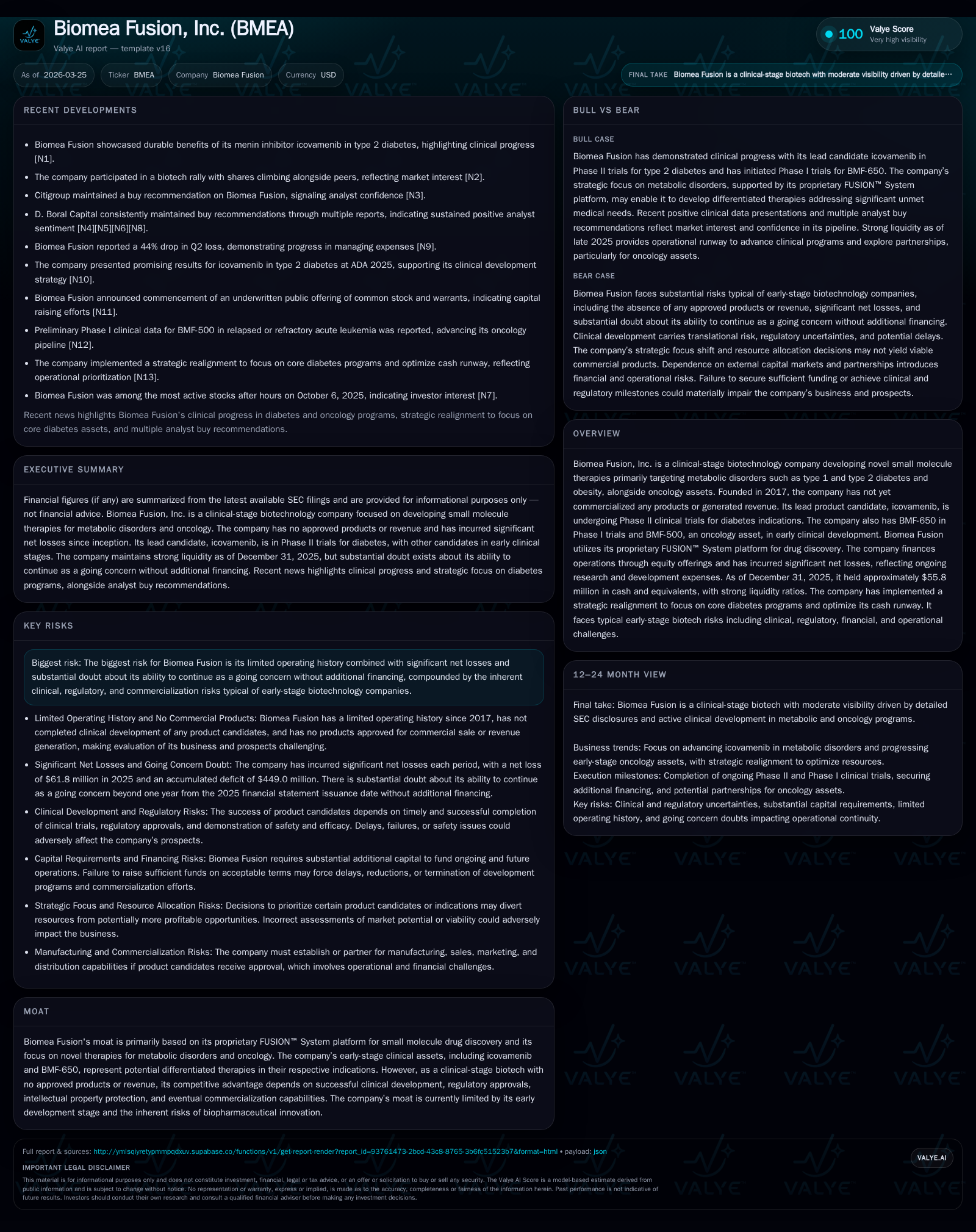
Biomea Fusion, Inc., a clinical-stage biotech focused on metabolic disorders and oncology, continues its early-stage development with lead asset icovamenib in Phase II trials. Despite recent IND clearance for BMF-650 and strategic oncology portfolio planning, the company remains unprofitable with escalating net losses and negative cash flows. Its liquidity position stands adequate for near-term operations but raises concerns about sustainability without further financing. Regulatory complexities, patent litigation risks, and commercialization capabilities constitute substantial barriers ahead.
Business Overview
Biomea Fusion, Inc., founded in 2017, operates as a clinical-stage biotechnology company specializing primarily in developing novel small molecule therapies targeting metabolic diseases such as type 1 and type 2 diabetes and obesity, alongside select oncology programs [S1][S2]. The company's lead candidate, icovamenib, currently undergoing Phase II clinical trials for diabetes indications, anchors the clinical pipeline. Additionally, BMF-650 commenced Phase I evaluation following FDA IND clearance in September 2025, focusing on obesity treatment in otherwise healthy volunteers [S1][S2]. Oncology asset BMF-500 remains early stage, with plans to seek partnerships for advancement [S1][S2].
A distinguishing feature is Biomea Fusion’s proprietary FUSION™ System platform that facilitates targeted small molecule drug discovery efforts tailored toward innovative therapeutic modalities.
Historical Performance and Financials
Since inception, Biomea has not commercialized any products nor generated revenue from operations—typical of early-stage biotech firms emphasizing R&D activities [S1][S2]. Reported revenue of approximately $1.24 billion as of Q3 2022 per [F1] likely represents non-core or related-party inputs rather than commercial sales; the company explicitly states zero product revenue historically.
Net losses have markedly increased over recent years due to escalating investment in clinical programs and infrastructure build-out:
Historical performance (annual)
| FY | Net ($mm) | CFO ($mm) | OpInc ($mm) | Capex ($mm) | Net YoY |
|---|---|---|---|---|---|
| 2025 | -62 | -70 | -84 | 0 | -110.9% |
| 2024 | -29 | -120 | -30 | 0 | +16.0% |
| 2023 | -35 | -97 | -37 | 3 | -37.8% |
| 2022 | -25 | -62 | -26 | 1 |
Source: SEC companyfacts cache [F1].
Capital returns and efficiency (annual)
| FY | FCF ($mm) | ROE% |
|---|---|---|
| 2025 | -71 | -209.1 |
| 2024 | -120 | -56.8 |
| 2023 | -100 | -20.6 |
| 2022 | -63 | -23.3 |
Source: SEC companyfacts cache [F1].
Source: SEC filings and company facts [F1]
The cash flow reflects ongoing significant investment in research and development with persistently negative free cash flow (operating cash flow minus capex). Equity has declined substantially since its peak at the end of FY2023.
Growth Drivers and Constraints
Growth prospects hinge on successful clinical milestones primarily for icovamenib and BMF-650—advancing through pivotal efficacy/safety endpoints in ongoing trials [S1][S2]. Further progression or partnering of oncology assets could unlock additional value.
Constraints include:
- High dependency on additional financing given recurring net losses of $61.8 million in FY2025 and operating cash outflows around $70 million despite a cash balance of $55.8 million at year-end [F1][S13][S16].
- Clinical trial risks typical for early-stage biopharma ventures.
- Regulatory challenges encompassing healthcare compliance laws such as anti-kickback statutes, FDA promotional restrictions including off-label use regulations, data protection laws impacting trial conduct/data management [S4–S10][S12][S15][S18].
- Intellectual property risks including USPTO post-grant proceedings (IPR/PGR), patent infringement litigation exposure, and potential third-party claims [S8][S10].
- Lack of commercial infrastructure necessitates partnerships or costly internal capability building if products receive approval.
Outlook and Milestones to Monitor
Key near-term catalysts include:
- Completion outcomes from the Phase II icovamenib program.
- Data readouts from Phase I BMF-650 trials validating safety/tolerability.
- Potential partnerships or licensing deals for oncology candidates.
Investors should monitor trial progress updates, regulatory communications including FDA decisions, fundraising activities extending operational runway, and partnership announcements.
Returns and Capital Allocation
Measured returns remain deeply negative with an approximate return on equity exceeding -200% due to net losses vastly exceeding equity base reductions [F1]. Free cash flow was approximately negative $70.7 million in FY2025 reflecting sustained heavy R&D investment.
The company pays no dividends nor conducts share buybacks; all capital is retained for reinvestment into development efforts [F1].
Strategic Challenges
Biomea Fusion faces typical clinical-stage biotech hurdles:
- Transitioning from pre-revenue research entity to commercial operation contingent on regulatory approvals,
- Navigating an increasingly complex healthcare regulatory environment impacting promotional practices and data privacy,
- Securing ongoing capital amid volatile markets where equity financings may cause dilution,
- Protecting intellectual property within an aggressive patent landscape often involving costly litigation beyond small company budgets,
- Demonstrating differentiation against competitors within metabolic disease and oncology sectors.
Building commercial capabilities or forging robust partnerships will be critical approaching commercialization phases.
Conclusion
Biomea Fusion operates at a critical juncture balancing innovative science with financial sustainability challenges typical for clinical-stage biotechs. While its proprietary FUSION™ System supports multiple early-phase assets progressing forward, the magnitude of net losses coupled with limited cash runway underscores urgent need for disciplined financing aligned with clear execution on clinical milestones.
Investors should closely evaluate upcoming trial data releases alongside corporate developments regarding capital raises or partnership formations that will materially influence the company’s trajectory.
This analysis is informational only and does not constitute investment advice.
Disclaimer: This is research-only, informational analysis and not investment advice. It may include AI-generated interpretation and general industry context. Always verify important details using primary sources.

Comments