
Fractyl Health’s Clinical Milestones and Financial Strains Reshape Growth Trajectory
Fractyl Health advances metabolic therapeutics amid mounting losses and liquidity concerns.
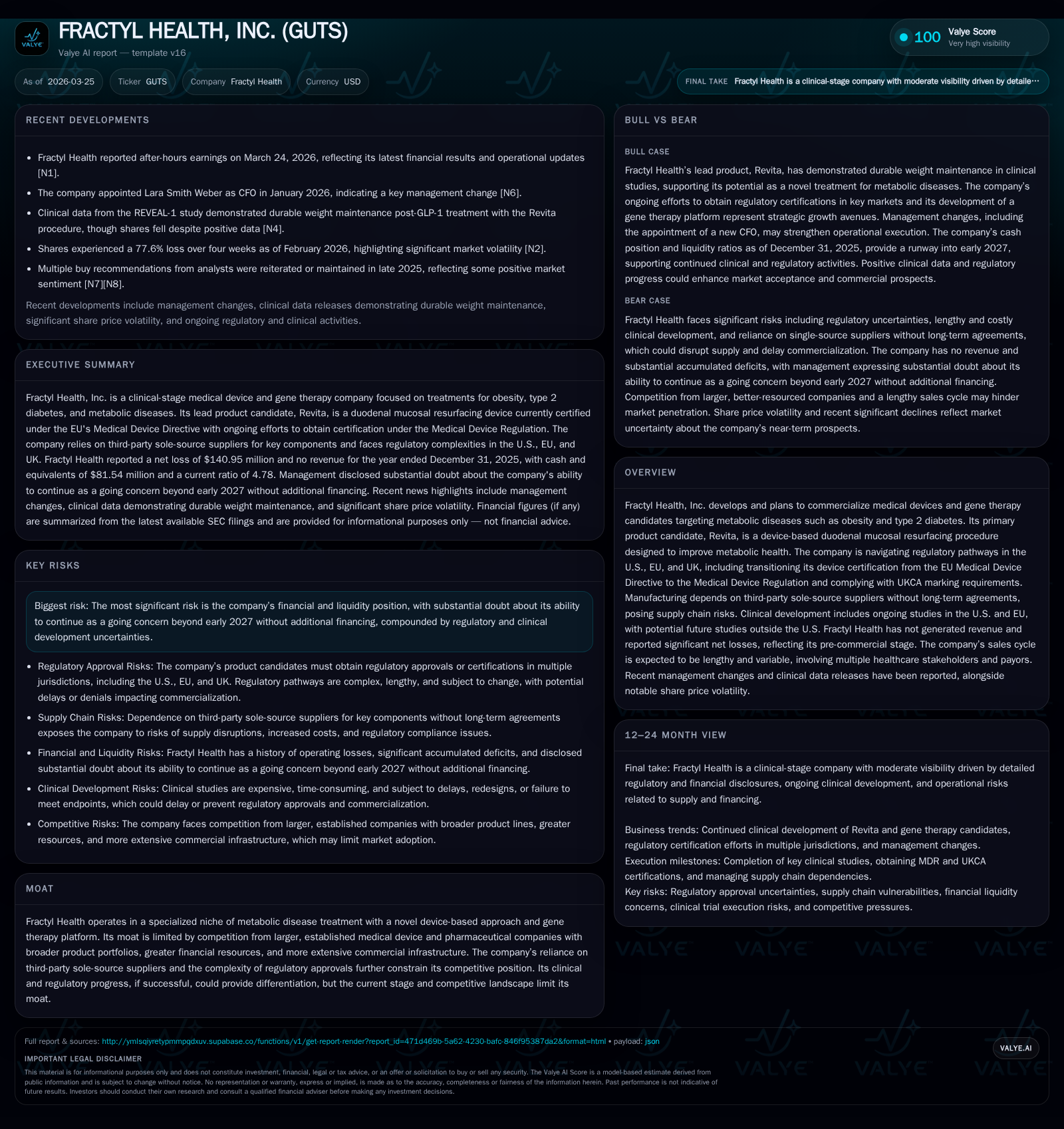
Fractyl Health, Inc. (GUTS) remains a clinical-stage company developing novel therapies for obesity and type 2 diabetes with its Revita device and Rejuva gene therapy candidates. While pivotal trial data for Revita are expected throughout 2026, the company faces significant net losses and operating cash flow deficits that raise substantial doubt about its ability to continue beyond early 2027 without additional capital. Cash reserves of $81.5 million at year-end 2025 provide some runway, but ongoing financing or partnerships will be critical to sustain operations amid regulatory complexities and competitive pressures.
Company Overview
Fractyl Health, Inc. is a clinical-stage metabolic therapeutics company focused on novel approaches to treat obesity and type 2 diabetes (T2D). Its lead product candidate, the Revita® Duodenal Mucosal Resurfacing (DMR) system, is designed as a catheter-based endoscopic procedure aiming to reverse metabolic disease by restoring duodenal mucosa integrity rather than merely managing symptoms chronically. The Rejuva® gene therapy platform complements this approach by targeting molecular pathways implicated in disease progression. The company has no commercial products generating revenues as of December 31, 2025 [F1][S1].
Historical Performance and Growth Drivers
Key developments include:
- Completion of enrollment for the REMAIN-1 pivotal cohort evaluating Revita’s efficacy in maintaining weight loss after GLP-1 receptor agonist discontinuation, with randomization finalized by February 2026 [S1].
- Submission of Clinical Trial Applications (CTAs) for RJVA-001 gene therapy candidate in the EU and Australia during the second half of 2025, advancing toward anticipated first-in-human studies.
- Strategic reprioritization announced January 31, 2025, pausing some T2D-focused trials such as REVITALIZE-1 without safety concerns; workforce reduced by approximately 17% [S1].
Financials reflect intensive R&D investment without revenue generation:
Historical performance (annual)
| FY | Net ($mm) | CFO ($mm) | OpInc ($mm) | Capex ($) | Net YoY |
|---|---|---|---|---|---|
| 2025 | -141 | -90 | -97 | 557000 | -105.2% |
| 2024 | -69 | -66 | -94 | 1765000 |
Source: SEC companyfacts cache [F1].
Capital returns and efficiency (annual)
| FY | FCF ($mm) | ROE% |
|---|---|---|
| 2025 | -91 | -1490.3 |
| 2024 | -67 | -241.7 |
Source: SEC companyfacts cache [F1].
The doubling of net losses year-over-year alongside escalating cash burn highlights heavy developmental spending despite no top-line revenues yet realized [F1]. Capital expenditures decreased as infrastructure investments matured.
Future Growth Prospects
Clinical Milestones
Anticipated key events in 2026 include:
- Q2: One-year REVEAL-1 cohort data on long-term Revita safety and efficacy.
- Q3: Interim randomized results from REMAIN-1 midpoint cohort.
- Early Q4: Six-month topline data from REMAIN-1 pivotal cohort.
- Late Q4: Potential FDA De Novo marketing application submission for post-GLP-1 weight maintenance indication.
- Midyear: Regulatory feedback on RJVA-001 CTAs with first-in-human dosing expected in H2 2026 [S1].
Success in these studies could enable transition toward commercialization.
Regulatory Complexity & Supply Chain Risks
The company faces challenges including:
- Transitioning EU device certification from Medical Device Directive (MDD) to Medical Device Regulation (MDR), which imposes more stringent requirements affecting CE marking timelines [S1].
- Compliance with UKCA regulations following Brexit introduces additional approval complexity.
- Dependence on third-party sole-source suppliers without long-term contracts presents risks of supply disruption impacting manufacturing scale-up.
Competitive Landscape
Fractyl competes against established medical device and pharmaceutical companies offering diversified portfolios encompassing lifestyle interventions, pharmaceuticals such as GLP-1 analogs, bariatric surgeries, and diabetes management devices [S21]. Larger competitors benefit from extensive sales networks, R&D capabilities, intellectual property portfolios, supplier leverage, and brand recognition—advantages Fractyl currently lacks due to its pre-commercial status.
Nonetheless, Fractyl’s combination of device-based metabolic intervention and gene therapy offers a potentially differentiated therapeutic avenue pending successful trial outcomes.
Financial Outlook & Capital Allocation
Liquidity & Capital Structure
At December 31, 2025, Fractyl held $81.5 million in cash and equivalents against current liabilities of $18.3 million, yielding a current ratio near 4.78x—a solid short-term liquidity position [F1][S4][S13].
Its debt comprises term loans under a Credit Agreement totaling $30 million with floating interest rates above prime or set minimums; principal payments have been deferred with maturities extended to September 2028 along with related exit fees [S4][S13][S26].
Warrant liabilities were valued at approximately $36.4 million at year-end reflecting embedded derivatives associated with stock purchase agreements [F1][S18][S27].
Operating Cash Flows & Burn Rate
Operating cash flow worsened significantly to negative $90.3 million in FY25 compared to negative $65.5 million in FY24—a nearly 38% increase in cash burn despite lower capital expenditures that halved year-over-year [F1][S14]. Free cash flow approximated negative $90.9 million given minimal capex spend.
Equity & Returns Analysis
Equity declined sharply from $28.4 million at FY24 year-end to roughly $9.5 million at FY25 close—a contraction contributing to an approximate return on equity near -1490%, indicative of deep losses relative to shareholder capital deployed [F1].
Fundraising Activities & Strategic Plans
Public offerings during calendar year 2025 generated proceeds exceeding $85 million net of underwriting costs according to SEC filings; an At-The-Market facility was also utilized before termination in March 2026 amid strategic adjustments [S14][S22].
Management indicates plans to secure additional equity or debt financing or licensing partnerships leveraging upcoming clinical data milestones as value inflection points [S1][S22]. Failure to raise further capital would likely necessitate operational cutbacks beyond recent workforce reductions executed during strategic reprioritization [S1].
Risks Highlighted by Management & Disclosures
Substantial doubt exists regarding Fractyl’s ability to continue as a going concern beyond early 2027 without additional financing—a risk explicitly emphasized by management [S23]. Other material risks include:
- Potential delays or failure obtaining required marketing certifications under MDR or FDA pathways could stall commercialization timelines.
- Supply chain vulnerabilities due to reliance on single-source suppliers without binding contracts.
- Intense competition from well-resourced industry players potentially limiting market penetration despite innovative technology.
- Exposure to product liability claims inherent in medical device development alongside complex healthcare compliance obligations involving anti-kickback statutes and privacy laws carrying significant penalties if breached [S5][S7][S10][S12][S17][S28].
- Intellectual property litigation risks that may arise given rapid technological change within biomedical sectors impacting exclusivity [S9][S19].
Analytical Outlook: Key Monitoring Points
Investors should watch for:
- Quality and timing of pivotal six-month REMAIN-1 cohort randomized results due Q4/26 as critical de-risking events ahead of potential FDA submission.
- Initial human dosing outcomes and preliminary data for Rejuva gene therapy program expected H2/26 defining pipeline expansion feasibility.
- Progress on MDR certification affecting European commercial readiness alongside evolving UKCA compliance requirements.
- Financing developments extending operational runway beyond the substantial doubt period through new capital raises or partnerships.
- Competitive dynamics shaped by new product introductions or pricing pressures from evolving GLP-1 class agents influencing Revita’s market positioning.
Conclusion
Fractyl Health stands at a challenging inflection point balancing pioneering metabolic disease therapies against significant financial constraints amid regulatory complexity and competitive headwinds. Upcoming clinical milestones offer potential catalysts toward market entry; however, persistent cash burn coupled with uncertain funding prospects underscores execution risks absent successful capital raises or alliance formation.
Investors tracking GUTS should weigh its differentiated technology platforms advancing toward late-stage validation against liquidity pressures, supply chain dependencies, regulatory hurdles, and competitive intensity typical within innovative medical device fields transitioning toward commercialization.
This report is based on publicly available information as of March 25, 2026 including SEC filings and recent news releases for Fractyl Health, Inc.. It does not constitute investment advice or recommendations.
Disclaimer: This is research-only, informational analysis and not investment advice. It may include AI-generated interpretation and general industry context. Always verify important details using primary sources.

Comments