
BeyondSpring Inc. Advances Cancer Therapeutics While Reshaping Its Asset Portfolio
The company leverages clinical successes with Plinabulin and strategic divestiture of its TPD platform to sharpen focus on oncology innovation.
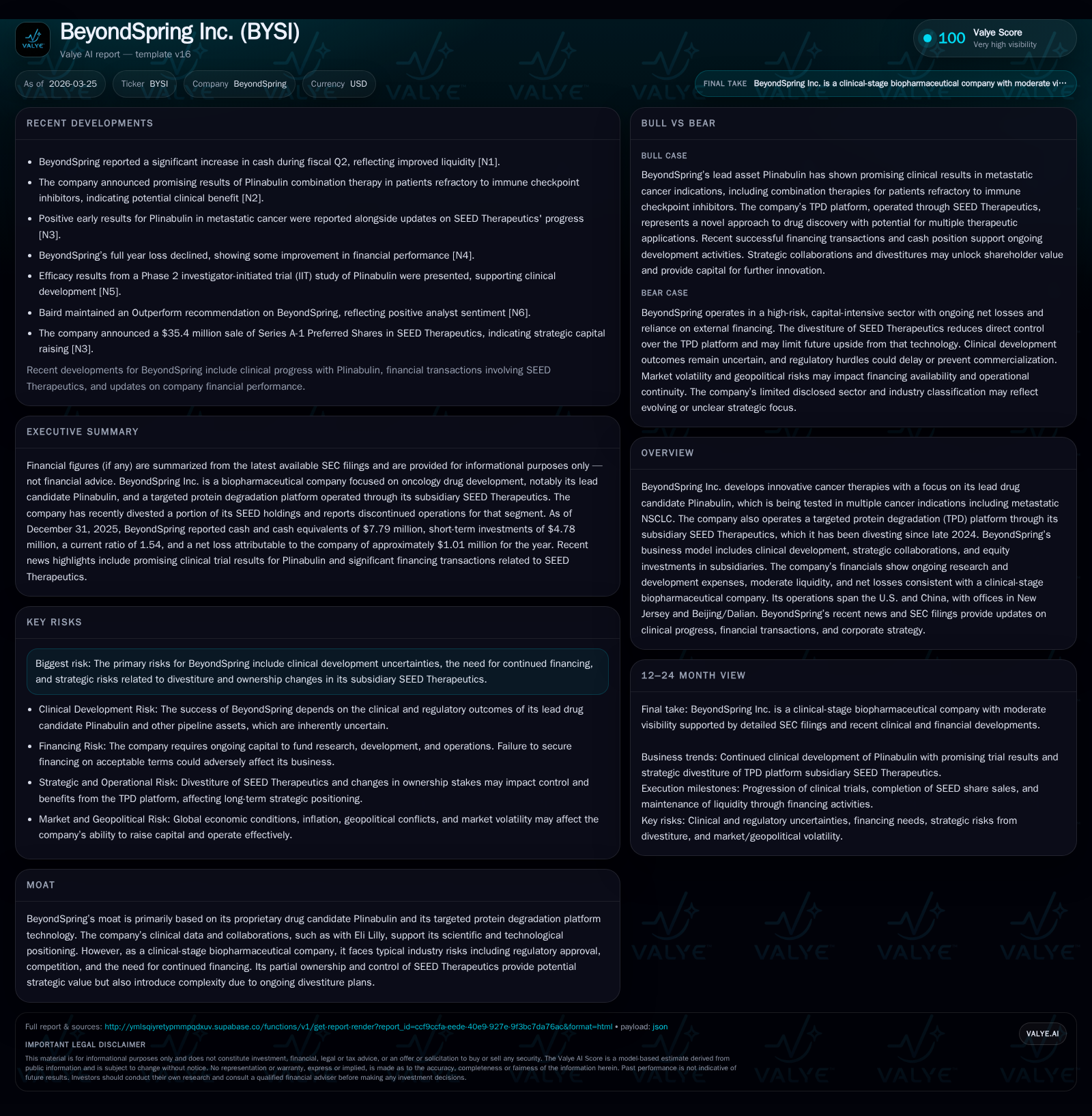
BeyondSpring has demonstrated meaningful clinical progress with its lead asset Plinabulin, notably through the positive results in the pivotal DUBLIN-3 Phase 3 trial for NSCLC patients resistant to immune checkpoint inhibitors. Concurrently, BeyondSpring initiated the divestiture of its targeted protein degradation platform subsidiary SEED Therapeutics, reflecting a strategic shift to concentrate resources on its core oncology pipeline. Financially, the company continues to operate at a loss typical of clinical-stage biopharma firms, with modest liquidity and ongoing cash burn driven by R&D investments. Investors should monitor planned NDA submissions, confirmatory trial milestones, and updates on the SEED divestiture status as key catalysts for future evaluation.
Clinical Breakthroughs Driving Historical Performance
BeyondSpring’s clinical narrative is dominated by Plinabulin, a novel brain-penetrant microtubule modulator exhibiting immunomodulatory and vasculature-modulating properties. The lead asset has been evaluated extensively in over 700 cancer patients demonstrating good tolerability [S1]. The pivotal DUBLIN-3 Phase 3 study enrolled 559 patients globally (over 80% from Asia), targeting second- and third-line nonsquamous NSCLC harboring epidermal growth factor receptor (EGFR) wild type after progression on immune checkpoint inhibitors (ICI), a patient population with acute unmet medical needs due to acquired resistance mechanisms like T cell exhaustion [S1].
The DUBLIN-3 results revealed a statistically significant improvement in overall survival (OS) when Plinabulin was combined with docetaxel compared to docetaxel alone. Notably, the two-year and three-year OS rates doubled, accompanied by clinically meaningful progression-free survival (PFS) gains and objective response rate (ORR) improvements. A distinctive differentiator lies in the safety profile: grade 4 neutropenia incidence was reduced by approximately 80%, critical given cytopenia risks associated with conventional chemotherapy [S1]. These data underpin BeyondSpring’s scientific moat anchored on microtubule modulation combined with immune system engagement.
Parallel investigator-initiated studies amplify this narrative; for example, collaborations at Peking Union Medical College Hospital assessed Plinabulin combined with pembrolizumab (Keytruda®) plus docetaxel post-PD-1/PD-L1 antibody progression yielding high disease control rates and prolonged PFS [S1]. Similarly, MD Anderson Cancer Center completed a phase 1 IIT evaluating combination with PD-(L)1 antibodies and radiation therapy further evidencing synergy potential [S1]. The company also develops three small molecule immune agents at preclinical stages complementing its oncology portfolio.
Financial Trajectory: Year-on-Year Operating and Net Results
Table summarizing key financial performance from FY2021 through FY2025 elucidates the challenging economics typical of clinical-stage biotech companies:
Historical performance (annual)
| FY | Net ($mm) | CFO ($mm) | OpInc ($mm) | Capex ($mm) | Net YoY |
|---|---|---|---|---|---|
| 2025 | -1 | -20 | -9 | 0 | +91.0% |
| 2024 | -11 | -16 | -9 | 0 | |
| 2022 | -33 | -27 | -37 | 0 | +48.1% |
| 2021 | -64 | -47 | -66 | 3 |
Source: SEC companyfacts cache [F1].
Capital returns and efficiency (annual)
| FY | FCF ($mm) | ROE% |
|---|---|---|
| 2025 | -20 | 3.1 |
| 2024 | -17 | 33.8 |
| 2022 | -27 | 556.6 |
| 2021 | -50 | -240.5 |
Source: SEC companyfacts cache [F1].
(Source: [F1])
Operating losses narrowed dramatically from tens of millions in early years to below $9 million in recent periods as development focus tightened around Plinabulin’s advancement [F1]. Despite this improvement in reported net loss—reaching near break-even levels in FY2025—the company generated negative cash flows from operations amounting to $19.8 million during the year driven primarily by substantial clinical trial costs and increased R&D investment tied to confirmatory studies and regulatory preparation [S11][F1]. Capital expenditures have contracted sharply since peak years because BeyondSpring leases facilities rather than owning significant property or manufacturing assets directly [F1][S20].
Strategic Divestiture and Its Impact on Business Focus
Signaling a decisive portfolio refocus, BeyondSpring initiated divestiture plans for SEED Therapeutics — its subsidiary operating a targeted protein degradation (TPD) platform based on proprietary molecular glue technology — starting in late 2024 [S8][S9]. This platform aims at novel oncology assets exemplified by an RBM39 degrader entering phase 1 trials early 2026 alongside partnerships with Eli Lilly and Eisai for new chemical entity discovery.
The divestiture strategy proposes selling up to approximately 90–100% ownership interests via staged transactions structured through definitive agreements finalized throughout calendar years 2025–2026 [S8][S14]. These moves have precipitated segment reporting shifts classifying TPD activities under discontinued operations while freeing capital allocations toward BeyondSpring’s main oncology programs focused on Plinabulin development.
Operationally, this divestiture introduces short-term complexity given consolidation considerations but strategically aligns BeyondSpring’s resource base with its core strengths aiming potentially for higher capital efficiency moving forward [S6][S8]. The partial ownership retained post-sales underscores management’s belief in residual value while accepting diminished controlling influence.
Capital Allocation and Liquidity Position
As of December 31, 2025, BeyondSpring reported cash and cash equivalents totaling approximately $7.79 million supplemented by short-term investments of about $4.78 million, supporting an overall current asset base of roughly $20.88 million against current liabilities of $13.58 million resulting in an estimated current ratio of around 1.54 — suggesting moderate liquidity coverage adequate for near-term operational needs without excess cushion [F1].
There have been no dividends declared nor systematic share repurchases noted; capital allocation focuses primarily on financing clinical development through equity raises, sales of subsidiary shares (particularly relating to SEED), debt arrangements, and strategic collaborations contributing proceeds intermittently [S12][S15][S18].[F1]
The considerable accumulated deficit—exceeding $400 million—and negative shareholder equity position (-$32.16 million as of FY2025)—reflect sustained investment over multiple years prior to commercialization stages common among biopharma startups [F1]. The approximate return on equity calculated using latest annual net income relative to equity is slightly positive (~3%) owed mainly to sharply reduced net losses relative to prior periods; however, structural equity deficits limit interpretability regarding profitability returns until scalable revenues commence.
Regulatory and Operational Risks Shaping Future Outlook
Clinical development inherently carries regulatory risk compounded here by the complexity of oncology indications involving ICI refractory populations presenting mechanistic hurdles such as immune cell exhaustion pathways documented scientifically [S4][S21]. Success hinges critically upon replicating DUBLIN-3 findings within confirmatory trials accepted by both NMPA and FDA standards alongside timely NDA dossier assembly.
The divestiture process regarding SEED Therapeutics adds operational volatility observable through fluctuating equity stakes affecting consolidated financial metrics alongside potential strategic risks if capital market conditions impair transaction completion or valuation realizations [S8][S9].
Liquidity risks also prevail amid an environment demanding continued sizeable R&D spend unsupported yet by product revenue necessitating fundraising that may dilute shareholders or increase indebtedness which can impose restrictive covenants limiting corporate flexibility [S17][S19]. Macro geopolitical tensions affecting cross-border collaborations between U.S.-China jurisdictions where operations exist inject additional ambiguity into currency exchange management and regulatory interactions [S21][S22].
What Investors Should Monitor Next
To gauge trajectory clarity amid inherent uncertainties detailed herein investors should track:
- NDA filing progress timelines especially regarding Chinese regulatory authorities following positive DUBLIN-3 outcomes;
- Enrollment status and interim results from confirmatory global Phase III trials designed per regulatory guidance;
- Completion updates concerning staged SEED Therapeutics sale closings scheduled into late 2026 impacting segment composition and potential cash inflows;
- Quarterly liquidity disclosures detailing cash runway adequacy given ongoing ~ $20 million annualized burn rate;
- Reports outlining additional clinical data releases from combination therapy IITs conducted at key academic centers supporting Plinabulin versatility;
- Announcements concerning any new collaboration or licensing agreements exploiting molecular glue TPD intellectual property outside remaining holdings.
As direct explicit guidance remains limited across recent filings, these operational markers will serve as critical indicators informing BeyondSpring’s evolving valuation fundamentals going forward.
This report synthesizes publicly filed SEC data and official corporate disclosures reflecting BeyondSpring Inc.’s current strategic posture without issuing investment recommendations or share price forecasts.
Disclaimer: This is research-only, informational analysis and not investment advice. It may include AI-generated interpretation and general industry context. Always verify important details using primary sources.

Comments